# Yolop
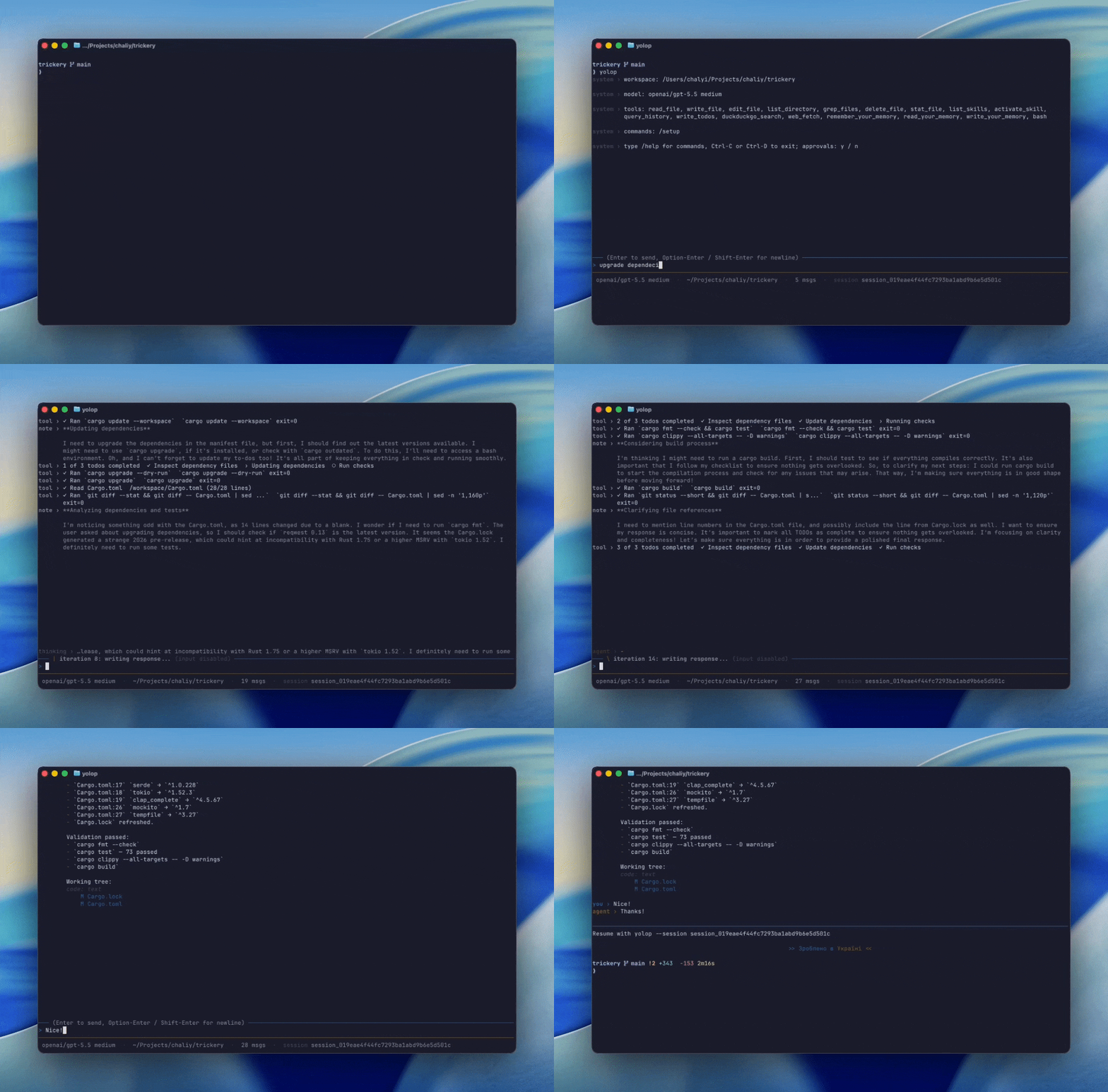
A terminal coding agent built on
[`everruns-runtime`](https://crates.io/crates/everruns-runtime). One binary
that plans, edits, runs, and verifies code in your repository — autonomous by
default, with persistent sessions, agent skills, MCP servers, and editor
integration over the Agent Client Protocol.
## Origin of the name
`yolop` comes from the Ukrainian `Йолоп`: a dummy, fool, or not-too-bright
person. The name was meant to sound clever and funny in Ukrainian while also
describing the agent's starting point: yolop does not believe in per-tool
approval pop-ups. It uses an AI-judgement approach instead — autonomous by
default, with [soft approval](./docs/features/approvals.md) for critical
moments when you want spoken consent and an audit trail.
## Install
```bash
brew install everruns/tap/yolop
```
Works on macOS (arm64/x86_64) and Linux (x86_64). If your Homebrew enforces
tap trust checks, trust the tap once first with `brew trust --tap everruns/tap`.
Building from source instead? `cargo install yolop --locked`.
## Quick start
```bash
cd your/repo
yolop
```
First launch with no credentials opens a guided, keyboard-driven setup:
provider → credentials → model. Or set a provider key and go:
```bash
OPENAI_API_KEY=sk-… yolop
yolop -C /path/to/repo # work in a different workspace
yolop -p "summarize the build setup" # one-shot, no TUI, prints to stdout
yolop --provider llmsim -p "hi" # offline demo, no API key required
```
## Features
### Agent core
- **Autonomous by default** — yolop runs writes, edits, deletes, and bash
commands without prompting. A standing **write blocklist** rejects writes
into `.git/`, `node_modules/`, `target/`, `dist/`, `build/`, `.next/`,
`.venv/`, `venv/`, `.tox/`, `.gradle/` at any depth; reads are unrestricted
inside the workspace.
- **Soft approval** — an optional spoken-consent layer for critical actions.
yolop batches the safe work and pauses to ask, in plain chat, only before
destructive or outward-facing steps; you approve by replying "yes". The
paranoia level (`protective` / `normal` / `off`) is shown in the status bar
and set with `/setup approval <level>` (or just by telling yolop to be more
or less careful). See [Soft approval](#soft-approval) below.
- **TUI chat** (ratatui): scrolling transcript, multiline composer, status
bar (with a `bg` count whenever the session has background tasks), slash commands
(`/help`, `/tools`, `/mcp`, `/cwd`, `/setup`, `/model`, `/effort`, `/goal`,
`/shell`, `/background`, `/clear`, `/quit`), a read-only background-tasks panel
toggled with `Ctrl+B`, `!<command>` as a direct shell shortcut, and
natural-language requests for terminal actions such as "exit" or "clear the screen".
- **Side questions** — `/btw <question>` answers a question about the current
session out-of-band: same context as the main task, no tools, and nothing
added to the conversation history.
- **Goal loops** — `/goal <condition>` keeps working across turns until a
separate evaluator model confirms the condition from the transcript; use
`/goal` for status and `/goal clear` to stop early. Works in `--print` mode
(`yolop -p "/goal …"`). See [`specs/goal.md`](./specs/goal.md).
- **Planning** — `write_todos` keeps multi-step tasks on track, and
loop detection stops the model from retrying the same failing tool call.
- **One-shot mode** — `--print` runs a single prompt non-interactively, for
scripts and CI.
### Tools
- **Filesystem** — `read_file`, `write_file`, `edit_file`, `list_directory`,
`grep_files`, `delete_file`, `stat_file`, backed by the real workspace disk.
- **Repo map** — `repo_map` and `repo_symbols` build an on-demand
multi-language symbol overview for broad codebase orientation before
targeted grep/read.
- **AST grep** — `ast_grep` runs read-only structural pattern search with
ast-grep syntax across Rust, Python, TypeScript/TSX, JavaScript/JSX, C#,
Go, CSS, HTML, and Bash.
- **Shell** — `bash -lc` from the workspace root, with a 120 s wall-clock
timeout and per-stream 1 MiB output cap; large output is spilled to disk
under the session folder and stays readable for model tool calls. Use
`/shell <command>` or `!<command>` in interactive sessions to run a command
directly with bounded inline output.
- **Background tasks** — `background_run` starts a shell command that runs
detached from the current turn (e.g. `gh pr checks <pr> --watch` waiting on
CI), and `background_agent` spins off a focused sub-agent (its own child
session, same tools and workspace) for a self-contained piece of work —
optionally on a cheaper model (same provider) via its `model` argument, so an
expensive lead can delegate grunt work;
`background_list`, `background_output`, and `background_cancel` track and read
them. Output streams to the session folder and a task's *result* survives a
restart (a task still running when yolop exits is restored as `interrupted`; a
sub-agent's child session is resumable with `--session`). When a task finishes
while the TUI is idle, yolop proactively wakes the agent with a turn so it
reacts without waiting for your next prompt (turn off with the `proactive_wake`
setting). Concurrent tasks are capped to keep fan-out bounded.
See [`specs/background.md`](./specs/background.md).
- **Web** — `web_fetch` (HTTP GET/HEAD with markdown/text conversion, DNS-pinned
SSRF protection) and `duckduckgo_search` (free, no API key). Setting
`EVERRUNS_SYSTEM_ALLOWLIST_ENABLED=true` restricts `web_fetch` to the
runtime's curated allowlist of well-known public resources (package
registries, source hosting, AI/cloud provider APIs, OS mirrors); off by
default.
### Context engineering
- **`AGENTS.md`** — project instructions re-read every turn.
- **Workspace context** — root, shell, local date/timezone, Git identity and
branch injected automatically.
- **Memory** — a central, structured `MEMORY.md` of durable, cross-session
user memories, each with a title, timestamp, and body. Managed in natural
language ("remember that I prefer terse answers") via the `remember` /
`recall` / `forget` tools. Only memory *titles* are injected each turn
(progressive disclosure); bodies are recalled on demand, so the prompt stays
small however much you remember. Tunable through the generic capability-config
system (`disclosed_titles`, `recall_limit`, `soft_cap`). See
[`specs/memory.md`](./specs/memory.md).
- **Skills** — `SKILL.md` files discovered from workspace
(`.agents/skills/`), global (`<config_dir>/yolop/skills/`), and system
(bundled) scopes, exposed via `list_skills`, `read_skill`, `write_skill`,
and `activate_skill`. Workspace/global skills installed after startup are
available immediately; the bundled `skill-management` skill covers search,
npx-style imports, and upgrades. See [`specs/skills.md`](./specs/skills.md).
- **Infinity context** — older history is trimmed out of the live prompt but
stays queryable via `query_history`, so long sessions don't hit the wall.
- **Tool search** — provider-agnostic deferred tool loading: core file/shell
tools stay loaded, long-tail tools are hidden until the model pulls them in
on demand, saving input tokens on every provider. See
[`specs/tool-search.md`](./specs/tool-search.md).
- **Prompt caching** — Anthropic prompt-caching markers out of the box.
### Extensibility
- **MCP servers** — extra tools from local (stdio) or remote (HTTP)
[Model Context Protocol](https://modelcontextprotocol.io) servers via
`.mcp.json` (see [MCP servers](#mcp-servers)).
- **Hooks** — workspace and global hook files can block, mutate, or audit
agent actions through the upstream `user_hooks` capability. Configure them
by chatting with yolop or by editing `hooks.json`. See
[`docs/features/hooks.md`](./docs/features/hooks.md).
- **Editor integration** — `--acp` speaks the
[Agent Client Protocol](https://agentclientprotocol.com) over stdio, so
editors such as Zed can drive yolop as an external agent (see
[Editor integration](#editor-integration-acp)).
- **Sessions** — every run writes a durable per-session event log; resume any
conversation with `--session <id>` (see
[Session persistence](#session-persistence)).
### Providers
| OpenAI | `OPENAI_API_KEY` | `gpt-5.5` |
| Codex subscription | browser/device ChatGPT login or `CODEX_ACCESS_TOKEN` | `gpt-5.5` |
| Anthropic | `ANTHROPIC_API_KEY` | `claude-sonnet-4-5` |
| OpenRouter | `OPENROUTER_API_KEY` | `openai/gpt-5.5` |
| Google | `GEMINI_API_KEY` / `GOOGLE_API_KEY` | `gemini-2.5-flash` |
| Ollama | `OLLAMA_BASE_URL` / `OLLAMA_API_KEY` | `llama3.2` |
| Custom | `CUSTOM_BASE_URL` (+ optional `CUSTOM_API_KEY`) | — (set via `/setup`) |
| llmsim | none (offline simulator) | — |
Pick explicitly with `--provider`, override the model with `-m/--model`.
**Codex subscription** signs in through ChatGPT and uses the Codex backend
directly; it does not shell out to the Codex CLI.
**Custom** is any OpenAI-compatible Chat Completions endpoint (vLLM,
llama.cpp, LM Studio, hosted gateways, …): point `CUSTOM_BASE_URL` at it or
configure the base URL, optional key, and model interactively via `/setup`.
### Git attribution
Enabled by default and configurable. When yolop creates commits, it keeps
your git author/committer identity and appends
`Co-Authored-By: yolop <yolop@everruns.com>` once. PR descriptions created or
edited through `gh` get a `Generated with yolop` footer. Disable with
`/setup attribution off`.
### Soft approval
Soft approval is prompt-engineering, not a hard gate: yolop is told, in its
system prompt, to batch safe work and pause for **spoken** consent only at the
critical moments. The model decides what is critical; you approve in plain
language ("yes", "approved"); each granted approval is recorded to the session
event log for audit (via the `record_approval` tool). There is no separate
approval UI — consent lives in the conversation.
A single central level, `approval_mode`, tunes how cautious yolop is:
| `protective` | any state-changing action (writes, commits, pushes, installs) |
| `normal` | only destructive/irreversible or outward-facing actions (the default) |
| `off` | nothing — fully autonomous, no soft-approval prompt |
The current level is always shown in the status bar. Change it with
`/setup approval <protective\|normal\|off>`, or just ask yolop to be more or
less careful ("stop asking me", "yolo mode") — it switches the level itself.
The setting is saved to `settings.toml`, so it persists across sessions.
Soft approval is judgement, not a guarantee. For deterministic enforcement
(hard-blocking a tool), use [hooks](specs/hooks.md); the two compose.
For the public user-facing details, see
[Approvals](./docs/features/approvals.md).
## Editor integration (ACP)
yolop implements the agent side of the [Agent Client
Protocol](https://agentclientprotocol.com). Launch it with `--acp` and it
speaks newline-delimited JSON-RPC 2.0 over stdin/stdout: the editor performs
the `initialize` handshake, opens a session with `session/new`, and sends
turns with `session/prompt`; yolop streams back assistant text, reasoning,
tool calls, and plans as `session/update` notifications. Editors can also
load an existing yolop session with `session/load`; yolop replays the persisted
conversation history and continues from the same JSONL session log used by
CLI `--session`.
To set up Zed:
```bash
yolop into zed
```
That adds a custom ACP agent server to `~/.config/zed/settings.json` using
the current yolop executable, preserving any existing `env` and extra
settings on re-run. Then pick **yolop** in Zed's agent panel. See
[`specs/acp.md`](./specs/acp.md) for the full protocol surface, mappings, and
current limitations.
## MCP servers
Yolop pulls in extra tools from MCP servers — remote (Streamable **HTTP**)
and local (**stdio**, a child process) — configured in the standard
`.mcp.json` shape every MCP client understands. Two scopes are read and
merged (workspace overrides global by name):
- **workspace**: `<workspace_root>/.mcp.json`
- **global**: `<config_dir>/yolop/mcp.json` (e.g. `~/.config/yolop/mcp.json`)
```json
{
"mcpServers": {
"docs": {
"type": "http",
"url": "https://example.com/mcp",
"headers": { "Authorization": "Bearer ${DOCS_TOKEN}" }
},
"fs": {
"type": "stdio",
"command": "mcp-server-filesystem",
"args": ["${WORKSPACE}"],
"env": { "RUST_LOG": "info" }
}
}
}
```
- `type` defaults to `http`; HTTP servers need a `url`, stdio servers need a
`command`.
- String values support `${VAR}` expansion from the environment, so secrets
stay out of the file (an unset `${VAR}` is left as-is so it's easy to spot).
- Discovered tools are exposed to the model as `mcp_<server>__<tool>`;
`/mcp` lists the configured servers.
Trust model: HTTP requests keep yolop's DNS-pinned SSRF protection; stdio
servers run local processes you listed yourself, so authoring `.mcp.json` is
the act of consent. MCP tools run autonomously like the rest of yolop's
tools. See [`specs/mcp.md`](specs/mcp.md).
## Reference
### Flags
| `-C, --cwd <PATH>` | Workspace root (default: current dir) |
| `--provider <P>` | Force `anthropic`, `codex`, `openai`, `google`, `openrouter`, `ollama`, `custom`, or `llmsim` |
| `-m, --model <ID>` | Override the model id for the chosen provider |
| `-p, --print <PROMPT>` | Run one prompt non-interactively and print the result |
| `--acp` | Speak the Agent Client Protocol over stdio (for editors like Zed) |
| `--session <ID>` | Resume a previous session by id |
| `--session-dir <PATH>` | Override the parent directory for session folders |
| `--reasoning-effort <E>` | Reasoning effort override when the selected model profile supports it |
### Commands
| `yolop version` | Print yolop, commit, and runtime versions |
| `yolop into zed` | Configure yolop as a custom ACP agent in Zed |
`RUST_LOG` is honored for the underlying tracing layer (writes to stderr).
### Provider env vars
| `OPENAI_API_KEY` | Select OpenAI unless `--provider` overrides |
| `CODEX_ACCESS_TOKEN` | Select Codex subscription auth unless a higher-priority provider is configured |
| `ANTHROPIC_API_KEY` | Select Anthropic when OpenAI is not configured |
| `OPENROUTER_API_KEY` | Select OpenRouter when OpenAI/Anthropic are not configured |
| `OPENROUTER_BASE_URL` | Optional, defaults to `https://openrouter.ai/api/v1` |
| `GEMINI_API_KEY` / `GOOGLE_API_KEY` | Select Google Gemini via its OpenAI-compatible endpoint |
| `GOOGLE_BASE_URL` | Optional, defaults to `https://generativelanguage.googleapis.com/v1beta/openai` |
| `OLLAMA_BASE_URL` | Select Ollama, defaults to `http://localhost:11434/v1` |
| `OLLAMA_API_KEY` | Optional, defaults to `ollama` for local Ollama |
| `CUSTOM_BASE_URL` | Select the custom OpenAI-compatible endpoint (beats the saved base URL) |
| `CUSTOM_API_KEY` | Optional key for the custom endpoint (a placeholder is sent otherwise) |
| `EVERRUNS_CLI_MODEL` | Override the auto-selected default model (beats the saved model) |
| `EVERRUNS_CLI_REASONING_EFFORT` | Reasoning effort override when the selected model profile supports it |
### Settings
A small TOML settings file persists the preferred provider, per-provider
model picks, custom endpoint base URLs, the soft-approval level
(`approval_mode`), Codex subscription login metadata, and (optionally)
provider API tokens across runs:
`<config_dir>/yolop/settings.toml` —
`~/.config/yolop/settings.toml` on Linux,
`~/Library/Application Support/yolop/settings.toml` on macOS,
`%APPDATA%\yolop\settings.toml` on Windows.
The TUI's `/setup`, `/model`, and `/effort` commands update the active
provider, saved API keys, current model, reasoning effort, or offline demo
mode. The `/setup` provider picker shows which providers are already
connected (env key, saved key/login, or no key needed); selecting a connected one
jumps straight to model selection, and `c` opens key/base-URL configuration
for any provider. Provider, model, and custom base URL choices are written
to this file.
The model picker queries the provider's models API live (OpenAI, Anthropic,
and OpenRouter via the everruns drivers; Ollama, Gemini, and other
OpenAI-compatible endpoints via `GET <base>/models`), enriched with
human-readable names and descriptions from the everruns model profiles. A
curated shortlist is shown until the API responds — or instead of it, when
listing is unavailable — and the "Custom..." entry always accepts any model
id.
Provider resolution at startup:
1. `--provider` flag (always wins)
2. Saved `default_provider` setting (the legacy `provider` key is still read)
3. Auto-detect: the first provider in the order **OpenAI → Codex →
Anthropic →
OpenRouter → Google → Ollama → Custom** with either a matching env var or
a saved token/login/base URL (the provider order decides the tiebreak, not the
credential source)
4. Fall back to OpenAI's default model and open setup so a provider/API key
can be configured
The model saved by `/setup model` for the resolved provider is restored,
unless `-m/--model` or `EVERRUNS_CLI_MODEL` overrides it. When the resolved
provider has no saved model, the global `default_model` setting (if set) is
applied as a cross-provider fallback. At runtime, the
per-provider env var (`OPENAI_API_KEY`, etc.) always beats the saved token,
so a per-run env override is always possible. `/model <id>` opens the model
picker prefilled for the active provider. Reasoning effort can be changed at
runtime with the `/effort` modal or `/setup effort <level>` when the selected
model profile exposes effort levels. The available values and default come from
that model profile, so they can vary by model.
`/setup` can store an API token under `[tokens]` in the settings file. The
Codex subscription provider stores OAuth data under `[codex_auth]` instead.
file is written with `0o600` on Unix (owner-only) and stored token values are
never echoed — but it is plain text on disk, so treat it the same way you
would `~/.aws/credentials`.
The settings file is also **schema-described**: every key carries a title,
description, type, default, and examples (see `specs/configuration.md`). yolop
itself can read and edit it through the `get_config` and `set_config` tools or
the `yolop-config` skill — for example, "use anthropic by default", "store my
OpenAI key", or "set the default model to gpt-5.5 high". Unknown keys in the
file are ignored, never fatal, so the format stays forward-compatible.
### Session persistence
Every run writes a durable per-session folder under the platform-native user
data directory:
| Linux | `$XDG_DATA_HOME/yolop/sessions/<session_id>/` (typically `~/.local/share/…`) |
| macOS | `~/Library/Application Support/yolop/sessions/<session_id>/` |
| Windows | `%APPDATA%\yolop\sessions\<session_id>\` |
The event log lives at `<session_folder>/events.jsonl`; the workspace root is
stored in `<session_folder>/workspace.json`; large tool output is spilled under
`<session_folder>/outputs/`. On Unix the session folder is `0o700` and the log
and workspace metadata are `0o600` (owner-only). The log keeps everything
needed to restore the transcript and provider continuation state on resume —
including prompts, tool arguments and output, and reasoning artifacts.
To continue a previous conversation:
```bash
yolop --session session_019e3db018a17450aba5407af5777237
```
When no `-C/--cwd` is supplied, resume uses the workspace root saved for that
session instead of the shell's current directory. Pass `-C <PATH>` with
`--session` to intentionally move the resumed session to a different
workspace.
`--session-dir <PATH>` overrides the parent storage location (useful for
keeping per-workspace session histories in `<workspace>/.yolop/sessions/`).
**Treat session logs as you would shell history.** They contain every prompt
you typed, every string passed to `bash` / `write_file` / `web_fetch`, tool
output, and reasoning artifacts — deliberately unredacted, because providers
need them to resume encrypted reasoning across sessions. There is no
retention policy or rotation. If a session should not be persisted, point
`--session-dir` at a path you can wipe (e.g. a `tmpfs`) or delete the JSONL
after the run.
## Contributing
Development setup, validation commands, and local smoke tests live in
[`CONTRIBUTION.md`](./CONTRIBUTION.md).
Please report vulnerabilities through [`SECURITY.md`](./SECURITY.md), and follow
the project [`CODE_OF_CONDUCT.md`](./CODE_OF_CONDUCT.md) when participating.
## Benchmarking
[`evals/`](./evals/) holds yolop's [Mira](https://github.com/everruns/mira) eval
studies. [`evals/swebench_verified/`](./evals/swebench_verified/) benchmarks yolop
on **SWE-bench Verified** and, behind the same interface, other terminal agents
(claude-code, codex, pi) for head-to-head comparison — recording resolved-rate
plus cost, tokens, turns, and tool usage per run. The `mira` host CLI drives it.
See [`evals/README.md`](./evals/README.md); `evals/swebench_verified/bootstrap.sh`
sets it up.
## Releases
Yolop ships to the `everruns/homebrew-tap` Homebrew tap and to crates.io as
the `yolop` crate. See [`specs/release.md`](./specs/release.md) for the
release procedure and [`CHANGELOG.md`](./CHANGELOG.md) for what shipped in
each version.
## License
MIT — see [`LICENSE`](./LICENSE).

