# weggli
## Introduction
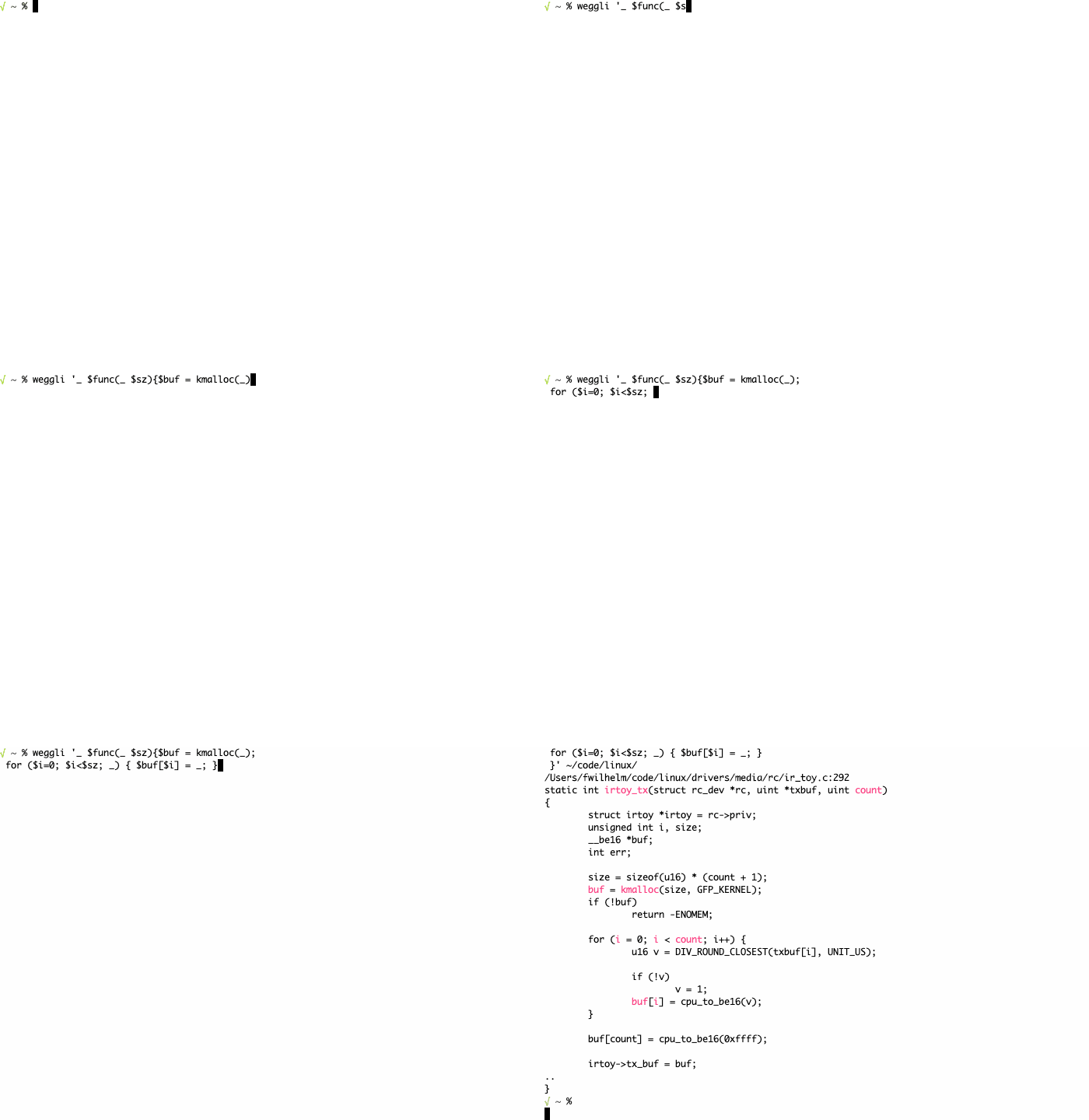
weggli is a fast and robust semantic search tool for C and C++ codebases.
It is designed to help security researchers identify interesting functionality in large codebases.
weggli performs pattern matching on Abstract Syntax Trees based on user provided queries. Its query language
resembles C and C++ code, making it easy to turn interesting code patterns into queries.
weggli is inspired by great tools like [Semgrep](https://semgrep.dev/), [Coccinelle](https://coccinelle.gitlabpages.inria.fr/website/), [joern](https://joern.readthedocs.io/en/latest/) and [CodeQL](https://securitylab.github.com/tools/codeql), but makes some different design decisions:
- **C++ support**: weggli has first class support for modern C++ constructs, such as lambda expressions, range-based for loops and constexprs.
- **Minimal setup**: weggli should work *out-of-the box* against most software you will encounter. weggli does not require the ability to build the software and can work with incomplete sources or missing dependencies.
- **Interactive**: weggli is designed for interactive usage and fast query performance. Most of the time, a weggli query will be faster than a grep search. The goal is to enable an interactive workflow where quick switching between code review and query creation/improvement is possible.
- **Greedy**: weggli's pattern matching is designed to find as many (useful) matches as possible for a specific query. While this increases the risk of false positives it simplifies query creation. For example, the query `$x = 10;` will match both assignment expressions (`foo = 10;`) and declarations (`int bar = 10;`).
## Usage
```
Use -h for short descriptions and --help for more details.
Homepage: https://github.com/googleprojectzero/weggli
USAGE: weggli [OPTIONS] <PATTERN> <PATH>
ARGS:
<PATTERN>
A weggli search pattern. weggli's query language closely resembles
C and C++ with a small number of extra features.
For example, the pattern '{_ $buf[_]; memcpy($buf,_,_);}' will
find all calls to memcpy that directly write into a stack buffer.
Besides normal C and C++ constructs, weggli's query language
supports the following features:
_ Wildcard. Will match on any AST node.
$var Variables. Can be used to write queries that are independent
of identifiers. Variables match on identifiers, types,
field names or namespaces. The --unique option
optionally enforces that $x != $y != $z. The --regex option can
enforce that the variable has to match (or not match) a
regular expression.
_(..) Subexpressions. The _(..) wildcard matches on arbitrary
sub expressions. This can be helpful if you are looking for some
operation involving a variable, but don't know more about it.
For example, _(test) will match on expressions like test+10,
buf[test->size] or f(g(&test));
not: Negative sub queries. Only show results that do not match the
following sub query. For example, '{not: $fv==NULL; not: $fv!=NULL *$v;}'
would find pointer dereferences that are not preceded by a NULL check.
strict: Enable stricter matching. This turns off statement unwrapping
and greedy function name matching. For example 'strict: func();'
will not match on 'if (func() == 1)..' or 'a->func()' anymore.
weggli automatically unwraps expression statements in the query source
to search for the inner expression instead. This means that the query `{func($x);}`
will match on `func(a);`, but also on `if (func(a)) {..}` or `return func(a)`.
Matching on `func(a)` will also match on `func(a,b,c)` or `func(z,a)`.
Similarly, `void func($t $param)` will also match function definitions
with multiple parameters.
Additional patterns can be specified using the --pattern (-p) option. This makes
it possible to search across functions or type definitions.
<PATH>
Input directory or file to search. By default, weggli will search inside
.c and .h files for the default C mode or .cc, .cpp, .cxx, .h and .hpp files when
executing in C++ mode (using the --cpp option).
Alternative file endings can be specified using the --extensions (-e) option.
When combining weggli with other tools or preprocessing steps,
files can also be specified via STDIN by setting the directory to '-'
and piping a list of filenames.
OPTIONS:
-A, --after <after>
Lines to print after a match. Default = 5.
-B, --before <before>
Lines to print before a match. Default = 5.
-C, --color
Force enable color output.
-X, --cpp
Enable C++ mode.
--exclude <exclude>...
Exclude files that match the given regex.
-e, --extensions <extensions>...
File extensions to include in the search.
-f, --force
Force a search even if the queries contains syntax errors.
-h, --help
Prints help information.
--include <include>...
Only search files that match the given regex.
-l, --limit
Only show the first match in each function.
-p, --pattern <p>...
Specify additional search patterns.
-R, --regex <regex>...
Filter variable matches based on a regular expression.
This feature uses the Rust regex crate, so most Perl-style
regular expression features are supported.
(see https://docs.rs/regex/1.5.4/regex/#syntax)
Examples:
Find calls to functions starting with the string 'mem':
weggli -R 'func=^mem' '$func(_);'
Find memcpy calls where the last argument is NOT named 'size':
weggli -R 's!=^size$' 'memcpy(_,_,$s);'
-u, --unique
Enforce uniqueness of variable matches.
By default, two variables such as $a and $b can match on identical values.
For example, the query '$x=malloc($a); memcpy($x, _, $b);' would
match on both
void *buf = malloc(size);
memcpy(buf, src, size);
and
void *buf = malloc(some_constant);
memcpy(buf, src, size);
Using the unique flag would filter out the first match as $a==$b.
-v, --verbose
Sets the level of verbosity.
-V, --version
Prints version information.
```
## Examples
Calls to memcpy that write into a stack-buffer:
```c
weggli '{
_ $buf[_];
memcpy($buf,_,_);
}' ./target/src
```
Calls to foo that don't check the return value:
```c
weggli '{
strict: foo(_);
}' ./target/src
```
Potentially vulnerable snprintf() users:
```c
weggli '{
$ret = snprintf($b,_,_);
$b[$ret] = _;
}' ./target/src
```
Potentially uninitialized pointers:
```c
weggli '{ _* $p;
NOT: $p = _;
$func(&$p);
}' ./target/src
```
Potentially insecure WeakPtr usage:
```cpp
weggli --cpp '{
$x = _.GetWeakPtr();
DCHECK($x);
$x->_;}' ./target/src
```
Debug only iterator validation:
```cpp
weggli -X 'DCHECK(_!=_.end());' ./target/src
```
Functions that perform writes into a stack-buffer based on
a function argument.
```c
weggli '_ $fn(_ $limit) {
_ $buf[_];
for (_; $i<$limit; _) {
$buf[$i]=_;
}
}' ./target/src
```
Functions with the string decode in their name
```c
weggli -R func=decode '_ $func(_) {_;}'
```
Encoding/Conversion functions
```c
weggli '_ $func($t *$input, $t2 *$output) {
for (_($i);_;_) {
$input[$i]=_($output);
}
}' ./target/src
```
## Install
```sh
$ cargo install weggli
```
## Build Instruction
```sh
# optional: install rust
git clone https://github.com/googleprojectzero/weggli.git
cd weggli; cargo build --release
./target/release/weggli
```
## Implementation details
Weggli is built on top of the [`tree-sitter`](https://tree-sitter.github.io/tree-sitter/) parsing library and its [`C`](https://github.com/tree-sitter/tree-sitter-c) and [`C++`](https://github.com/tree-sitter/tree-sitter-cpp) grammars.
Search queries are first parsed using an extended version of the corresponding grammar, and the resulting `AST` is
transformed into a set of tree-sitter queries
in `builder.rs`.
The actual query matching is implemented in `query.rs`, which is a relatively small wrapper around tree-sitter's query engine to add weggli specific features.
## Contributing
See [`CONTRIBUTING.md`](CONTRIBUTING.md) for details.
## License
Apache 2.0; see [`LICENSE`](LICENSE) for details.
## Disclaimer
This project is not an official Google project. It is not supported by
Google and Google specifically disclaims all warranties as to its quality,
merchantability, or fitness for a particular purpose.
