1
2
3
4
5
6
7
8
9
10
11
12
13
14
15
16
17
18
19
20
21
22
23
24
25
26
27
28
29
30
31
32
33
34
35
36
37
38
39
40
41
42
43
44
45
46
47
48
49
50
51
52
53
54
55
56
57
58
59
60
61
62
63
64
65
66
67
68
69
70
71
72
73
74
75
76
77
78
79
80
81
82
83
84
85
86
87
88
89
90
91
92
93
94
95
96
97
98
99
100
101
102
103
104
105
106
107
108
109
110
111
112
113
114
115
116
117
118
119
120
121
122
123
124
125
126
127
128
129
130
131
132
133
134
135
136
137
138
139
140
141
142
143
144
145
146
147
148
149
150
151
152
153
154
155
156
157
158
159
160
161
162
163
164
165
166
167
168
169
170
171
172
173
174
175
176
177
178
179
180
181
182
183
184
185
186
187
188
189
190
191
192
193
194
195
196
197
198
/*!
**A global allocator for Wasm that traces allocations and deallocations for
debugging purposes.**
[](https://docs.rs/wasm-tracing-allocator/)
[](https://crates.io/crates/wasm-tracing-allocator)
[](https://crates.io/crates/wasm-tracing-allocator)
[](https://dev.azure.com/rustwasm/wasm-tracing-allocator/_build/latest?definitionId=2&branchName=master)
`wasm-tracing-allocator` enables you to better debug and analyze memory leaks
and invalid frees in an environment where we don't have access to the
conventional tools like Valgrind. The tracing hooks are safely implemented in
JS, outside the Wasm module and its linear memory, to ensure that the tracing
code doesn't perturb results.
## Table of Contents
* [Enabling the Tracing Allocator](#enabling-the-tracing-allocator)
* [Analyzing and Debugging](#analyzing-and-debugging)
## Enabling the Tracing Allocator
First, add `wasm-tracing-allocator` to your `Cargo.toml`'s dependency list:
```toml
[dependencies]
wasm-tracing-allocator = "0.1.0"
```
Next, configure `wasm_tracing_allocator::WasmTracingAllocator` as the global
allocator:
```no_run
// src/lib.rs
# fn main() {}
use std::alloc::System;
use wasm_tracing_allocator::WasmTracingAllocator;
#[global_allocator]
static GLOBAL_ALLOCATOR: WasmTracingAllocator<System> = WasmTracingAllocator(System);
```
Finally, make the JS implementations of the tracing hooks are available for your
Wasm module to import:
* On the Web, add this script *before* your Wasm module is instantiated:
```html
<script src="https://unpkg.com/wasm-tracing-allocator@0.1.0/js/hooks.js"></script>
```
* On Node.js, require the hooks *before* your Wasm module is instantiated:
```js
require("wasm-tracing-allocator");
```
## Analyzing and Debugging
Use your developer tools console to invoke methods of the global
`WasmTracingAllocator` object to get analyses about allocations and
deallocations.
The output is typically rendered with `console.table`:
[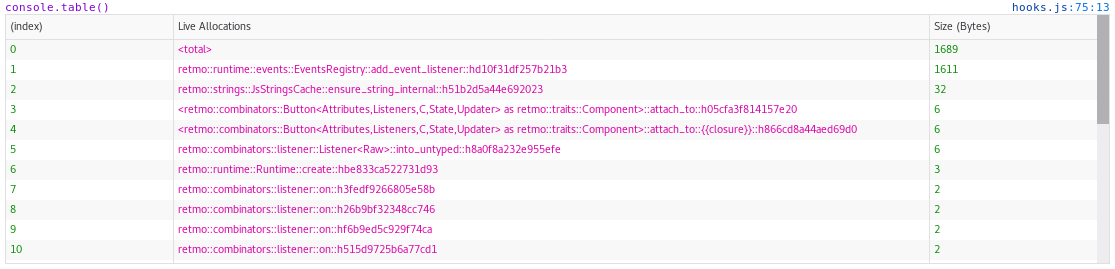](https://raw.githubusercontent.com/rustwasm/wasm-tracing-allocator/master/live-allocations-dump.png)
### `WasmTracingAllocator.dumpLiveAllocations`
Dump a table of live allocations to the console.
```js
WasmTracingAllocator.dumpLiveAllocations({
keyLabel: String,
valueLabel: String,
getKey: Object => any,
getValue: Object => Number,
});
```
* `keyLabel`: Optional. The string label used to describe the keys column in the
table.
* `valueLabel`: Optional. The string label used to describe the values column in
the table.
* `getKey`: Optional. Function from an allocation entry object to anything. The
table will group and aggregate entries by their keys. Defaults to the stack at
the time of the allocation.
* `getValue`: Optional. Function from an allocation entry object to a
number. The values for all entries with the same key are summed. Defaults to
the byte size of each allocation; a potential alternative would be to ignore
the argument and return `1` to count the number of allocations instead.
### `WasmTracingAllocator.dumpInvalidFrees`
Dump a table of invalid frees (double frees, frees of things that were never
allocated, etc...) to the console.
```js
WasmTracingAllocator.dumpInvalidFrees({
keyLabel: String,
valueLabel: String,
getKey: Object => any,
getValue: Object => Number,
});
```
* `keyLabel`: Optional. The string label used to describe the keys column in the
table.
* `valueLabel`: Optional. The string label used to describe the values column in
the table.
* `getKey`: Optional. Function from an invalid free entry object to anything. The
table will group and aggregate entries by their keys. Defaults to the stack at
the time of the deallocation.
* `getValue`: Optional. Function from an invalid free entry object to a
number. The values for all entries with the same key are summed. Defaults to
counting the number of invalid frees.
*/
use ;
/// A global allocator that traces the Wasm module's allocations and
/// deallocations.
///
/// It wraps some global allocator `A` that actually implements the allocation
/// and deallocation, and inserts its tracing after each invocation.
///
/// ## Example
///
/// Just give it the global allocator `A` to wrap, and add the
/// `#[global_allocator]` attribute. The module level documentation has an
/// example of wrapping the default system allocator. Here is an example of
/// wrapping [`wee_alloc`](https://github.com/rustwasm/wee_alloc):
///
/// ```ignore
/// // src/lib.rs
/// # fn main() {}
///
/// use wasm_tracing_allocator::WasmTracingAllocator;
/// use wee_alloc::WeeAlloc;
///
/// #[global_allocator]
/// static GLOBAL_ALLOCATOR: WasmTracingAllocator<WeeAlloc> =
/// WasmTracingAllocator(WeeAlloc::INIT);
/// ```
where
A: GlobalAlloc;
unsafe