
wallust - Generate colors from an image






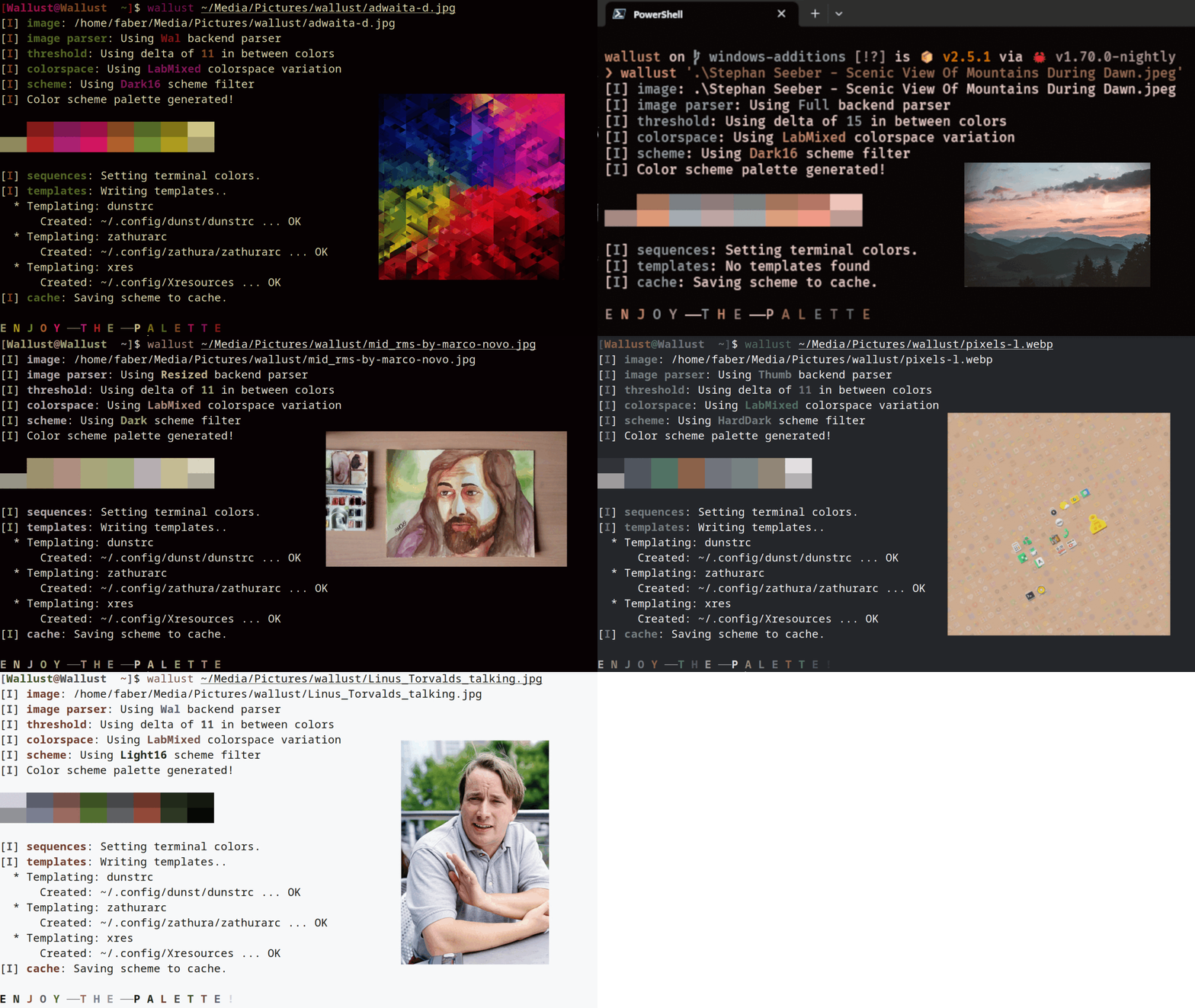
sources: adwaita - scenic view of mountains - rms by marco novo - pixels - linus talking


Major version 3.0.0 is closer than ever, check how to prepare for v3 for future changes.
Usage
wallust run my_wallpaper.png
use wallust -h for an overview and wallust --help for a more detailed explanation
Features
- Sets terminal colors on all active terminals
- *NIX: ASCII escape sequences
- MacOS: iTerm2 sequences
- Windows: Adds a color scheme for the windows terminal
- Cache scheme palettes, overwritten by
-w- Linux:
$XDG_CACHE_HOMEor$HOME/.cache - MacOs:
$HOME/Library/Caches - Windows:
{FOLDERID_LocalAppData}
- Linux:
- Read pywal/terminal-sexy colorschemes with
cssubcommand - Built-in pywal themes with the
themesubcommand (can be disabled with compile-time features)wallust theme --helpto list possible themes - Configuration file,
wallust.toml:- When no config file, the default config file will be generated
- Optional templating with two different engines:
- Default is using usual
{variable} - By enabling
new_engine = true, you use{{variable}}
- Default is using usual
- Configurable methods for backends, colorspaces and palettes (chart below)
- Configurable threshold
- Linux:
$XDG_CONFIG_HOMEor$HOME/.config - MacOs:
$HOME/Library/Application Support - Windows:
{FOLDERID_RoamingAppData}
| Methods | Description |
|---|---|
| Backends | How to extract the colors from the image. (e.g pywal uses convert) |
| ColorSpace | Get the most prominent color, and sort them according to the Palette, configurable with a threshold |
| Palette | Makes a scheme palette with the gathered colors, (e.g. sets light background) |
Make sure to read the sample config file for more documentation.
Threshold
Default is 20 with a more colorful approach, 19 is also suggested.
| Number | Description |
|---|---|
| 1 | Not perceptible by human eyes. |
| 1 - 2 | Perceptible through close observation. |
| 2 - 10 | Perceptible at a glance. |
| 11 - 49 | Colors are more similar than opposite |
| 100 | Colors are exact opposite |
Terminal colors
By default, wallust will send these sequences to all open terminals:
/dev/pts/on Linux/dev/ttys00on MacOSpsto search active terminals on OpenBSD- Updates
settings.jsonon Windows Terminal, to enable this scheme for the first time you will have to selected it manually
You can skip this with the -s or --skip-sequences flag.
When opening new terminals you will notice that the color sequences are not
applied. To solve this you can send the sequences yourself when your shell
opens. wallust will store the sequences in the cache directory as a file
called sequences, the usual way is to cat ~/.cache/wallust/sequences in
your .zshrc, .bashrc, etc.
Templating
OPTIONAL
NOTE: You can enable a new method by using new_engine = true inside a
template This "new engine" difers by using double brackets like {{variable}}
instead of one like {variable} (as in the example below), which helps with
file formats that use brackets like json. With the new_engine enabled you can
escape and produce a literal {{ by {{{{}}, and for }} you escape it with {{}}}}.
You can use wallust generated colors in a program by templating the colors
in it's config file, like the following example:
# zathurarc config file

#keybindings
...

# colors
set default-bg     "{color2}"
set default-fg     "{foreground}"
set statusbar-bg   "{color4}"
set statusbar-fg   "{color6}"
set inputbar-bg    "{color1}"
You can find examples at pywal templates or wpgtk templates
Then add this file to ~/.config/wallust/ e.g. ~/.config/wallust/zathurarc
(config directory defined by the platform) and add a new template to
wallust.toml inside templates:
[]
= "zathurarc"
= '~/.config/zathura/zathurarc'
# or, alternatively, like:
#zathura = { src = 'zathurarc', dst = '~/.config/zathura/zathurarc' }
The name after doesn't really matters, in this case zathura, and is used as
an identifier for the user.
Variables and Methods
wallpaper: The full path to the current wallpaper, colorscheme file or the name of the theme in use.backend: Current backend being used.colorspace: Current colorspace being used.palette: Current palette being used.alpha: Default to 100, can be modified in the config file or with--alpha/-a.alpha_dec: instead of [0..=100], displays it from 0.00 to 1.00.var: Output the color inhex.var.rgb: Output the color inrgb.var.rgba: Output the color inrgba.var.xrgba: Output the color inxrgb.var.strip: Output the color inhex(without a#).var.red: Output the red value.var.green: Output the green value.var.blue: Output the blue value.
Where var can be colors from color0 to color15, background, foreground and cursor.
Installation
wallust doesn't require third party packages, but has an optional
dependency: imagemagick to use the wal backend
(just like pywal). Other methods are built in.
Distros Packages
NetBSD
If you are using NetBSD, a native package is available from the official repositories. To install it, simply run:
pkgin install wallust
Nix
If you are using Nix, a native package is available for the unstable channel.
Install it for your profile:
nix-env -iA nixos.wallust # change `nixos` for `nixpkgs`, if on a non-NixOS system
Try it with nix-shell
nix-shell -p wallust
Arch User Repository (AUR)
Using an Arch based distro, you can use the wallust or wallust-git packages.
wallustfetches the latest stable version fromstatic.crates.io, which mirrors themasterbranch. Prefer this package.wallust-gitfetches the latest unstable version from thedevbranch.
Either can be installed on an Arch based distro with the following commands:
Binary
Go to the releases
and download the tar.gz file, which contains a binary for musl, so it should
work for most *nix platforms.
tar -xf wallust-TARGET.tar.gz
Build from source
The master branch is stable
From this repo
Go to the releases
page and download the .zip or .tar.gz repository. After extracting the contents,
go to the directory (cd MAYOR.MINOR.PATCH).
Then you can do the following, which moves the binary into your $CARGO_HOME/bin
cargo install --path .
or build it and copy the binary to one folder present in your $PATH like
/usr/local/bin
cargo build --release
cp -f ./target/release/wallust /usr/local/bin
From crates.io
cargo install wallust
This will use the lastest version
Packaging
Binary-based distros can grab the latest pre-compiled binary from the releases page.
Source-based distros, if they wish to build wallust from source, must ensure
that the following dependencies are available:
- Build Dependencies:
- Rust (
cargo,rustc)
- Rust (
- Runtime Dependencies
imagemagickis required only for thewalbackend, such limiting should be mentined and considered an optional dependency, since all other backends work without it.
Contribute!
Use the dev branch
Show some of your taste by adding a backend, colorspace, palette, and/or colorscheme.
Having thoughts or suggestios is also very welcome.
TODOs
for more, grep the src for TODO rg TODO
- automate binary releases with a CI, figure out woodkeeper codeberg CI
- use
thiserrorfor errors in the modules (there aren't that many) - shell completions and man page (allows up readme)
Related
- pywal - 🎨Generate and change color-schemes on the fly
- pywal16 - 16 colors fork of pywal
- wpgtk - 🎴a colorscheme, wallpaper and template manager for *nix
- wal-theme-picker - pick the best theme for the image (rather than generating one)
- pigmnts - 🎨Color palette generator from an image using WebAssesmbly and Rust
- Chameleon - 🦎Theme your linux system to match any image
- lule_bash - Genretare all 255 colors from wallpapers
- lule -
lule_bashrewriten for efficiency - using vscode-wal-theme with
wallust - base16 - Framework for Tomorrow styled themes
- flavours - 🎨💧An easy to use base16 scheme manager that integrates with any workflow
- oxidec - Eye-candy manager written in Rust
- raventhemer - A theme manager and switcher for desktop linux
- rose-pine Issue #2 - Ideas with using the whole 15 color palette