# Vomit - The Very Opinionated Mail Interaction Toolkit
[](https://crates.io/crates/vomit)
[](https://builds.sr.ht/~bitfehler/vomit/commits?)
**NOTE:** Vomit is still in a somewhat early stage. The functionality described
here should work reasonably reliably, but the interfaces (subcommands,
parameters) may change as new features get added.
Vomit currently provides only one tool: `vmt`. It is designed to let you do
anything with your email, except for reading and writing - there are plenty of
tools for that. Instead, it helps you locate emails (or attachments of emails)
you already know about and lets you efficiently work with those.
The central mechanism that `vmt` employs is providing an interactive search
mechanism based on [Skim][1] (the Rust equivalent to the somewhat more popular
[fzf][2]), which lets you pick one or more emails and will produce the
filenames of those. These filenames can then e.g. be passed to other tools. It
also provides a few built-in commands for common stuff you might want to use
other tools for.
[1]: https://github.com/lotabout/skim "Skim Github project"
[2]: https://github.com/junegunn/fzf "fzf Github project"
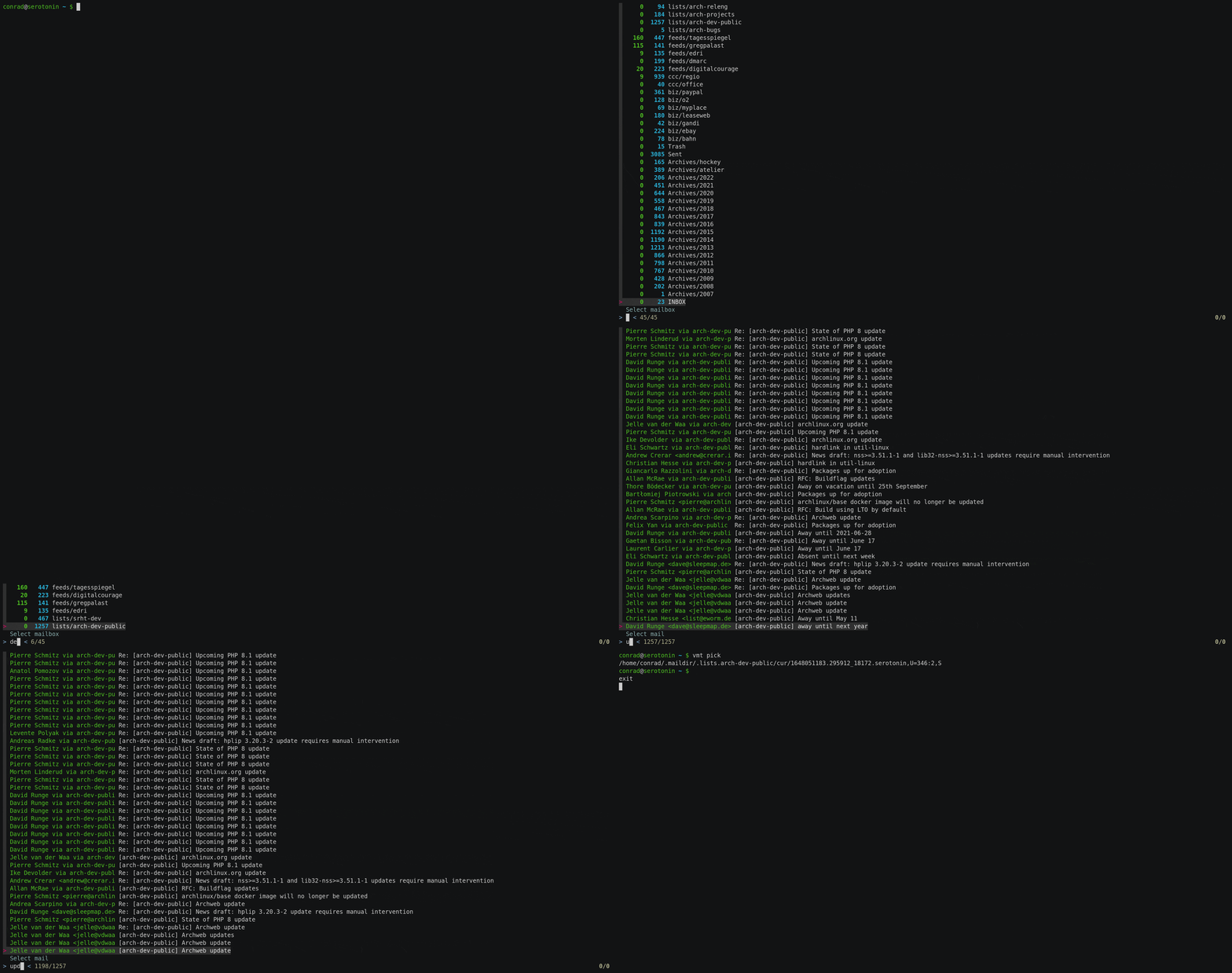
The described base functionality is provided by the `vmt pick` command. It
captures your terminal, lets you interactively pick an email, and then writes
the email's filename to stdout. Here is an example:
[](https://bitfehler.net/pick.gif)
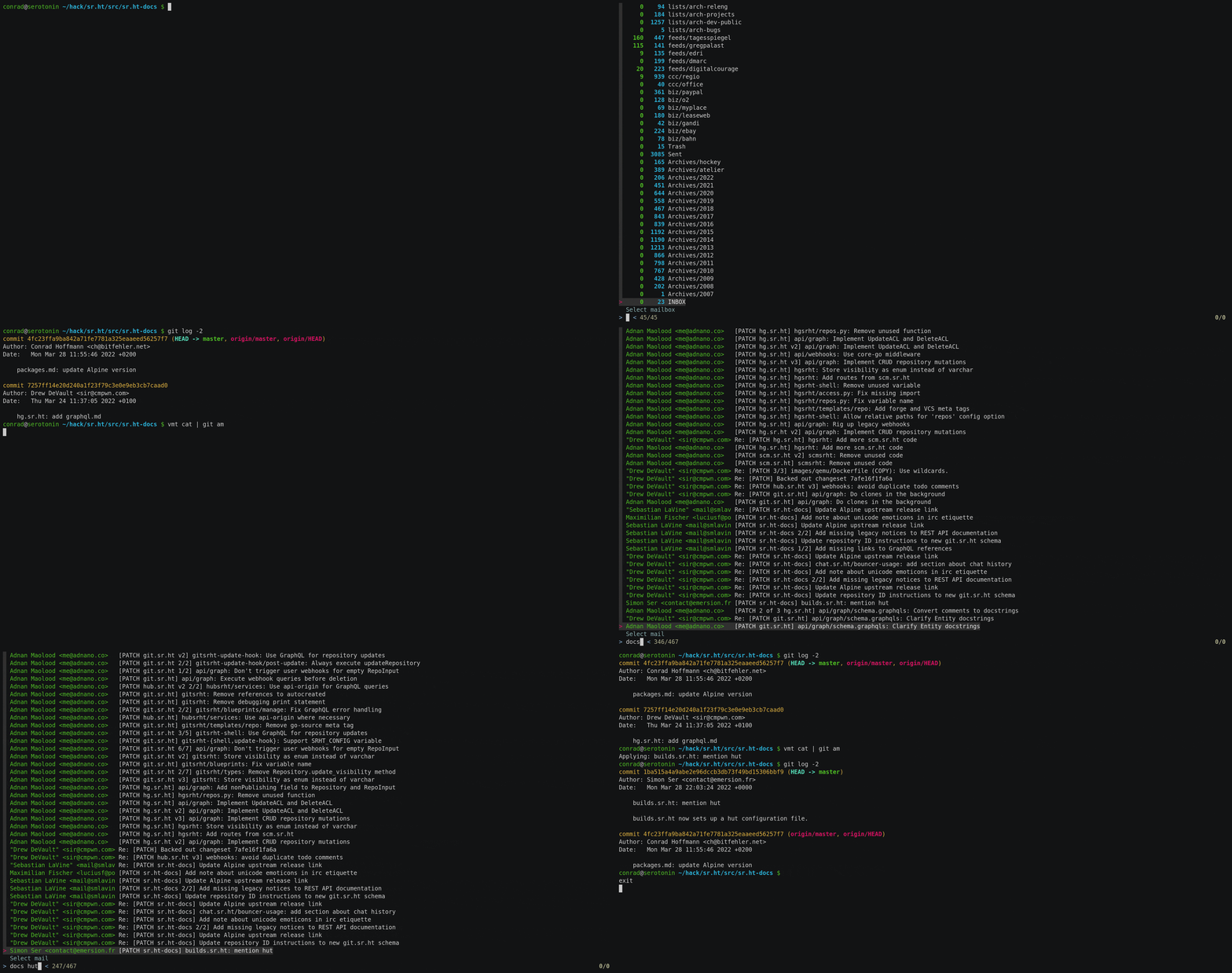
In the simplest case, this could be used to output the file and pipe the
contents to something that handles email as input, such as `git am`. Since this
is a common use case, `vmt` provides the `cat` subcommand. Here is an example
of applying a patch that was circulated on a mailing list:
[](https://bitfehler.net/patch.gif)
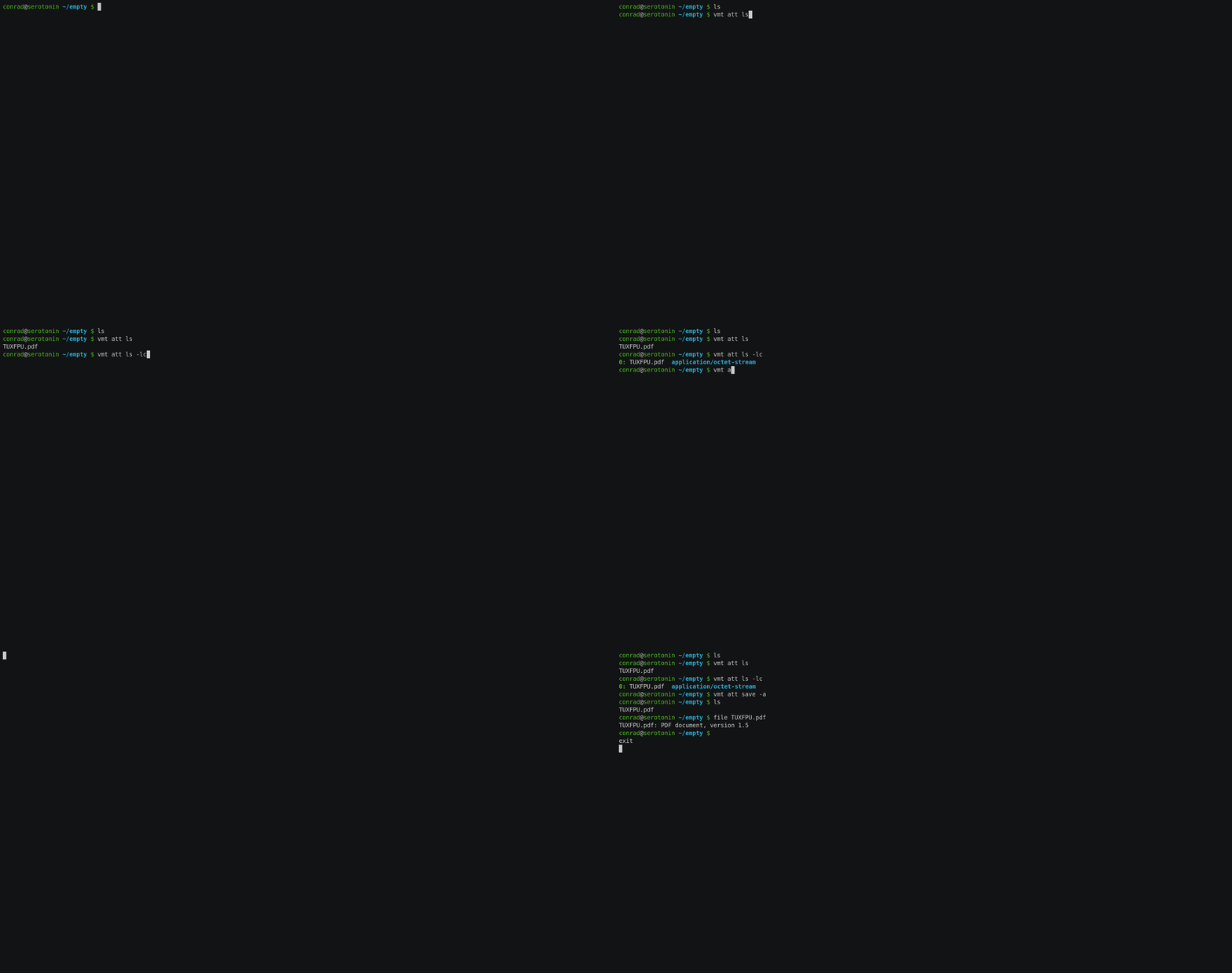
Of course email is used for other stuff, like sending attachments. `vmt` has
you covered and offers the `att` subcommand (which itself has various
subcommands). Here is a little example listing and then saving attachments:
[](https://bitfehler.net/save.gif)
## Opinions
* Vomit doesn't care how you read or write emails
* Vomit wants mail stored in [Maildir++][3] format
* Vomit doesn't care how your mail gets there (see note below)
* Vomit does not alter your mail (i.e. mark as seen)
* Vomit wants to be used with tab completion (WIP)
Note about getting your mail into a maildir: if you need inspiration, Vomit
hopes to provide `vmt sync` soon, but for now recommends that you use e.g.
[mbsync][4].
[3]: https://en.wikipedia.org/wiki/Maildir#Maildir++ "Maildir++ on Wikipedia"
[4]: https://isync.sourceforge.io/mbsync.html "mbsync homepage"
## Commands
```
USAGE:
vmt [OPTIONS] <SUBCOMMAND>
FLAGS:
-h, --help Prints help information
-V, --version Prints version information
OPTIONS:
-a, --account <account> The account to operate on (defaults to first account in config file)
-c, --config <config> Sets a custom config file location
SUBCOMMANDS:
att Work with mail attachments
cat Output entire mail to stdout
help Prints this message or the help of the given subcommand(s)
ls List mailboxes or emails in a mailbox
pick Interactively pick mail(s) and print full path to stdout
```
### pick
```
vmt-pick
Interactively pick mail(s) and print full path to stdout
USAGE:
vmt pick [FLAGS] [mailbox]
ARGS:
<mailbox> The mailbox to list mails for (omit to pick mailbox interactively)
FLAGS:
-a, --attachments Show attachment marker (can be slow)
-A, --attachments-only Show only mails with attachment (can be slow)
-d, --date Show date
-e, --emtpy Show empty mailboxes (default: hide)
-h, --help Prints help information
-m, --multiple Allow selection of multiple mails
-V, --version Prints version information
```
### ls
```
vmt-ls
List mailboxes or emails in a mailbox
USAGE:
vmt ls [FLAGS] [mailbox]
ARGS:
<mailbox> The mailbox to list mails for (omit to list mailboxes, . for INBOX)
FLAGS:
-a, --all List all mailboxes (even if no mail)
-h, --help Prints help information
-l, --long Show more details
-r, --real-name Show real directory name
-V, --version Prints version information
```
### cat
```
vmt-cat
Output entire mail to stdout
USAGE:
vmt cat [email]
ARGS:
<email> The email to output. If not specified, uses `pick` to select one
FLAGS:
-h, --help Prints help information
-V, --version Prints version information
```
### att
```
vmt-att
Work with mail attachments
USAGE:
vmt att <SUBCOMMAND>
FLAGS:
-h, --help Prints help information
-V, --version Prints version information
SUBCOMMANDS:
cat Write attachment to stdout
help Prints this message or the help of the given subcommand(s)
ls List attachments
save Save attachments in current directory
```
#### att ls
```
vmt-att-ls
List attachments
USAGE:
vmt att ls [FLAGS] [email]
ARGS:
<email> The email to process. If not specified, uses `pick` to select one
FLAGS:
-c, --color Use colored output
-h, --help Prints help information
-l, --long Show more details
-V, --version Prints version information
```
#### att cat
```
vmt-att-cat
Write attachment to stdout
USAGE:
vmt att cat [ARGS]
ARGS:
<email> The email to process. If not specified, uses `pick` to select one
<index> The zero-based index of the attachment to output. If not specified, uses `pick`
to select one
FLAGS:
-h, --help Prints help information
-V, --version Prints version information
```
#### att save
```
vmt-att-save
Save attachments in current directory
USAGE:
vmt att save [FLAGS] [ARGS]
ARGS:
<email> The email to process. If not specified, uses `pick` to select one
<index> The zero-based index of the attachment to output. If not specified, uses `pick`
to select one (ignored for -a)
FLAGS:
-a, --all Save all attachments
-h, --help Prints help information
-V, --version Prints version information
```
### mime
```
vmt-mime
Work with MIME parts
USAGE:
vmt mime <SUBCOMMAND>
OPTIONS:
-h, --help Print help information
SUBCOMMANDS:
help Print this message or the help of the given subcommand(s)
ls List MIME parts
```
#### mime ls
```
vmt-mime-ls
List MIME parts
USAGE:
vmt mime ls [OPTIONS] [EMAIL]
ARGS:
<EMAIL> The email to process. If not specified, uses `pick` to select one
OPTIONS:
-c, --color Use colored output
-h, --help Print help information
-l, --long Show more details
```
### show
```
vmt-show
Show plain text mail body (if present)
USAGE:
vmt show [OPTIONS] [EMAIL]
ARGS:
<EMAIL> The email to process. If not specified, uses `pick` to select one
OPTIONS:
-h, --help Print help information
-l, --long Also show subject and sender
```
## Config file
Per default located at `~/$XDG_CONFIG_HOME/vomit/config.toml`, which usually
means `~/.config/vomit/config.toml`. Fallback for platforms not supporting XDG
directories is `~/.vomitrc`. A configuration file at an arbitrary
location can be used by using the global `-c <path>` flag.
A simple config example:
```
[<account>]
local = ~/.maildir
```
Multiple accounts can be specified, by default `vmt` will use the first one. To
use a different one, the global flag `-a <account>` can be used.
## Installation
Sorry, nothing fancy yet. Build with `cargo build --release` and copy the
executable to your `$PATH`. If you have your `$PATH` set up to include your
cargo home dir, then `cargo install` should do.
You can also run `cargo install vomit` directly, but the version on crates.io
might be a few commits behind.