# velesdb-memory
[](https://crates.io/crates/velesdb-memory)
[](https://docs.rs/velesdb-memory)
[](https://www.npmjs.com/package/@wiscale/velesdb-memory-node)
[](https://pypi.org/project/velesdb/)
[](https://registry.modelcontextprotocol.io)
[-e8702a)](https://github.com/cyberlife-coder/VelesDB/blob/main/LICENSE)
**The explainable, local-first memory engine for AI agents — as a single MCP
server.** Give your coding agent durable memory that never leaves your machine:
it remembers decisions, recalls them semantically, and — the differentiator —
**connects** them so it can answer *why* a decision was made, not just retrieve
look-alike text. That auditable `why()` recall trail is the kind of
traceability the [EU AI Act](https://artificialintelligenceact.eu/implementation-timeline/)
(enforceable from Aug 2026) asks of AI systems; running fully local, it **helps
meet** those data-residency and explainability expectations rather than claiming
certified compliance.
> **Release 0.10.1** — patch over the V2 wave: the `compile_context`
> prompt-cache prefix is now query-independent (issue #1455), so a new
> question no longer churns the cached prefix. 0.10.0 brought: `compile_transcript` (one call
> turns a raw agent-session transcript into deterministically segmented,
> budget-compiled context with a full segmentation audit report),
> path-referenced fragments (opt-in, allowlisted via
> `VELESDB_MEMORY_INGEST_ROOTS`, symlink-safe), binding parity for the
> compiler's read tools (`explainCompilation`/`contextSavings` on Node,
> `explain_compilation` on Python, `retrieveContextSource` on WASM/TS), and
> a `--version` flag; published to the registries by the
> `velesdb-memory-v0.10.1`
> tag, so the links below may briefly lag right after merge. `velesdb-memory`
> ships on [crates.io](https://crates.io/crates/velesdb-memory) and on the
> [official MCP registry](https://registry.modelcontextprotocol.io)
> (`io.github.cyberlife-coder/velesdb-memory`, with **5 prebuilt `.mcpb` bundles**:
> macOS arm64/x64, Linux arm64/x64, Windows x64). Bindings: Node
> [`@wiscale/velesdb-memory-node`](https://www.npmjs.com/package/@wiscale/velesdb-memory-node) **0.10.1**
> and Python in [`velesdb`](https://pypi.org/project/velesdb/) **3.12.0**
> (memory API only — the context compiler is merged on `develop` but **the
> published 3.12.0 wheel predates it**; it ships with the next PyPI release,
> until then Python agents reach it through the MCP server).
> **`cargo install velesdb-memory` installs the latest published release.**
> **Bring your own reranker (Rust)**: `compile_context_reranked` hands the
> full fused candidate pool (vector + graph, pre-cutoff) to any
> [`Reranker`] you inject — a cross-encoder, an LLM judge — and its
> ordering decides which memories get compiled in. Never a default, and
> deliberately not on the wire: the shipped `DeterministicReranker` is
> lexical, and a lexical second stage demotes exactly the
> zero-vocabulary-overlap evidence the graph walk rescues (both behaviours
> pinned by tests). `recall_fused_reranked` is the same seam for plain
> recall.
Built on [VelesDB](https://velesdb.com)'s in-core Agent Memory SDK, which fuses
three engines behind its memory tools:
| `remember` | store a fact, optionally linked + tagged with metadata, with an optional expiry (`ttl_seconds`) | Vector + Graph + ColumnStore |
| `recall` | semantic retrieval, optional exact-match metadata filter | Vector + ColumnStore |
| `relate` | create a typed edge between two memories | Graph |
| `recall_fused` | recall with graph-aware re-ranking (vector + typed links fused) | Vector + Graph |
| `recall_where` | recall filtered by typed column predicates (ranges, comparisons) | Vector + ColumnStore |
| `forget` | delete a memory | — |
| `why` | recall a decision **+ its connected subgraph** (multi-hop) | Vector + Graph + ColumnStore |
| `feedback` | reinforce a recalled fact (**useful/noise**) — `recall` re-ranks by this learned confidence, so the memory **improves with use** without retraining | Vector |
| `remember_extracted` | extract facts from raw text + **auto-build the graph** (opt-in backend) | Vector + Graph |
`why` is the wedge: it surfaces related memories (the PR, the ticket, the
benchmark) reachable through typed links **even when they share no words** with
your question — exactly what a pure vector search is blind to.
By design the server exposes **memory semantics only** — never raw database
capabilities (`query`, `create_collection`, `upsert`, `traverse`). See
[License](#license).
## See it (offline, one command)
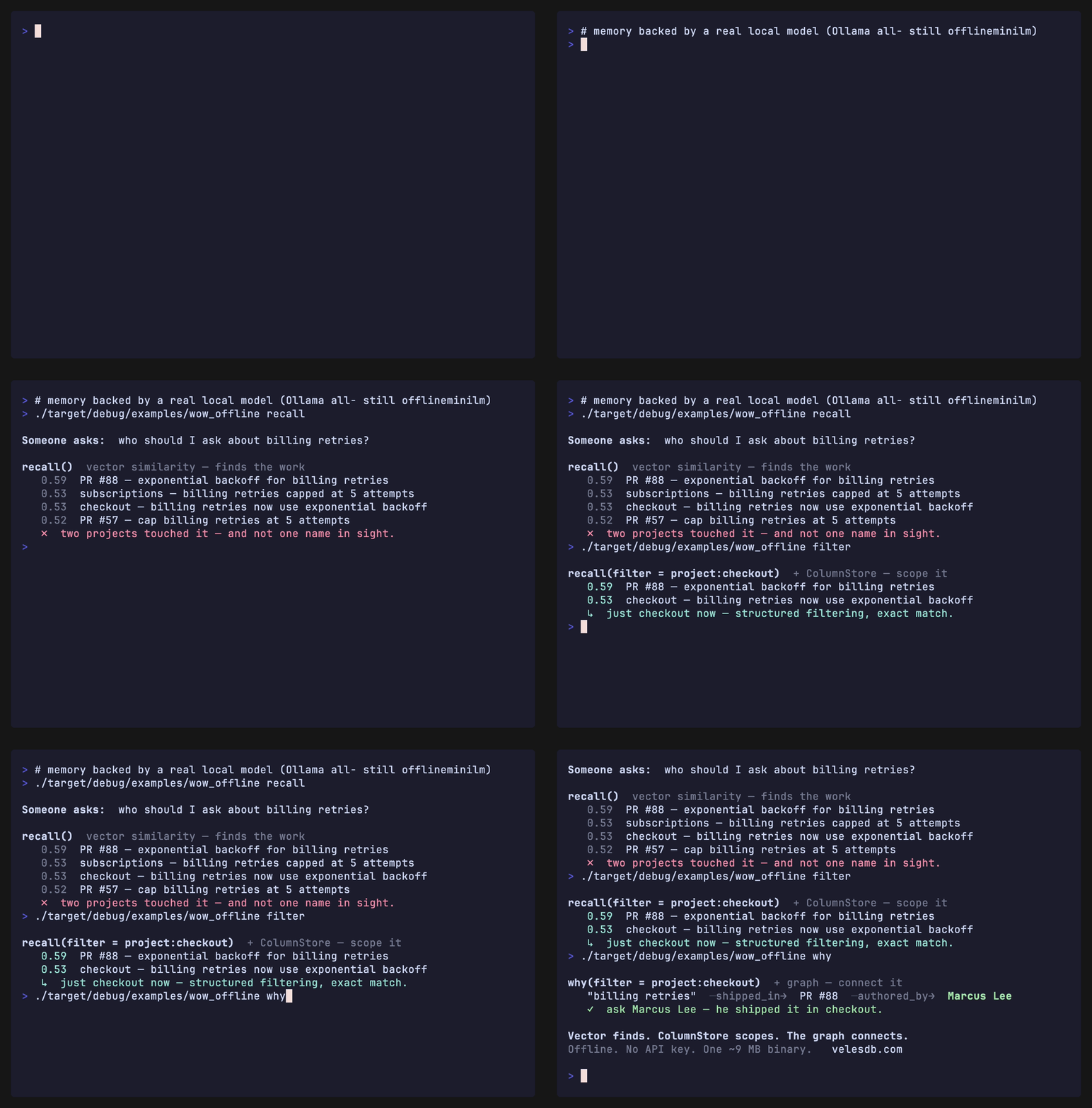
```bash
cargo run -p velesdb-memory --example wow_offline
```
```text
recall("why we chose parking_lot") [vector similarity only]
0.47 we chose parking_lot to avoid lock poisoning after a panic
0.18 PR #42 swaps the std Mutex for parking_lot
└─ EPIC-317 is nowhere here — it shares no words with the question.
why("why we chose parking_lot") [vector seed + graph traversal]
hop 0 we chose parking_lot ...
hop 1 PR #42 ...
hop 2 EPIC-317: intermittent CI hang under load
└─ the graph reached the very ticket the decision fixed.
```
A vector search ranks by resemblance; the ticket shares no words with the
question, so a pure similarity search is blind to it. `why()` follows the typed
links and reaches it. That gap is the product.
### Four runnable demos of the wedge
Each is a real run that shows what plain recall misses and `why()` recovers:
| [`why_across_sessions.py`](../../examples/agent_memory/why_across_sessions.py) | the reason survives a process restart — recall of the top 5 of 16 memories stays blind, `why()` reaches it |
| [`why_magic_constant.py`](../../examples/agent_memory/why_magic_constant.py) | *why* a magic constant has its value — a business reason that shares no words with the code |
| [`memory_builds_its_own_graph.py`](../../examples/agent_memory/memory_builds_its_own_graph.py) | paste raw prose → a local model auto-wires the graph (no `relate()`), `why()` walks it to the root cause |
| [`why_magic_constant.mjs`](../velesdb-node/examples/why_magic_constant.mjs) (Node) | the same engine and wedge in the `@wiscale/velesdb-memory-node` binding |
> **Not a weak-embedder trick.** In each retrieval demo, recall stays blind to the
> reason **even under a real semantic embedder** (`ollama` / `all-minilm`), not just
> the offline `hash` default — the reason is connected by a *decision*, not by surface
> similarity, which is exactly what a vector store cannot follow.
## How it compares — and who it's for
velesdb-memory is **embedded memory, not a cloud memory service.** The
difference isn't a benchmark bar chart — it's three things no competitor
counters: an **evidence trail you can audit** (`why()` shows which facts an
answer came from), **zero AI calls to store a memory** (the incumbents run 2–3
AI-model calls per save — by default, paid cloud calls), and **published
retrieval numbers** — we measure, with no AI grader in the loop, how often the
memory finds the right information; to our knowledge, nobody else in this
market publishes that at all:
| What it is | one embedded binary (vector + graph + column engines) | coordinator over separate services (Qdrant + Postgres) | coordinator, graph-centric (needs Neo4j/FalkorDB) |
| AI calls to store a memory | **zero required** (optional extraction runs on your local model) | AI-model calls on every write (cloud by default) | AI-model calls on every write (cloud by default) |
| Runs | **100% local / offline** | self-host still needs an AI service in the write path | Zep's self-hosted edition was discontinued; Graphiti needs a graph database + an AI service |
| Explains its answers | **yes** — `why()` returns the evidence trail | no — returns an answer only | no — returns an answer only |
| Publishes retrieval accuracy | **yes** — [+7.2pts multi-hop, +9.7pts time-scoped, no AI grader](BENCHMARK.md) | no | no |
| Time-related questions on LoCoMo | **55–61%** on a fully local model — floor = without the optional scaffold ([method + stats](BENCHMARK.md)) | 55.5% base / 58.1% graph-enhanced "Mem0g" (its own best score), both on cloud AI ([own paper](https://arxiv.org/abs/2504.19413)) | 49.3% on cloud AI — [as measured in Mem0's evaluation](https://arxiv.org/abs/2504.19413), which Zep disputes |
*Why no single "overall score" comparison row? Because overall scores from
different labs can't be fairly compared: the same product's score can swing
~21 points between two test setups, and vendor headlines often diverge widely
from what other labs measure. Our fully-local 56% aggregate comes with the
full method and statistics disclosed, and instead of a bar chart we publish
the complete sourced landscape — who measured what, with which AI models, and
which figures are disputed: [`BENCHMARK.md`](BENCHMARK.md).*
**Choose velesdb-memory when local-first is a requirement, not a preference:**
- **Regulated / sovereign data** (health, legal, finance, defense) — context can't transit a third-party LLM API; `why()` gives both data residency and an auditable recall trail.
- **Air-gapped / on-prem / edge** — a self-contained binary against a local model is the only shape that deploys with no outbound internet.
- **Cost-sensitive, high-volume agents** — running extraction + recall on a local stack removes the per-token cloud bill.
If you're cloud-native and want the largest community, Mem0 is the default reach. If your
data can't leave the box — or you need to *audit why* it recalled something — this is the
one that fits. (Deeper positioning: [`POSITIONING.md`](POSITIONING.md).)
### Benchmark
`cargo run --release -p velesdb-memory --example bench_multihop` isolates the
graph's contribution — 24 `decision → PR → problem` chains, the same embedder
throughout, only the graph toggled. Each question (`"why did we adopt <tech>"`)
has a 1-hop answer (the decision, shares words) and a 2-hop answer (the original
problem, shares none):
| `hash` (deterministic) | 100% | 0% | **100%** |
| real model (Ollama `all-minilm`) | 100% | 33% | **100%** |
Read it this way: the **direct** control confirms the vector engine is healthy
(100% — it aces look-alike retrieval). On **multi-hop**, a real semantic embedder
still recovers only a third of the answers (the problem shares no words with the
question); the graph recovers all of them — **+67 pp** with a real model
(structurally +100 pp with the deterministic one). Run the real one yourself:
```bash
cargo build --release -p velesdb-memory --features ollama && ollama pull all-minilm
VELESDB_MEMORY_EMBEDDER=ollama \
cargo run --release -p velesdb-memory --features ollama --example bench_multihop
```
> **Engine isolation, and extraction.** `bench_multihop` measures the *engine's*
> contribution on controlled data with the graph pre-wired, so the numbers
> reflect retrieval, not an LLM. For end-to-end *extraction* (turning raw text
> into the graph automatically), the server ships an opt-in layer — the
> `remember_extracted` tool / `MemoryService::remember_extracted`, backed by the
> dependency-free `Extractor` trait (bring your own LLM) or the built-in
> `OllamaExtractor` behind `--features extract`. The apples-to-apples comparison
> on the real [LoCoMo](https://github.com/snap-research/locomo) dataset lives in
> [`examples/locomo/`](examples/locomo/README.md): it builds a fact↔entity graph
> from the conversations and scores the graph's QA contribution with a hybrid
> LLM-judge + deterministic metric. The core stays bring-your-own-links;
> extraction is a commodity on top.
### On public benchmarks — each engine, measured
The controlled demo above proves the *idea*; these run the same engines on
**public, third-party datasets** with **generation-free** metrics (pure retrieval
recall — no LLM in the scoring loop, so the number is the memory, not a model).
Each engine is isolated against a pure-vector baseline. Full method, tables and
honest limits in [`BENCHMARK.md`](BENCHMARK.md) and [`POSITIONING.md`](POSITIONING.md);
every figure reproduces from the bundled examples.
| **Graph** (`why()` BFS) | HotpotQA (3 000 dev, distractor) | retrieving *both* bridge facts of a multi-hop question | **+7.2pp** both-facts on bridge questions (+5.6pp all types) |
| **Graph** — *replicated* | 2WikiMultiHopQA (1 000 dev) | supporting-fact recall, second independently built dataset | **+2.6 to +3.1pp** on its three bridged types (+2.1pp overall) |
| **ColumnStore** (`recall_where`) | TimeQA (real Wikipedia bios) | time-scoped recall a year-range filter can do and cosine can't | **+9.7pp** gold-sentence recall |
| **Tri-engine** (compound) | synthetic, multi-hop **and** time-scoped | do the engines *stack*? | **+29pp** together — more than the sum of each alone |
Read it straight: the graph helps exactly where a second hop is required — and the
lift survives moving to a *different* multi-hop dataset (more modest there, +2.1pp
overall, stated as measured — not a one-dataset fluke). The ColumnStore wins where
the answer hinges on a number cosine cannot rank. And on a task that needs *both*,
they compound rather than merely coexist. A pure vector store / RAG orchestrator
has none of these — it ranks by similarity and stops.
## Install
**One command (recommended, with a Rust toolchain present):**
```bash
cargo install velesdb-memory
# → installs the `velesdb-memory` MCP server binary onto your PATH
```
The binary is tiny, zero-dependency, and fully offline. It speaks MCP over
**stdio**, so client and server run on the same machine and the memory never
leaves it.
**From the workspace (for hacking on the server itself):**
```bash
cargo build --release -p velesdb-memory # → target/release/velesdb-memory
```
> **In an MCP client (no Rust toolchain needed):** velesdb-memory is listed on the
> [official MCP registry](https://registry.modelcontextprotocol.io) as
> `io.github.cyberlife-coder/velesdb-memory`. Registry-aware clients can install it
> straight from the per-platform `.mcpb` bundles attached to each
> [GitHub release](https://github.com/cyberlife-coder/VelesDB/releases). A
> `curl | sh` / Homebrew installer is a tracked follow-up; with a Rust toolchain,
> `cargo install velesdb-memory` is the supported one-liner.
## Configure your client
All clients use the same stdio shape — point `command` at the built binary.
`cargo install velesdb-memory` puts it at `~/.cargo/bin/velesdb-memory`
(or the path of your local build, `target/release/velesdb-memory`).
JSON/TOML configs spawn the binary without a shell, so `~` is **not**
expanded there — use an absolute path (shown below as
`/home/you/.cargo/bin/velesdb-memory`; adjust to your home directory).
**Claude Code**
```bash
claude mcp add velesdb-memory \
--env VELESDB_MEMORY_PATH="$HOME/.velesdb-memory" \
-- ~/.cargo/bin/velesdb-memory
```
**Cursor** — `~/.cursor/mcp.json` (global) or `.cursor/mcp.json` (per project)
```json
{ "mcpServers": { "velesdb-memory": {
"command": "/home/you/.cargo/bin/velesdb-memory",
"env": { "VELESDB_MEMORY_PATH": "/home/you/.velesdb-memory" }
} } }
```
**Cline** — `cline_mcp_settings.json` — same `mcpServers` block as Cursor.
**Zed** — `settings.json`
```json
{ "context_servers": { "velesdb-memory": {
"command": { "path": "/home/you/.cargo/bin/velesdb-memory", "args": [],
"env": { "VELESDB_MEMORY_PATH": "/home/you/.velesdb-memory" } }
} } }
```
**Codex CLI** — `codex mcp add`, or a `[mcp_servers.*]` table in `~/.codex/config.toml`
```bash
codex mcp add velesdb-memory \
--env VELESDB_MEMORY_PATH="$HOME/.velesdb-memory" \
-- ~/.cargo/bin/velesdb-memory
```
```toml
# equivalent ~/.codex/config.toml entry
[mcp_servers.velesdb-memory]
command = "/home/you/.cargo/bin/velesdb-memory"
args = []
env = { VELESDB_MEMORY_PATH = "/home/you/.velesdb-memory" }
```
**opencode** — `opencode.json` (per project) or `~/.config/opencode/opencode.json` (global)
```json
{ "mcp": { "velesdb-memory": {
"type": "local",
"command": ["/home/you/.cargo/bin/velesdb-memory"],
"enabled": true,
"environment": { "VELESDB_MEMORY_PATH": "/home/you/.velesdb-memory" }
} } }
```
## Teach your agent the flow (skill)
Wiring the MCP server gives your agent the *tools*; it doesn't tell it *when* to
use them — and the differentiator (`why`) only pays off if the agent builds the
graph as it works. Ship it the flow with the bundled **agent skill**:
```bash
# Claude Code / opencode: copy the skill into your skills directory
cp -r crates/velesdb-memory/skill/velesdb-memory ~/.claude/skills/
```
[`skill/velesdb-memory/SKILL.md`](skill/velesdb-memory/SKILL.md) teaches the agent
the loop — *recall before acting → remember decisions with metadata **and** links →
`relate` facts as relationships appear → `why` to explain → `feedback` to reinforce* —
with concrete scenarios (incident→decision→"why?", onboarding, cross-session
continuity). Without it, an agent will call `recall` at best and never build the
graph that makes `why` shine.
A second bundled skill, **`velesdb-context-optimizer`**, teaches the compiler
workflow below (when/what to compress, how to read `risk`). Install it the
same way:
```bash
cp -r skills/velesdb-context-optimizer ~/.claude/skills/
```
[`skills/velesdb-context-optimizer/SKILL.md`](https://github.com/cyberlife-coder/VelesDB/blob/main/skills/velesdb-context-optimizer/SKILL.md)
— see [The context compiler tools](#the-context-compiler-tools) below.
**No repo clone needed:** every [GitHub Release](https://github.com/cyberlife-coder/VelesDB/releases/latest)
attaches `velesdb-skills.tar.gz` — both skills, one folder per skill at the
archive root — so a one-liner installs them straight from the release:
```bash
curl -L https://github.com/cyberlife-coder/VelesDB/releases/latest/download/velesdb-skills.tar.gz \
| tar -xz -C ~/.claude/skills/
```
**Skills teach an agent what to do; they don't make it remember to do it.**
[`integrations/agent-hooks/`](https://github.com/cyberlife-coder/VelesDB/tree/develop/integrations/agent-hooks)
closes that gap for Claude Code with real `SessionStart`/`Stop`/`PreCompact`
hooks that nudge `load_working_context`/`save_working_context` automatically
— install once **globally** (`~/.claude/hooks/`) to get continuous memory
across every project, or per-project if you'd rather vendor the scripts into
one repo. Codex CLI has no hook mechanism yet; the same directory documents
an `AGENTS.md`-based convention for it.
## Using the tools
Once configured, your agent discovers the tools automatically (via MCP
`tools/list`). Each takes JSON and returns JSON:
```jsonc
// remember — store a fact; returns a stable, content-derived id
// (re-remembering identical text is idempotent — same id, updated in place)
remember { "fact": "we chose parking_lot to avoid lock poisoning",
"metadata": { "project": "checkout" }, // optional → enables filtering
"links": [ { "target": 1234, "relation": "decided_in" } ], // optional typed edges
"ttl_seconds": 604800 } // optional → expires in 7 days
→ { "id": 9876543210 }
// relate — add a typed edge between two existing memories
relate { "from": 9876543210, "to": 1234, "relation": "depends_on" }
→ { "edge_id": 42 }
// recall — semantic search; optional exact-match metadata filter (ColumnStore)
recall { "query": "billing retries", "limit": 5, "filter": { "project": "checkout" } }
→ { "memories": [ { "id": 9876543210, "score": 0.59, "content": "…" }, … ] }
// why — the differentiator: best match + its connected subgraph (multi-hop)
why { "decision": "why did we choose parking_lot", "max_hops": 2,
"filter": { "project": "checkout" } }
→ { "nodes": [ { "id": …, "content": "…", "hop": 0 }, … ],
"edges": [ { "from": …, "to": …, "relation": "decided_in" }, … ] }
// forget — delete a memory by id
forget { "id": 9876543210 } → { "id": 9876543210, "found": true }
// remember_extracted — extract facts from raw text and auto-wire the graph
// (opt-in: needs a server built with --features extract + VELESDB_MEMORY_EXTRACTOR)
remember_extracted { "text": "Met Dana at the Rust meetup; she now leads the parser rewrite." }
→ { "ids": [ 11122233, 44455566 ] } // stored facts; topics become shared graph hubs
```
`limit` defaults to 10 (capped at 1000); `max_hops` defaults to 2 (capped at 10);
`links`, `metadata`, and `filter` are optional.
### The context compiler tools
**Compiler surfaces today: MCP server and Rust** ship the full tool set
(`compile_context`, `retrieve_context_source`, `context_savings`,
`save_working_context`, `load_working_context`, `explain_compilation`;
`compile_context_reranked` is Rust-only). **Node**
(`@wiscale/velesdb-memory-node`) has `compileContext`, `retrieveContextSource`,
`save/loadWorkingContext`, and `feedback`, but not yet `context_savings` or
`explain_compilation`. **Python** (`from velesdb import MemoryService`) has
`compile_context`, `retrieve_context_source`, `context_savings`,
`save/load_working_context`, and `feedback` merged on `develop` (no
`explain_compilation` yet) — but the published PyPI wheel predates all of
it; until the next PyPI release, Python agents reach the compiler through
the MCP server. Any MCP-speaking client gets the full surface regardless of
language. **`compile_transcript` is MCP-only for now** — Rust callers get the
same building blocks directly (`context::segment_transcript` +
`ContextCompiler`/`MemoryService::compile_context`), but neither the Node nor
the Python binding exposes a one-call convenience method yet (tracked as a
follow-up, see `CHANGELOG.md`).
**Why:** agents spend most of their tokens re-reading redundant context.
`compile_context` compresses it **deterministically** — no LLM, no cloud, no
API key: same request, byte-identical output. What must survive verbatim
does (code fences, URLs, numbers/dates/ids, negative constraints, anything
marked `{"verbatim": true}`); duplicates drop; repeated log lines collapse
with counts (`ERROR timeout (x50)`); over-budget content becomes a
recoverable `ctx://source/` handle instead of a silent loss; and every
fragment gets one auditable decision (stable rule id, reason, relevance,
risk). Guarantees, per compilation:
- **Budget**: the assembled content never exceeds `token_budget`.
- **Provenance**: `sources` + per-decision `content_hash` identify the exact
bytes; `retrieval_handles` list what was externalized.
- **Nothing critical silently lost**: losing preserve-classified content
raises the compilation's `risk` to `"high"` — check it before use.
#### How it works

**Not a transparent proxy.** `compile_context` only touches what your agent
explicitly hands it as `fragments` — logs, retrieved docs, conversation
history you choose to route through the call. It never sees or compresses
the harness's system prompt or tool-call schemas; those stay outside the
compiler entirely. Knowing *when* and *what* to route through it is the
[`velesdb-context-optimizer`](https://github.com/cyberlife-coder/VelesDB/blob/main/skills/velesdb-context-optimizer/SKILL.md)
skill's job, not the compiler's — the compiler just compresses what it's
given, deterministically.
**No automatic repo indexing.** Nothing enters *recallable* memory — what
`recall` / `why` / `memory_scope` can surface — unless you call `remember` /
`relate` / `remember_extracted` explicitly. Compilation does write two things
to the local store under `VELESDB_MEMORY_PATH` (default `~/.velesdb-memory`):
**all** fragment sources are cached locally (content-addressed — not just the
over-budget ones) so every `ctx://source/` handle stays recoverable via
`retrieve_context_source`, and `context_savings` records aggregate stats
(tokens in/out/saved) per project. Both stay on disk — local-first, nothing
is ever sent off the machine.

```jsonc
// compile_context — minimal call: query + token_budget + fragments
compile_context { "query": "state of the canary deploy",
"token_budget": 500,
"fragments": [
{ "content": "The canary is green: 2% traffic, zero errors in the last 10 minutes." },
{ "content": "Rollback runbook: kubectl rollout undo deployment/canary." } ] }
→ { "content": "…both fragments packed…", "decisions": […2 entries, "action": "preserve"…],
"insights": { "tokens_in": 44, "tokens_out": 45, "tokens_saved": 0 }, "risk": "low" }
```
Add `memory_scope`, `project`, and `metadata: {"cache": true}` once you need
stored-memory recall or provider prompt-cache alignment — the full request:
```jsonc
// compile_context — deterministic compression under a token budget
compile_context { "query": "state of the canary deploy",
"token_budget": 4000,
"project": "veles",
"memory_scope": { "k": 5 }, // optional: pull relevant memories in
"fragments": [
{ "content": "You are the deploy assistant.", "metadata": { "cache": true } },
{ "content": "<600 lines of CI logs>", "kind": "log" },
{ "content": "Never restart the primary during a rebalance." } ] }
→ { "content": "…", "sections": […], "decisions": […], "sources": […],
"retrieval_handles": […], "insights": { "tokens_in": 2244, "tokens_out": 545,
"tokens_saved": 1699, … }, "risk": "low" }
// retrieve_context_source — what was externalized is recoverable, byte for byte
retrieve_context_source { "handle": "ctx://source/1234567890" }
→ { "handle": "ctx://source/1234567890", "content": "…original bytes…" }
// explain_compilation — "why was this fragment dropped/shortened?" (stateless:
// compilation is deterministic, so the request is re-compiled)
explain_compilation { "request": { …same request… }, "fragment_id": 1234567890 }
→ { "action": "drop", "rule_id": "drop.duplicate", "reason": "…", "risk": "low", … }
// explain_compilation — byte-identical fragments share a content-addressed
// fragment_id, so a plain fragment_id lookup always resolves to the
// deduplication survivor. Pass fragment_index (0-based position in
// request.fragments) to target one specific fragment instead:
explain_compilation { "request": { …fragments: [a, a]… }, "fragment_id": 1234567890,
"fragment_index": 1 }
→ { "action": "drop", "rule_id": "drop.duplicate", … } // the SECOND "a", not the survivor
// context_savings — aggregate recorded savings, optionally per project
context_savings { "project": "veles" }
→ { "events": 12, "tokens_in": …, "tokens_saved": …, "truncated": false }
```
> **JS clients talking raw MCP (no Node binding): watch `fragment_id` /
> `content_hash` / `memory_id` precision.** Every id in a `compile_context` or
> `explain_compilation` response is a `u64`. The [`@wiscale/velesdb-memory-node`
> binding](https://www.npmjs.com/package/@wiscale/velesdb-memory-node) always crosses ids as
> decimal strings, so it is unaffected — but a plain MCP client speaking JSON
> straight over stdio/SSE (no binding in between) gets a JSON *number*, and
> `JSON.parse` in JS represents that as an IEEE-754 double: ids above
> `2^53 − 1` (`9007199254740991`) silently lose precision. Set
> `"policy": { "ids_as_strings": true }` on the request to opt every id field
> of that response into decimal-string form instead (same rewrite the Node
> binding applies internally, reused — not reimplemented). Default `false`:
> existing clients keep today's numeric response unless they opt in.
> `fragments[].id` on the way IN already accepts either a JSON number or a
> decimal string, so a caller can resubmit an id it received stringified
> without converting it back.
Preservation rules (stable ids, first match wins): `preserve.marked_verbatim`,
`cache.stable_prefix` (cache-marked fragments form a stable prefix for
provider prompt caching), `preserve.code_fence`,
`preserve.negative_constraint`, `abstract.log_dedup`,
`preserve.exact_values`, `preserve.url`, `preserve.default`; the budget layer
adds `budget.externalize` and dedup adds `drop.duplicate` /
`drop.near_duplicate`. First-match-wins also means `media.atomic` is checked
*before* `cache.stable_prefix`: a media fragment marked `metadata: {"cache":
true}` still classifies `media.atomic` and packs in the Body section, never
the Cache prefix — the cache flag is ignored on media fragments.
`insights.tokens_saved` is a **local estimate**, calibrated against a real
BPE (cl100k) to deliberately over-count every measured content class
(+9.6 %…+63.8 %, per-class figures in the table below) — not the provider's
count, not billed tokens, not cache reads.
The reproducible benchmark ([`examples/context_savings`](examples/context_savings))
measures **82.5 % real (cl100k) token savings on a committed 12-turn agent-session benchmark** (sub-ms stateless compiles), 75–82 % estimated savings on its static corpus in ~2 ms compile, and — with `memory_scope`'s fused HNSW + graph-walk recall over `relate`-linked fact chains — **9/9 answer facts surfaced vs 3/9 for vector-only recall** on the committed tri-engine benchmark
latency. The committed
[`cache_prefix`](examples/context_savings/real_measures/cache_prefix.mjs)
harness measures the `cache: true` prefix's byte stability directly: across
10 consecutive compiles with changing volatile content, the cache section is
a byte-identical **100 % stable prefix on all 9 consecutive turn pairs**
(reproducible: two full 10-turn runs, byte-identical). That measurement
holds the query fixed across turns; the guarantee also holds when the query
*changes* ([issue #1455](https://github.com/cyberlife-coder/VelesDB/issues/1455),
fixed): a `cache: true` fragment's rank never consults relevance, so when a
budget is too tight for every cache-marked fragment, which ones survive is
decided by priority then input order alone — never by lexical relevance to
the query — so the Cache prefix stays byte-identical across a query change
at a fixed fragment set and budget. The accepted trade-off: a same-tier
non-cache fragment that is more relevant to the query can still lose that
tight-budget race to a cache-marked fragment (stability wins over relevance,
but only for cache-marked fragments). That tri-engine path — the one `memory_scope` drives inside `compile_context` — looks like this:

The [`velesdb-context-optimizer`](https://github.com/cyberlife-coder/VelesDB/blob/main/skills/velesdb-context-optimizer/SKILL.md)
skill teaches an agent the full workflow — including when *not* to compress.
#### Measured on a real coding session
Your AI coding assistant re-sends everything it has seen on every single
message — old screenshots, logs it already read, files it re-opened. VelesDB
compiles that context first: same information, fewer tokens (what LLM
providers bill you for), so each message costs less and your session lasts
longer before hitting the context limit.
To measure that, a committed benchmark replays a realistic multi-turn coding
session — screenshots, CI logs, documents the assistant reads again, code
files re-opened after edits — two ways: once sending everything raw, once
compiled through `compile_context`. Everything is counted with cl100k (a
real tokenizer — the same counting the API does) and the API's own
image-pricing formula. Every run is deterministic and was reproduced twice,
byte-identical:

| A balanced bug-fix session (14 turns) | 84,334 tokens | 69,843 tokens | **17.2 %** — duplicates and outdated screenshots only; nothing unique removed |
| The same session with a hard 8,000-token window | 84,334 tokens | 67,194 tokens | **20.3 %** — the extra points come from content set aside (retrievable on demand — never deleted), not from more duplicates |
| A long session where you keep iterating (36 turns) | 449,836 tokens | 310,850 tokens | **30.9 %** — savings compound as the session grows |
| With the memory features turned on (14 turns) | 84,334 tokens | 68,839 tokens | **18.4 %** — reference docs stored once, recalled per turn, out-of-the-box settings |

The long session also answers the endurance question: over the full
measured session (feature-building included) the raw context grows ~555
tokens per message versus ~333 compiled — **1.7× more headroom** (how many
more turns fit in one session before the context limit forces a
summarize-and-restart), and **up to 6.6×** in the verification/wrap-up
phase, where most turns are re-reads. Projections always use the
full-session rate:

Reproduce any of these in one command, no key and no network needed
(`node examples/real-session-benchmark/offline.mjs`, `long-session.mjs`,
`memory-enabled.mjs`). An opt-in billed mode measures the same session
against real provider usage — through your own Claude Code CLI account with
zero configuration, or an API key — and additionally grades real generated
answers in both arms against a committed fact checklist, so a token saving
that costs answer quality is reported, never hidden. Full protocol,
attribution details, and caveats →
[`examples/real-session-benchmark/`](https://github.com/cyberlife-coder/VelesDB/tree/main/examples/real-session-benchmark)
(repo root — commands above run from a repo checkout).
#### Exact token estimators
The default [`HeuristicEstimator`](https://docs.rs/velesdb-memory/latest/velesdb_memory/context/struct.HeuristicEstimator.html)
is a deterministic, dependency-free char-class approximation, calibrated to
**always over-count** a real BPE (never under, so packing never silently
overflows a provider's window) — measured margins from +9.6 % (CJK) to
+63.8 % (English prose) on the committed
[`exact_estimator`](examples/context_savings/real_measures/exact_estimator.mjs)
harness (numbers below are from its own runs, reproducible: two runs, byte-
and figure-identical). For an id-dense corpus against a tight budget, or
whenever you need the provider's real count instead of a safe
over-approximation, inject a model-exact
[`TokenEstimator`](https://docs.rs/velesdb-memory/latest/velesdb_memory/context/trait.TokenEstimator.html)
via `ContextCompiler::with_estimator` — the trait is two methods, one of
them defaulted:
```rust
use velesdb_memory::context::TokenEstimator;
/// OpenAI cl100k, via any tiktoken-style encoder you already depend on
/// (not a VelesDB dependency — bring your own, e.g. `tiktoken-rs`).
struct Cl100kEstimator(tiktoken_rs::CoreBPE);
impl TokenEstimator for Cl100kEstimator {
fn estimate(&self, text: &str) -> u64 {
self.0.encode_ordinary(text).len() as u64
}
// bytes_per_token_hint: default (3) is a fine sizing hint for cl100k prose.
}
// with_estimator takes a boxed trait object (DynTokenEstimator):
let compiler = ContextCompiler::new(CompilePolicy::default())
.with_estimator(Box::new(Cl100kEstimator(bpe)));
```
Anthropic does not publish a tokenizer, so there is no exact-count
equivalent to plug in the same way; the closest honest option is to price
and pack against a cl100k estimator (Claude's real count runs close to it
for prose/code) or to keep the default heuristic's safe over-count, which
never claims to be exact. Injecting a custom estimator only changes
`estimate()`'s output — the pipeline (`chunk → classify → dedup → score →
pack → assemble`) and its determinism guarantee are unaffected either way.
Measured on the harness's per-category corpus (two runs, identical):
| English prose | 77 | 47 | +63.8 % | over (safe) |
| French prose | 90 | 59 | +52.5 % | over (safe) |
| Repetitive logs | 730 | 479 | +52.4 % | over (safe) |
| Rust code | 64 | 49 | +30.6 % | over (safe) |
| Digit-dense ids/dates | 89 | 68 | +30.9 % | over (safe) |
| Markdown | 78 | 69 | +13.0 % | over (safe) |
| JSON | 50 | 44 | +13.6 % | over (safe) |
| URLs | 57 | 51 | +11.8 % | over (safe) |
| CJK | 80 | 73 | +9.6 % | over (safe) |
#### Audit mode: a dry-run importance report
`compile_context` has no separate "audit" flag — pass a budget large enough
that nothing gets dropped, abstracted, or externalized (the request's own
hard ceiling, `MAX_TOKEN_BUDGET` = 10,000,000 tokens, always qualifies), and
the response *is* the audit: every fragment gets a full
[`ContextDecision`](https://docs.rs/velesdb-memory/latest/velesdb_memory/context/struct.ContextDecision.html)
(rule id, `relevance` in `[0, 1]`, reason, content hash) with `risk: "low"`
(nothing critical was lost — a dry run should never itself lose anything).
Sort `decisions` by `relevance` descending client-side for an at-a-glance
importance report of what the compiler *would* prioritize under a tighter
budget, without actually dropping anything:
```jsonc
compile_context { "query": "state of the canary deploy",
"token_budget": 10000000, // MAX_TOKEN_BUDGET: dry-run, nothing lost
"fragments": [ /* … */ ] }
→ { "risk": "low", "decisions": [ /* one per fragment, every action + relevance + reason */ ], … }
```
#### Normalizing timestamped logs
By default, `abstract.log_dedup` collapses only **byte-identical** repeated
lines — real logs are usually timestamped, so a burst of otherwise-identical
lines survives as distinct entries and the fragment falls through to
whichever rule matches its literal bytes instead (see the skill's
"Timestamped logs" note). Set `policy.normalize_log_timestamps: true` to
opt in to a **deterministic, fixed-pattern** mask applied before grouping,
for `kind: "log"` fragments only:
- a leading timestamp — ISO-8601 (`2026-07-18T10:23:45.123Z`,
`2026-07-18T10:23:45+02:00`) or the space/comma log4j variant
(`2026-07-18 10:23:45,123`), or syslog (`Jul 18 10:23:45`);
- one or more immediately-following bracketed hex/decimal counters
(`[a1b2c3]`, `[1234]`) — a bracket whose content is not purely hex/decimal
(`[ERROR]`, `[shard-3]`) is left alone, so level tags and named ids never
match.
Only the **grouping key** changes — the emitted line is still the first
occurrence's exact bytes, so nothing is rewritten into the output. The
patterns are fixed in the compiler (never a caller-supplied regex), so the
same request keeps producing the same collapse. When normalization actually
merged lines that would otherwise have stayed distinct, the fragment's
`decision.reason` says so (`"… — timestamps normalized before collapsing"`),
so an audit trail always shows *why* a log collapsed the way it did. Off by
default: it changes what "duplicate" means for logs, so existing callers
keep byte-exact grouping unless they opt in.
#### Media fragments
A fragment may carry an inline image alongside its text: set
`media: {"mime": "image/png", "bytes_b64": "<base64>"}` on a
`ContextFragment`; `content` stays the caption (often empty for a bare
screenshot).
- **Atomic packing**: a media fragment is never chunked — it packs whole
under the budget or not at all, so an image can never be cut mid-stream.
- **Token cost from the image itself**, not its base64 text: PNG/JPEG
dimensions are sniffed from the header (`ceil(width * height / 750)`, a
published Claude image-token constant); an unsupported mime or an
unreadable header falls back to a safe over-count of the base64 text.
- **Dedup on raw bytes**: two fragments with byte-identical decoded media
are deduplicated regardless of their caption text (screenshots are often
captionless, so caption-text dedup would false-positive on "" == "").
Media is never near-duplicated.
- **Capped at 4 MiB of base64** (`limits::MAX_MEDIA_BYTES`, ≈3 MiB decoded),
independent of the text-content cap; malformed base64 is rejected at
validation.
- **Real retrieval, through the memory bridge.** A media fragment that does
not fit the budget externalizes exactly like text: `decision.action ==
"retrieve"`, `rule_id == "budget.externalize"`, and a `ctx://source/`
handle. A media handle is content-addressed on the **raw decoded bytes**
(the same identity dedup uses), never the caption — two different images
always get two distinct, independently resolving handles even when both
captions are blank (the common case), and byte-identical images share one
handle. `MemoryService::compile_context` (with `policy.store_sources`,
the default) persists the fragment's base64 payload alongside its caption
— `MemoryService::retrieve_context_source(handle)` returns `{content,
media?}`, `media` present whenever the original fragment carried one.
Media is embedded with a deterministic placeholder vector derived from
its raw bytes' hash, never through the text embedder: resolution is by
content-addressed hash only, never by vector search. The bare
`ContextCompiler` (no memory) still just *mints* the handle, exactly as
it does for text — it never knows or cares whether a resolver is
attached.
- **Screenshot supersession.** Fragments that share `media`, `kind:
"screenshot"`, and the same `metadata.target` value form a succession
series: only the LAST one in the request (input order — never a clock)
stays inline; every earlier one is reclassified
`retrieve.screenshot_superseded` and externalized behind a resolvable
handle, regardless of budget — a stale screenshot never competes with the
current one for space. `metadata.target` should identify the *subject*
being screenshotted (a URL, a test name, a UI element id — the caller's
choice); a screenshot with no `metadata.target` is never superseded, since
there is no evidence it succeeds anything. Opt out per request with
`policy.disabled_rules: ["retrieve.screenshot_superseded"]`.
- **Every surface carries media**: the MCP tools (`compile_context` /
`retrieve_context_source`, schemas included — `fragments[].media` and the
optional `media` on the retrieve result are both advertised, not just
accepted), the Python binding, the Node binding (`compileContext` /
`retrieveContextSource`, same `{handle, content, media?}` shape as the MCP
tool — see the [Node README](../velesdb-node/README.md#media-fragments-retrievecontextsource)),
and WASM's `compileContext` (media fragments compile, dedup, and cost
correctly on the in-memory `WasmStore`; `retrieveContextSource` is not yet
exposed on the WASM binding, so resolving a media handle back to bytes
*within* a wasm session is Node/Python/MCP-only for now).
Minimal end-to-end example, over the MCP tools (the exact calls
`examples/context_savings/real_measures/mcp_e2e.py` makes against a real
`velesdb-memory` server over stdio):
```python
handle_req = {"query": "a screenshot of the failing build", "token_budget": 1,
"fragments": [{"content": "the failing build, before the fix",
"media": {"mime": "image/png", "bytes_b64": png_b64}}]}
out = server.call("compile_context", handle_req)
handle = out["retrieval_handles"][0]["handle"] # too big for budget=1, externalized
source = server.call("retrieve_context_source", {"handle": handle})
assert source["media"]["bytes_b64"] == png_b64 # byte-identical round trip
```
#### Ingesting files by reference (`path`)
A `compile_context` (or `explain_compilation`) fragment may set `path`
instead of inline `content`, to ingest a file straight off disk:
```jsonc
compile_context { "query": "review the failing test",
"token_budget": 4000,
"fragments": [ { "path": "/home/you/project/tests/failing_test.rs" } ] }
```
**Opt-in and allowlisted — off by default.** Nothing is readable until the
server is started with `VELESDB_MEMORY_INGEST_ROOTS` set to a `PATH`-list of
directories (`:`-separated on Unix, `;`-separated on Windows, parsed with
[`std::env::split_paths`](https://doc.rust-lang.org/std/env/fn.split_paths.html)):
```bash
VELESDB_MEMORY_INGEST_ROOTS="/home/you/project:/home/you/notes" \
velesdb-memory
```
Each root is canonicalized **once, at startup** — an entry that does not
exist or is not a directory is a fail-fast configuration error (the server
refuses to start), never something discovered later on a caller's first
`path` fragment. An unset or empty variable leaves the allowlist empty, which
disables the field entirely — every `path` fragment then fails with
`IngestDisabled`, not silently ignored.
Every `path` fragment runs the same ordered, short-circuiting pipeline:
1. A fragment may set exactly one of `path`, non-empty `content`, or
`media` — checked first, independent of whether ingestion is enabled.
2. The path must be **absolute** (an MCP server's working directory is not
something a caller can rely on) — a relative path is rejected outright.
3. [`std::fs::canonicalize`](https://doc.rust-lang.org/std/fs/fn.canonicalize.html)
resolves every symlink in one call.
4. The canonical path is checked against the canonical roots
**component-wise** (`Path::starts_with`, never a string prefix — a
sibling directory like `/root-evil` next to a root of `/root` is
correctly rejected). On failure the error cites the path the caller
**asked for**, never the resolved target, so a rejection never leaks
where a symlink actually points.
5. The target must be a plain file (directories are rejected), no larger
than **1 MiB** (`MAX_INGEST_FILE_BYTES`) — checked from metadata
*before* any read.
6. The file is read, its length re-checked against the running total for
the whole request — capped at **64 MiB** (`MAX_TOTAL_INGEST_BYTES`) — and
decoded as UTF-8; non-UTF-8 content is **rejected, never lossily
decoded** (a short hint is added when the leading bytes look like a
PNG or JPEG, pointing toward a `media` fragment instead).
A request may reference at most **64 files** (`MAX_INGEST_FILES`) via
`path`. Symlinks are allowed as long as their canonical target lands under a
root — no special-casing needed, step 3 already resolves them.
**Typed errors** (`INVALID_PARAMS` on the wire): `IngestDisabled` (no root
configured), `IngestOutsideRoots` (the path escapes every root — carries the
requested path, never the resolved one), `IngestPath` (a relative path, an
unreadable/nonexistent/non-file path, a `path` combined with `content` or
`media`, or non-UTF-8 content), and `ContextOverLimit` for the file-count and
byte caps.
**WASM builds never ingest.** The `context::ingest` module is compiled only
under `#[cfg(not(target_arch = "wasm32"))]` — a `path` fragment reaching the
WASM binding's in-memory compiler is rejected with `IngestDisabled`, the same
error a native build reports with no roots configured; there is no adapter
in a wasm session to resolve a filesystem path against.
**Determinism caveat.** A file that changes between two calls compiles
whatever content was actually read at call time — the deterministic
contract is on the bytes read, not on the file as it exists at any other
instant (a documented, accepted TOCTOU non-goal: this is a local,
single-user server). `explain_compilation` re-reads the path when it
re-compiles, so its decision reflects the file's *current* content, not
necessarily what the original `compile_context` call saw.
#### compile_transcript: one-call transcript ingestion
`compile_transcript` is a shortcut over `compile_context` for a raw
agent-session transcript: it deterministically segments the transcript into
turns and sub-turns, then compiles the result exactly like `compile_context`
— an agent no longer has to hand-split a transcript into fragments first.
```jsonc
compile_transcript { "query": "what did we decide about the canary rollback",
"token_budget": 4000,
"transcript": "System: You are the deploy assistant.\nUser: …\nAssistant: …" }
→ { "context": { /* byte-compatible with compile_context's output */ },
"segmentation": { "format_detected": "plain",
"segments": [ { "index": 0, "turn": 0, "role": "System", "kind": "body",
"byte_start": 0, "byte_end": 34, "fragment_id": … }, … ],
"merged_segments": 2 } }
```
Exactly one of `transcript` (inline text) or `path` (an absolute filesystem
path) must be set. `path` goes through the **same
`VELESDB_MEMORY_INGEST_ROOTS` allowlist and security pipeline** as a
`compile_context` fragment's `path` (above), except capped at **8 MiB**
(`MAX_TRANSCRIPT_BYTES`) instead of the ordinary 1 MiB fragment ceiling — a
transcript is the one caller-facing shape allowed to read past that limit,
because it is immediately segmented into sub-1-MiB pieces before compilation
ever sees it as one oversized fragment.
**Format detection** (`segmentation.format`, default `auto`):
- **`jsonl`** — one line, one turn; each line must parse as a
`{"role": …, "content": …}` JSON object. A blank line never opens a turn
of its own (its bytes fold into the surrounding turn), so a JSONL
transcript that merely uses blank lines as separators still parses.
- **`plain`** — turns are opened by the first match of a **CLOSED** table
of markers at the start of a line, checked in order:
`System:`, `User:`, `Human:`, `Assistant:`, `AI:`, `Tool:`,
`### User`, `### Assistant`. A transcript with no marker at all is one
turn with `role: null`. The table is fixed in the compiler, never a
caller-supplied pattern — a `"User:"` cited in prose (a false positive)
is a known, accepted trade-off: predictable, deterministic segmentation
beats configurable-but-fragile marker matching. Force `plain` when a
transcript's content would otherwise trip a false positive, or fall back
to plain `compile_context` with hand-built fragments for full control.
- **`auto`** (default) — tries `jsonl` first, falls back to `plain` when the
transcript does not parse as JSONL. A caller-forced format that fails to
parse is a **hard error**, never a silent fallback to the other format.
Within each `plain` turn, content is further cut into sub-segments: a
fenced code block becomes an atomic `code` segment (never split, exactly
like `compile_context`'s own fence handling); a run of at least 8
consecutive log-like lines (a volatile timestamp/pid prefix, or a raw-text
repeat) becomes a `log` segment (so `abstract.log_dedup` can collapse it
exactly like a caller-declared `kind: "log"` fragment); everything else is
`body`, left for the ordinary classification rules to judge. Segments under
`segmentation.min_segment_bytes` (default 256) merge into an adjacent
segment of the *same turn and kind* — but merging never crosses
`MAX_FRAGMENT_BYTES` (1 MiB), the one invariant every normalization step
upholds. When `segmentation.cache_system_turn` is `true` (the default) and
the first turn's role is `"system"` (case-insensitive), every segment of
that turn is marked `metadata.cache = true` — the same signal
`cache.stable_prefix` reads — so a system-prompt turn becomes the compiled
output's stable, cache-friendly prefix without hand-annotating it.
The response's `segmentation.segments` field is the full audit trail (see
`SegmentInfo` in the crate docs): index, turn, role, kind, byte range, and
the `fragment_id` the segment carries into `context.decisions`. **Two
documented edge cases:**
- **Segmentation failures reuse `compile_context`'s error taxonomy.** An
unsplittable fence over 1 MiB, a forced `jsonl` format that fails to
parse, or too many fragments after merging all surface as
`ContextOverLimit` with a segmentation-specific message — deliberately no
new error variant for this PR; revisit if that makes a segmentation
failure hard to tell apart from an ordinary budget error.
- **A single JSONL line whose decoded content alone exceeds 1 MiB** is
re-split into several sub-1-MiB segments, but every child segment reports
the **same** `byte_start`/`byte_end` (the original line's span) — a JSONL
line's decoded text has no byte-aligned mapping back into the raw
(JSON-escaped) source bytes. An extreme edge case; every other segment
kind keeps a unique, non-overlapping range.
#### Source TTL & disk growth
`policy.source_ttl_seconds` (`None` by default) controls how long a
compiled fragment's cached original — the bytes behind its
`ctx://source/<hash>` handle — stays retrievable. **Default is permanent**:
every distinct fragment compiled through the memory bridge is kept until
explicitly forgotten, on purpose — a compiler that silently expired sources
would make `retrieve_context_source` unreliable exactly when an audit needs
it most (auditability over disk thrift). Set a TTL (seconds) when you
compile high-volume, low-value volatile content (e.g. per-turn logs in a
long-running agent) and do not need those sources recoverable past a
bounded window; `policy.event_ttl_seconds` applies the same trade-off to
`context_savings`' aggregated compilation events.
**Disk growth**: with the default permanent TTL, every distinct fragment's
source accumulates under `VELESDB_MEMORY_PATH` (default
`~/.velesdb-memory`) for as long as the process compiles new content — by
design, since sources are what makes retrieval and audit trustworthy. To
reclaim space:
- set `source_ttl_seconds` / `event_ttl_seconds` going forward so new
compilations self-expire;
- or purge the whole store manually: stop every process using it, then
delete the store directory at `VELESDB_MEMORY_PATH` (the same manual
purge documented above for `remember`-stored facts) — there is no
selective "purge sources older than N days" command today, only whole-
store deletion or per-fact `forget`.
#### Usage-driven importance: RL confidence + recency in the same ranking
`memory_scope` selection composes one more engine pair: the learned RL
confidence that [`feedback`] trains, and a batch-relative recency term.
`policy.importance` drives the blend; per pulled memory the ranking key is
```text
score = fused_norm + confidence·(rl_confidence − 0.5)·2 + recency·recency_norm
```
```jsonc
"policy": { "importance": {
"confidence": 0.2, // default; 0.0 switches the term off
"recency": 0.1, // default; inert without recency_field
"recency_field": "day" // optional caller metadata key; no default
} }
```
- **Selection is untouched.** The blend re-ranks only the pool the fused
vector+graph similarity already selected — confidence is *not* relevance,
so an over-reinforced but off-topic fact can never buy its way in (pinned
by an adversarial test).
- **Recency contract (strict).** `recency_field: null` disables the term —
no implicit default key exists. When set, it must name a **numeric**
caller metadata field on one monotone scale per batch (e.g. `YYYYMMDD`
integers as in dated recall, or an epoch); the scale is documented, not
verified. Values are min-max normalised **within the pulled batch**: the
newest reads `1.0`, the oldest `0.0`, a memory without the key contributes
`0` (never penalised), and a degenerate batch (`max == min`) contributes
`0` for all. The compile pipeline never reads a clock — recency is
relative to the batch, so compilation stays byte-deterministic.
- **Compat.** Both weights at `0.0` reproduce the 0.8.0 output byte for
byte (golden-pinned); requests without `importance` parse unchanged.
**Behavioral change on upgrade**: the defaults are active, so with an
untouched policy RL-reinforced memories rank higher out of the box —
zero the weights to restore the exact 0.8.0 ordering.
- **Weight range.** Recommended `[0, 1]` for both weights. Out-of-range
values are accepted verbatim, never clamped: a negative weight inverts
its term (e.g. demote reinforced facts), a weight above `1` lets the
term dominate similarity; only the recorded decision `relevance` is
clamped into `[0, 1]`.
- **Explainable.** Every pulled memory's decision `reason` ventilates all
four signals, e.g. (from the committed tri-engine benchmark):
`pulled from memory 1444253315203703248 (vector 0.00, graph 1.00,
confidence 1.00, recency 0.00)` — a fact invisible to vector search,
rescued by the graph walk, promoted by learned confidence.
- **Reranker seam.** The blend also composes with
`compile_context_reranked` (Rust-only seam for a semantic cross-encoder
or LLM judge): the reranker picks and orders the pool, then the same
importance blend re-ranks inside it — one coherent, auditable ranking
across HNSW seed, graph reach, fusion, reranker, confidence, and recency.
The committed [`tri_engine_rescue`](examples/context_savings/real_measures/tri_engine_rescue.mjs)
harness measures the synergy end-to-end: with zero weights the wordy
similar-only fact precedes the real fix (0.8.0 behaviour); with
`confidence: 0.8`, the fact the team reinforced via `feedback` **and** that
only the typed-edge walk reaches leads the compiled context — identical
across two runs.
[`feedback`]: https://docs.rs/velesdb-memory
**IDs & linking.** `remember` returns a stable id derived from the fact's
content. Pass it to `relate` / `forget`, or as a `links[].target` on a later
`remember` — that is how the graph gets built, and what `why` traverses.
**A natural agent pattern.** At the end of a task, `remember` the decision with
`metadata` (project, author, status) and a `link` to the PR or ticket. Days
later, `why("…")` recovers not just the decision but the PR, ticket, and
benchmark linked to it — where `recall` alone returns only look-alike text.
**Forgetting & expiry.** Facts are permanent by default. Delete one explicitly
with `forget { "id": … }`. To make a fact self-expire, pass `ttl_seconds` to
`remember` (a durable TTL persisted with the fact, so it survives a restart;
expired facts stop being recalled). Set `VELESDB_MEMORY_DEFAULT_TTL` (seconds) to
apply a default expiry to every fact that doesn't set its own. To wipe everything,
delete the store directory at `VELESDB_MEMORY_PATH`.
> **Embedding the library directly?** The same wedge is available without the
> MCP server: as a **Rust** API (`MemoryService::remember/recall/relate/forget/why`,
> see the rustdoc on [docs.rs](https://docs.rs/velesdb-memory)), in **Python**
> (`from velesdb import MemoryService`), and in **Node.js**
> (`npm install @wiscale/velesdb-memory-node`).
## Embedding backend
`remember` / `relate` / `why` / `forget` behave the same regardless of the
embedder — the graph is what makes `why` shine. Only `recall`'s semantic
quality (and `why`'s seed match) depend on it.
| `hash` (default) | keyword-ish, deterministic | tiny, **fully offline, zero-dep** | nothing |
| `ollama` | real semantic | tiny binary + your local model | a running Ollama; build `--features ollama` |
The default keeps the *single tiny offline binary* promise intact. For real
semantic recall, build with the `ollama` feature and point it at a local model
— the model runs in your own Ollama, so memory still never leaves the machine:
```bash
cargo build --release -p velesdb-memory --features ollama
ollama pull all-minilm
VELESDB_MEMORY_EMBEDDER=ollama \
VELESDB_MEMORY_OLLAMA_MODEL=all-minilm \
/path/to/velesdb-memory
```
Env vars: `VELESDB_MEMORY_OLLAMA_URL` (default `http://localhost:11434`),
`VELESDB_MEMORY_OLLAMA_MODEL` (default `all-minilm`). The embedding dimension is
probed from the model, so a store is fixed to one embedder — don't switch
embedders on an existing store.
## Auto-extraction backend (opt-in)
By default the graph is **bring-your-own-links**: you wire edges with `relate`
or `links`. The `remember_extracted` tool turns that into a commodity — a local
LLM reads raw text and the server stores its facts + auto-builds the fact↔topic
graph. It is off by default (it pulls an HTTP dependency), so the standard
binary stays tiny and offline:
```bash
cargo build --release -p velesdb-memory --features extract
VELESDB_MEMORY_EXTRACTOR=ollama \
VELESDB_MEMORY_EXTRACTOR_MODEL=qwen3.6:35b-mlx \
/path/to/velesdb-memory
```
Env vars: `VELESDB_MEMORY_EXTRACTOR` (`ollama` to enable), `VELESDB_MEMORY_EXTRACTOR_URL`
(default `http://localhost:11434`), `VELESDB_MEMORY_EXTRACTOR_MODEL` (required, a
generative model). Without a backend the tool returns a clear "not configured"
error. To plug a different model, implement the dependency-free `Extractor`
trait and pass it to `MemoryService::remember_extracted` from Rust.
## License
The distributed binary embeds `velesdb-core` and is therefore governed by the
**VelesDB Core License 1.0** (source-available): redistribution must keep the
license and notices, with [velesdb.com](https://velesdb.com) attribution for
public apps. The wrapper source in this crate is intentionally readable and
forkable.
**By design, this server exposes memory semantics only** —
`remember/recall/relate/forget/why`, which return *results*. It never exposes
raw database capabilities (`query`, `create_collection`, `upsert`, `traverse`).
Run locally over stdio, you operate the software for yourself: this is the
license's expressly-permitted **embedded, local-first use** — not a hosted
service to third parties.
### License FAQ
**Is this open source?** It is **source-available**: the full source is
readable, modifiable, and redistributable under the **VelesDB Core License 1.0**
(a derivative of the Elastic License 2.0). It is not an OSI-approved license.
**Can I use it at work / in a commercial product?** **Yes.** Running the server
locally, or embedding the library inside your own application where *your* users
only ever receive results (a memory, a `why()` subgraph), is expressly permitted
— the license's **embedded, local-first use** clause.
**What's actually forbidden?** Re-hosting VelesDB as a multi-tenant *service*
where third parties drive the database (run arbitrary queries, manage
collections/indexes/graph nodes). This server makes that impossible by design:
it exposes **memory semantics only** (`remember/recall/relate/forget/why`),
never raw `query` / `create_collection` / `upsert` / `traverse`.
**Why this license?** So that *you* can embed agent memory locally and freely,
while a third party cannot turn *our* engine into a memory-as-a-service and
resell it. The moat protects the project, not your usage.
**What do I owe when I redistribute?** Keep the LICENSE file and copyright
notices, and add a [velesdb.com](https://velesdb.com) attribution in any public
app that ships the binary. Internal, dev, and test use need no attribution.
> Full terms and the canonical FAQ: [LICENSE](https://github.com/cyberlife-coder/VelesDB/blob/main/LICENSE).
> Questions: contact@wiscale.fr.