# uvunwrap
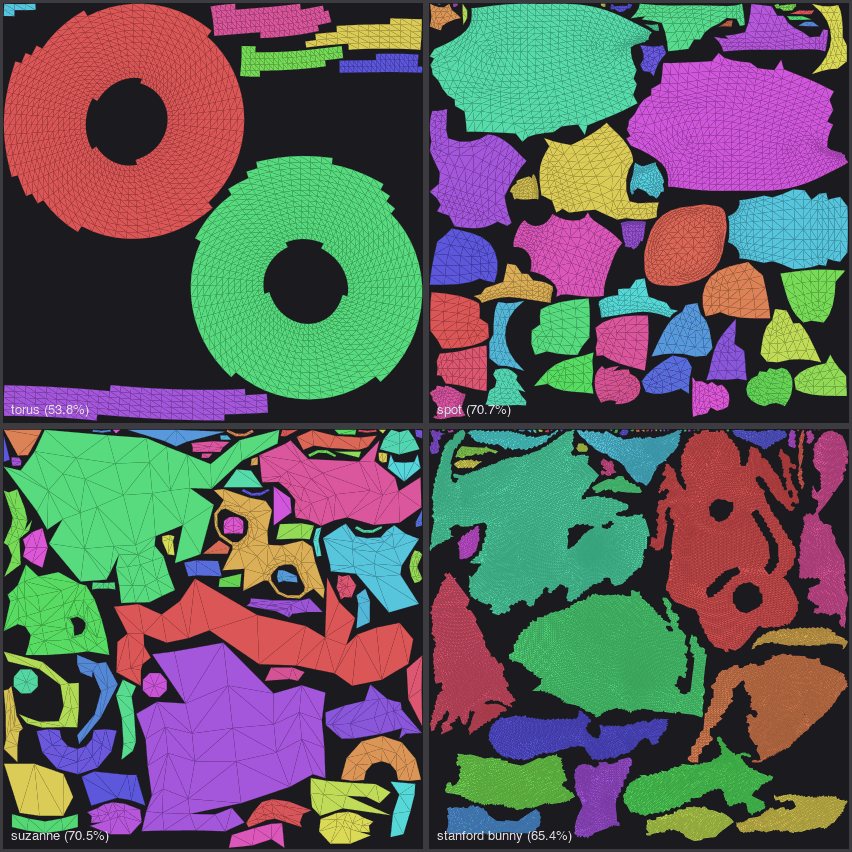
Pure-Rust automatic UV unwrapping: generates unique, non-overlapping texture
coordinates for lightmaps, texture baking and texture painting. Inspired by
[xatlas](https://github.com/jpcy/xatlas), with no C++ toolchain required, so it
builds for wasm and cross-compiles trivially.
## Usage
```rust
use uvunwrap::{generate, Density, MeshInput, Options};
let mesh = MeshInput::new(&positions, &indices);
let atlas = generate(&[mesh], &Options::default())?;
for v in &atlas.meshes[0].vertices {
// v.xref: original vertex index, v.uv: [0, 1] coordinate, v.page: atlas page
}
// Engines usually want a fixed texel density (5 texels per unit here), on a
// page that grows to fit or on as many fixed-size pages as needed:
let options = Options {
density: Density::Fixed { texels_per_unit: 5.0, page_size: None },
..Options::default()
};
```
`Density::Auto { page_size }` (the default, 1024) picks the highest density
that fits one page. `generate_with_progress` takes a callback that receives
the current stage and progress counts and can return `false` to cancel, for
running large unwraps as background tasks.
Output meshes keep the input triangles in order; vertices on chart seams are
duplicated, and `xref` maps each one back to its input vertex.
Pass meshes as your engine stores them, with vertices split for normals and
UVs: identical positions are welded, and the split edges (hard edges, UV
seams) become chart boundaries. Optional per-mesh inputs:
- `face_materials`: charts never span two materials.
- `ignored_faces`: faces that get no UV space.
- `polygons`: for meshes triangulated from quads and n-gons, the polygon
each triangle came from. A polygon's triangles always share a chart, so
every polygon corner gets exactly one UV, as UV maps that store one UV
per corner (e.g. Blender's) require.
- `scale`: mesh-to-world scale, so differently scaled instances share one
texel density.
- `instance_scales`: one scale per instance of a mesh drawn several times. The mesh
is unwrapped once (its UVs cover `[0, 1]`) and each instance gets its own
rectangle in the atlas (`OutputMesh::instances`), the way engines lightmap
shared meshes (e.g. Bevy's `Lightmap::uv_rect`). With one instance this
also keeps a mesh on a single page.
- `existing_uvs`: existing UVs to repack instead of unwrapping: each UV island
becomes one chart, rescaled to its surface area for uniform texel density.
Mirrored islands are flipped; unusable ones are unwrapped normally.
Try it on an OBJ file (writes an OBJ with `vt` coordinates plus an SVG per page):
```sh
cargo run --release --example unwrap -- model.obj out/model
```
## How it works
1. **Topology**: welds identical positions, drops triangles too thin for f32
UVs (and ignored ones), and connects faces only across manifold,
consistently oriented edges within one material that the input doesn't
split. Split edges are ignored when most edges are split (flat shading).
2. **Segmentation**: grows charts from the largest planar regions, xatlas
style: candidates are ranked by normal deviation (on crease-preserving
smoothed normals, limited by `max_chart_angle`), with bonuses for filling
boundary notches and penalties for crossing creases. Small charts mostly
enclosed by a neighbor are merged, and single-triangle teeth are smoothed
off the boundaries.
3. **Parameterization**: planar projection for flat charts, otherwise Least
Squares Conformal Maps solved by sparse Cholesky. Results with flipped
triangles, overlaps or area distortion above `max_area_distortion` are split
and retried, so output is always valid. Large, strongly curved charts are
split without attempting a solve.
4. **Packing**: charts are rotated to their minimum-area bounding rectangle,
rasterized (conservatively, dilated by the padding) and packed by shape, so
they nest into each other's concavities and holes, with 90° rotations.
Texel density is automatic (fit one page) or fixed (one growing page, or
multiple fixed-size pages). `Packing::Fast` instead folds charts into rows
and pushes each row up against the previous ones by the charts' outlines
(after TABI, Gu, Vining & Sheffer 2026): milliseconds for thousands of
charts, but it can't use holes or the space under overhangs, so atlases
are less dense. `max_chart_size` scales
oversized charts down; `block_align` gives every chart its own 4×4 texel
blocks for block-compressed lightmaps.
## Features
| `direct-solver` | yes | Sparse Cholesky via pure-Rust `faer`; about 10× faster on large charts. Without it, an iterative CGLS solver is used. |
| `parallel` | yes | Parameterizes charts in parallel with `rayon`. Disable for wasm32 without threads. |
With no default features the crate has zero dependencies.
## Determinism
The same input, options and features give bit-identical output on any thread
count. No platform math library calls are used, so without `direct-solver`
output depends only on IEEE-754 arithmetic and matches across platforms: CI
compares output hashes on Linux x86-64 and ARM64, macOS ARM64, Windows
x86-64, wasm32-wasip1 (wasmtime) and wasm32-unknown-unknown (Node). With
`direct-solver`, faer selects SIMD kernels at runtime, so output can differ
between CPU architectures. If you cache unwraps or bake on one machine and
ship to another, build without it. The `unwrap` example prints an output hash
for comparing builds.
## Performance
1024×1024 page, 2 texels of padding, release build, Apple M5 (10 cores). Utilization
is true surface area over atlas area.
| Spot | 5.9K | 47 | 27 ms | 19 ms | 71% |
| Stanford bunny | 69K | 58 | 0.19 s | 82 ms | 65% |
| Armadillo | 100K | 257 | 0.40 s | 0.16 s | 60% |
| Nefertiti | 100K | 456 | 0.74 s | 0.40 s | 64% |
| Igea | 269K | 83 | 0.96 s | 0.48 s | 66% |
`cargo bench` runs criterion benchmarks on procedural meshes, plus any of
`spot`, `beetle`, `bunny`, `armadillo`, `nefertiti` and `igea` found in
`models/`; `scripts/fetch-models.sh` downloads them from
[common-3d-test-models](https://github.com/alecjacobson/common-3d-test-models)
at a pinned commit.
## License
MIT