# uas-cot
**A five dollar board can put a fake drone and a fake pilot on your TAK map, with the same marker as a real one. uas-cot stamps every Remote ID marker SPOOFED or PLAUSIBLE before it reaches the map.**
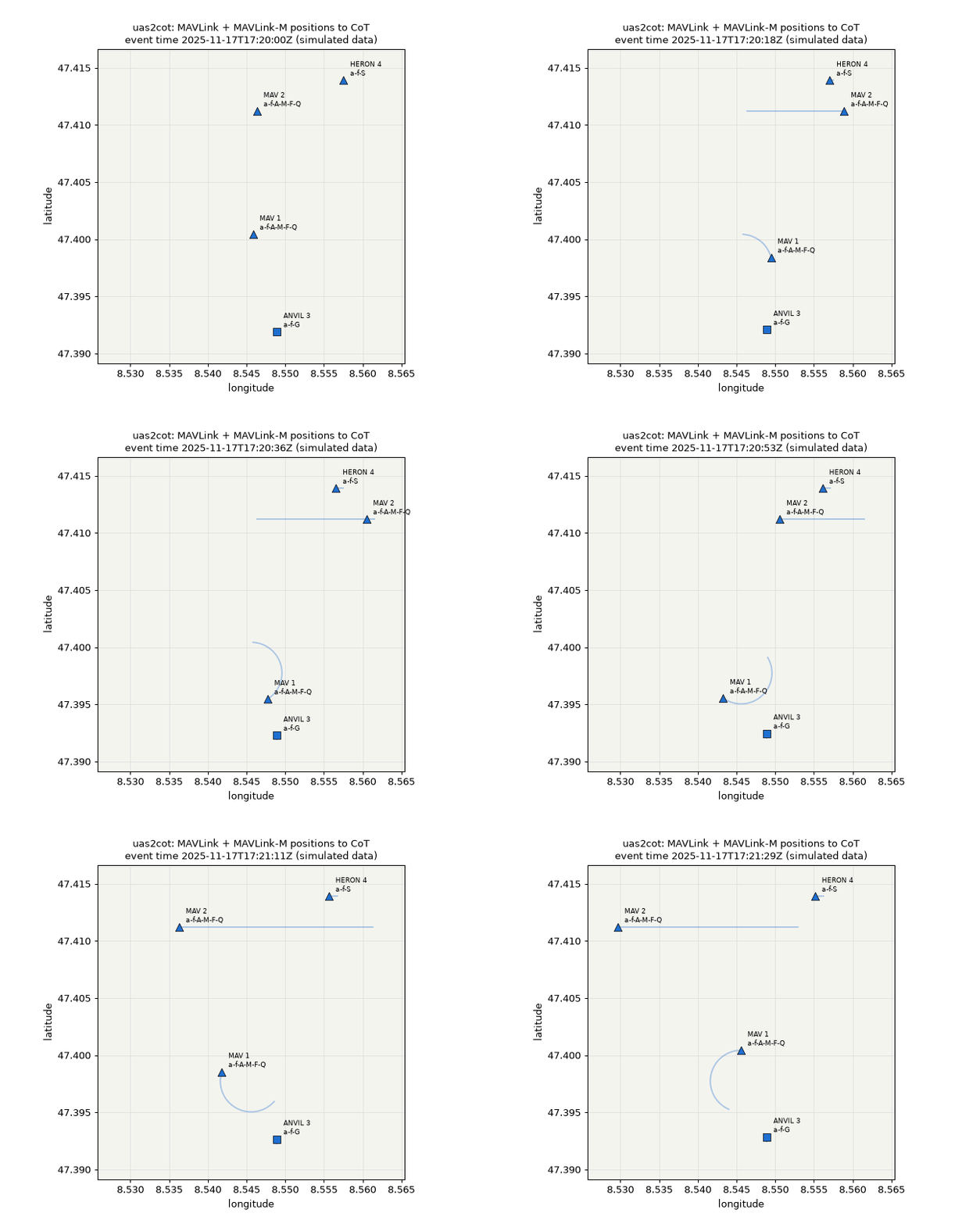
*uas2cot output for the simulated scenario in `examples/mavlink_m_sim.rs`
(synthetic data): two drones, plus a friendly ground team and a friendly
survey boat relayed as MAVLink-M PPLI reports.*
**[Live demo](https://mattbusel.github.io/drone-demos/)**
[](https://crates.io/crates/uas-cot)
[](https://crates.io/crates/uas-cot)
[](https://docs.rs/uas-cot)
[](#license)
[](https://github.com/Mattbusel/uas-cot/actions/workflows/ci.yml)
Remote ID bridges decode a broadcast and paint it on the map. The broadcast is
not a proof. uas-cot never sends an unjudged marker: every aircraft carries the
[`remoteid`](https://crates.io/crates/remoteid) trust verdict in its remarks,
`Trust: spoofed (teleport, known_spoofer; ...)` or `Trust: plausible.`, checked
against teleport, frozen timestamps, spoofer fingerprints and DRIP signatures.
MAVLink-M support is telemetry and position only: every targeting, fires and
engagement message is refused at compile time and at run time, not by a config
flag. CoT output is checked against the MITRE CoT schemas in CI and converts
cleanly to TAK Protocol v1.
```
$ uas2cot pcap capture.pcap --udp 239.2.3.1:6969
rid-1A0123456789 aircraft 47.39774, 8.54559 Trust: plausible.
rid-takeoff-1A01 takeoff 47.39770, 8.54551 Takeoff point of MFG1A0123456789
rid-9900112233DE aircraft 47.39801, 8.54490 Trust: spoofed (teleport, known_spoofer)
-> 3 CoT events sent to 239.2.3.1:6969
```
**Your TAK map shows fake drones as real ones, and nothing on the marker tells
the operator.** We threw 10 fake drones at eight open-source Remote ID
receivers: **0 of 10 flagged, 62 of 80 receiver and transmitter pairs shown as
real drones**
([receipts](https://github.com/Mattbusel/remoteid/blob/main/docs/receivers.md)).
Feed that to TAK and a five dollar ESP8266 puts an aircraft and a pilot location
in front of a security team, with the same marker as a real one. A bridge that
can't say SPOOFED is passing the attacker's message along. remoteid flags all 10
corpus spoofers.
| What reaches the TAK map | A decode-only Remote ID bridge | uas-cot |
|---|---|---|
| Spoofed Remote ID transmitter | an ordinary aircraft marker | a marker whose remarks say `Trust: spoofed (...)` |
| Why to believe it | nothing | teleport, frozen timestamp, spoofer fingerprint, DRIP signature result |
| MAVLink-M targeting and engagement messages | | refused at compile time and at run time |
| CoT output | | checked against the MITRE CoT schemas in CI |
Drone data arrives in four standards that do not talk to each other: Remote ID in the air, MISB KLV in the video, MAVLink on the control link, Cursor on Target on the TAK map. uas-cot puts all of them on the map, and draws a hard line: every MAVLink-M target, track, handover, fires, munition and engagement message is refused at compile time and at run time. In drone code a default is a claim about a real aircraft (a fix we upstreamed stopped a default MAVLink HEARTBEAT from serializing as SAFETY_ARMED: [rust-mavlink #576](https://github.com/mavlink/rust-mavlink/pull/576)), so interoperability code should make the dangerous message impossible to send by accident, not just undocumented.
- Remote ID (Wi-Fi Beacon, NAN, Bluetooth via [`remoteid`](https://crates.io/crates/remoteid)): aircraft and operator markers
- MISB ST 0601 KLV from STANAG 4609 video (via [`misb`](https://crates.io/crates/misb)): platform, camera field of view, sensor point of interest
- MAVLink `GLOBAL_POSITION_INT`: vehicle markers, from a `.tlog` or live UDP
- MAVLink-M (Dronecode `military.xml`, feature `mavlink-m`): friendly position reports (`PARTICIPANT_POSITION`) as CoT markers, plus `mavlinkm-check`, a framing and checksum checker for MAVLink-M traffic. Telemetry and position interoperability only: every target, track, handover, fires, munition and engagement message, and every generic payload (`PAYLOAD_*`) message, is refused at compile time and at run time. See [docs/mavlink-m.md](docs/mavlink-m.md)
- Remote ID affiliation rules: mark your own fleet friendly by serial or Operator ID (`--friendly`), and a spoofed or suspicious transmitter is never drawn friendly, even when it copies one of your serials
- The Remote ID ground position labelled for what it is: a takeoff point gets its own `rid-takeoff-<id>` marker instead of a marker that says "operator"
- Sends to the SA multicast group (239.2.3.1:6969), a TAK Server TCP input, a TAK Server TLS input with a client certificate (feature `tls`, rustls, no OpenSSL), or stdout
- Output passes the MITRE CoT schemas and converts cleanly to TAK Protocol v1
## How it works: watch the bytes decode
You are watching the real wire bytes of a real frame resolve into the decoded fields. The real ASTM F3411 Location/Vector message: the lat and lon int32s (scaled by 1e7) flipping and resolving to decimal degrees on a map, with the scaling math shown. remoteid decodes it; uas-cot turns it into the TAK marker.

[See the live gallery piece](https://mattbusel.github.io/drone-demos/bits/f3411-location/)
## Install
```
cargo install uas-cot # Remote ID, KLV, MAVLink
cargo install uas-cot --features mavlink-m # plus MAVLink-M and mavlinkm-check
cargo install uas-cot --features tls # plus TAK Server TLS (8089) streaming
```
## Use
```
uas2cot pcap capture.pcap --udp 239.2.3.1:6969 # Remote ID from a Wi-Fi capture
uas2cot pcap capture.pcap --friendly MFG1A0123456789 --suspicious-as s --tls takserver:8089 --ca ca.pem --cert user.pem --key user.key # your fleet friendly, over TLS
uas2cot klv flight.klv --video rtsp://cam/1 --realtime # ffmpeg -i in.ts -map 0:d -c copy -f data flight.klv
uas2cot tlog flight.tlog --tcp takserver:8087
uas2cot mavlink-udp 0.0.0.0:14550 --udp 239.2.3.1:6969 # with mavlink-m: MAVLink-M friendly positions too
mavlinkm-check tlog flight.tlog # MAVLink-M traffic against military.xml
```
As a library:
```rust
use uas_cot::{mavlink, net::UdpSender};
let pos = mavlink::GlobalPositionInt { lat: 473_977_418, lon: 85_455_939, alt: 488_000, ..Default::default() };
if let Some(event) = mavlink::vehicle(1, &pos, Some(2), uas_cot::now_us(), &Default::default()) {
UdpSender::sa_multicast()?.send(&event)?;
}
# Ok::<(), std::io::Error>(())
```
### Who is friendly, and where the pilot is not
```rust
use uas_cot::rid::{self, AffiliationRules, Options};
let rules = AffiliationRules::default() // spoofed verdict: suspect (s)
.friendly_id("MFG1A0123456789") // our drone: friendly (f) ...
.suspicious_as('s'); // ... unless its broadcast looks fake
// uas: the &TrackedUas that remoteid's Tracker::ingest returns
let events = rid::tracked_with(uas, None, uas_cot::now_us(), &Options::default(), &rules);
```
A friendly list matched on serial numbers alone is what a spoofer exploits:
the serial is in the broadcast, so anyone can copy it. `AffiliationRules`
checks the remoteid verdict first, and only a transmitter that is not
spoofed or suspicious can match the list (`require_authenticated_friendly`
makes it DRIP signed only).
Remote ID sends one ground position with a type: live operator GNSS, a
fixed operator location, or the takeoff point. A marker that calls all
three "operator" (as uas-cot 0.5 did) sends a security team to where the
drone left from, not to where the pilot stands. In both Open Drone ID sample captures in `tests/data`
the position is the takeoff point; `tracked_with` and `uas2cot` put it on
the map as `Takeoff point of MFG1A0123456789`, a separate entity from any
live operator marker.
### The whole story on one marker
A decode-only bridge drops a marker whose callsign is a serial and whose type
is `a-u-A-M-F-Q`. The operator still has to ask: what is it, do I believe it,
where did it launch, what is it watching. `rid::tracked_picture` (and
`uas2cot pcap --picture`) answer all four on the aircraft itself:
```
uas2cot pcap capture.pcap --picture --udp 239.2.3.1:6969
```
The aircraft remarks open with a one-line headline, for example from the
opendroneid Wi-Fi Beacon sample:
```
Undeclared-type MFG1A0123456789. Trust: PLAUSIBLE. Launched 45.544388, -122.972687. ...
```
and, with a real ANSI/CTA-2063-A serial, the maker code the airframe
broadcast:
```
HelicopterOrMultirotor 1596F35074529ABCDEFG (maker code 1596 per CTA-2063-A). Trust: PLAUSIBLE. Launched 45.544388, -122.972687. Camera on 38.895000, -77.030000.
```
- **What it is**: the UA type and, when the Basic ID is a serial number, the
four-character manufacturer code decoded from the serial the aircraft sent.
No brand-name lookup is invented, and a code is never read from an id of the
wrong type.
- **Whether it is fake**: the trust verdict in capitals, with the reasons kept
in the detail that follows.
- **Where it launched**: the takeoff (or operator) marker, now joined to the
aircraft with a `<link>` so ATAK draws it connected, not as a stray marker.
- **What it is watching**: when you pair the aircraft with a MISB ST 0601
video feed, pass its frame center as the camera target and
`tracked_picture` adds a sensor point of interest linked to the aircraft.
The pairing is yours: a Remote ID broadcast carries no camera data, and the
video carries no Remote ID serial.
```rust
use uas_cot::{rid::{self, AffiliationRules, Options}, Point};
// camera: the frame center of a correlated ST 0601 feed, or None.
let camera = Some(Point::new(38.8950, -77.0300, 0.0));
let events = rid::tracked_picture(uas, None, uas_cot::now_us(), &Options::default(), &AffiliationRules::default(), camera);
// events[0] is the aircraft with the headline; the takeoff marker links back
// to it; events.last() is the camera ground target, linked to the aircraft.
```
## Docs
- [docs/integration.md](docs/integration.md): using it as a library (features, the API to depend on, MSRV, versioning)
- [docs/mapping.md](docs/mapping.md): which field goes where
- [docs/mavlink-m.md](docs/mavlink-m.md): MAVLink-M scope (what is blocked and how), mapping, the conformance checks, the demo
- [docs/tak.md](docs/tak.md): seeing it in ATAK, WinTAK and TAK Server
- [docs/testing.md](docs/testing.md): how it is checked
- API: [docs.rs/uas-cot](https://docs.rs/uas-cot)
## License
MIT OR Apache-2.0. `dialects/military.xml` is from
[Dronecode/mavlink-military](https://github.com/Dronecode/mavlink-military),
MIT, Copyright (c) 2026 Dronecode Project, Inc (`dialects/LICENSE-MIT-dronecode`).