
uas-cot: drones belong on the TAK map, weapons messages do not belong on the wire



Your TAK map shows fake drones as real ones, and nothing on the marker tells the operator. Remote ID bridges decode a broadcast and paint it. The broadcast is not a proof. We threw 10 fake drones at eight open-source Remote ID receivers: 0 of 10 flagged, 62 of 80 receiver and transmitter pairs shown as real drones (receipts). Feed that to TAK and a five dollar ESP8266 puts an aircraft and a pilot location in front of a security team, with the same marker as a real one. A bridge that can't say SPOOFED is passing the attacker's message along.
uas-cot does not send an unjudged Remote ID marker from uas2cot pcap:
every aircraft carries the remoteid
trust verdict in its remarks, Trust: spoofed (teleport, known_spoofer; ...)
or Trust: plausible., and remoteid flags all 10 corpus spoofers. MAVLink-M
support is telemetry and position only: every targeting, fires and
engagement message is refused at compile time and at run time, not by a
config flag.
| What reaches the TAK map | A decode-only Remote ID bridge | uas-cot |
|---|---|---|
| Spoofed Remote ID transmitter | an ordinary aircraft marker | a marker whose remarks say Trust: spoofed (...) |
| Why to believe it | nothing | teleport, frozen timestamp, spoofer fingerprint, DRIP signature result |
| MAVLink-M targeting and engagement messages | refused at compile time and at run time | |
| CoT output | checked against the MITRE CoT schemas in CI |
Drone data arrives in four standards that do not talk to each other: Remote ID in the air, MISB KLV in the video, MAVLink on the control link, Cursor on Target on the TAK map. uas-cot puts all of them on the map, and draws a hard line: every MAVLink-M target, track, handover, fires, munition and engagement message is refused at compile time and at run time. In drone code a default is a claim about a real aircraft (a fix we upstreamed stopped a default MAVLink HEARTBEAT from serializing as SAFETY_ARMED: rust-mavlink #576), so interoperability code should make the dangerous message impossible to send by accident, not just undocumented.
- Remote ID (Wi-Fi Beacon, NAN, Bluetooth via
remoteid): aircraft and operator markers - MISB ST 0601 KLV from STANAG 4609 video (via
misb): platform, camera field of view, sensor point of interest - MAVLink
GLOBAL_POSITION_INT: vehicle markers, from a.tlogor live UDP - MAVLink-M (Dronecode
military.xml, featuremavlink-m): friendly position reports (PARTICIPANT_POSITION) as CoT markers, plusmavlinkm-check, a framing and checksum checker for MAVLink-M traffic. Telemetry and position interoperability only: every target, track, handover, fires, munition and engagement message, and every generic payload (PAYLOAD_*) message, is refused at compile time and at run time. See docs/mavlink-m.md - Remote ID affiliation rules: mark your own fleet friendly by serial or Operator ID (
--friendly), and a spoofed or suspicious transmitter is never drawn friendly, even when it copies one of your serials - The Remote ID ground position labelled for what it is: a takeoff point gets its own
rid-takeoff-<id>marker instead of a marker that says "operator" - Sends to the SA multicast group (239.2.3.1:6969), a TAK Server TCP input, a TAK Server TLS input with a client certificate (feature
tls, rustls, no OpenSSL), or stdout - Output passes the MITRE CoT schemas and converts cleanly to TAK Protocol v1
Install
cargo install uas-cot                       # Remote ID, KLV, MAVLink
cargo install uas-cot --features mavlink-m  # plus MAVLink-M and mavlinkm-check
cargo install uas-cot --features tls        # plus TAK Server TLS (8089) streaming
Use
uas2cot pcap capture.pcap --udp 239.2.3.1:6969        # Remote ID from a Wi-Fi capture
uas2cot pcap capture.pcap --friendly MFG1A0123456789 --suspicious-as s     --tls takserver:8089 --ca ca.pem --cert user.pem --key user.key   # your fleet friendly, over TLS
uas2cot klv flight.klv --video rtsp://cam/1 --realtime   # ffmpeg -i in.ts -map 0:d -c copy -f data flight.klv
uas2cot tlog flight.tlog --tcp takserver:8087
uas2cot mavlink-udp 0.0.0.0:14550 --udp 239.2.3.1:6969   # with mavlink-m: MAVLink-M friendly positions too
mavlinkm-check tlog flight.tlog                           # MAVLink-M traffic against military.xml
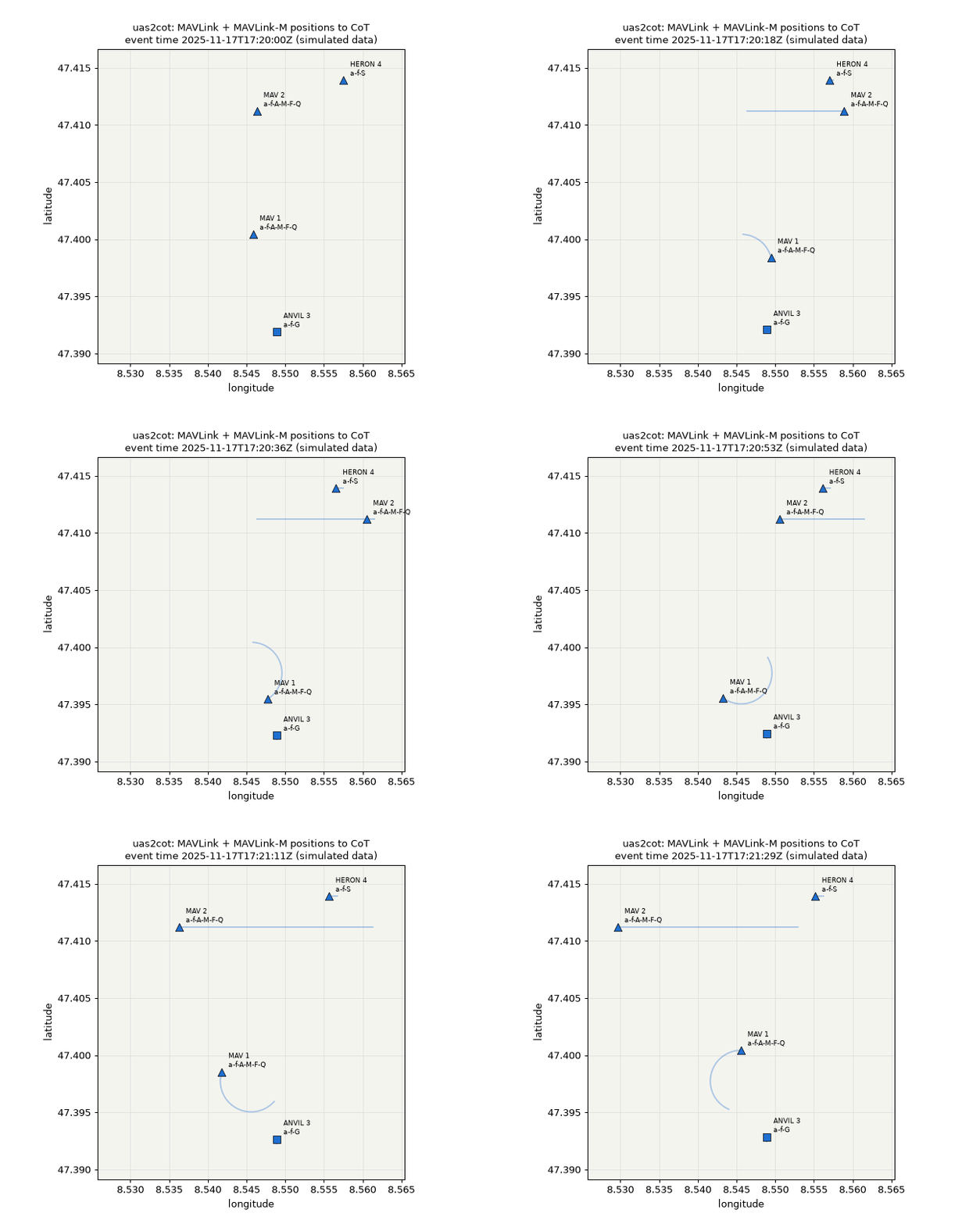
uas2cot output for the simulated scenario in examples/mavlink_m_sim.rs
(synthetic data): two drones, plus a friendly ground team and a friendly
survey boat relayed as MAVLink-M PPLI reports.
As a library:
use ;
let pos = GlobalPositionInt ;
if let Some = vehicle
# Ok::
Who is friendly, and where the pilot is not
use ;
let rules = default // spoofed verdict: suspect (s)
.friendly_id // our drone: friendly (f) ...
.suspicious_as; // ... unless its broadcast looks fake
// uas: the &TrackedUas that remoteid's Tracker::ingest returns
let events = tracked_with;
A friendly list matched on serial numbers alone is what a spoofer exploits:
the serial is in the broadcast, so anyone can copy it. AffiliationRules
checks the remoteid verdict first, and only a transmitter that is not
spoofed or suspicious can match the list (require_authenticated_friendly
makes it DRIP signed only).
Remote ID sends one ground position with a type: live operator GNSS, a
fixed operator location, or the takeoff point. A marker that calls all
three "operator" (as uas-cot 0.5 did) sends a security team to where the
drone left from, not to where the pilot stands. In both Open Drone ID sample captures in tests/data
the position is the takeoff point; tracked_with and uas2cot put it on
the map as Takeoff point of MFG1A0123456789, a separate entity from any
live operator marker.
Docs
- docs/integration.md: using it as a library (features, the API to depend on, MSRV, versioning)
- docs/mapping.md: which field goes where
- docs/mavlink-m.md: MAVLink-M scope (what is blocked and how), mapping, the conformance checks, the demo
- docs/tak.md: seeing it in ATAK, WinTAK and TAK Server
- docs/testing.md: how it is checked
- API: docs.rs/uas-cot
License
MIT OR Apache-2.0. dialects/military.xml is from
Dronecode/mavlink-military,
MIT, Copyright (c) 2026 Dronecode Project, Inc (dialects/LICENSE-MIT-dronecode).