# uas-cot: drones belong on the TAK map, weapons messages do not belong on the wire
[](https://crates.io/crates/uas-cot)
[](https://docs.rs/uas-cot)
[](https://github.com/Mattbusel/uas-cot/actions/workflows/ci.yml)
**Your TAK map shows fake drones as real ones, and nothing on the marker
tells the operator.** Remote ID bridges decode a broadcast and paint it. The
broadcast is not a proof. We threw 10 fake drones at eight open-source
Remote ID receivers: **0 of 10 flagged, 62 of 80 receiver and transmitter
pairs shown as real drones**
([receipts](https://github.com/Mattbusel/remoteid/blob/main/docs/receivers.md)).
Feed that to TAK and a five dollar ESP8266 puts an aircraft and a pilot
location in front of a security team, with the same marker as a real one.
A bridge that can't say SPOOFED is passing the attacker's message along.
uas-cot does not send an unjudged Remote ID marker from `uas2cot pcap`:
every aircraft carries the [`remoteid`](https://crates.io/crates/remoteid)
trust verdict in its remarks, `Trust: spoofed (teleport, known_spoofer; ...)`
or `Trust: plausible.`, and remoteid flags all 10 corpus spoofers. MAVLink-M
support is telemetry and position only: every targeting, fires and
engagement message is refused at compile time and at run time, not by a
config flag.
| What reaches the TAK map | A decode-only Remote ID bridge | uas-cot |
|---|---|---|
| Spoofed Remote ID transmitter | an ordinary aircraft marker | a marker whose remarks say `Trust: spoofed (...)` |
| Why to believe it | nothing | teleport, frozen timestamp, spoofer fingerprint, DRIP signature result |
| MAVLink-M targeting and engagement messages | | refused at compile time and at run time |
| CoT output | | checked against the MITRE CoT schemas in CI |
Drone data arrives in four standards that do not talk to each other: Remote ID in the air, MISB KLV in the video, MAVLink on the control link, Cursor on Target on the TAK map. uas-cot puts all of them on the map, and draws a hard line: every MAVLink-M target, track, handover, fires, munition and engagement message is refused at compile time and at run time. In drone code a default is a claim about a real aircraft (a fix we upstreamed stopped a default MAVLink HEARTBEAT from serializing as SAFETY_ARMED: [rust-mavlink #576](https://github.com/mavlink/rust-mavlink/pull/576)), so interoperability code should make the dangerous message impossible to send by accident, not just undocumented.
- Remote ID (Wi-Fi Beacon, NAN, Bluetooth via [`remoteid`](https://crates.io/crates/remoteid)): aircraft and operator markers
- MISB ST 0601 KLV from STANAG 4609 video (via [`misb`](https://crates.io/crates/misb)): platform, camera field of view, sensor point of interest
- MAVLink `GLOBAL_POSITION_INT`: vehicle markers, from a `.tlog` or live UDP
- MAVLink-M (Dronecode `military.xml`, feature `mavlink-m`): friendly position reports (`PARTICIPANT_POSITION`) as CoT markers, plus `mavlinkm-check`, a framing and checksum checker for MAVLink-M traffic. Telemetry and position interoperability only: every target, track, handover, fires, munition and engagement message, and every generic payload (`PAYLOAD_*`) message, is refused at compile time and at run time. See [docs/mavlink-m.md](docs/mavlink-m.md)
- Sends to the SA multicast group (239.2.3.1:6969), a TAK Server TCP input, or stdout
- Output passes the MITRE CoT schemas and converts cleanly to TAK Protocol v1
## Install
```
cargo install uas-cot # Remote ID, KLV, MAVLink
cargo install uas-cot --features mavlink-m # plus MAVLink-M and mavlinkm-check
```
## Use
```
uas2cot pcap capture.pcap --udp 239.2.3.1:6969 # Remote ID from a Wi-Fi capture
uas2cot klv flight.klv --video rtsp://cam/1 --realtime # ffmpeg -i in.ts -map 0:d -c copy -f data flight.klv
uas2cot tlog flight.tlog --tcp takserver:8087
uas2cot mavlink-udp 0.0.0.0:14550 --udp 239.2.3.1:6969 # with mavlink-m: MAVLink-M friendly positions too
mavlinkm-check tlog flight.tlog # MAVLink-M traffic against military.xml
```
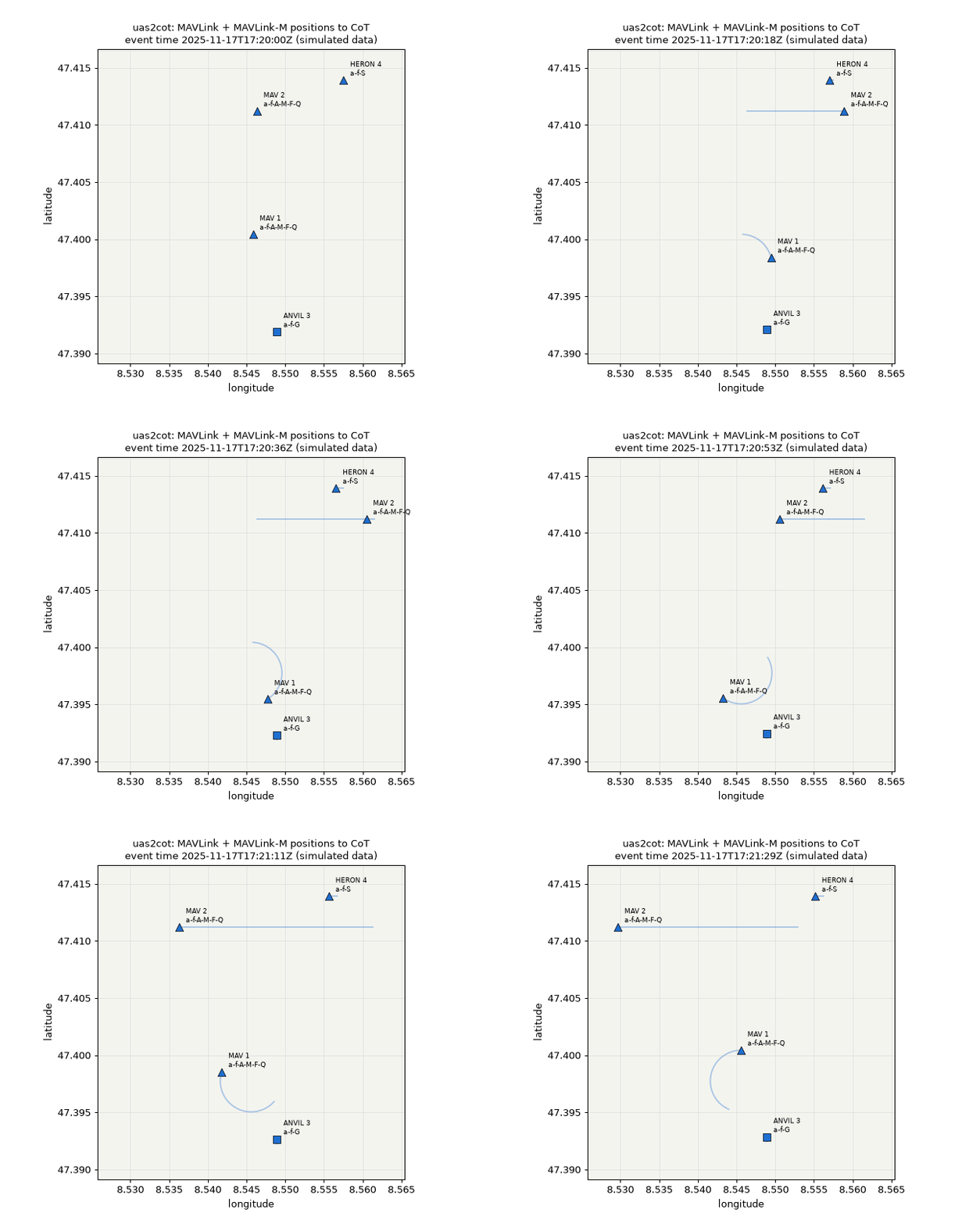
*uas2cot output for the simulated scenario in `examples/mavlink_m_sim.rs`
(synthetic data): two drones, plus a friendly ground team and a friendly
survey boat relayed as MAVLink-M PPLI reports.*
As a library:
```rust
use uas_cot::{mavlink, net::UdpSender};
let pos = mavlink::GlobalPositionInt { lat: 473_977_418, lon: 85_455_939, alt: 488_000, ..Default::default() };
if let Some(event) = mavlink::vehicle(1, &pos, Some(2), uas_cot::now_us(), &Default::default()) {
UdpSender::sa_multicast()?.send(&event)?;
}
# Ok::<(), std::io::Error>(())
```
## Docs
- [docs/integration.md](docs/integration.md): using it as a library (features, the API to depend on, MSRV, versioning)
- [docs/mapping.md](docs/mapping.md): which field goes where
- [docs/mavlink-m.md](docs/mavlink-m.md): MAVLink-M scope (what is blocked and how), mapping, the conformance checks, the demo
- [docs/tak.md](docs/tak.md): seeing it in ATAK, WinTAK and TAK Server
- [docs/testing.md](docs/testing.md): how it is checked
- API: [docs.rs/uas-cot](https://docs.rs/uas-cot)
## License
MIT OR Apache-2.0. `dialects/military.xml` is from
[Dronecode/mavlink-military](https://github.com/Dronecode/mavlink-military),
MIT, Copyright (c) 2026 Dronecode Project, Inc (`dialects/LICENSE-MIT-dronecode`).