# typwire
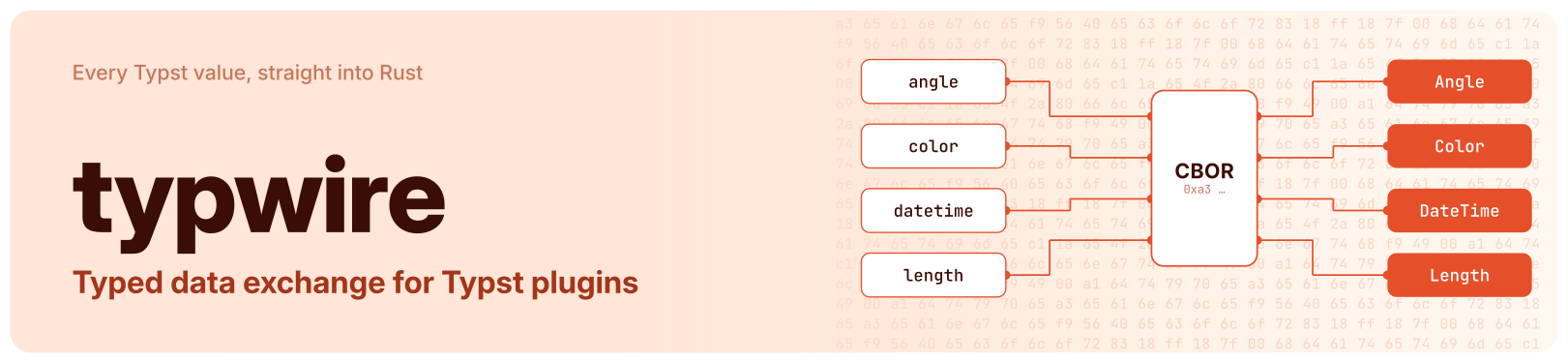
Typed data exchange between Typst and (Rust) WASM plugins.
## Installation
Add the Rust crate to a plugin:
```sh
cargo add typwire
cargo add serde --features derive
```
Add the Typst package to a document:
```typ
#import "@preview/typwire:0.2.0"
```
## Quick Start
Export a plugin function from Rust:
```rust
use serde::{Deserialize, Serialize};
use typwire::{Any, Length, OneOf3, Typwire, initiate_protocol};
initiate_protocol!();
#[derive(Serialize, Deserialize, Typwire)]
struct Options {
label: String,
scale: f64,
}
#[derive(Serialize, Deserialize, Typwire)]
struct Report {
text: String,
width: Length,
metadata: Any,
}
#[typwire::export]
fn measure(
value: OneOf3<i64, f64, String>,
options: Options,
fallback: Option<Length>,
metadata: Any,
) -> Result<Report, String> {
let value = match value {
OneOf3::First(value) => value.to_string(),
OneOf3::Second(value) => value.to_string(),
OneOf3::Third(value) => value,
};
Ok(Report {
text: format!("{}{}", options.label, value),
width: fallback.unwrap_or_else(|| Length::new(12.0 * options.scale)),
metadata,
})
}
```
Call the plugin function from Typst:
```typ
#import "@preview/typwire:0.2.0"
#let plugin = plugin("plugin.wasm")
#let report = typwire.call(
plugin.measure,
42,
(label: "Value: ", scale: 1.5),
12pt,
(source: "example", enabled: true),
)
#assert(report.text == "Value: 42")
#assert(report.width == 12pt)
```
## Performance
If you're considering moving a pure-Typst implementation to a WASM plugin
via typwire, be aware of the performance overhead that comes with it. These
measurements were taken with medium-sized data, like a gradient with 9 stops;
performance scales directly with the size of the data.
- **~10 ms** to load the plugin, once per compilation.
- **~1 ms** extra for the first call.
- **~150 μs** per call after that.
Use CBOR unless you specifically need JSON, which is ~2.5x slower. Compared
to [sertyp](https://typst.app/universe/package/sertyp), typwire is ~2x to
~66x faster, depending on the workload. See the full
[benchmark results](https://github.com/T1mVo/typwire/blob/v0.2.0/benchmarks/RESULT.md).
## Version compatibility
The Rust crate and the Typst package are versioned together and must be on
the **exact same version**. There is no compatibility guarantee across a
version mismatch.
## Documentation
The Typst API reference can be found in the
[project repository](https://github.com/T1mVo/typwire#readme).
## License
`typwire` is available under the MIT OR Apache-2.0 license. See
[LICENSE-MIT](https://github.com/T1mVo/typwire/blob/main/LICENSE-MIT) and
[LICENSE-APACHE](https://github.com/T1mVo/typwire/blob/main/LICENSE-APACHE)
for details.