1
2
3
4
5
6
7
8
9
10
11
12
13
14
15
16
17
18
19
20
21
22
23
24
25
26
27
28
29
30
31
32
33
34
35
36
37
38
39
40
41
42
43
44
45
46
47
48
49
50
51
52
53
54
55
56
57
58
59
60
61
62
63
64
65
66
67
68
69
70
71
72
73
74
75
76
77
78
79
80
81
82
83
84
85
86
87
88
89
90
91
92
93
94
95
96
97
98
99
100
101
102
103
104
105
106
107
108
109
110
111
112
113
114
115
116
117
118
119
120
121
122
123
124
125
126
127
128
129
130
131
132
133
134
135
136
137
138
139
140
141
142
143
144
145
146
147
148
149
150
151
152
153
154
155
156
157
158
159
160
161
162
163
164
165
166
167
168
169
170
171
172
173
174
175
176
177
178
179
180
181
182
183
184
185
186
187
188
189
190
191
192
193
194
195
196
197
198
199
200
201
202
203
204
205
206
207
208
209
210
211
212
213
214
215
216
217
218
219
220
221
222
223
224
225
226
227
228
229
230
231
232
233
234
235
236
237
238
239
240
241
242
243
244
245
//! Flex container — the composition primitive.
//!
//! Holds a [`LayoutStyle`] and a list of children, each tagged with a
//! [`Dimension`] for its main-axis sizing. Delegates rect assignment to the
//! [`solve`](crate::layout::solve) flexbox solver, then renders each
//! child into its rect through a clipped child surface. Nesting `Flex`es is how
//! every screen is built.
use ratatui_core::layout::Rect;
use ratatui_core::style::Style;
use crate::geometry::Size;
use crate::layout::{Dimension, Item, LayoutStyle, solve};
use crate::surface::Surface;
use crate::view::{Element, RenderCtx, View};
struct Child {
view: Element,
dimension: Dimension,
}
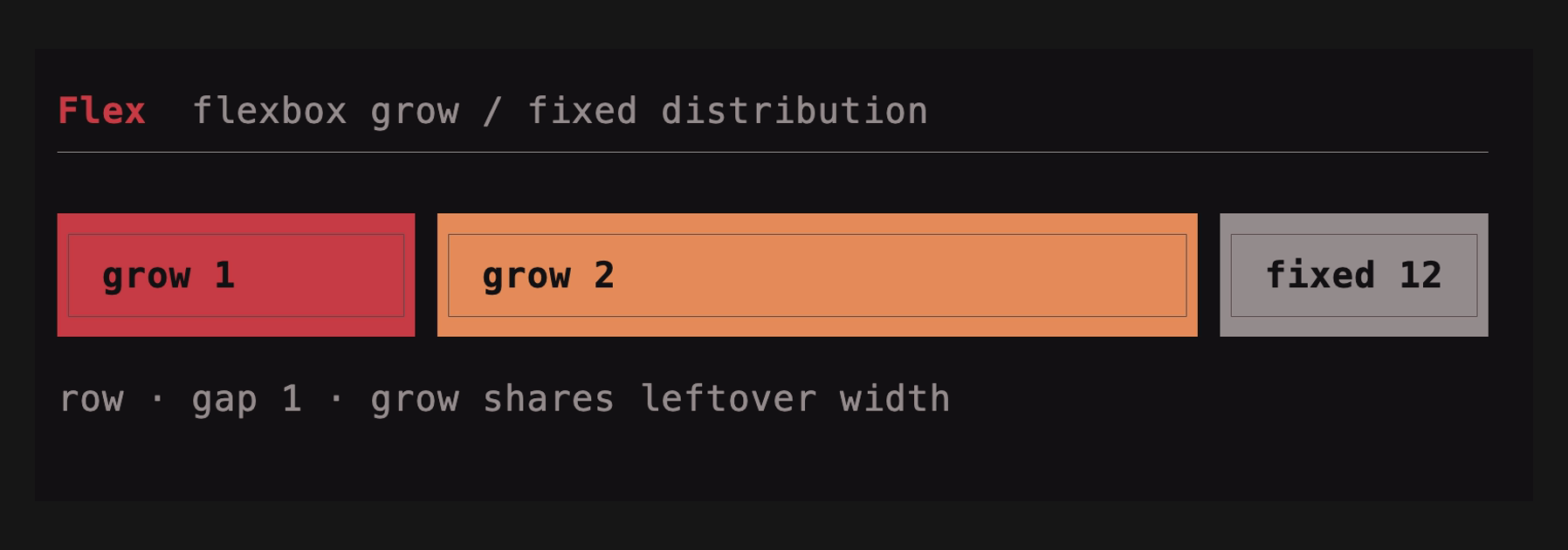
/// A flexbox container of child views.
///
/// # Example
///
/// ```
/// use tuika::prelude::*;
/// use tuika::testing::{grid, render};
///
/// // A row of two fixed-width cells, laid left to right.
/// let view = Flex::row()
/// .fixed(3, element(Text::raw("abc")))
/// .fixed(3, element(Text::raw("xyz")));
///
/// let buffer = render(&view, 6, 1, &Theme::default());
/// assert_eq!(grid(&buffer), "abcxyz");
/// ```
///
/// 
pub struct Flex {
style: LayoutStyle,
children: Vec<Child>,
background: Option<Style>,
}
impl Flex {
/// An empty flex container with the given layout style.
pub fn new(style: LayoutStyle) -> Self {
Self {
style,
children: Vec::new(),
background: None,
}
}
/// An empty container laying children left-to-right along the horizontal axis.
pub fn row() -> Self {
Self::new(LayoutStyle::row())
}
/// An empty container stacking children top-to-bottom along the vertical axis.
pub fn column() -> Self {
Self::new(LayoutStyle::column())
}
/// Fill the container area with `style` before drawing children.
pub fn background(mut self, style: Style) -> Self {
self.background = Some(style);
self
}
/// Set the gap between children (passthrough to the layout style).
pub fn gap(mut self, gap: u16) -> Self {
self.style.gap = gap;
self
}
/// Set padding inside the container (passthrough to the layout style).
pub fn padding(mut self, padding: crate::geometry::Padding) -> Self {
self.style.padding = padding;
self
}
/// Set cross-axis alignment (passthrough to the layout style).
pub fn align(mut self, align: crate::layout::Align) -> Self {
self.style.align_items = align;
self
}
/// Set main-axis distribution (passthrough to the layout style).
pub fn justify(mut self, justify: crate::layout::Justify) -> Self {
self.style.justify = justify;
self
}
/// Add a child with an explicit main-axis dimension.
pub fn child(mut self, dimension: Dimension, view: Element) -> Self {
self.children.push(Child { view, dimension });
self
}
/// Add an auto-sized child (sizes to its measured content).
pub fn auto(self, view: Element) -> Self {
self.child(Dimension::Auto, view)
}
/// Add a flexible child that grows to share leftover space.
pub fn grow(self, weight: u16, view: Element) -> Self {
self.child(Dimension::Flex(weight), view)
}
/// Add a fixed-size child.
pub fn fixed(self, cells: u16, view: Element) -> Self {
self.child(Dimension::Fixed(cells), view)
}
fn items(&self, available: Size) -> Vec<Item> {
self.children
.iter()
.map(|c| Item::new(c.dimension, c.view.measure(available)))
.collect()
}
/// Resolve the child rects this container would assign inside `area`,
/// without painting anything.
///
/// This is the same measure-then-[`solve`] pass `render` runs, exposed so a
/// host can compute layout ahead of (or instead of) a render — to clamp a
/// scroll offset to a pane's real height, hit-test a click against child
/// rects, or decide what fits before drawing. The returned `Vec` has one
/// rect per child, in insertion order.
///
/// ```
/// use tuika::prelude::*;
/// use ratatui_core::layout::Rect;
///
/// let flex = Flex::row()
/// .fixed(4, element(Text::raw("abcd")))
/// .grow(1, element(Text::raw("rest")));
/// let rects = flex.solve(Rect::new(0, 0, 10, 1));
/// assert_eq!(rects.len(), 2);
/// assert_eq!(rects[0], Rect::new(0, 0, 4, 1));
/// assert_eq!(rects[1], Rect::new(4, 0, 6, 1)); // grows into the leftover
/// ```
pub fn solve(&self, area: Rect) -> Vec<Rect> {
solve(area, &self.style, &self.items(Size::from(area)))
}
}
impl View for Flex {
fn measure(&self, available: Size) -> Size {
// Sum children on the main axis, max on the cross axis, plus gaps and
// padding. Used when this Flex is itself an Auto child.
let axis = self.style.direction.axis();
let inner = self
.style
.padding
.inner(Rect::new(0, 0, available.width, available.height));
let inner_avail = Size::from(inner);
let mut main_total: u16 = 0;
let mut cross_max: u16 = 0;
for (i, c) in self.children.iter().enumerate() {
let sz = c.view.measure(inner_avail);
main_total = main_total.saturating_add(axis.main(sz));
if i > 0 {
main_total = main_total.saturating_add(self.style.gap);
}
cross_max = cross_max.max(axis.cross(sz));
}
let content = axis.size(main_total, cross_max);
Size::new(
content
.width
.saturating_add(self.style.padding.horizontal()),
content.height.saturating_add(self.style.padding.vertical()),
)
}
fn render(&self, area: Rect, surface: &mut Surface, ctx: &RenderCtx) {
if let Some(bg) = self.background {
let mut fill = surface.child(area);
fill.fill(bg);
}
let rects = self.solve(area);
for (child, rect) in self.children.iter().zip(rects) {
let mut child_surface = surface.child(rect);
child.view.render(rect, &mut child_surface, ctx);
}
}
}
#[cfg(test)]
mod tests {
use super::*;
use crate::components::Text;
use crate::probe::RectProbe;
use crate::style::Theme;
use crate::view::element;
#[test]
fn solve_matches_the_rects_render_paints_into() {
// Probe every child, render, then compare the painted rects to what the
// paint-free `solve` returns for the same area — they must be identical.
let area = Rect::new(0, 0, 20, 6);
let probes: Vec<RectProbe> = (0..3).map(|_| RectProbe::new()).collect();
let flex = Flex::column()
.fixed(1, probes[0].wrap(element(Text::raw("header"))))
.grow(1, probes[1].wrap(element(Text::raw("body"))))
.fixed(2, probes[2].wrap(element(Text::raw("footer"))));
let precomputed = flex.solve(area);
let _ = crate::testing::render(&flex, area.width, area.height, &Theme::default());
let painted: Vec<Rect> = probes.iter().map(|p| p.rect()).collect();
assert_eq!(
precomputed, painted,
"solve() must return exactly the rects render() paints into"
);
// And they are the expected column layout: 1-row header, grown body, 2-row footer.
assert_eq!(precomputed[0], Rect::new(0, 0, 20, 1));
assert_eq!(precomputed[1], Rect::new(0, 1, 20, 3));
assert_eq!(precomputed[2], Rect::new(0, 4, 20, 2));
}
#[test]
fn solve_of_empty_container_is_empty() {
let flex = Flex::row();
assert!(flex.solve(Rect::new(0, 0, 10, 3)).is_empty());
}
#[test]
fn crate_root_reexports_solver_primitives() {
// `solve` and `Item` are reachable from the crate root, not just
// `tuika::layout` — build a layout by hand without a Flex.
use crate::Size;
use crate::layout::{Dimension, Item, LayoutStyle, solve};
let items = [
Item::new(Dimension::Fixed(3), Size::new(3, 1)),
Item::new(Dimension::Flex(1), Size::new(0, 1)),
];
let rects = solve(Rect::new(0, 0, 10, 1), &LayoutStyle::row(), &items);
assert_eq!(rects[0], Rect::new(0, 0, 3, 1));
assert_eq!(rects[1], Rect::new(3, 0, 7, 1));
}
}