
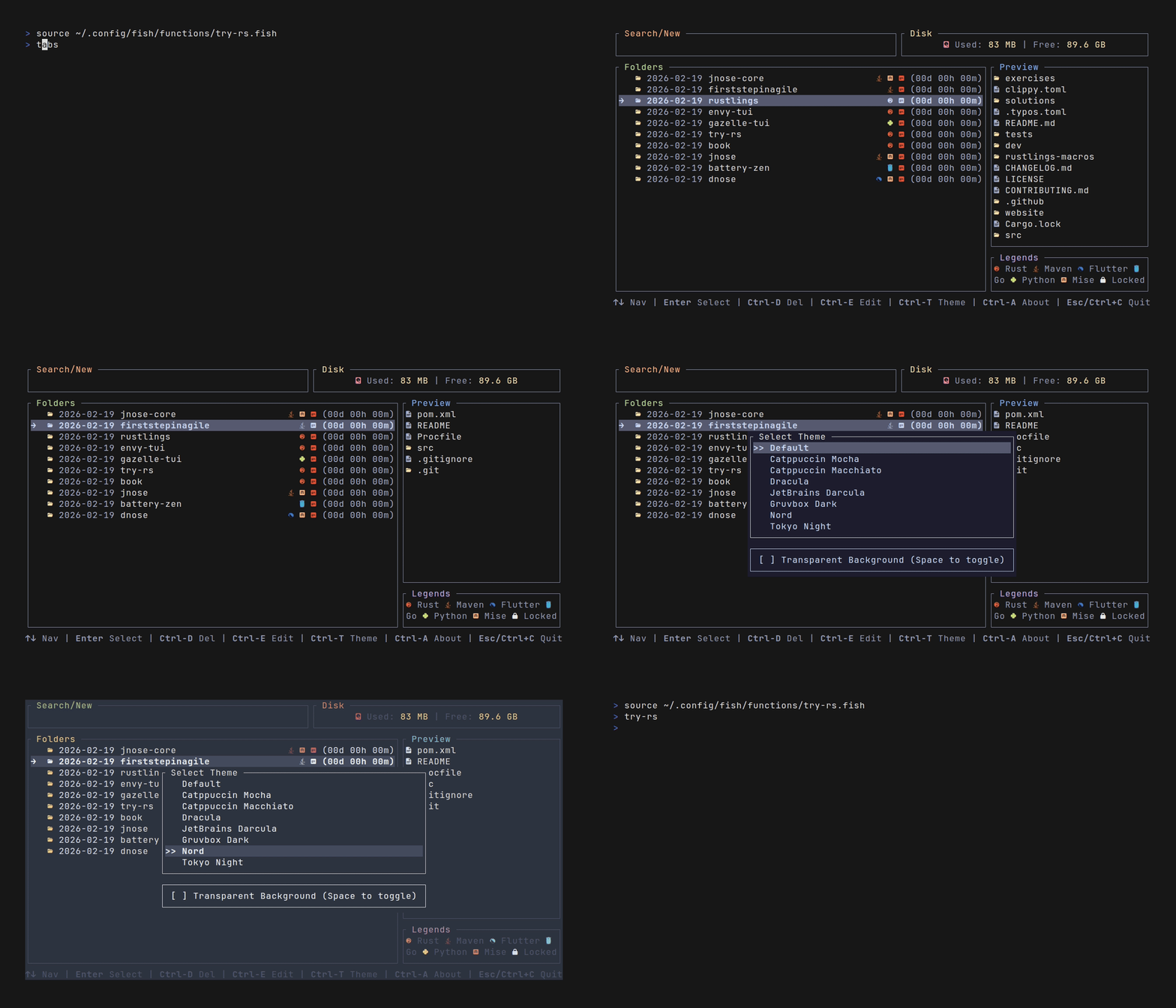
try-rs is a CLI tool designed to manage the chaos of temporary projects. Instead of cluttering your Desktop or /tmp with test1, new-test, and final-test, try-rs organizes them into date-prefixed directories, offering a robust TUI (Terminal User Interface) to create, navigate, and clean up your experiments.
Features
| Feature | Description |
|---|---|
| Blazing Fast | Built in Rust, compiled to native binary. No interpreter lag. |
| Rich TUI | Beautiful terminal interface built with Ratatui. |
| Fuzzy Search | Instantly find old experiments with smart matching. |
| Auto-Dating | Creates directories like rust-test automatically. |
| Git Integration | Auto-clones URLs (try-rs <url>) and marks repos with (). |
| Content Preview | Inspect files inside a folder before entering it. |
| Editor Integration | Open experiments directly in your editor (Ctrl+E). |
| Theming | Switch themes at runtime (Ctrl+T) or set a default in config. |
| Safe Deletion | Delete old experiments via UI with confirmation (Ctrl+D). |
| Configurable | Supports XDG Base Directory (view section Configuration). |
| Multi-Shell Support | Supports Fish, Zsh, Bash, Power Shell and Nushell. |
| Multi-OS Support | Supports Linux, macOS and Windows. |
| Shell Tab Completion | Dynamic tab completion for directory names from your tries path. |
| Icons Identification | Supports icons identification projects ( ). |
Installation
Prerequisites
- A shell (Fish, Zsh, Bash, Power Shell or Nushell).
- A Nerd Font installed (required for icons like and 🦀).
Building from source
Cargo install try-rs
Eget
Install in Archlinux
Ubuntu/Debian (APT Repository)
# Add the repository
|
# Update and install
Ubuntu/Debian (.deb manual)
- Download the latest
.debfor your architecture (amd64/arm64) from the Releases page and install it:
# Replace X.Y.Z with the latest version and choose amd64 or arm64
- Alternatively, browse all assets at: https://github.com/tassiovirginio/try-rs/releases
Windows (Releases)
- Download the Windows build from the Releases downloads: https://github.com/tassiovirginio/try-rs/releases/download/
- Unzip or place the binary somewhere on your
PATH(e.g., add the folder to the System EnvironmentPath) so you can runtry-rsfrom any terminal (PowerShell, Command Prompt).
Homebrew
Nix Install (flakes)
Automatic Setup
On the first run, try-rs will attempt to detect your shell and ask if you want to automatically configure the shell integration.
Configuration
- Setup the Shell Integration
Since try-rs needs to change your shell's current directory, it requires a small wrapper function.
- Fish Shell (Recommended)
(Optional) Create an alias:
- Zsh
- Bash
- Power-shell
- Nushell
Shell Tab Completion (Optional)
try-rs supports dynamic tab completion for directory names in your tries_path. When you type try-rs <partial-name> and press <Tab>, it will suggest existing directories from your tries folder.
To enable tab completion, run:
# For Bash
# For Zsh
# For Fish
# For PowerShell
# For Nushell
Or generate the completion script to stdout and redirect it manually:
The completion script automatically detects your tries_path from:
- The
TRY_PATHenvironment variable (highest priority) - The
tries_pathsetting in your config file - The default
~/work/triespath
Example usage:
If you have folders like rust-test, go-playground, and python-ml in your tries path:
# Completes to: try-rs rust-test
# Completes to: try-rs go-playground
# Completes to: try-rs python-ml
You can also use it with the TUI - typing a partial name will fuzzy-match existing directories.
2. Config File
The configuration file is stored in a platform-specific directory:
| Platform | Value | Example |
|---|---|---|
| Linux | $XDG_CONFIG_HOME or $HOME/.config |
/home/tassio/.config/try-rs |
| macOS | $HOME/Library/Application Support |
/Users/tassio/Library/Application Support/try-rs |
| Windows | {FOLDERID_RoamingAppData} |
C:\Users\tassio\AppData\Roaming\try-rs |
By default, experiments are stored in ~/work/tries. You can customize the path, choose a theme, and configure the editor. To change this, create config.toml in the directory shown above:
# config.toml
= "~/Development/playground"
= "code" # Optional: code, nvim, hx, etc.
= true # optional, default is false
= true # optional, default is true (uses terminal background)
# Theme configuration (choose one of the available themes)
= "Catppuccin Mocha"
Background Transparency:
By default, try-rs uses a transparent background (inherits from your terminal). Each theme includes its own background color that will be used when transparent_background = false. You can control this with:
# Use theme's background color (solid background)
= false
# Use terminal's background (transparent/inherit) - default
= true
Available Themes:
You can use any of these theme names in your configuration:
"Default""Catppuccin Mocha""Catppuccin Macchiato""Dracula""JetBrains Darcula""Gruvbox Dark""Nord""Tokyo Night""One Dark Pro""Everforest""SynthWave '84""OLED True Black""Silver Gray""Black & White""Matrix""Tron"
3. Environment Variables
You can also configure try-rs using environment variables:
| Variable | Description |
|---|---|
TRY_PATH |
Overrides the path where experiments are stored. |
TRY_CONFIG_DIR |
Overrides the default configuration directory. |
TRY_CONFIG |
Overrides the config filename (defaults to config.toml). |
VISUAL / EDITOR |
Default editor to use if not specified in config.toml. |
Usage
Simply type try-rs (or your alias) in your terminal.
Key Bindings
| Key | Action |
|---|---|
Type |
Filter the list (Fuzzy Search) |
↑ / ↓ / Ctrl+K / Ctrl+J / Ctrl+P / Ctrl+N |
Navigate the list |
Ctrl+U |
Clear the search box |
Enter |
Select directory (or create new if text doesn't match) |
Ctrl+D |
Delete the selected directory (triggers popup) |
Ctrl+E |
Open in editor (configured in config.toml) |
Ctrl+T |
Open theme selector |
Ctrl+A |
Open about popup |
Esc/Ctrl+C |
Cancel / Close Popup / Exit |
Theme Selector Key Bindings
| Key | Action |
|---|---|
↑ / ↓ / j / k / n / p |
Navigate themes |
Enter |
Select theme |
Esc/Ctrl+C |
Close theme selector |
Themes
You can switch between themes at runtime by pressing Ctrl+T. The following themes are available:
- Default
- Catppuccin Mocha
- Catppuccin Macchiato
- Dracula
- JetBrains Darcula
- Gruvbox Dark
- Nord
- Tokyo Night
- One Dark Pro
- Everforest
- SynthWave '84
- OLED True Black
- Silver Gray
- Black & White
- Matrix
- Tron
CLI Commands
You can also bypass the UI:
| Command | Description |
|---|---|
try-rs |
Opens the TUI |
try-rs <name> |
Create (or jump to) a named experiment |
try-rs <https://github.com/user/repo> |
Clones a repository into a dated folder |
try-rs <https://github.com/user/repo> <name> |
Clones a repository into a specific folder name (destination) |
try-rs -s <url> / try-rs --shallow-clone |
Shallow clone (--depth 1) when cloning repositories |
try-rs -w <name> / try-rs --worktree |
Create a git worktree from current repository (must be inside repo) |
try-rs --setup <shell> |
Setup shell integration (fish, zsh, bash, nu-shell, power-shell) |
try-rs --setup-stdout <shell> |
Print shell integration script to stdout (for manual setup) |
try-rs --completions <shell> |
Generate shell completion script for tab completion |
try-rs --version |
Show application version |
try-rs --help |
Show help message |
Inspiration
This project is a Rust port and re-imagination of the excellent try tool by Tobi Lütke.
While the original is a lightweight Ruby script, try-rs aims to bring the same philosophy, "Your experiments deserve a home", but with the performance, type safety, and modern TUI capabilities (using Ratatui) of the Rust ecosystem.
Contributing
Pull requests are welcome! For major changes, please open an issue first to discuss what you would like to change.
📄 License MIT