# tracing-log-sample
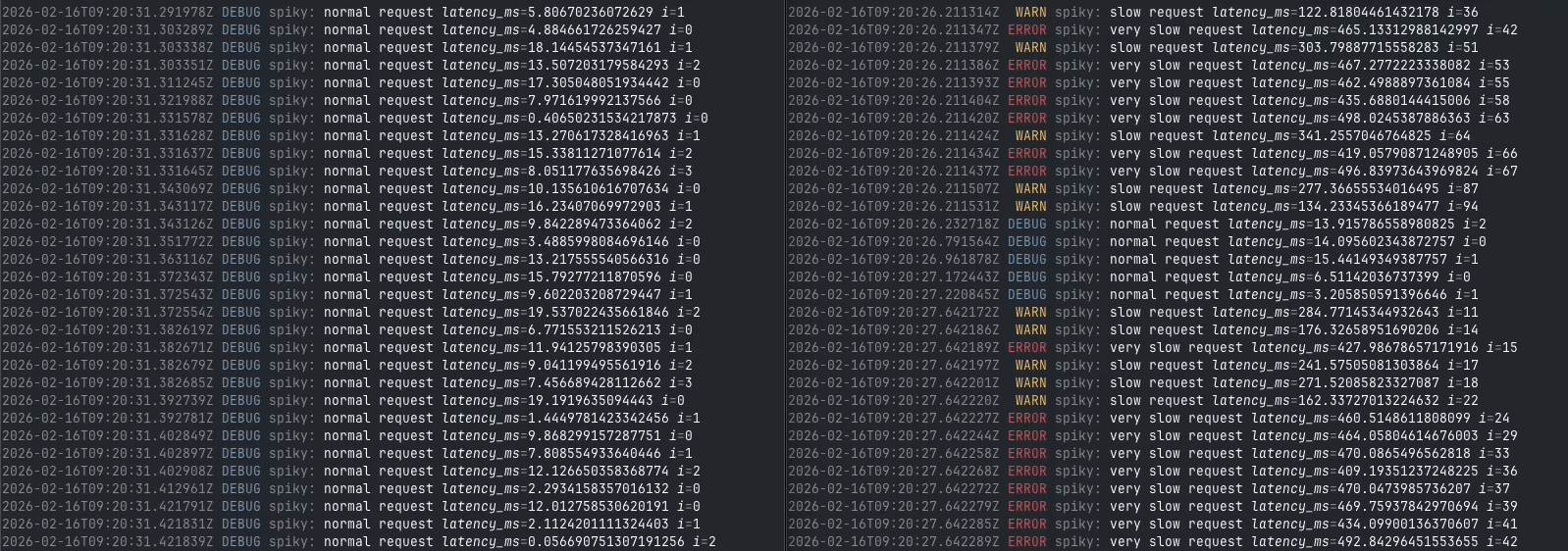
A [`tracing-subscriber`] layer that rate-limits log output using [reservoir sampling].
Instead of dropping logs above a threshold or probabilistically skipping them up-front,
this layer collects events into fixed-duration time buckets and keeps a statistically
uniform random sample per bucket. When a spike of logs occurs, you still see a
representative cross-section rather than just the first N or a biased subset.
## Features
- **Cascading budgets** — define multiple sampling budgets with `EnvFilter` patterns.
Events displaced from one budget's reservoir are passed to the next matching budget.
- **Budget-based** — configure a per-second event limit for each budget; the layer
automatically scales this to the bucket duration.
- **Smeared output** — sampled events from the previous bucket are released gradually
across the next bucket, avoiding write bursts at rotation boundaries.
- **Low overhead** — non-matching callsites are rejected at `register_callsite` time,
filter results are cached in a bitset, and format buffers are reused via thread-local storage.
- **Full `fmt::Layer` integration** — formatting is delegated to `tracing_subscriber::fmt::Layer`,
so compact, pretty, JSON, timestamps, and all other formatting options work out of the box.
## Usage
```rust
use std::time::Duration;
use tracing_subscriber::{Registry, filter::EnvFilter, layer::SubscriberExt};
use tracing_log_sample::SamplingLayer;
let (layer, stats) = SamplingLayer::<Registry>::builder()
.without_time()
.compact()
.bucket_duration(Duration::from_millis(50))
.budget(EnvFilter::new("error"), 1000) // up to 1000 error events/s
.budget(EnvFilter::new("info"), 5000) // up to 5000 info events/s
.build();
let subscriber = Registry::default().with(layer);
tracing::subscriber::set_global_default(subscriber).unwrap();
// stats.received(), stats.sampled(), stats.dropped()
```
## How it works
1. Each budget has an `EnvFilter` and a reservoir sized to
`ceil(limit_per_second * bucket_duration_secs)`.
2. On each event, the layer checks which budgets match (via a `u64` bitset),
delegates to the inner `fmt::Layer` to format the event once, then feeds the
formatted bytes through matching reservoirs in order.
3. If a reservoir is under capacity the event is stored directly. If full,
the incoming event randomly replaces an existing sample with decreasing
probability — guaranteeing every event has an equal chance of being kept.
Any displaced event cascades to the next matching budget.
4. When the time bucket advances, all reservoirs are drained. Rather than
writing everything at once, the events are released gradually over the
next bucket via adaptive smearing.
[`tracing-subscriber`]: https://docs.rs/tracing-subscriber
[reservoir sampling]: https://en.wikipedia.org/wiki/Reservoir_sampling