
toml-spanner
High-performance, fast compiling, TOML serialization and deserialization library for rust with full compliance with the TOML 1.1 spec.



toml-spanner is a complete TOML library featuring:
- High Performance: See Benchmarks
- Fast (Increment & Clean) Compilation: See Compile Time Benchmarks
- Compact Span Preserving Tree
- Derive macros: optional, powerful, zero-dependency: See Derive Documentation
- Format Preserving Serialization, even through mutation on your own data types.
- Full TOML 1.1, including date-time support, passing 100% of official TOML test-suite
- Tiny Binary Size: See Binary Size Benchmarks
- Extensively tested with miri and fuzzing under memory sanitizers and debug assertions.
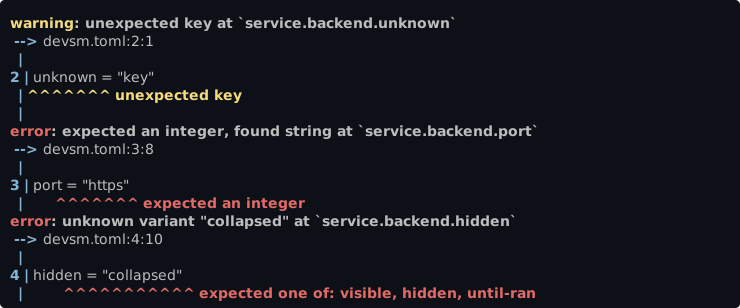
- High quality error messages: See Error Examples
Example
Suppose you have some TOML document declared in TOML_DOCUMENT as a &str:
= false
= 37
[[]]
= 43
[[]]
= true
= 12
Parse the TOML document into an Item tree:
let arena = new;
let doc = parse.unwrap;
Traverse the tree and inspect values:
assert_eq!;
match doc.value
Derive Macros
The Toml derive macro generates FromToml and/or ToToml implementations.
use ;
// By default only `FromToml` is derived.
let arena = new;
let mut doc = parse.unwrap;
let config = doc..unwrap;
See the Toml derive docs
for the full set of attributes (rename, default, flatten, skip, tagged enums, etc.).
Manual FromToml
Implement FromToml directly using TableHelper for type-safe field extraction.
use ;
let arena = new;
let mut doc = parse.unwrap;
match doc.
Serialization
Any type implementing ToToml (including via derive) can be written to TOML
with to_string or the Formatting builder for format-preserving output.
// Use default formatting.
let output = to_string.unwrap;
// Preserve formatting from a parsed document
let output = preserved_from.format.unwrap;
See Formatting docs
for indentation, format preservation, and other options.
Please consult the API documentation for more details.
Benchmarks
Measured on AMD Ryzen 9 5950X, 64GB RAM, Linux 6.18, rustc 1.94.1. Relative parse time across real-world TOML files (lower is better):
Crate versions: toml-spanner 1.0.0, toml 1.0.7+spec-1.1.0, toml_edit 0.25.5+spec-1.1.0, toml-span 0.7.1
                  time(μs)  cycles(K)   instr(K)  branch(K)
zed/Cargo.toml
  toml-spanner        24.5        115        440         93
  toml               228.5       1088       2912        523
  toml_edit          306.6       1460       4252        861
  toml-span          393.8       1866       5024       1045
extask.toml
  toml-spanner         8.9         43        149         29
  toml                78.5        374       1031        177
  toml_edit          106.7        505       1470        290
  toml-span          105.8        500       1331        263
devsm.toml
  toml-spanner         3.7         17         70         15
  toml                35.8        171        459         79
  toml_edit           48.7        232        650        127
  toml-span           56.4        269        708        140
This runtime benchmark is pretty simple and focuses just on the parsing step. In practice,
if you also deserialize into your own data types (where toml-spanner has only made marginal
improvements), the total runtime improvement is less, but it is highly dependent on the content
and target data types. Switching devsm from toml-span to toml-spanner saw a total 8x reduction
in runtime measured from the actual application when including both parsing and deserialization.
Deserialization and Parsing
Usually, you don't just parse TOML, toml-spanner derive macros for full deserialization.
The following benchmarks have taken the exact data structures and deserialization code (originally
using toml and serde), and added support for toml-spanner and toml-span based parsing and
deserialization. (I haven't added toml-span support for Cargo.toml due to its complexity.)
Crate versions: toml-spanner = 1.0.0, toml = 1.0.7+spec-1.1.0, toml-span = 0.7.1
Commit 3ca292befbc3585084922c1592ea3d17e423f035 was used from rust-lang/cargo as reference.
                  time(μs)  cycles(K)   instr(K)  branch(K)
zed/Cargo.lock (parse + deserialize)
  toml-spanner      1023.5       4803      16135       3514
  toml              2977.4      14248      37270       7296
  toml-span         5643.2      26831      74584      15460
zed/Cargo.toml (parse + deserialize)
  toml-spanner        92.5        439       1405        283
  toml               309.4       1475       3622        662
Compile Time
For a crate serializing and deserializing a simplified cargo manifest using the derive macro for each crate. With unrestricted parallelism we get the following:
See Compile Time Benchmarks for more details.
Divergence from toml-span
While toml-spanner started as a fork of toml-span, it's diverged a lot:
-
7x faster than
toml-span, and 2-3x faster thantomlon end-2-end benchmarks. -
Preserved index order: tables retain their insertion order by default, unlike
toml_spanand the default mode oftoml. -
Compact
Valuetype (on 64bit platforms):Crate Value/Item TableEntry toml-spanner 24 bytes 48 bytes toml-span 48 bytes 88 bytes toml 32 bytes 56 bytes toml (preserve_order) 80 bytes 104 bytes Note that the
tomlcrateValuetype doesn't contain any span information and thattoml-spandoesn't support table entry order preservation. -
Full TOML v1.1.0 compliance including date-time support
-
Native derive macro
-
Format-preserving serialization
Error Examples
Toml-spanner provides specific errors with spans and paths pointing directly to the problem, multi-error accumulation, and methods for easy use with annotate-snippets and codespan-reporting.
Here are some parsing examples using the annotated-snippets feature:


Here are some conversion errors, note how multiple errors are reported instead of bailing out after the first error.
Trade-offs
toml-spanner makes extensive use of unsafe code to achieve its performance
and size goals. This is mitigated by fuzzing and running the test suite under
Miri.
Testing
The unsafe in this crate demands thorough testing. The full suite includes
Miri for detecting undefined behavior,
fuzzing against the reference toml crate, and snapshot-based integration
tests.
# Test 32bit support under MIRI
Integration tests use insta for snapshot assertions.
Run cargo insta test -p snapshot-tests and cargo insta review to review
changes.
Code coverage:
Note: See the devsm.toml file in the root for typical commands that are run during development.
Acknowledgements
toml-spanner started off as a fork of toml-span and though it's been pretty much completely rewritten at this point, the original test suite and some of the API patterns remain.
Thanks to both the toml and toml-edit crates inspired the API as well as the error messages as well as serving targets to fuzz against.
License
This contribution is dual licensed under EITHER OF
- Apache License, Version 2.0, (LICENSE-APACHE or http://www.apache.org/licenses/LICENSE-2.0)
- MIT license (LICENSE-MIT or http://opensource.org/licenses/MIT)
at your option.