# toml-spanner
High-performance, fast compiling, TOML serialization and deserialization library for rust with full compliance with the TOML 1.1 spec.
[](https://crates.io/crates/toml-spanner)
[](https://docs.rs/toml-spanner/latest/toml_spanner/)
[](LICENSE-MIT)
toml-spanner is a complete TOML library featuring:
- High Performance: [See Benchmarks](#benchmarks)
- Fast (Increment & Clean) Compilation: [See Compile Time Benchmarks](https://github.com/exrok/rust-serialization-build-time-benchmarks/blob/main/README.md)
- Compact Span Preserving Tree
- Derive macros: optional, powerful, zero-dependency: [See Derive Documentation](https://docs.rs/toml-spanner/latest/toml_spanner/derive.Toml.html)
- Format Preserving Serialization, even through mutation on your own data types.
- Full TOML 1.1, including date-time support, passing 100% of official TOML test-suite
- Tiny Binary Size: [See Binary Size Benchmarks](https://github.com/exrok/rust-serialization-build-time-benchmarks/blob/main/report/BENCH-cargo-toml.md#binary-size)
- Extensively tested with miri and fuzzing under memory sanitizers and debug assertions.
- High quality error messages: [See Error Examples](#error-examples)
## Example
Suppose you have some TOML document declared in `TOML_DOCUMENT` as a `&str`:
```toml
enabled = false
number = 37
[[nested]]
number = 43
[[nested]]
enabled = true
number = 12
```
Parse the TOML document into an `Item` tree:
```rust
let arena = toml_spanner::Arena::new();
let doc = toml_spanner::parse(TOML_DOCUMENT, &arena).unwrap();
```
Traverse the tree and inspect values:
```rust
assert_eq!(doc["nested"][1]["enabled"].as_bool(), Some(true));
match doc["nested"].value() {
Some(Value::Array(array)) => assert_eq!(array.len(), 2),
Some(other) => panic!("Expected Array but found: {:#?}", other),
None => panic!("Expected value but found nothing"),
}
```
### Derive Macros
The `Toml` derive macro generates `FromToml` and/or `ToToml` implementations.
```rust
use toml_spanner::{Arena, Toml};
#[derive(Debug, Toml)]
#[toml(FromToml, ToToml)] // By default only `FromToml` is derived.
struct Config {
name: String,
port: u16,
#[toml(default)]
debug: bool,
}
let arena = Arena::new();
let mut doc = toml_spanner::parse("name = 'app'\nport = 8080", &arena).unwrap();
let config = doc.to::<Config>().unwrap();
```
See the [`Toml` derive docs](https://docs.rs/toml-spanner/latest/toml_spanner/derive.Toml.html)
for the full set of attributes (`rename`, `default`, `flatten`, `skip`, tagged enums, etc.).
### Manual `FromToml`
Implement `FromToml` directly using `TableHelper` for type-safe field extraction.
```rust
use toml_spanner::{Arena, Context, FromToml, Failed, Item};
#[derive(Debug)]
struct Config {
enabled: bool,
nested: Vec<Config>,
number: u32,
}
impl<'de> FromToml<'de> for Config {
fn from_toml(ctx: &mut Context<'de>, item: &Item<'de>) -> Result<Self, Failed> {
let mut th = item.table_helper(ctx)?;
let config = Config {
enabled: th.optional("enabled").unwrap_or(false),
number: th.required("number")?,
nested: th.optional("nested").unwrap_or_default(),
};
th.require_empty()?;
Ok(config)
}
}
let arena = Arena::new();
let mut doc = toml_spanner::parse(TOML_DOCUMENT, &arena).unwrap();
match doc.to::<Config>() {
Ok(config) => println!("parsed: {config:?}"),
Err(errors) => {
for error in &errors {
println!("error: {error}");
}
}
}
```
### Serialization
Any type implementing `ToToml` (including via derive) can be written to TOML
with `to_string` or the `Formatting` builder for format-preserving output.
```rust
// Use default formatting.
let output = toml_spanner::to_string(&config).unwrap();
// Preserve formatting from a parsed document
let output = toml_spanner::Formatting::preserved_from(&doc).format(&config).unwrap();
```
See [`Formatting` docs](https://docs.rs/toml-spanner/latest/toml_spanner/struct.Formatting.html)
for indentation, format preservation, and other options.
Please consult the [API documentation](https://docs.rs/toml-spanner/latest/toml_spanner/) for more details.
## Benchmarks
Measured on AMD Ryzen 9 5950X, 64GB RAM, Linux 6.18, rustc 1.94.1.
Relative parse time across real-world TOML files (lower is better):

Crate versions: `toml-spanner 1.0.0`, `toml 1.0.7+spec-1.1.0`, `toml_edit 0.25.5+spec-1.1.0`, `toml-span 0.7.1`
```
time(μs) cycles(K) instr(K) branch(K)
zed/Cargo.toml
toml-spanner 24.5 115 440 93
toml 228.5 1088 2912 523
toml_edit 306.6 1460 4252 861
toml-span 393.8 1866 5024 1045
extask.toml
toml-spanner 8.9 43 149 29
toml 78.5 374 1031 177
toml_edit 106.7 505 1470 290
toml-span 105.8 500 1331 263
devsm.toml
toml-spanner 3.7 17 70 15
toml 35.8 171 459 79
toml_edit 48.7 232 650 127
toml-span 56.4 269 708 140
```
This runtime benchmark is pretty simple and focuses just on the parsing step. In practice,
if you also deserialize into your own data types (where toml-spanner has only made marginal
improvements), the total runtime improvement is less, but it is highly dependent on the content
and target data types. Switching devsm from `toml-span` to `toml-spanner` saw a total 8x reduction
in runtime measured from the actual application when including both parsing and deserialization.
### Deserialization and Parsing
Usually, you don't just parse TOML, `toml-spanner` derive macros for full deserialization.
The following benchmarks have taken the exact data structures and deserialization code (originally
using toml and serde), and added support for `toml-spanner` and `toml-span` based parsing and
deserialization. (I haven't added `toml-span` support for Cargo.toml due to its complexity.)

Crate versions: `toml-spanner = 1.0.0`, `toml = 1.0.7+spec-1.1.0`, `toml-span = 0.7.1`
Commit `3ca292befbc3585084922c1592ea3d17e423f035` was used from `rust-lang/cargo` as reference.
```
time(μs) cycles(K) instr(K) branch(K)
zed/Cargo.lock (parse + deserialize)
toml-spanner 1023.5 4803 16135 3514
toml 2977.4 14248 37270 7296
toml-span 5643.2 26831 74584 15460
zed/Cargo.toml (parse + deserialize)
toml-spanner 92.5 439 1405 283
toml 309.4 1475 3622 662
```
### Compile Time
For a crate serializing and deserializing a simplified cargo manifest using the derive macro for each crate. With unrestricted parallelism we get the following:
<img alt="cargo-toml_aggregate" src="https://github.com/user-attachments/assets/d311f26d-0815-4758-9cee-de520390e329" />
See [Compile Time Benchmarks](https://github.com/exrok/rust-serialization-build-time-benchmarks/blob/main/README.md) for more details.
## Divergence from `toml-span`
While `toml-spanner` started as a fork of `toml-span`, it's diverged a lot:
- 7x faster than `toml-span`, and 2-3x faster than `toml` on end-2-end benchmarks.
- Preserved index order: tables retain their insertion order by default,
unlike `toml_span` and the default mode of `toml`.
- Compact `Value` type (on 64bit platforms):
| Crate | Value/Item | TableEntry |
| --------------------- | ---------- | ---------- |
| **toml-spanner** | 24 bytes | 48 bytes |
| toml-span | 48 bytes | 88 bytes |
| toml | 32 bytes | 56 bytes |
| toml (preserve_order) | 80 bytes | 104 bytes |
Note that the `toml` crate `Value` type doesn't contain any span information
and that `toml-span` doesn't support table entry order preservation.
- Full TOML v1.1.0 compliance including date-time support
- Native derive macro
- Format-preserving serialization
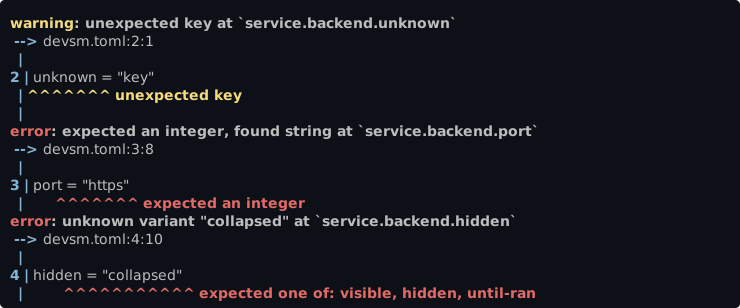
### Error Examples
Toml-spanner provides specific errors with spans and paths pointing directly to the problem, multi-error accumulation,
and methods for easy use with [annotate-snippets](https://crates.io/crates/annotate-snippets)
and [codespan-reporting](https://crates.io/crates/codespan-reporting).
Here are some parsing examples using the annotated-snippets feature:


Here are some conversion errors, note how multiple errors are reported instead of
bailing out after the first error.
### Trade-offs
`toml-spanner` makes extensive use of `unsafe` code to achieve its performance
and size goals. This is mitigated by fuzzing and running the test suite under
Miri.
### Testing
The `unsafe` in this crate demands thorough testing. The full suite includes
[Miri](https://github.com/rust-lang/miri) for detecting undefined behavior,
fuzzing against the reference `toml` crate, and snapshot-based integration
tests.
```bash
cargo test --workspace # all tests
cargo test -p snapshot-tests # integration tests only
cargo +nightly miri nextest run # undefined behavior checks
cargo +nightly fuzz run parse_compare_toml # fuzz against the toml crate
cargo +nightly fuzz run parse_value # fuzz the parser directly
# Test 32bit support under MIRI
cargo +nightly miri nextest run -p toml-spanner --target i686-unknown-linux-gnu
```
Integration tests use [insta](https://insta.rs/) for snapshot assertions.
Run `cargo insta test -p snapshot-tests` and `cargo insta review` to review
changes.
Code coverage:
```bash
cargo +nightly llvm-cov --branch --show-missing-lines -- -q
```
Note: See the `devsm.toml` file in the root for typical commands that are run during development.
### Acknowledgements
toml-spanner started off as a fork of toml-span and though it's been pretty much completely rewritten at this point, the original test suite and some of the API patterns remain.
Thanks to both the toml and toml-edit crates inspired the API as well as the error messages as
well as serving targets to fuzz against.
### License
This contribution is dual licensed under EITHER OF
- Apache License, Version 2.0, ([LICENSE-APACHE](LICENSE-APACHE) or <http://www.apache.org/licenses/LICENSE-2.0>)
- MIT license ([LICENSE-MIT](LICENSE-MIT) or <http://opensource.org/licenses/MIT>)
at your option.