
tomesole



A terminal client for searching and downloading from Library Genesis: a full-screen interface and a scriptable CLI in one small Rust binary.
Libgen has no stable address and is run by people you have no reason to trust. Most of the work here goes into those two problems: finding a mirror that works, and treating everything it sends back as hostile until proven otherwise.
Quick start
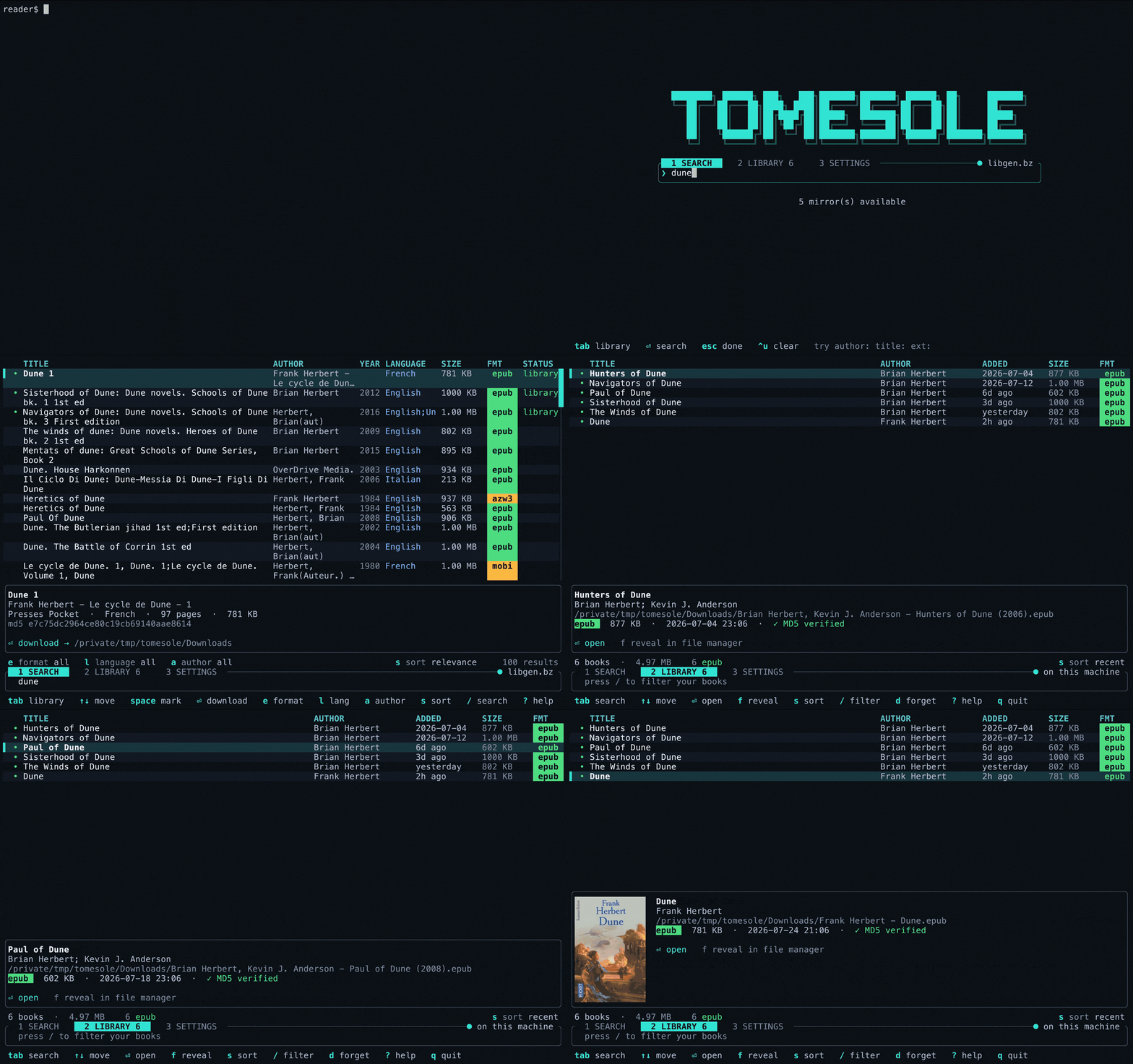
The interface
tomesole with no arguments opens three tabs: Search, Library for the
books you already have, and Settings. Tab cycles through them, 1/2/3
jumps straight to one, and ? shows every key.
╭  1 SEARCH    2 LIBRARY 12    3 SETTINGS  ────────────────── ● libgen.li ╮
│❯ dune                                                                   │
╰─────────────────────────────────────────────────────────────────────────╯
 e format all   l language English 6   a author all   x clear   s sort year ▼
   TITLE                AUTHOR         YEAR LANG     SIZE   FMT  STATUS ╭──╮
▌  Dune                 Frank Herbert  1965 English 781 KB epub library│▄▄│
   Dune Messiah         Frank Herbert  1969 English 922 KB epub        │██│
   Children of Dune     Frank Herbert  1976 English 1.1 MB pdf         │▀▀│
                                                                       ╰──╯
 tab library  ↑↓ move  ⏎ download  e format  l lang  a author  s sort  ? help
A search returns a lot of near-duplicates (Das Kapital comes back as forty
German editions with the English translations mixed in), so results narrow in
place without re-searching: e, l and a open pick-lists of the formats,
languages and authors actually present, s sorts by relevance, title, author,
year or size, and x clears every filter. Books you already have are marked
library with a green dot, space marks results for a batch download, and
y copies the highlighted book's MD5.
The highlighted book's cover is drawn beside its record: real pixels in kitty,
Ghostty, WezTerm and iTerm2, half-block characters anywhere else with colour.
On the Library tab the cover is read straight out of the downloaded file where
the format carries one. --no-covers turns covers off.
The Library tab lists every download, newest first, and persists between
sessions: ⏎ opens a book in your reader, f reveals it in the file manager,
/ filters, and d forgets an entry without deleting the file. The
Settings tab edits the same values as the config file and saves as you go.
Searching and downloading run on worker threads, so the interface stays responsive during a large download. Downloads run one at a time, since parallel requests to a volunteer-run mirror tend to get rate-limited.
The CLI
The same functionality from the command line, for scripting and one-off downloads:
$ tomesole --title "the rust programming language" -n 4

  4 results from libgen.li

    #  Title                          Author               Year  Lang          Size  Fmt
  ───  ─────────────────────────────  ───────────────────  ────  ────────  ────────  ─────
    1  The Rust Programming Languag…  Steve Klabnik        2019  English    3.00 MB  epub
    2  The Rust Programming Languag…  Steve Klabnik        2019  English    5.00 MB  pdf
    3  The Rust Programming Languag…  Steve Klabnik        2019  English    3.00 MB  lit
    4  The Rust Programming Languag…  Steve Klabnik        2019  English    5.00 MB  fb2

  Select 1-4 (e.g. 3, or 1-4; Enter to cancel) › 1

  ↓ The Rust Programming Language
  ✓ Steve Klabnik - The Rust Programming Language (2019).epub
    ~/Downloads · 3.00 MB · MD5 verified
Any query, in the box or on the command line, can carry tags:
author:herbert title:dune ext:epub. author: title: series: publisher:
year: isbn: narrow which column is matched; ext: and lang: filter what
comes back; topic: picks the collection. Quote a value to keep spaces in it.
Anything else is left exactly as typed, so Dune: Messiah searches for
Dune: Messiah rather than being read as a tag. Selections accept numbers,
lists and ranges: 3, 1,4,7, 2-5.
Every completed download is recorded in tomesole/history.tsv under
$XDG_DATA_HOME, mode 0600, capped at the last thousand, so it can be found
again without going back to Libgen; tomesole history --clear forgets
everything, and history = false in the config stops recording. Which
application opens a book is reader in the config, or --with.
tomesole config --init writes a commented config file under
$XDG_CONFIG_HOME; flags always override it.
Finding a live mirror
Mirror domains get seized, expire, or serve a perfectly healthy front page while their search endpoint returns HTTP 500 (during development, three of the nine built-in mirrors were doing exactly that). So the health check runs a real search and requires parseable results back: a mirror counts as up only if it can do the thing it is needed for.
Mirrors you configured are used without second-guessing. Otherwise tomesole reuses a ranking cached from a probe in the last 6 hours, or probes the built-in list concurrently and ranks by search latency; if the entire list is dead, it asks any reachable mirror for its own list of siblings, so a new domain works without a new release. The result is a pool, not a single pick: if the chosen mirror fails partway through, the next one is tried automatically.
Security
Every byte, header and filename from a mirror is treated as attacker-controlled.
- Integrity: files are verified against their catalogue MD5 as the bytes stream past, and moved into place only on a match; a mismatch is deleted. MD5 is broken for collision resistance, so this catches corruption and opportunistic substitution, not a crafted collision. It is the strongest check the catalogue offers.
- Filenames are built from catalogue metadata, never from the server's
Content-Disposition(the obvious place to attempt a path traversal). Path separators, control characters and leading dots are stripped, Windows reserved names are escaped. - Extensions are allowlisted: a "book" claiming to be
.exe,.dmg,.shor.jaris refused, and anything unrecognised is saved as.binso it cannot be launched by double-clicking. - Network: TLS is always verified, with deliberately no flag to disable
it; cleartext HTTP needs
--allow-http. Redirects are followed one hop at a time and re-validated at every hop against private and reserved address ranges, so a mirror cannot bounce the client onto localhost or a cloud metadata endpoint. URLs are parsed by the samehttp::Urithat opens the socket, not a second parser. - Responses are size-capped twice, and an HTML response is rejected as a
captcha or error page. Downloads land in a
0600temp file and are renamed only after verification; existing files are never overwritten without--force. On macOS the result gets the same quarantine attribute a browser would set. - Covers are the one place a mirror gets to name a URL that is then fetched, so the image must be on the same host, small, and begin with a real image signature. The in-tree JPEG decoder bounds-checks every length and index, and the tests fuzz it with truncated and corrupted files.
- Opening a book starts another program, so the path is canonicalised and
passed as a single argument to
execwith no shell in the chain.
Dependencies and tests
Four dependencies on any one target: ureq for HTTPS, ratatui and
crossterm for the interface, plus xattr on Unix or windows-sys on
Windows. Everything else (argument parsing, HTML scanning, MD5, JSON output,
the JPEG decoder) is in-tree, each a few dozen lines against a dependency tree
that was considerably larger.
cargo test runs 300+ tests without touching the network: the MD5 vectors,
the SSRF and scheme guards, filename sanitising, HTML scanning against real
saved markup, the streaming download path against a throwaway loopback server,
JPEG decoding of truncated and corrupted files at every offset, and the
interface through ratatui's off-screen backend on terminals from 20×8 to
250×12.
Legal
This is a client for a public search index. What you download with it, and whether you are entitled to, is your call and your responsibility.