<p align="center">
<img src="assets/logo.png" alt="timeglyph" width="180" />
</p>
# timeglyph
[](https://crates.io/crates/timeglyph)
[](https://docs.rs/timeglyph)
[](LICENSE)
[](https://github.com/SecurityRonin/timeglyph/actions/workflows/ci.yml)
[](https://github.com/SecurityRonin/timeglyph/releases)
[](https://github.com/sponsors/h4x0r)
**Decode any timestamp. Identify the unknown ones. See time itself.**
Every examination throws raw timestamps at you — a `133801920000000000` buried in
an artifact — that you need in human-readable time. `timeglyph` reads that value
every way a system might have written it and reports the results **ranked, scored,
and cited** — honest about the ambiguity instead of guessing one answer. Convert
in bulk from a CSV, hover the number on screen and read the time live, or lay a
month out as a **forensic calendar** — DST fold/gap days, leap seconds, GPS week,
format epochs, and the moon's phase, all flagged. No more copying each value into a
converter app. One static Rust binary, plus a live overlay that decodes whatever is
under your cursor.
**[Try it in your browser →](https://securityronin.github.io/timeglyph/playground.html)** · **[Full documentation →](https://securityronin.github.io/timeglyph/)**
The playground runs the real engine as WebAssembly, entirely client-side — paste a value, see every ranked, cited reading; nothing leaves the page.
```console
$ timeglyph 1577836800
# readings consistent with 1577836800 (ranked; a raw value is usually underdetermined — not a single verdict):
[1.00] unix 2020-01-01T00:00:00Z (Unix time (seconds))
[0.94] postgres 2000-01-01T00:26:17.8368Z (PostgreSQL timestamp (µs since 2000))
[0.67] cocoa 2051-01-01T00:00:00Z (Cocoa / CFAbsoluteTime (s since 2001))
[0.67] hfsplus 1953-12-31T00:00:00Z (Apple HFS+ (s since 1904))
...
```
---
## Install
**macOS**
```bash
brew install securityronin/tap/timeglyph
```
**Debian / Ubuntu**
```bash
```
**Windows**
```powershell
winget install SecurityRonin.timeglyph
```
**Cargo**
```bash
cargo install timeglyph
```
On macOS and Windows this also installs the
[`timeglyph-lens`](#timeglyph-lens--hover-anything-decode-time-data) overlay.
---
## What you do with it
### Identify an unknown value
```bash
timeglyph 1577836800 # ranked, scored readings across every format
timeglyph identify --json 1577836800 # same, machine-readable
timeglyph --as hex 0060947C58B2D501 # raw bytes only: little/big-endian + packed on-disk
timeglyph --as string 20200101000000Z # string forms only: ISO / RFC 2822 / ASN.1
```
Exit codes are pipeline-safe: `0` clear top reading, `2` ambiguous or a sentinel
(review needed), `1` error. Render in any timezone with `--tz` (`UTC`, a fixed
offset, or a DST-correct IANA name); nudge readings toward a source family with
`--artifact "<hint>"`.
### Decode or encode a known format
```bash
timeglyph decode filetime 132223104000000000
timeglyph decode fat 1545691136 # FAT/DOS packed date+time (LOCAL) — one of 45 formats
timeglyph encode unix 2020-01-01T00:00:00Z
timeglyph explain filetime # a spec card: epoch, tick, tz/leap, range, sentinels, citation
timeglyph list # the format registry, with spec citations
```
### Mine artifacts at scale
```bash
timeglyph scan app.log # find & decode every timestamp in text (or stdin)
timeglyph carve aabbcc… --from 2015 --to 2026 --json # carve timestamps at every byte offset
timeglyph csv events.csv # enrich a CSV with human-readable timestamp columns
```
Convert in bulk: enrich a whole CSV of timestamps in one pass instead of pasting
them into a converter one at a time. `carve` sweeps a raw blob (a config, a
record, a hex selection) for timestamps at every offset — window- and
score-thresholded — and exports JSONL, ImHex bookmarks, or Timesketch events.
[CSV enrichment →](docs/csv.md)
### See time itself — the forensic calendar
```bash
timeglyph cal # this month, with DST/leap/epoch markers
timeglyph cal 2026-11 --tz America/New_York # DST fold/gap days flagged
timeglyph cal 2026-09-18 # one day in full: week/epoch systems + a moon disc
timeglyph cal 2026 --json # a whole year, faithful per-day records
```
`cal` is a calendar built for temporal analysis: per-day UTC offset and DST
fold/gap days, leap-second days and GPS week, ISO week / Julian Day / Unix,
timestamp-format epoch and rollover markers, seven alternative calendars (Chinese
lunisolar with the 干支 four pillars, plus ROC, Japanese, Buddhist, Hebrew, Islamic,
and Persian), and the moon's phase — every value computed and oracle-validated
(`date`, `zdump`, USNO, IERS, JPL).
[The forensic calendar →](docs/cal.md)
### Use it from an LLM / agent
```bash
timeglyph mcp # a Model Context Protocol stdio server
```
`mcp` exposes `identify` / `decode` / `explain` as MCP tools, so an LLM-driven
DFIR workflow gets a cited, reproducible reading instead of a hallucinated epoch
conversion.
---
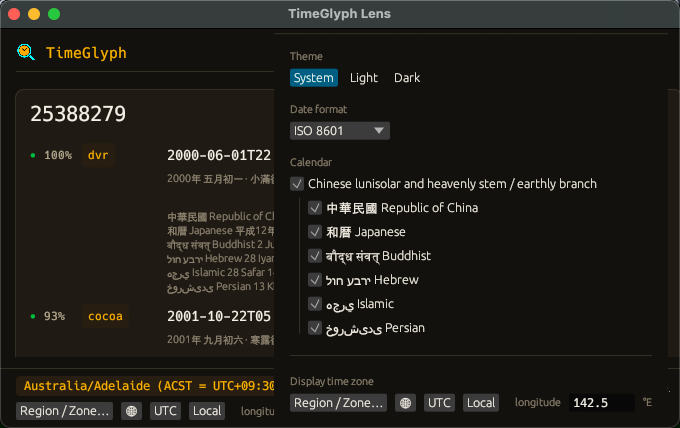
## TimeGlyph Lens — hover anything, decode time data
Convert live: hover any number on screen and read its time in real time. An
always-on-top overlay follows your cursor and shows timeglyph's ranked readings
for the number in the UI element under the pointer, so you never copy a value into
a converter. Each row carries its confidence, the weekday, and the public holiday
for that date in the chosen zone. Pick any display timezone from the footer.
<p align="center">
<img src="assets/lens-in-action.png" alt="timeglyph-lens decoding a SQLite timestamp column live over DB Browser for SQLite" width="640" />
</p>
It installs with the CLI on macOS and Windows and reads the element under the
cursor through the platform accessibility layer — the Accessibility API on macOS,
UI Automation on Windows. (Linux support is in progress.)
[Overlay guide →](docs/lens.md)
---
## Formats
`timeglyph` decodes and auto-identifies **45 registered formats** plus the
self-describing string forms:
- **Epoch integers & floats** — Unix (s/ms/µs/ns and `double`), FILETIME (incl.
Active Directory / LDAP), WebKit/Chrome, Cocoa / CFAbsoluteTime (integer, signed
double, iOS-11 ns), Apple HFS+/HFS, .NET ticks, OLE automation, Excel-1904,
PostgreSQL, Mozilla PRTime, SQLite Julian day, DHCPv6, Modified Julian Day
- **Embedded IDs** — KSUID, ULID, UUIDv1 / v6 / v7, MongoDB ObjectId, GMail message
IDs, and Snowflake-class IDs (Twitter/X, Discord, Mastodon, LinkedIn, TikTok, Sonyflake)
- **Packed & mobile/broadcast** — FAT/DOS and exFAT date-time words, 128-bit
SYSTEMTIME structs, Microsoft DTTM, BCD, GSM 7-byte semi-octet, Nokia, DVR,
Motorola, Symantec, and SQL Server DATETIME
- **Strings** — ISO 8601 / RFC 3339, RFC 2822 email dates, EXIF, ASN.1
GeneralizedTime & UTCTime
- **Leap-aware scales** (`--features leap`) — GPS, TAI64, NTP, kept separate from
the POSIX spine
Every reading names the spec it assumes and is scored on window membership,
granularity, magnitude, byte-width, endianness, artifact context, and neighbour
monotonicity. Correctness is checked against primary-spec worked examples and the
MIT [`time_decode`](https://github.com/digitalsleuth/time_decode) oracle — see
[validation](docs/validation.md).
---
## Why another converter?
Good ones exist ([`time_decode`](https://github.com/digitalsleuth/time_decode),
MIT; DCode, proprietary). `timeglyph` is a single static Rust binary built on a
**rigorous, cited model** where a reading is *evidence, not a verdict*: a
POSIX-correct internal spine (never mislabelled UTC), the leap-second family kept
separate, and **ambiguity as first-class, scored output**. Calendar and timezone
math is reused (`jiff`), never reinvented. See
[the design decisions](docs/decisions/).
---
[Privacy Policy](https://securityronin.github.io/timeglyph/privacy/) · [Terms of Service](https://securityronin.github.io/timeglyph/terms/) · © 2026 Security Ronin Ltd