A tiny, fast and panic-free alternative to core::fmt
The basis for the development of tfmt is [japaric's ufmt](https://github.com/japaric/ufmt). All
the main ideas and concepts come from there. However, the author makes it clear that the
representation of floating point numbers and padding is not the focus of the implementation. For
some projects, it is precisely these points that are important.
## Design Goals
- Optimised for size and speed for small embedded systems
- Usable during development `Debug`and runtime `Display`
- No panicking branches in generated code when optimised
- It should be easy to integrate additional data types
## Features
- String conversation and formatting options for the following data types included
- u8, u16, u32, u64, u128, usize
- i8, i16, i32, i64, i128, isize
- bool, str, char
- f32, f64
- [`#[derive(uDebug)]`][macro@derive]
- `uDebug` and `uDisplay` traits like [core::fmt::Debug] and [core::fmt::Display]
- [uDisplayPadded] trait for formatted outputs
- [uDisplayFormatted] trait for complex formatted outputs
- [uformat] macro to simply generating of strings
## Restrictions
`tfmt` offers significantly less functionality than `core::fmt`. For example:
- No named arguments
- No exponential representation of float numbers
- Restricted number range of float numbers (see `tests/float.rs`)
- Arrays may have a maximum of 32 elements [`#[derive(uDebug)]`][macro@derive]
- Tuples can have a maximum of 12 elements [`#[derive(uDebug)]`][macro@derive]
- Unions are not supported [`#[derive(uDebug)]`][macro@derive]
## Examples
### Format Standard Rust Types
```rust
use tfmt::uformat;
assert_eq!(
uformat!(100, "The answer to {} is {}", "everything", 42).unwrap().as_str(),
"The answer to everything is 42"
);
assert_eq!("4711", uformat!(100, "{}", 4711).unwrap().as_str());
assert_eq!("00004711", uformat!(100, "{:08}", 4711).unwrap().as_str());
assert_eq!(" -4711", uformat!(100, "{:8}", -4711).unwrap().as_str());
assert_eq!("-4711 ", uformat!(100, "{:<8}", -4711).unwrap().as_str());
assert_eq!(" 4711 ", uformat!(100, "{:^8}", 4711).unwrap().as_str());
assert_eq!("1ab4", uformat!(100, "{:x}", 0x1ab4).unwrap().as_str());
assert_eq!(" 1AB4", uformat!(100, "{:8X}", 0x1ab4).unwrap().as_str());
assert_eq!("0x1ab4", uformat!(100, "{:#x}", 0x1ab4).unwrap().as_str());
assert_eq!("00001ab4", uformat!(100, "{:08x}", 0x1ab4).unwrap().as_str());
assert_eq!("0x001ab4", uformat!(100, "{:#08x}", 0x1ab4).unwrap().as_str());
assert_eq!("0b010010", uformat!(100, "{:#08b}", 18).unwrap().as_str());
assert_eq!("0o011147", uformat!(100, "{:#08o}", 4711).unwrap().as_str());
assert_eq!("3.14", uformat!(100, "{:.2}", 3.14).unwrap().as_str());
assert_eq!(" 3.14", uformat!(100, "{:8.2}", 3.14).unwrap().as_str());
assert_eq!("3.14 ", uformat!(100, "{:<8.2}", 3.14).unwrap().as_str());
assert_eq!(" 3.14 ", uformat!(100, "{:^8.2}", 3.14).unwrap().as_str());
assert_eq!("00003.14", uformat!(100, "{:08.2}", 3.14).unwrap().as_str());
assert_eq!("hello", uformat!(100, "{}", "hello").unwrap().as_str());
assert_eq!(" true ", uformat!(100, "{:^8}", true).unwrap().as_str());
assert_eq!("c ", uformat!(100, "{:<8}", 'c').unwrap().as_str());
```
### Using Derive uDebug
```rust
use tfmt::{uformat, derive::uDebug};
#[derive(uDebug)]
struct S1Struct {
f: f32,
b: bool,
sub: S2Struct,
}
#[derive(uDebug)]
struct S2Struct {
tup: (i16, f32),
end: [u16; 2],
}
let s2 = S2Struct { tup: (-4711, 3.14), end: [1, 2] };
let s1 = S1Struct { f: 1.0, b: true, sub: s2 };
let s = uformat!(200, "{:#?}", &s1).unwrap();
assert_eq!(
s.as_str(),
"S1Struct {
f: 1.000,
b: true,
sub: S2Struct {
tup: (
-4711,
3.140,
),
end: [
1,
2,
],
},
}");
let s = uformat!(200, "{:?}", &s1).unwrap();
assert_eq!(
s.as_str(),
"S1Struct { f: 1.000, b: true, sub: S2Struct { tup: (-4711, 3.140), end: [1, 2] } }"
);
```
### Format Your own Structures
```rust
use tfmt::{uformat, uDisplayPadded, uWrite, Formatter, Padding};
struct EmailAddress {
fname: &'static str,
lname: &'static str,
email: &'static str,
}
impl uDisplayPadded for EmailAddress{
fn fmt_padded<W>(
&self,
fmt: &mut Formatter<'_, W>,
padding: Padding,
pad_char: char,
) -> Result<(), W::Error>
where
W: uWrite + ?Sized
{
let s = uformat!(128, "{}.{} <{}>", self.fname, self.lname, self.email).unwrap();
fmt.write_padded(s.as_str(), pad_char, padding)
}
}
let email = EmailAddress { fname: "Graydon", lname: "Hoare", email: "graydon@pobox.com"};
let s = uformat!(100, "'{:_^50}'", email).unwrap();
assert_eq!(
s.as_str(),
"'________Graydon.Hoare <graydon@pobox.com>_________'"
);
```
## Technical Notes
### Performance
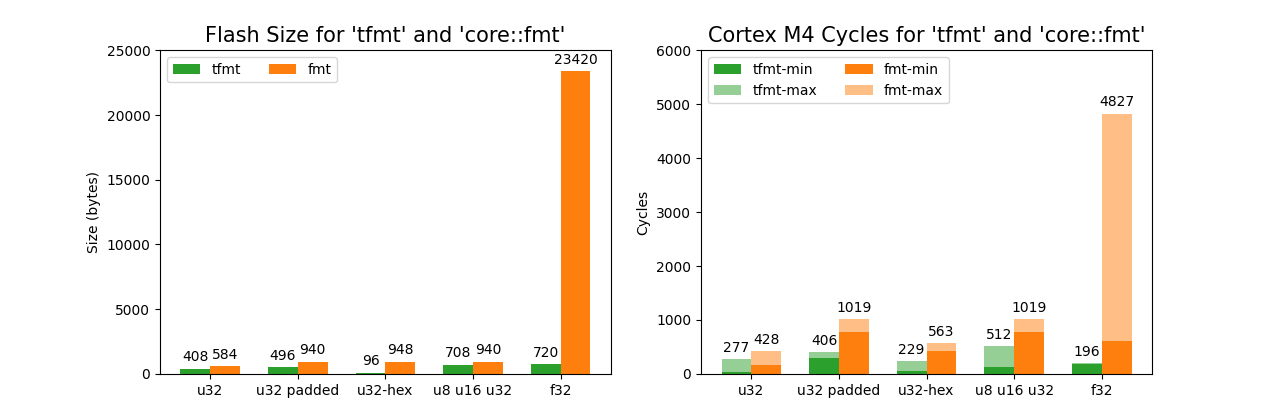
The use of micro-benchmarks is usually problematic. Nevertheless, the trends can be recognised
very well. The following table shows a comparison of `tfmt` with `core::fmt` using a few examples.
tfmt is significantly smaller and also much faster than `core::fmt`. Another difference is that
`tfmt` does not contain a panicking branch. This can be an important difference for embedded
systems. The high memory requirement of `core::fmt` in connection with floats is astonishing. The
strong fluctuations in the required cycles are also surprising.
The sources for generating the data and the visualisation can be found in the `tests/size`
directory.
| u32 | tfmt | 408 | 34 | 277 |
| u32 | fmt | 584 | 166 | 428 |
| u32 padded | tfmt | 496 | 284 | 406 |
| u32 padded | fmt | 940 | 770 | 1019 |
| u32-hex | tfmt | 128 | 125 | 237 |
| u32-hex | fmt | 948 | 422 | 563 |
| u8 u16 u32 | tfmt | 708 | 118 | 512 |
| u8 u16 u32 | fmt | 940 | 770 | 1019 |
| f32 | tfmt | 720 | 189 | 196 |
| f32 | fmt | 23420 | 1049 | 4799 |
The contents of the table are shown graphically below:
### Use of unsafe
Unsafe is used in several places in the code. Careful consideration has been given to whether this
is necessary and safe. Unsafe is useful in the following situations:
- Some cycles can be saved if buffers that are guaranteed to be written later are not initialised
initially. In simple situations, the compiler sees this and omits the initialisation itself. In
more complex structures, however, it is not able to do this (src/float.rs).
- To avoid panicking branches, arrays are usually accessed with pointers. Either the context
ensures that this works or it is checked.
- Bytes buffer is converted to str without checking for UTF8 compatibility. This is safe because
the buffer was previously written with defined UTF8-compliant characters.
All positions have been commented accordingly.
## License
All source code (including code snippets) is licensed under either of
- Apache License, Version 2.0 ([LICENSE-APACHE](LICENSE-APACHE) or
[https://www.apache.org/licenses/LICENSE-2.0][L1])
- MIT license ([LICENSE-MIT](LICENSE-MIT) or
[https://opensource.org/licenses/MIT][L2])
[L1]: https://www.apache.org/licenses/LICENSE-2.0
[L2]: https://opensource.org/licenses/MIT
at your option.
## Contribution
Unless you explicitly state otherwise, any contribution intentionally submitted
for inclusion in the work by you, as defined in the Apache-2.0 license, shall be
licensed as above, without any additional terms or conditions.