# tachyonix
An asynchronous, multi-producer, single-consumer (MPSC) bounded channel
that operates at [tachyonic][tachyon] speeds.
This library is an offshoot of [Asynchronix][asynchronix], an ongoing effort at a
high performance asynchronous computation framework for system simulation.
No laws of physics were broken in the making of this library.
[](https://crates.io/crates/tachyonix)
[](https://docs.rs/tachyonix)
[](https://github.com/asynchronics/tachyonix#license)
[tachyon]: https://en.wikipedia.org/wiki/Tachyon
[asynchronix]: https://github.com/asynchronics/asynchronix
## Overview
This is a no-frills `async` channel which only claim to fame is to be extremely
fast (see [benchmarks](#benchmarks)), without taking any shortcuts on
correctness and implementation quality. Its performance mainly results from its
focus on the MPSC use-case and from a number of careful optimizations, among
which:
- aggressively **optimized notification primitives** for full-queue and
empty-queue events (the latter is courtesy of
[diatomic-waker][diatomic-waker], a fast, spinlock-free alternative to
`atomic-waker`),
- **no allocation** after channel creation except for blocked sender
notifications,
- **no spinlocks** whatsoever, and no mutex in the hot path (the only mutex is a
`std::sync::mutex` used for blocked senders notifications),
- underlying queue **optimized for single receiver**.
[diatomic-waker]: https://github.com/asynchronics/diatomic-waker
## Usage
Add this to your `Cargo.toml`:
```toml
[dependencies]
tachyonix = "0.3.1"
```
## Example
```rust
use tachyonix;
use futures_executor::{block_on, ThreadPool};
let pool = ThreadPool::new().unwrap();
let (s, mut r) = tachyonix::channel(3);
block_on( async move {
pool.spawn_ok( async move {
assert_eq!(s.send("Hello").await, Ok(()));
});
assert_eq!(r.recv().await, Ok("Hello"));
});
```
## Limitations
The original raison d'être of this library was to provide a less idiosyncratic
sibling to the channels developed for [Asynchronix][asynchronix] that could be
easily benchmarked against other channel implementations. The experiment turned
out better than anticipated so a slightly more fleshed out version was released
for public consumption in the hope that others may find it useful. However, its
API surface is intentionally kept small and it does not aspire to become much
more than it is today. More importantly, it makes trade-offs that may or may not
be acceptable depending on your use-case:
* just like most other async channels except the MPSC channels in the `tokio`
and `futures` crates, fairness for blocked senders is not enforced: while the
first sender blocked on a full channel is indeed notified first, it may still
be outrun if another sender happens to be scheduled before; if your
application requires better fairness guarantees, you should use `tokio`'s or
`futures`'s channels.
* just like most other async channels except the MPSC channels in the `futures`
crate, the effective capacity of the channel decreases with each "forgotten"
blocked sender (*i.e.* blocked senders which, for some reason, were not polled
to completion but were not dropped either) and the channel will eventually
deadlock if the effective capacity drops to zero; if this can happen in your
application, you should use `futures`'s channels.
* just like most other async channel with the exception of `flume`, its
low-level primitives rely on `unsafe` (see [dedicated section](#safety)),
* zero-capacity channels (a.k.a. rendez-vous channels) are not supported.
## Safety
Despite the focus on performance, implementation quality and correctness are the
highest priority.
The library comes with a decent battery of tests, in particular for all
low-level (unsafe) concurrency primitives which are extensively tested with
[Loom][loom], complemented with MIRI for integrations tests. As amazing as they
are, however, Loom and MIRI cannot formally prove the absence of data races so
soundness issues _are_ possible. You should therefore exercise caution before
using it in mission-critical software until it receives more testing in the
wild.
[loom]: https://github.com/tokio-rs/loom
## Benchmarks
### Benchmarks overview
A custom [benchmarking suite][bench] was implemented that can test a number of
popular MPSC and MPMC channels with several executors (Tokio, async-std,
smolscale and Asynchronix).
It contains at the moment 2 benchmarks:
- *pinball*: an upgraded version of the classical pin-pong benchmark where
messages ("balls") perform a random walk between 13 vertices ("pins") of a
fully connected graph; it is parametrized by the total number of balls within
the graph,
- *funnel*: the most common MPSC benchmark where messages are sent in a tight
loop from 13 senders to a unique receiver; it is parametrized by the channel
capacity.
Each benchmark executes 61 instances of an elementary bench rig, which ensures
that all executor threads are busy at nearly all times. The *pinball* benchmark
is a relatively good proxy for performance in situations where channel receivers
are often starved but senders are never blocked (i.e. the channel capacity is
always sufficient).
Regardless of its popularity, the *funnel* benchmark is **less realistic and
less objective** as it is sensitive not only to the absolute speed of enqueue,
dequeue and notifications, but is also strongly affected by their relative speed
and by other subtle details. Its extrapolation to real-life performance is
rather debatable.
More information about these benchmarks can be found in the [bench repo][bench].
[bench]: https://github.com/asynchronics/tachyobench/
### Benchmark results
> Keep in mind that raw speed is not everything: every channel makes design
> choices and trade-offs (regarding *e.g.* unsafety, fairness, mpmc support,
> ...) which can have a significant impact on performance. Be sure to read the
> sections about [limitations](#limitations) and [safety](#safety).
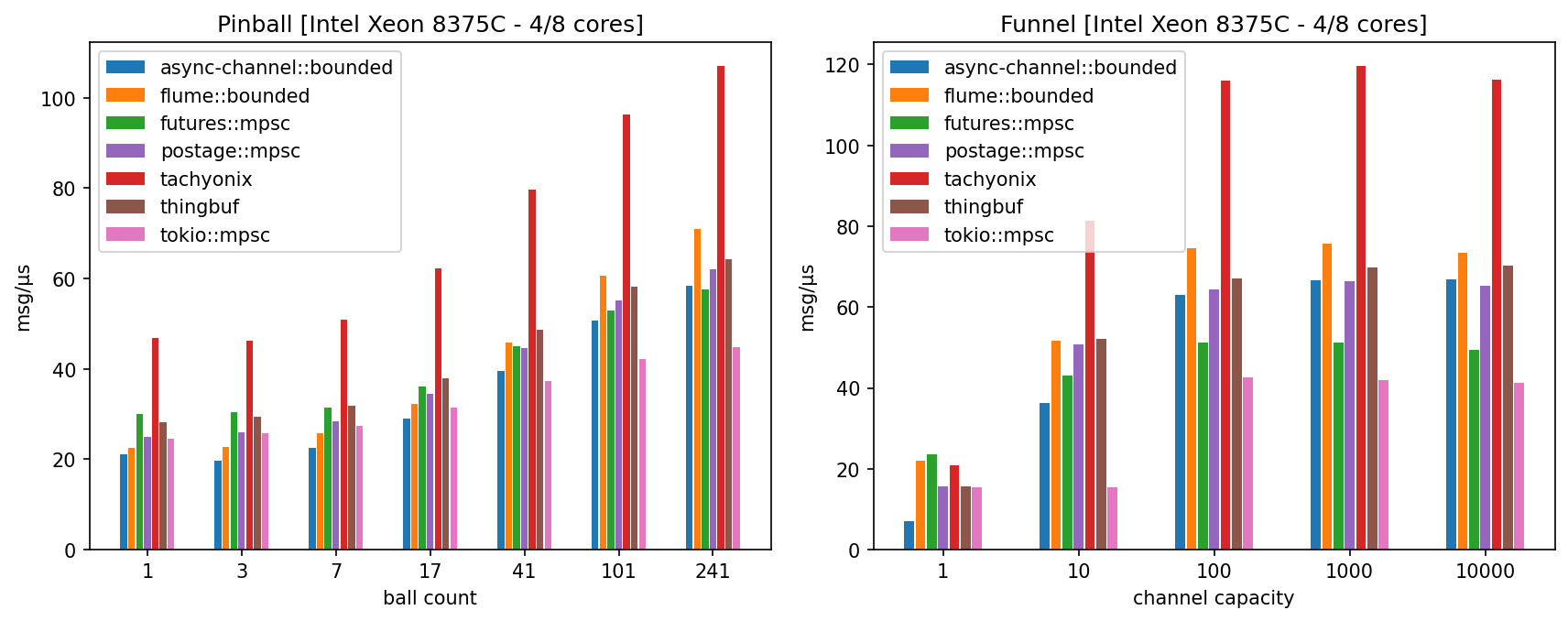
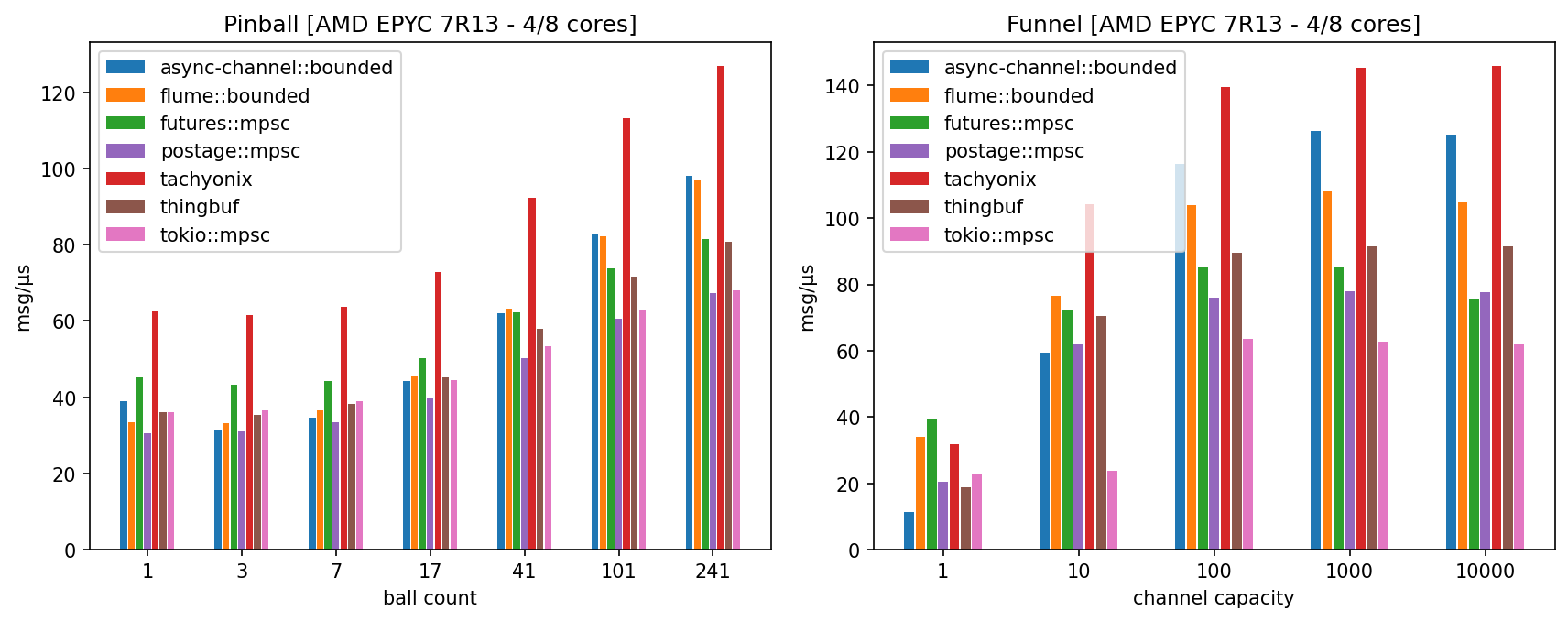
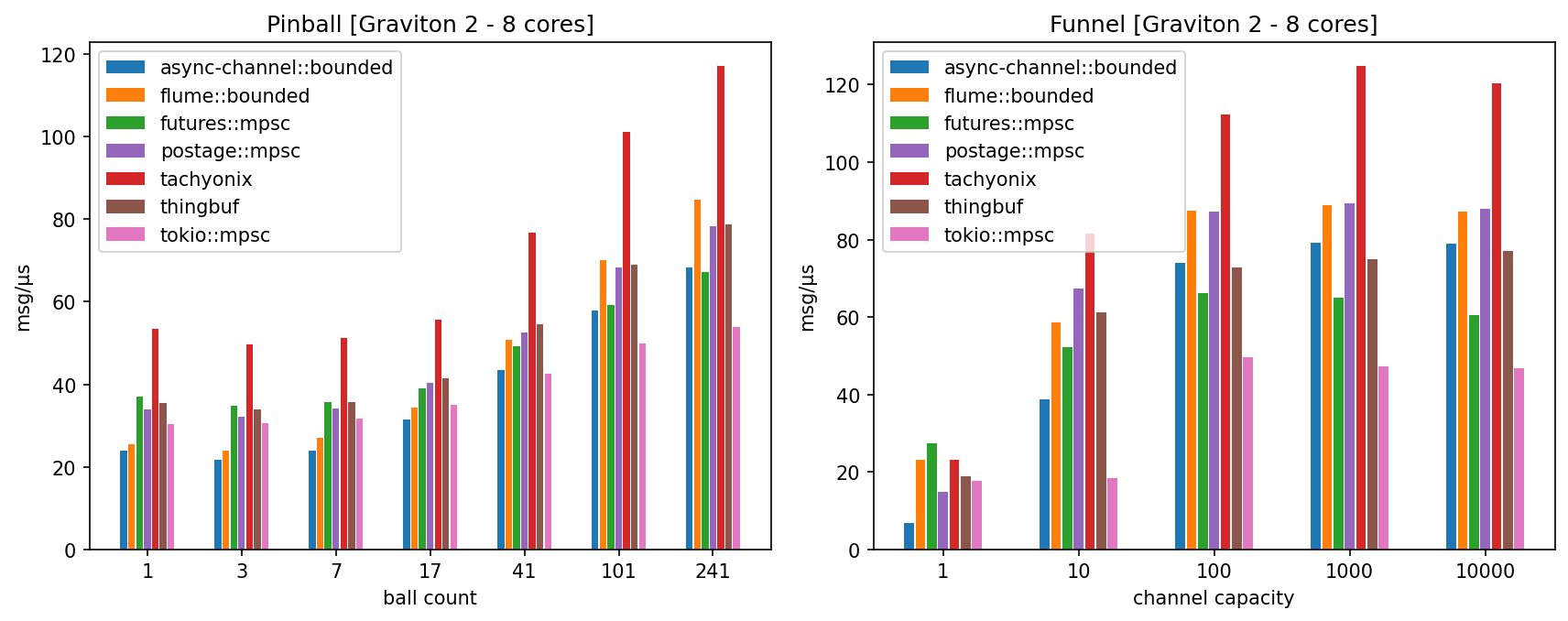
The benchmarks were run on EC2 instances of comparable performance but different
micro-architectures (Intel Ice Lake, AMD Zen 3, ARM Graviton 2). The reported
performance is the mean number of messages per microsecond after averaging over
10 benchmark runs (higher is better).
The reported results were obtained with Tokio, which in practice was found
significantly faster than either async-std or smolscale. Asynchronix is faster
yet, but less relevant as a baseline as it is not meant for general-purpose
`async` programming.
#### EC2 c6i.2xlarge
#### EC2 c6a.2xlarge
#### EC2 c6g.2xlarge
## License
This software is licensed under the [Apache License, Version
2.0](LICENSE-APACHE) or the [MIT license](LICENSE-MIT), at your option.
## Contribution
Unless you explicitly state otherwise, any contribution intentionally submitted
for inclusion in the work by you, as defined in the Apache-2.0 license, shall be
dual licensed as above, without any additional terms or conditions.