String Pools / Strings Interning
### Features
- quick `Deref<str>` implementation - one pointer resolution, one comparison, and one pointer increment
- thin [`PoolStr`] type - a pointer
- The pool is deallocated only when every object referencing it have been dropped.
- no_std, but `alloc` is required
- thread-safe
- [`Pool`]'s `Debug` implementation allows you to see all of its strings
- simple O(n / `P`) insertion/search, where `P` is `Pool`'s const generic parameter
### Example
```rust
# use {strpool::{Pool, PoolStr}, core::ops::Deref};
// you can reduce insertion/search complexity by raising this number,
// at the expense of more frequent allocations for small strings.
// strings are spread evenly into these subpools based on their hash.
// => must be a non-zero power of two.
const SUB_POOLS: usize = 1;
// no need for mutability, the pool uses atomic operations
let pool: Pool<SUB_POOLS> = Pool::new();
// use Pool::intern(&self, &str) to insert a string slice into the pool
// if the string was already present, that PoolStr will be reused.
let pool_string = pool.intern("Hello world!");
// you can obtain a &str with the Deref implementation
assert_eq!(pool_string.deref(), "Hello world!");
// Hash, Eq, Debug, Display are implemented as well.
// you can use Pool::find(&self, &str) to check if the pool contains a string
assert_eq!(pool.find("oh hi mark"), None);
// the empty string doesn't rely on a pool, it's always there
assert_eq!(pool.find(""), Some(PoolStr::empty()));
// See all interned strings via the Debug implementation
println!("{:#?}", pool);
```
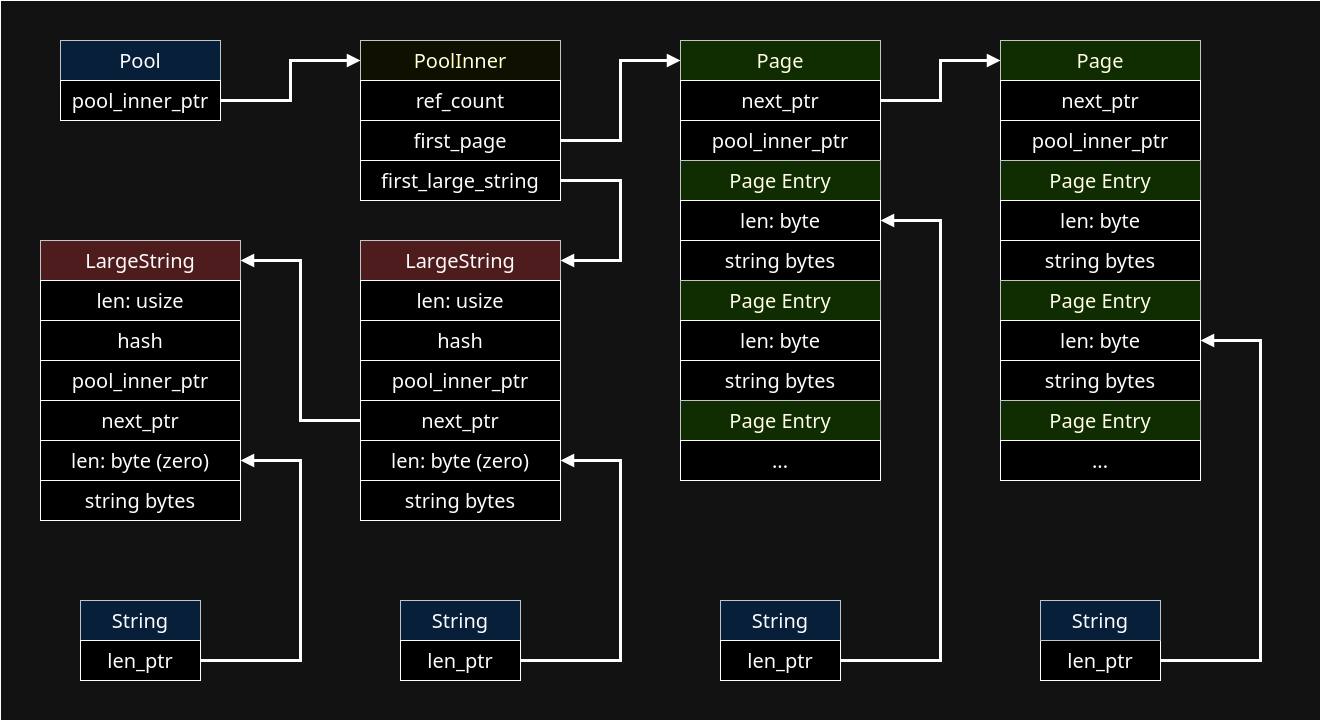
### Internal Memory Structure (Example)