[](https://travis-ci.org/lotabout/skim)
> Life is short, skim!
Half of our life is spent on navigation: files, lines, commands... You need
skim! It is a general fuzzy finder that saves you time.
It is blazingly fast as it reads the data source asynchronously.

skim provides a single executable: `sk`, basically anywhere you would want to use
`grep` try `sk` instead.
# Table of contents
- [Installation](#installation)
- [Usage](#usage)
- [As Filter](#as-filter)
- [As Interactive Interface](#as-interactive-interface)
- [Key Bindings](#key-bindings)
- [Search Syntax](#search-syntax)
- [Exit code](#exit-code)
- [Customization](#customization)
- [Keymap to redefine](#keymap)
- [Sort Criteria](#sort-criteria)
- [Color Scheme](#color-scheme)
- [Misc](#misc)
- [Advance Topics](#advance-topics)
- [Interactive Mode](#interactive-mode)
- [Preview Window](#preview-window)
- [Fields Support](#fields-support)
- [Difference to fzf](#difference-to-fzf)
- [How to contribute](#how-to-contribute)
# Installation
skim project contains several components:
1. `sk` executable -- the core.
2. `sk-tmux` -- script for launching `sk` in a tmux plane.
3. vim/nvim plugin -- to call `sk` inside vim/nvim. check [skim.vim](https://github.com/lotabout/skim.vim) for more vim support.
## Linux
Clone this repository and run the install script:
```sh
git clone --depth 1 git@github.com:lotabout/skim.git ~/.skim
~/.skim/install
```
Next: add `~/.skim/bin` to your PATH by putting the following line into your `~/.bashrc`
```
export PATH="$PATH:$HOME/.skim/bin"
```
As an alternative, you can directly [download the sk
executable](https://github.com/lotabout/skim/releases), but extra utilities are recommended.
## OSX
Using Homebrew:
```
brew install sbdchd/skim/skim
```
But the Linux way described above will also work.
## Install as vim plugin
Once you have cloned the repository, add the following line to your .vimrc.
```
set rtp+=~/.skim
```
Or you can have vim-plug manage skim (recommended):
```
Plug 'lotabout/skim', { 'dir': '~/.skim', 'do': './install' }
```
## Build Manually
Clone the repo and run:
```
cargo install
```
Alternatively, run:
```
cargo build --release
```
then put the resulting `target/release/sk` executable on your PATH.
Note: on linux, also make sure the `libncursesw5-dev` package is installed.
# Usage
skim can be used as a general filter(like `grep`) or as an interactive
interface for invoking commands.
## As filter
Try the following
```
# directly invoke skim
sk
# or pipe some input to it: (press TAB key select multiple items with -m enabled)
vim $(find . -name "*.rs" | sk -m)
```
The above command will allow you to select files with ".rs" extension and open
the ones you selected in vim.
## As Interactive Interface
`skim` can invoke other commands dynamically. Normally you would want to
integrate it with [rg](https://github.com/BurntSushi/ripgrep)
[ag](https://github.com/ggreer/the_silver_searcher) or
[ack](https://github.com/petdance/ack2) for searching contents in a project
directory:
```
# work with ag
sk --ansi -i -c 'ag --color "{}"'
# or with rg
sk --ansi -c 'rg --color=always --line-number "{}"'
```

## Key Bindings
Some common used keybindings.
| Enter | Accept (select current one and quit) |
| ESC/Ctrl-G/Ctrl-Q | Abort |
| Ctrl-P/Up | Move cursor up |
| Ctrl-N/Down | Move cursor Down |
| TAB | Toggle selection and move down (with `-m`) |
| Shift-TAB | Toggle selection and move up (with `-m`) |
## Search Syntax
`skim` borrowed `fzf`'s syntax for matching items:
| `text` | fuzzy-match | items that match `text` |
| `^music` | prefix-exact-match | items that start with `music` |
| `.mp3$` | suffix-exact-match | items that end with `.mp3` |
| `'wild` | exact-match (quoted) | items that include `wild` |
| `!fire` | inverse-exact-match | items that do not include `fire` |
| `!.mp3$` | inverse-suffix-exact-match | items that do not end with `.mp3` |
`skim` also support the combination of tokens.
- space has the meaning of `AND`. With the term `src main`, `skim` will search
for items that match **both** `src` and `main`.
- ` | ` means `OR` (note the spaces around `|`). With the term `.md$ |
.markdown$`, `skim` will search for items ends with either `.md` or
`.markdown`.
- `OR` have higher precedence. So `readme .md$ | .markdown$` is groupped into
`readme AND (.md$ OR .markdown$)`.
In case that you want to use regular expressions, `skim` provide `regex` mode:
```
sk --regex
```
You can switch to `regex` mode dynamically by pressing `Ctrl-R` (Rotate Mode).
## exit code
| 0 | Exit normally |
| 1 | No Match found |
| 130 | Abort by Ctrl-C/Ctrl-G/ESC/etc... |
# Customization
## Keymap
Specify the bindings with comma seperated pairs(no space allowed), example:
`sk --bind 'alt-a:select-all,alt-d:deselect-all'`
| abort | esc, ctrl-c, ctrl-g, ctrl-q |
| accept | enter |
| backward-char | left, ctrl-b |
| backward-delete-char | ctrl-h, backspace |
| backward-kill-word | alt-backspace |
| backward-word | alt-b, shift-left |
| beginning-of-line | ctrl-a |
| cancel | None |
| clear-screen | ctrl-l |
| delete-char | del |
| delete-charEOF | ctrl-d |
| deselect-all | None |
| down | ctrl-j, ctrl-n, down |
| end-of-line | ctrl-e, end |
| forward-char | ctrl-f, right |
| forward-word | alt-f, shift-right |
| ignore | None |
| kill-line | ctrl-k |
| kill-word | alt-d |
| page-down | page-down |
| page-up | page-up |
| rotate-mode | ctrl-r |
| scroll-left | alt-h |
| scroll-right | alt-l |
| select-all | None |
| toggle | None |
| toggle-all | None |
| toggle-down | tab |
| toggle-interactive | ctrl-q |
| toggle-out | None |
| toggle-preview | None |
| toggle-sort | None |
| toggle-up | shift-tab |
| unix-line-discard | ctrl-u |
| unix-word-rubout | ctrl-w |
| up | ctrl-p, ctrl-k, up |
## Sort Criteria
There are four sort keys for results: `score, index, begin, end`, you can
specify how the records are sorted by `sk --tiebreak score,index,-begin` or any
other order you want.
## Color Scheme
It is a high chance that you are a better artist than me. Luckily you won't
be stuck with the default colors, `skim` supports customization of the color scheme.
```
--color=[BASE_SCHEME][,COLOR:ANSI]
```
The configuration of colors starts with the name of the base color scheme and
followed by custom color mappings. For example:
```
sk --color=current_bg:24
sk --color=light,fg:232,bg:255,current_bg:116,info:27
```
You can choose the `BASE SCHEME` among the following(default: dark on
256-color terminal, otherwise 16):
| dark | Color scheme for dark 256-color terminal |
| light | Color scheme for light 256-color terminal |
| 16 | Color scheme for 16-color terminal |
| bw | No colors |
While the customisable `COLOR`s are
| fg | Text |
| bg | Background |
| matched | Text color of matched items |
| matched_bg | Background color of matched items |
| current | Text color (current line) |
| current_bg | Background color (current line) |
| current_match | Text color of matched items (current line) |
| current_match_bg | Background color of matched items (current line) |
| spinner | Streaming input indicator |
| info | Info area |
| prompt | Prompt |
| cursor | Cursor |
| selected | Text color of "selected" indicator |
| border | Border color of preview window |
## Misc
- `--ansi`: to parse ANSI color codes(e.g `\e[32mABC`) of the data source
- `--regex`: use the query as regular expression to match the data source
# Advance Topics
## Interactive mode
In interactive mode, `sk` will pass the query to the command you specified and
present the output to you. You can specify the command using the `-c` option:
`sk -i -c 'ag --color "{}"'`
In the above example, the replace string `{}` will be replaced with the query you
type before invoking the command. Use `-I <replstr>` to change replstr if you
want.
For example, with the input "hello" in interactive mode, `skim` will replace
the above command with `ag --color "hello"` and invoke it.
If you want to further narrow down the result returned by the command, press
`Ctrl-Q` to toggle interactive mode.
## Preview Window
This is a great feature of fzf that skim borrows. For example, we use 'ag' to
find the matched lines, once we narrow down to the target lines, we want to
finally decide which lines to pick by checking the context around the line.
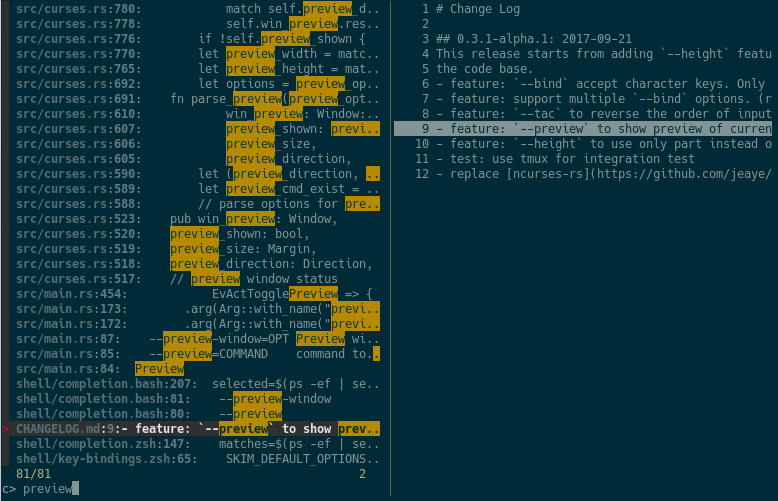
`grep` and `ag` has an option `--context`, skim can do better with preview
window. For example:
```
sk --ansi -i -c 'ag --color "{}"' --preview "preview.sh {0}"
```
(Note the [preview.sh](https://github.com/junegunn/fzf.vim/blob/master/bin/preview.sh) is a script to print the context given filename:lines:columns)
You got things like this:
### How it work?
If preview command is given by `--preview` option, skim will replace the `{}`
with the current highlighted line surrounded by single quote. Then call the
command to get the output. And print the output on the preview window.
Sometimes you don't need the whole line for invoking the command, in this case
you can use `{0}`, `{1..}`, `{..3}` or `{1..5}` to select the fields. The
syntax is explained in the section "Fields Support".
Last, you might want to configure the position of preview windows, use
`--preview-window`.
- `--preview-window up:30%` to put the window in the up position with height
30% of the total height of skim.
- `--preview-window left:10:wrap`, to specify the `wrap` allows the preview
window to wrap the output of the preview command.
- `--preview-window wrap:hidden` to hide the preview window at startup, later
it can be shown by the action `toggle-preview`.
## Fields support
Normally only plugin users need to understand this.
For example, you have the data source with the format:
```
<filename>:<line number>:<column number>
```
However, you want to search `<filename>` only when typing in queries. That
means when you type `21`, you want to find a `<filename>` that contains `21`,
but not matching line number or column number.
You can use `sk --delimiter ':' --nth 0` to achieve this.
Also you can use `--with-nth` to re-arrange the order of fields.
**Range Syntax**
- `<num>` -- to specify the `num`-th fields, starting with 0.
- `start..` -- starting from the `start`-th fields, and the rest.
- `..end` -- starting from the `0`-th field, all the way to `end`-th field,
excluding `end`.
- `start..end` -- starting from `start`-th field, all the way to `end`-th
field, excluding `end`.
# Difference to fzf
[fzf](https://github.com/junegunn/fzf) is a command-line fuzzy finder written
in Go and [skim](https://github.com/lotabout/skim) tries to implement a new one
in Rust!
This project is written from scratch. Some decisions of implementation are
different from fzf. For example:
1. The fuzzy search algorithm is different.
2. UI of showing matched items. `fzf` will show only the range matched while
`skim` will show each character matched.
3. `skim` has an interactive mode.
4. `skim`'s range syntax is git style.
# How to contribute
[Create new issues](https://github.com/lotabout/skim/issues/new) if you meet any bugs
or have any ideas. Pull requests are warmly welcomed.