The Historian
===
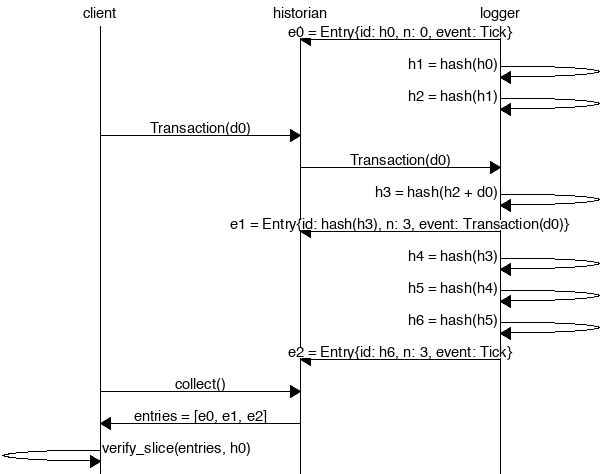
Create a *Historian* and send it *events* to generate an *event log*, where each log *entry*
is tagged with the historian's latest *hash*. Then ensure the order of events was not tampered
with by verifying each entry's hash can be generated from the hash in the previous entry:
```rust
extern crate silk;
use silk::historian::Historian;
use silk::log::{verify_slice, Entry, Hash};
use silk::event::{generate_keypair, get_pubkey, sign_claim_data, Event};
use std::thread::sleep;
use std::time::Duration;
use std::sync::mpsc::SendError;
fn create_log(hist: &Historian<Hash>) -> Result<(), SendError<Event<Hash>>> {
sleep(Duration::from_millis(15));
let asset = Hash::default();
let keypair = generate_keypair();
let event0 = Event::new_claim(get_pubkey(&keypair), asset, sign_claim_data(&asset, &keypair));
hist.sender.send(event0)?;
sleep(Duration::from_millis(10));
Ok(())
}
fn main() {
let seed = Hash::default();
let hist = Historian::new(&seed, Some(10));
create_log(&hist).expect("send error");
drop(hist.sender);
let entries: Vec<Entry<Hash>> = hist.receiver.iter().collect();
for entry in &entries {
println!("{:?}", entry);
}
// Proof-of-History: Verify the historian learned about the events
// in the same order they appear in the vector.
assert!(verify_slice(&entries, &seed));
}
```
Running the program should produce a log similar to:
```rust
Entry { num_hashes: 0, id: [0, ...], event: Tick }
Entry { num_hashes: 3, id: [67, ...], event: Transaction { asset: [37, ...] } }
Entry { num_hashes: 3, id: [123, ...], event: Tick }
```
Proof-of-History
---
Take note of the last line:
```rust
assert!(verify_slice(&entries, &seed));
```
[It's a proof!](https://en.wikipedia.org/wiki/Curry–Howard_correspondence) For each entry returned by the
historian, we can verify that `id` is the result of applying a sha256 hash to the previous `id`
exactly `num_hashes` times, and then hashing then event data on top of that. Because the event data is
included in the hash, the events cannot be reordered without regenerating all the hashes.