




Silk, a silky smooth implementation of the Loom specification
Loom is a new achitecture for a high performance blockchain. Its whitepaper boasts a theoretical
throughput of 710k transactions per second on a 1 gbps network. The specification is implemented
in two git repositories. Reserach is performed in the loom repository. That work drives the
Loom specification forward. This repository, on the other hand, aims to implement the specification
as-is. We care a great deal about quality, clarity and short learning curve. We avoid the use
of unsafe Rust and write tests for everything. Optimizations are only added when
corresponding benchmarks are also added that demonstrate real performance boosts. We expect the
feature set here will always be a ways behind the loom repo, but that this is an implementation
you can take to the bank, literally.
Usage
Add the latest silk package to the [dependencies] section
of your Cargo.toml.
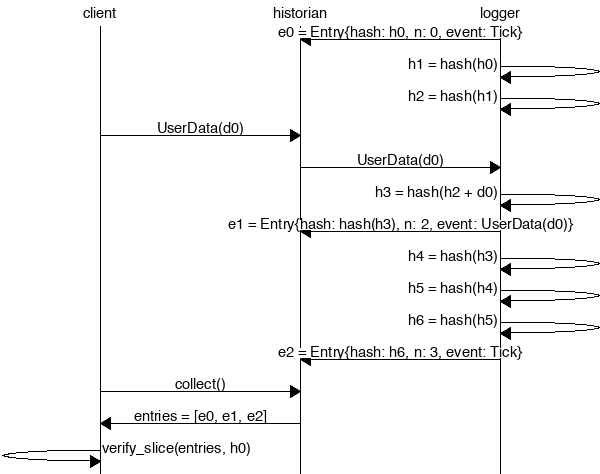
Create a Historian and send it events to generate an event log, where each log entry is tagged with the historian's latest hash. Then ensure the order of events was not tampered with by verifying each entry's hash can be generated from the hash in the previous entry:
extern crate silk;
use Historian;
use ;
use sleep;
use Duration;
use SendError;
Running the program should produce a log similar to:
Entry
Entry
Entry
Proof-of-History
Take note of the last line:
assert!;
It's a proof! For each entry returned by the
historian, we can verify that end_hash is the result of applying a sha256 hash to the previous end_hash
exactly num_hashes times, and then hashing then event data on top of that. Because the event data is
included in the hash, the events cannot be reordered without regenerating all the hashes.
Developing
Building
Install rustc, cargo and rustfmt:
|
Download the source code:
Testing
Run the test suite:
Benchmarking
First install the nightly build of rustc. cargo bench requires unstable features:
Run the benchmarks: