# Architecture & project layout
## Data flow
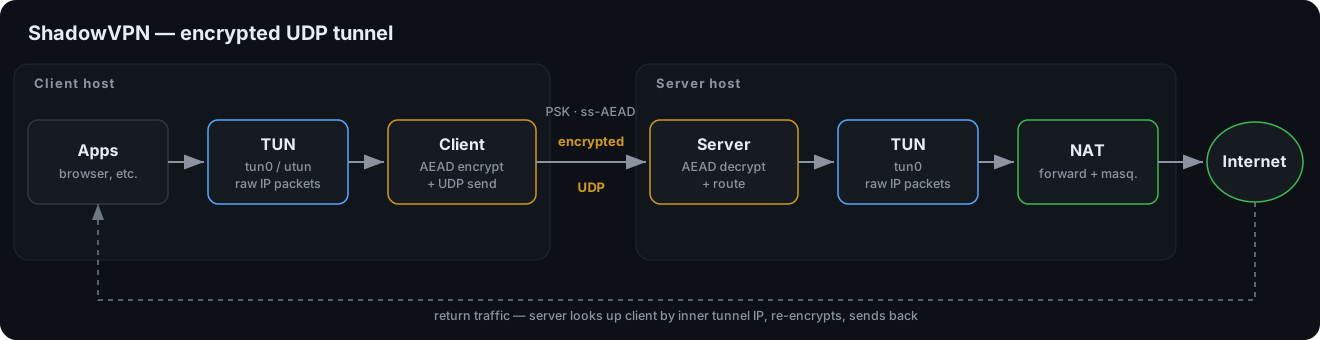
The client encrypts every TUN packet to the server over UDP; the server
decrypts, writes to its own TUN, and (with forwarding + NAT) lets traffic
egress. Return traffic is matched back to the client by its inner tunnel IP
and re-encrypted.
Design notes:
- **Pipelined relay loops** — on each relay direction a dedicated reader task
drains the socket/TUN continuously and feeds a single ordered
crypto-and-send processor, instead of a strict per-packet
`recv → crypt → send` loop. Overlapping the receive syscall with the crypto
roughly triples single-flow TCP at high rates (see
[benchmarks](./benchmarks)).
- **Enlarged socket buffers** — UDP sockets are created with enlarged
`SO_RCVBUF`/`SO_SNDBUF` so bursts aren't dropped at the socket.
- **Client-address learning** — the server maps each client's inner tunnel IP
to its current UDP endpoint, learning (and re-learning after NAT rebinds)
from keepalives and traffic. In [`--nat` mode](/guide/multi-client) the
mapping is keyed by UDP 4-tuple instead, with inner-address rewriting.
## Policy routing (client)
In `gfwlist`/`chinadns` modes a split-DNS proxy decides per query and programs
per-destination host routes into the tun through the OS routing socket. The
control plane installs routes; the data plane is just the ordinary kernel
routing table.

See the [policy routing guide](/guide/policy-routing).
## Project layout
```
src/
lib.rs crate root + module docs
crypto.rs Cipher enum, EVP_BytesToKey, HKDF-SHA1 subkey, AEAD seal/open
net.rs UDP socket construction with enlarged SO_RCVBUF/SO_SNDBUF
protocol.rs tunnel framing constants and buffer sizing
obfs.rs optional carrier obfuscation (quic / base64 wire formats)
config.rs JSON file + clap CLI config, merge/validate
tun_device.rs async TUN wrapper (tun-rs: macOS utun, Linux, Windows Wintun)
policy/ client policy routing (gfwlist / chinadns, user-mode)
mod.rs Mode, PolicyConfig, orchestration
gfwlist.rs domain-suffix matching
chnroute.rs China IP range lookup
geoip.rs build the China set from a GeoLite2 .mmdb
dns.rs minimal DNS wire parsing
cache.rs TTL-respecting DNS answer cache
proxy.rs split-DNS proxy + routing decisions (IpSink trait)
route.rs per-dest routes into the tun (rtnetlink / PF_ROUTE / IP Helper API)
dnsconf.rs point the system resolver at the proxy (networksetup / resolv.conf / netsh)
bin/server.rs server binary: UDP<->TUN forwarding + client routing table
bin/client.rs client binary: TUN<->UDP relay loops + keepalive + policy
docs/ this documentation site (VitePress)
dist/
systemd/ Linux service units (server + client)
launchd/ macOS client daemon
desktop/ Tauri v2 desktop GUI (experimental)
docker/ end-to-end tests + benchmark harness
scripts/
install.sh one-line curl installer/uninstaller (Linux + macOS)
shadowvpn-client.ps1 self-elevating Windows client launcher
shadowvpn-client.cmd execution-policy-bypass wrapper for the launcher
gen-gfwlist.sh regenerate assets/gfwlist.txt from upstream
assets/
gfwlist.txt vendored routing list bundled into release packages
```
## Dependencies
A deliberately small set: `tokio` for the async runtime, RustCrypto's
`aes-gcm` / `chacha20poly1305` for the AEAD, `tun-rs` for the cross-platform
TUN device, and `clap`/`serde` for config. Key derivation
(`EVP_BytesToKey`, HKDF-SHA1) is implemented in-tree.