<!doctype html>
<html lang="en">
<head>
<meta charset="utf-8">
<meta name="viewport" content="width=device-width, initial-scale=1">
<title>ShadowVPN — UDP PSK user-mode VPN in Rust</title>
<meta name="description" content="ShadowVPN is a UDP-based, pre-shared-key, user-mode VPN written in Rust. shadowsocks AEAD wire format, cross-platform TUN, and user-mode policy routing (gfwlist / chinadns).">
<meta property="og:title" content="ShadowVPN">
<meta property="og:description" content="A UDP-based, pre-shared-key, user-mode VPN written in Rust.">
<meta property="og:type" content="website">
<style>
:root{
--bg:#0d1117; --bg2:#11161d; --card:#161b22; --border:#21262d;
--text:#e6edf3; --muted:#8b949e; --faint:#6e7681;
--blue:#58a6ff; --green:#3fb950; --amber:#d29922; --purple:#a371f7;
}
*{box-sizing:border-box}
html{scroll-behavior:smooth}
body{
margin:0; background:var(--bg); color:var(--text);
font-family:-apple-system,BlinkMacSystemFont,"Segoe UI",Helvetica,Arial,sans-serif;
line-height:1.65; -webkit-font-smoothing:antialiased;
}
a{color:var(--blue); text-decoration:none}
a:hover{text-decoration:underline}
code,kbd,pre{font-family:ui-monospace,SFMono-Regular,Menlo,Consolas,monospace}
.wrap{max-width:1000px; margin:0 auto; padding:0 24px}
header.hero{
position:relative; overflow:hidden;
border-bottom:1px solid var(--border);
background:
radial-gradient(1100px 420px at 80% -10%, rgba(88,166,255,.16), transparent 60%),
radial-gradient(900px 360px at 0% 0%, rgba(63,185,80,.12), transparent 55%);
}
.hero .wrap{padding-top:86px; padding-bottom:72px}
.eyebrow{
display:inline-block; font-size:13px; letter-spacing:.12em; text-transform:uppercase;
color:var(--muted); border:1px solid var(--border); border-radius:999px;
padding:5px 14px; margin-bottom:22px; background:var(--bg2);
}
h1.brand{
font-size:clamp(44px,8vw,84px); line-height:1.02; margin:0 0 18px; letter-spacing:-.02em;
background:linear-gradient(100deg,#7cc4ff,#58a6ff 35%,#56d364); -webkit-background-clip:text;
background-clip:text; color:transparent; font-weight:800;
}
.tagline{font-size:clamp(18px,2.6vw,23px); color:#c9d1d9; max-width:640px; margin:0 0 14px}
.subtle{color:var(--muted); max-width:660px; margin:0 0 30px}
.cta{display:flex; gap:14px; flex-wrap:wrap}
.btn{
display:inline-flex; align-items:center; gap:9px; padding:12px 20px; border-radius:10px;
font-weight:600; font-size:15px; border:1px solid var(--border); cursor:pointer;
}
.btn.primary{background:var(--blue); color:#08111f; border-color:transparent}
.btn.primary:hover{background:#79c0ff; text-decoration:none}
.btn.ghost{background:var(--bg2); color:var(--text)}
.btn.ghost:hover{border-color:var(--faint); text-decoration:none}
.badges{margin-top:34px; display:flex; gap:8px; flex-wrap:wrap}
.badge{font-size:12.5px; color:var(--muted); background:var(--bg2); border:1px solid var(--border);
border-radius:7px; padding:5px 11px}
.badge b{color:var(--text); font-weight:600}
section{padding:64px 0; border-bottom:1px solid var(--border)}
h2{font-size:clamp(26px,4vw,34px); margin:0 0 10px; letter-spacing:-.01em}
h2 .num{color:var(--faint); font-weight:600; font-size:.62em; margin-right:12px}
.lede{color:var(--muted); max-width:720px; margin:0 0 28px; font-size:17px}
h3{font-size:18px; margin:30px 0 8px}
.grid{display:grid; grid-template-columns:repeat(3,1fr); gap:16px}
.feat{background:var(--card); border:1px solid var(--border); border-radius:14px; padding:22px}
.feat .ic{width:34px;height:34px;border-radius:9px;display:grid;place-items:center;margin-bottom:14px;
background:rgba(88,166,255,.12); color:var(--blue); font-size:18px; border:1px solid rgba(88,166,255,.25)}
.feat h3{margin:0 0 6px; font-size:16px}
.feat p{margin:0; color:var(--muted); font-size:14.5px}
figure{margin:8px 0 4px}
.diagram{width:100%; height:auto; display:block; border:1px solid var(--border); border-radius:14px;
background:var(--bg); box-shadow:0 1px 0 rgba(255,255,255,.02)}
figcaption{color:var(--faint); font-size:13px; margin-top:10px; text-align:center}
pre{background:#0b0f15; border:1px solid var(--border); border-radius:12px; padding:18px 20px;
overflow-x:auto; font-size:13.5px; line-height:1.6; margin:14px 0}
pre code{color:#d6dee8}
.c{color:var(--faint)}
.k{color:var(--amber)}
.v{color:var(--green)}
p code,li code{background:var(--bg2); border:1px solid var(--border); border-radius:6px;
padding:1px 6px; font-size:13px}
ul.clean{padding-left:20px; color:var(--muted)} ul.clean li{margin:6px 0}
ul.clean b{color:var(--text)}
.two{display:grid; grid-template-columns:1fr 1fr; gap:18px}
table.modes{width:100%; border-collapse:collapse; margin-top:8px; font-size:14.5px}
table.modes th,table.modes td{border:1px solid var(--border); padding:10px 13px; text-align:left; vertical-align:top}
table.modes th{background:var(--bg2); color:var(--text); font-weight:600}
table.modes td{color:var(--muted)}
table.modes code{color:var(--amber)}
footer{padding:46px 0 70px; color:var(--muted)}
footer .wrap{display:flex; justify-content:space-between; gap:18px; flex-wrap:wrap; align-items:center}
@media (max-width:820px){
.grid{grid-template-columns:1fr 1fr}
.two{grid-template-columns:1fr}
}
@media (max-width:560px){ .grid{grid-template-columns:1fr} }
</style>
</head>
<body>
<header class="hero">
<div class="wrap">
<span class="eyebrow">UDP · PSK · user-mode VPN · Rust</span>
<h1 class="brand">ShadowVPN</h1>
<p class="tagline">A UDP-based, pre-shared-key, user-mode VPN written in Rust on Tokio.</p>
<p class="subtle">A fixed point-to-point / multi-client tunnel whose on-wire crypto matches the
shadowsocks AEAD UDP scheme byte-for-byte. Runs on Linux, macOS, and Windows, with optional
user-mode policy routing (gfwlist / chinadns), QUIC/HTTP3 carrier obfuscation, and no kernel
ipset or nft rules.</p>
<div class="cta">
<a class="btn primary" href="https://github.com/madeye/shadowvpn">★ View on GitHub</a>
<a class="btn ghost" href="#quickstart">Quick start →</a>
</div>
<div class="badges">
<span class="badge"><b>Wire:</b> shadowsocks AEAD (UDP)</span>
<span class="badge"><b>Ciphers:</b> AES-128/256-GCM · ChaCha20-Poly1305</span>
<span class="badge"><b>Platforms:</b> Linux · macOS · Windows</span>
<span class="badge"><b>Obfuscation:</b> QUIC/HTTP3 · base64</span>
<span class="badge"><b>License:</b> MIT</span>
</div>
</div>
</header>
<main>
<section id="overview">
<div class="wrap">
<h2><span class="num">01</span>Why ShadowVPN</h2>
<p class="lede">A TUN-based client reads IP packets from a virtual interface, encrypts each as a
single UDP datagram, and sends it to the server; the server decrypts, routes, and tunnels
return traffic back. Small, spec-correct, and entirely in user space.</p>
<div class="grid">
<div class="feat"><div class="ic">🔒</div><h3>Spec-correct crypto</h3>
<p>Per-datagram random salt, HKDF-SHA1 <code>ss-subkey</code>, zero nonce, AEAD tag — the
shadowsocks UDP scheme exactly, interoperable by construction.</p></div>
<div class="feat"><div class="ic">📦</div><h3>One packet, one datagram</h3>
<p>No length prefix, no SOCKS header, no multiplexing. The plaintext is the raw IP packet —
UDP boundaries are the frame boundaries.</p></div>
<div class="feat"><div class="ic">🖧</div><h3>User-mode TUN</h3>
<p>Async TUN on Tokio via <code>tun-rs</code> — Linux <code>tun0</code> and macOS
<code>utun</code>. Two relay loops plus a keepalive.</p></div>
<div class="feat"><div class="ic">🧭</div><h3>Policy routing</h3>
<p>Optional split-tunnel: send only selected destinations through the tunnel, decided in
user space — no ipset, no nft.</p></div>
<div class="feat"><div class="ic">🌏</div><h3>gfwlist · chinadns</h3>
<p>Tunnel a domain list, or everything that isn't a China IP. Build the China set from a
plain CIDR file or a GeoLite2 database.</p></div>
<div class="feat"><div class="ic">🎭</div><h3>Carrier obfuscation</h3>
<p>Optionally shape the UDP payload to look like <b>QUIC/HTTP3</b>, or encode it as printable
base64 — cosmetic framing to dodge naive classification.</p></div>
<div class="feat"><div class="ic">🪟</div><h3>Cross-platform client</h3>
<p>The client runs on Linux, macOS, and <b>Windows</b> (TUN via Wintun), policy routing
included — a self-elevating launcher ships in <code>scripts/</code>.</p></div>
<div class="feat"><div class="ic">🦀</div><h3>Lean Rust</h3>
<p>Tokio + RustCrypto, a tiny dependency set, and a Docker end-to-end test suite covering
the tunnel, HTTP/3, and policy routing.</p></div>
</div>
</div>
</section>
<section id="architecture">
<div class="wrap">
<h2><span class="num">02</span>Architecture</h2>
<p class="lede">The client encrypts every TUN packet to the server over UDP; the server decrypts,
writes to its own TUN, and (with forwarding + NAT) lets traffic egress. Return traffic is
matched back to the client by its inner tunnel IP and re-encrypted.</p>
<figure>
<img class="diagram" src="architecture.svg" alt="ShadowVPN end-to-end data flow: apps to TUN to client encrypt, encrypted UDP to server decrypt, server TUN, NAT, Internet, and the return path.">
<figcaption>End-to-end data flow between a client host and a server host.</figcaption>
</figure>
</div>
</section>
<section id="wire">
<div class="wrap">
<h2><span class="num">03</span>Wire protocol</h2>
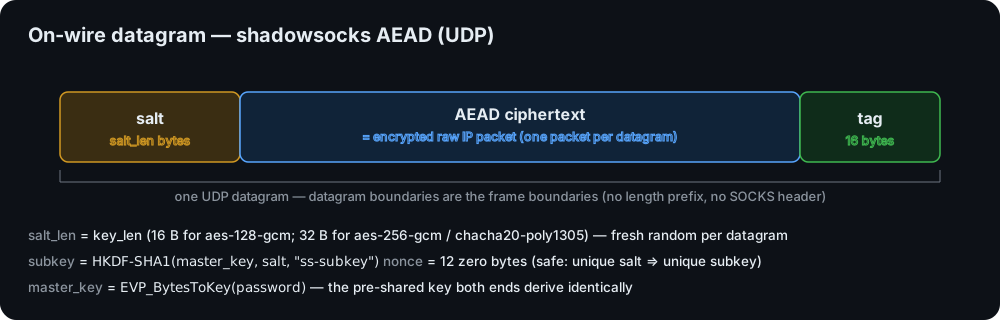
<p class="lede">Each datagram is <code>salt ++ AEAD(ciphertext ++ tag)</code>. A fresh random salt
per datagram yields a unique subkey, so the all-zero nonce is never reused.</p>
<figure>
<img class="diagram" src="wire.svg" alt="On-wire datagram layout: salt, AEAD ciphertext of the raw IP packet, and a 16-byte tag, with subkey and key derivation notes.">
<figcaption>One datagram = one encrypted IP packet.</figcaption>
</figure>
<p class="subtle" style="margin-top:18px"><b style="color:var(--text)">Deviation from ss-proxy:</b>
standard shadowsocks UDP relays prepend a SOCKS target address; ShadowVPN does not. This is a
fixed tunnel, so the plaintext is exactly the raw IP packet — everything else matches the AEAD
scheme byte-for-byte.</p>
<p class="subtle" style="margin-top:14px"><b style="color:var(--text)">Optional obfuscation:</b>
set <code>obfs</code> (both ends must match) to wrap each datagram as a <b>QUIC/HTTP3</b>
short-header packet, or encode it as printable <b>base64</b>. This is cosmetic framing to dodge
naive UDP classification — it adds no security; the AEAD envelope underneath is unchanged.</p>
</div>
</section>
<section id="policy">
<div class="wrap">
<h2><span class="num">04</span>Policy routing</h2>
<p class="lede">Instead of pushing all traffic through the tunnel, the client can route only
selected destinations. A built-in split-DNS proxy decides per query, then programs a
per-destination route into the tun via the OS routing socket — rtnetlink on Linux,
<code>PF_ROUTE</code> on macOS. Direct traffic stays on the normal kernel path.</p>
<figure>
<img class="diagram" src="policy-routing.svg" alt="Client policy routing: control plane where the split-DNS proxy decides and installs a per-destination route; data plane where the routing table sends tunneled IPs through the tunnel and everything else direct.">
<figcaption>Control plane installs routes; the routing table picks the path. No ipset / nft.</figcaption>
</figure>
<table class="modes">
<tr><th>Mode</th><th>Decision</th><th>Needs</th></tr>
<tr><td><code>gfwlist</code></td><td>tunnel names listed in a gfwlist file; everything else is direct</td><td><code>--gfwlist</code></td></tr>
<tr><td><code>chinadns</code></td><td>query a domestic + a clean resolver; tunnel anything that does <b>not</b> resolve to an in-China address</td><td><code>--chnroute</code> or <code>--geoip</code></td></tr>
<tr><td><code>full</code></td><td>no policy routing — the whole TUN is the tunnel (default)</td><td>—</td></tr>
</table>
</div>
</section>
<section id="quickstart">
<div class="wrap">
<h2><span class="num">05</span>Quick start</h2>
<p class="lede">Build the two binaries, then run the server and client. Creating a TUN device
needs root / <code>sudo</code>.</p>
<h3>Build</h3>
<pre><code><span class="k">cargo</span> build --release
<span class="c"># produces target/release/shadowvpn-server and shadowvpn-client</span></code></pre>
<div class="two">
<div>
<h3>Server</h3>
<pre><code><span class="k">sudo</span> ./shadowvpn-server \
--listen <span class="v">0.0.0.0:8388</span> \
--password <span class="v">"correct horse battery staple"</span> \
--cipher <span class="v">chacha20-poly1305</span> \
--tun-ip <span class="v">10.9.0.1</span> --peer-ip <span class="v">10.9.0.2</span></code></pre>
</div>
<div>
<h3>Client</h3>
<pre><code><span class="k">sudo</span> ./shadowvpn-client \
--server <span class="v">vpn.example.com:8388</span> \
--password <span class="v">"correct horse battery staple"</span> \
--cipher <span class="v">chacha20-poly1305</span> \
--tun-ip <span class="v">10.9.0.2</span> --peer-ip <span class="v">10.9.0.1</span></code></pre>
</div>
</div>
<h3>Split tunnel (policy routing)</h3>
<pre><code><span class="c"># tunnel only the domains in a gfwlist</span>
<span class="k">sudo</span> ./shadowvpn-client -c client.json --mode <span class="v">gfwlist</span> --gfwlist <span class="v">/etc/shadowvpn/gfwlist.txt</span>
<span class="c"># or: tunnel everything that isn't a China IP, from a GeoLite2 database</span>
<span class="k">sudo</span> ./shadowvpn-client -c client.json --mode <span class="v">chinadns</span> --geoip <span class="v">/etc/shadowvpn/GeoLite2-Country.mmdb</span>
<span class="c"># the client points the system resolver at its split-DNS proxy automatically</span>
<span class="c"># (restored on exit); pass --no-set-dns to manage DNS yourself.</span></code></pre>
<p class="subtle">Configuration can come from a JSON file, CLI flags, or both (CLI wins). See the
<a href="https://github.com/madeye/shadowvpn#configuration">full configuration reference</a> and the
<a href="https://github.com/madeye/shadowvpn#policy-routing-gfwlist--chinadns--client-linux--macos">policy-routing guide</a>
in the README.</p>
</div>
</section>
</main>
<footer>
<div class="wrap">
<div>ShadowVPN — UDP PSK user-mode VPN in Rust · MIT licensed</div>
<div><a href="https://github.com/madeye/shadowvpn">github.com/madeye/shadowvpn</a></div>
</div>
</footer>
</body>
</html>