# self_encryption
Self encrypting files (convergent encryption plus obfuscation)
|[](https://crates.io/crates/self_encryption)|[](https://docs.rs/self_encryption)|
## Table of Contents
- [Overview](#overview)
- [Documentation](#documentation)
- [Features](#features)
- [Usage](#usage)
- [Rust Usage](#rust-usage)
- [Basic Operations](#basic-operations)
- [Storage Backends](#storage-backends)
- [Streaming Operations](#streaming-operations)
- [Advanced Usage](#advanced-usage)
- [Python Usage](#python-usage)
- [Implementation Details](#implementation-details)
- [License](#license)
- [Contributing](#contributing)
- [Release Process](#release-process)
## Overview
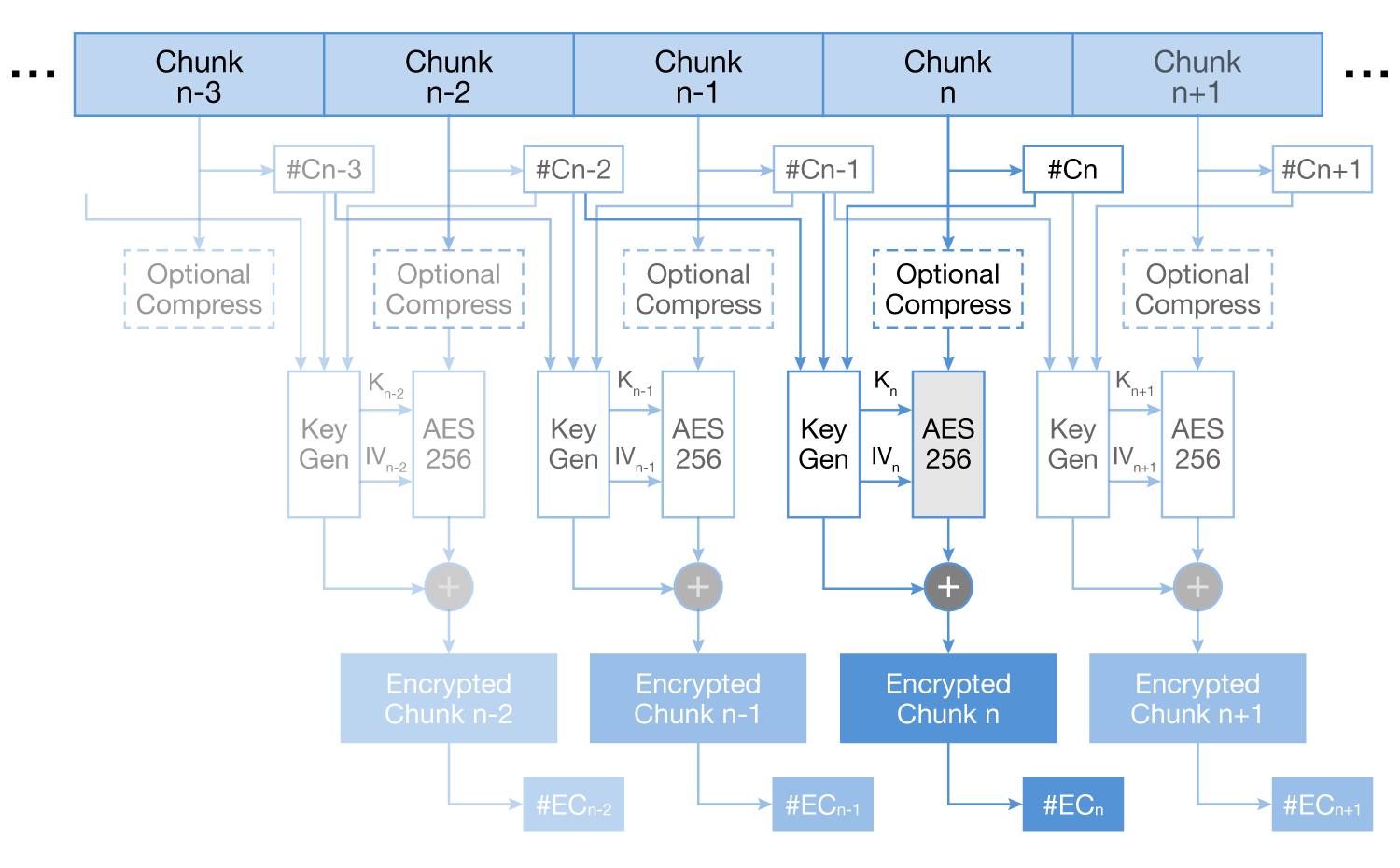
A version of [convergent encryption](http://en.wikipedia.org/wiki/convergent_encryption) with an additional obfuscation step. This pattern allows secured data that can also be [de-duplicated](http://en.wikipedia.org/wiki/Data_deduplication). This library presents an API that takes a set of bytes and returns a secret key derived from those bytes, and a set of encrypted chunks.
**Important Security Note**: While this library provides very secure encryption of the data, the returned secret key **requires the same secure handling as would be necessary for any secret key**.
## Documentation
- [Self Encrypting Data Whitepaper](https://docs.maidsafe.net/Whitepapers/pdf/SelfEncryptingData.pdf)
- [Process Overview Video](https://www.youtube.com/watch?v=Jnvwv4z17b4)
## Features
- Content-based chunking
- Convergent encryption
- Self-validating chunks
- Hierarchical data maps for handling large files
- Streaming encryption/decryption
- Python bindings
- Flexible storage backend support
- Custom storage backends via functors
## Usage
### Rust Usage
#### Installation
Add this to your `Cargo.toml`:
```toml
[dependencies]
self_encryption = "0.30"
bytes = "1.0"
```
#### Basic Operations
```rust
use self_encryption::{encrypt, decrypt_full_set};
use bytes::Bytes;
// Basic encryption/decryption
fn basic_example() -> Result<()> {
let data = Bytes::from("Hello, World!".repeat(1000)); // Must be at least 3072 bytes
// Encrypt data
let (data_map, encrypted_chunks) = encrypt(data.clone())?;
// Decrypt data
let decrypted = decrypt(&data_map, &encrypted_chunks)?;
assert_eq!(data, decrypted);
Ok(())
}
```
#### Storage Backends
```rust
use self_encryption::{shrink_data_map, get_root_data_map};
use std::collections::HashMap;
use std::sync::{Arc, Mutex};
// Memory Storage Example
fn memory_storage_example() -> Result<()> {
let storage = Arc::new(Mutex::new(HashMap::new()));
// Store function
let store = |hash, data| {
storage.lock().unwrap().insert(hash, data);
Ok(())
};
// Retrieve function
let retrieve = |hash| {
storage.lock().unwrap()
.get(&hash)
.cloned()
.ok_or_else(|| Error::Generic("Chunk not found".into()))
};
// Use with data map operations
let shrunk_map = shrink_data_map(data_map, store)?;
let root_map = get_root_data_map(shrunk_map, retrieve)?;
Ok(())
}
// Disk Storage Example
fn disk_storage_example() -> Result<()> {
let chunk_dir = PathBuf::from("chunks");
// Store function
let store = |hash, data| {
let path = chunk_dir.join(hex::encode(hash));
std::fs::write(path, data)?;
Ok(())
};
// Retrieve function
let retrieve = |hash| {
let path = chunk_dir.join(hex::encode(hash));
Ok(Bytes::from(std::fs::read(path)?))
};
// Use with data map operations
let shrunk_map = shrink_data_map(data_map, store)?;
let root_map = get_root_data_map(shrunk_map, retrieve)?;
Ok(())
}
```
### Python Usage
#### Installation
```bash
pip install self-encryption
```
#### Basic Operations
```python
from self_encryption import encrypt, decrypt
# Basic in-memory encryption/decryption
def basic_example():
# Create test data (must be at least 3072 bytes)
data = b"Hello, World!" * 1000
# Encrypt data - returns data map and encrypted chunks
data_map, chunks = encrypt(data)
print(f"Data encrypted into {len(chunks)} chunks")
print(f"Data map has child level: {data_map.child()}")
# Decrypt data
decrypted = decrypt(data_map, chunks)
assert data == decrypted
```
## Implementation Details
### Core Process
- Files are split into chunks of up to 1MB
- Each chunk is processed in three steps:
1. Compression (using Brotli)
2. Encryption (using AES-256-CBC)
3. XOR obfuscation
### Key Generation and Security
- Each chunk's encryption uses keys derived from the content hashes of three chunks:
```
For chunk N:
- Uses hashes from chunks [N, N+1, N+2]
- Combined hash = hash(N) || hash(N+1) || hash(N+2)
- Split into:
- Pad (first X bytes)
- Key (next 16 bytes for AES-256)
- IV (final 16 bytes)
```
- This creates a chain of dependencies where each chunk's encryption depends on its neighbors
- Provides both convergent encryption and additional security through the interdependencies
### Encryption Flow
1. Content Chunking:
- File is split into chunks of optimal size
- Each chunk's raw content is hashed (SHA3-256)
- These hashes become part of the DataMap
2. Per-Chunk Processing:
```rust
1. Compress data using Brotli
2. Generate key materials:
- Combine three consecutive chunk hashes
- Extract pad, key, and IV
3. Encrypt compressed data using AES-256-CBC
4. XOR encrypted data with pad for obfuscation
```
3. DataMap Creation:
- Stores both pre-encryption (src) and post-encryption (dst) hashes
- Maintains chunk ordering and size information
- Required for both encryption and decryption processes
### Decryption Flow
1. Chunk Retrieval:
- Use DataMap to identify required chunks
- Retrieve chunks using dst_hash as identifier
2. Per-Chunk Processing:
```rust
1. Regenerate key materials using src_hashes from DataMap
2. Remove XOR obfuscation using pad
3. Decrypt using AES-256-CBC with key and IV
4. Decompress using Brotli
```
3. Chunk Reassembly:
- Chunks are processed in order specified by DataMap
- Reassembled into original file
### Storage Features
- Flexible backend support through trait-based design
- Supports both memory and disk-based storage
- Streaming operations for memory efficiency
- Hierarchical data maps for large files:
```rust
1. Serialize large DataMap
2. Encrypt serialized map using same process
3. Create new DataMap with fewer chunks
4. Repeat until manageable size reached
```
### Security Properties
- Content-based convergent encryption
- Additional security through chunk interdependencies
- Self-validating chunks through hash verification
- No single point of failure in chunk storage
- Tamper-evident through hash chains
### Performance Optimizations
- Parallel chunk processing where possible
- Streaming support for large files
- Efficient memory usage through chunking
- Optimized compression settings
- Configurable chunk sizes
This implementation provides a balance of:
- Security (through multiple encryption layers)
- Deduplication (through convergent encryption)
- Performance (through parallelization and streaming)
- Flexibility (through modular storage backends)
## License
Licensed under either of
- MIT license ([LICENSE-MIT](LICENSE-MIT) or https://opensource.org/licenses/MIT)
- Apache License, Version 2.0 ([LICENSE-APACHE](LICENSE-APACHE) or https://www.apache.org/licenses/LICENSE-2.0)
at your option.
### Contribution
Unless you explicitly state otherwise, any contribution intentionally submitted for inclusion in the work by you, as defined in the Apache-2.0 license, shall be dual licensed as above, without any additional terms or conditions.
## Contributing
Want to contribute? Great :tada:
There are many ways to give back to the project, whether it be writing new code, fixing bugs, or just reporting errors. All forms of contributions are encouraged!
## Release Process
To prepare a new release:
1. **Create a PR with version bump and changelog**:
- Update version in `Cargo.toml` based on [Semantic Versioning](https://semver.org/)
- Add new version entry to `CHANGELOG.md` with release date and changes
- Example: [PR #416](https://github.com/WithAutonomi/self_encryption/pull/416)
2. **Run the release workflow manually**:
- After PR is merged, go to [GitHub Actions](https://github.com/WithAutonomi/self_encryption/actions/workflows/release.yml)
- Click "Run workflow" to trigger the automated release process