# Ryūū
[<img alt="github" src="https://img.shields.io/badge/github-hanyu%20dev/ryuu-8da0cb?style=for-the-badge&labelColor=555555&logo=github" height="20">](https://github.com/hanyu-dev/ryuu)
[<img alt="crates.io" src="https://img.shields.io/crates/v/ryuu.svg?style=for-the-badge&color=fc8d62&logo=rust" height="20">](https://crates.io/crates/ryuu)
[<img alt="docs.rs" src="https://img.shields.io/badge/docs.rs-ryuu-66c2a5?style=for-the-badge&labelColor=555555&logo=docs.rs" height="20">](https://docs.rs/ryuu)
[<img alt="build status" src="https://img.shields.io/github/actions/workflow/status/hanyu-dev/ryuu/ci.yml?branch=master&style=for-the-badge" height="20">](https://github.com/hanyu-dev/ryuu/actions?query=branch%3Amaster)
> This is a **fork** of the [ryu](https://crates.io/crates/ryu) crate with the following changes:
>
> - Const ready, requiring Rust 1.83.
> - The APIs are changed, so it is not compatible with the original `ryu` crate, though migration is trivial:
>
> The original `ryu` crate provided a `Buffer` type:
>
> ```rust
> use ryu::Buffer;
> let mut buffer = Buffer::new();
> let formatted = buffer.format(1.234f64); // the `formatted` is a `&str`, referencing the buffer
> assert_eq!(formatted, "1.234");
> ```
>
> Now it is:
>
> ```rust
> use ryuu::Formatter;
> let formatted = Formatter::format(1.234f64);
> assert_eq!(&*formatted, "1.234"); // the `formatted` is now with a dedicated type `Formatted`
> ```
>
> The most significant change is that `Formatted` allows being "dereferenced" into a string with specified decimal places.
>
> See the [API documentation](https://docs.rs/ryuu/latest/ryuu/) for more details.
>
> According to the bench results, no significant performance regression was observed.
Pure Rust implementation of Ryū, an algorithm to quickly convert floating point
numbers to decimal strings.
The PLDI'18 paper [*Ryū: fast float-to-string conversion*][paper] by Ulf Adams
includes a complete correctness proof of the algorithm. The paper is available
under the creative commons CC-BY-SA license.
This Rust implementation is a line-by-line port of Ulf Adams' implementation in
C, [https://github.com/ulfjack/ryu][upstream].
*Requirements: this crate supports any compiler version back to rustc 1.36; it
uses nothing from the Rust standard library so is usable from no_std crates.*
[paper]: https://dl.acm.org/citation.cfm?id=3192369
[upstream]: https://github.com/ulfjack/ryu/tree/77e767f5e056bab96e895072fc21618ecff2f44b
```toml
[dependencies]
ryuu = "1.0"
```
<br>
## Example
```rust
fn main() {
let formatted = ryuu::Formatter::format_f64(1.234);
assert_eq!(&*formatted, "1.234");
}
```
<br>
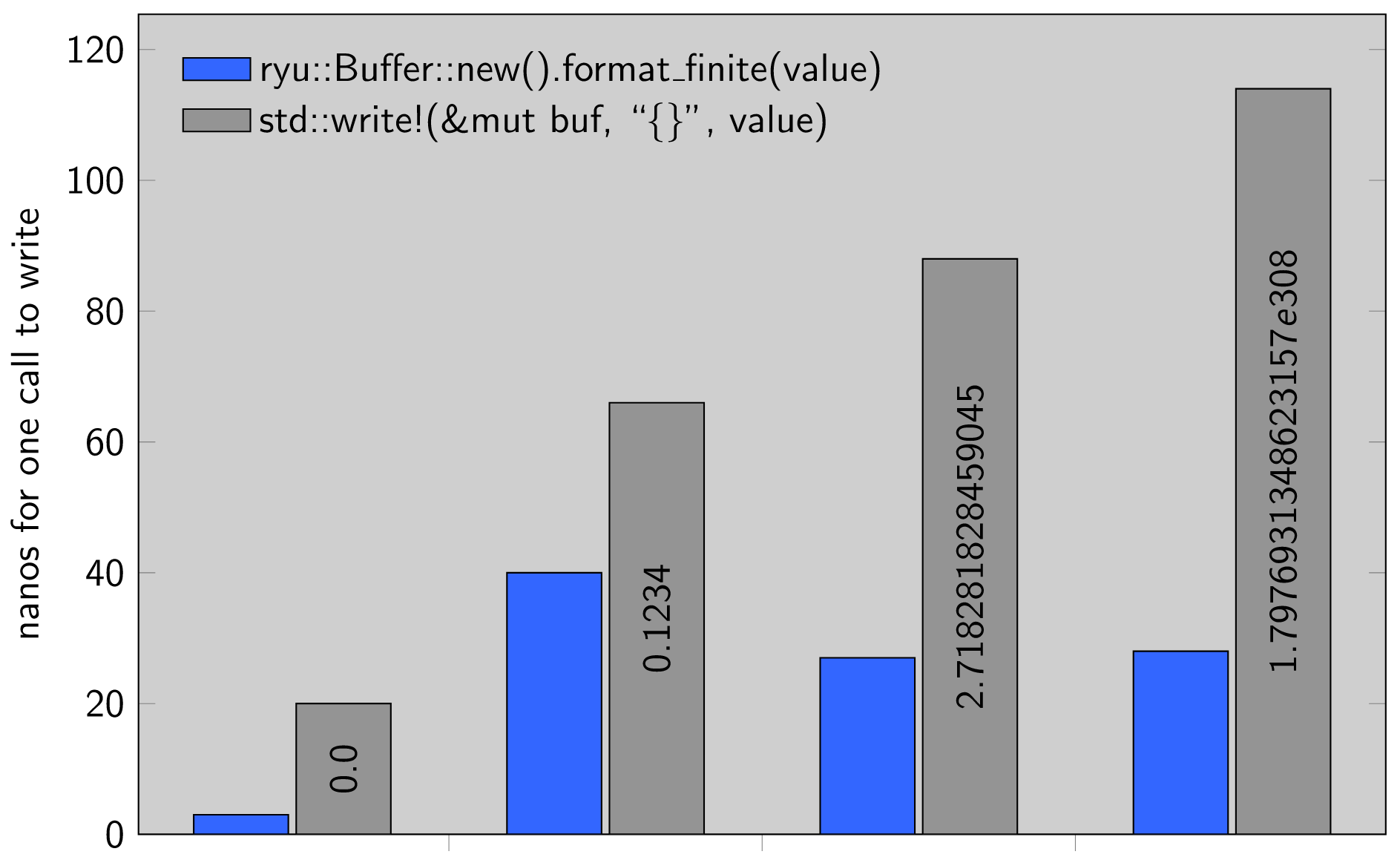
## Performance (lower is better)
You can run upstream's benchmarks with:
```console
$ git clone https://github.com/ulfjack/ryu c-ryu
$ cd c-ryu
$ bazel run -c opt //ryu/benchmark:ryu_benchmark
```
And the same benchmark against our implementation with:
```console
$ git clone https://github.com/hanyu-dev/ryuu rust-ryuu
$ cd rust-ryuu
$ cargo run --example upstream_benchmark --release
```
These benchmarks measure the average time to print a 32-bit float and average
time to print a 64-bit float, where the inputs are distributed as uniform random
bit patterns 32 and 64 bits wide.
The upstream C code, the unsafe direct Rust port, and the safe pretty Rust API
all perform the same, taking around 21 nanoseconds to format a 32-bit float and
31 nanoseconds to format a 64-bit float.
There is also a Rust-specific benchmark comparing this implementation to the
standard library which you can run with:
```console
$ cargo bench
```
The benchmark shows Ryū approximately 2-5x faster than the standard library
across a range of f32 and f64 inputs. Measurements are in nanoseconds per
iteration; smaller is better.
## Formatting
This library tends to produce more human-readable output than the standard
library's to\_string, which never uses scientific notation. Here are two
examples:
- *ryuu:* 1.23e40, *std:* 12300000000000000000000000000000000000000
- *ryuu:* 1.23e-40, *std:* 0.000000000000000000000000000000000000000123
Both libraries print short decimals such as 0.0000123 without scientific
notation.
<br>
#### License
<sup>
Licensed under either of <a href="LICENSE-APACHE">Apache License, Version
2.0</a> or <a href="LICENSE-BOOST">Boost Software License 1.0</a> at your
option.
</sup>
<br>
<sub>
Unless you explicitly state otherwise, any contribution intentionally submitted
for inclusion in this crate by you, as defined in the Apache-2.0 license, shall
be dual licensed as above, without any additional terms or conditions.
</sub>