# rustrtc
[](https://crates.io/crates/rustrtc)
[](https://docs.rs/rustrtc)
A high-performance, full-stack real-time communication library — **WebRTC, RTP/SRTP, T.38 Fax, and UPnP NAT traversal** — all through a **unified `PeerConnection` API**.
## Features
- **High performance** — ~2.7× faster than `webrtc-rs` and ~2.4× faster than `pion` (Go) in throughput, with ~30% less memory than `webrtc-rs` (see the benchmark below).
- **Full protocol stack** — WebRTC, RTP, SRTP, and **T.38 fax** in a single library, plus **UPnP IGD** NAT traversal. Few moving parts, no missing pieces.
- **Unified `PeerConnection` API** — one interface for every transport mode (`WebRtc` ICE/DTLS/SRTP, `Srtp`, `Rtp`, and T.38). No fragmented APIs.
- **WebRTC compliant** — interoperable with Chrome/WebRTC and pion; offer/answer, renegotiation, and standard SDP attributes.
- **Complete media pipeline** — packetizer/depacketizer, jitter buffer, NACK/FIR/PLI, TWCC, and REMB for audio and video.
- **Full ICE** — STUN, TURN (UDP + TCP), ICE Lite, ICE TCP (RFC 6544), and single-port UDP mux for SFU/WHEP deployments.
- **NAT traversal & deployment** — RTP latching, UPnP IGD port mapping, and firewall-friendly port ranges (`rtp_start_port`/`rtp_end_port`).
- **Production extras** — RTP rewrite bridge (SSRC/PT/sequence remapping) and a WebRTC-compatible stats model.
## Benchmark game (rustrtc vs webrtc-rs & pion) in 0.3.113
**CPU:** `AMD Ryzen 7 5700X 8-Core Processor`
**OS** `5.15.0-118-generic #128-Ubuntu`
**Compiler** `rustc 1.97.1 (8bab26f4f 2026-07-14)`, `go version go1.23.0 linux/amd64`
```shell
nice@miuda.ai rustrtc % cargo run -r --example benchmark
Comparison (Baseline: webrtc)
Duration (s) | 10.05 | 10.05 | 10.08
Setup Latency (ms) | 0.92 | 0.20 | 0.90
Throughput (MB/s) | 285.64 | 758.67 | 310.14
Msg Rate (msg/s) | 292495.02 | 776880.40 | 317586.71
CPU Usage (%) | 1348.20 | 1341.00 | 1154.67
Memory (MB) | 33.00 | 23.00 | 44.00
--------------------------------------------------------------------------------
Performance Charts
==================
Throughput (MB/s) (Higher is better)
pion | ████████████████ 310.14
Message Rate (msg/s) (Higher is better)
pion | ████████████████ 317586.71
Setup Latency (ms) (Lower is better)
pion | ███████████████████████████████████████ 0.90
CPU Usage (%) (Lower is better)
pion | ██████████████████████████████████ 1154.67
Memory (MB) (Lower is better)
pion | ████████████████████████████████████████ 44.00
```
**Key Findings:**
- **Throughput**: `rustrtc` is ~2.7x faster than `webrtc-rs` and ~2.4x faster than `pion`.
- **Memory**: `rustrtc` uses ~30% less memory than `webrtc-rs` and ~48% less than `pion`.
- **Setup Latency**: Significantly faster connection setup (0.20ms vs 0.92ms/0.90ms).
## Usage
Here is a simple example of how to create a `PeerConnection` and handle an offer:
```rust
use rustrtc::{PeerConnection, RtcConfiguration, SessionDescription, SdpType};
#[tokio::main]
async fn main() {
let config = RtcConfiguration::default();
let pc = PeerConnection::new(config);
// Create a Data Channel
let dc = pc.create_data_channel("data", None).unwrap();
// Handle received messages
let dc_clone = dc.clone();
tokio::spawn(async move {
while let Some(event) = dc_clone.recv().await {
if let rustrtc::DataChannelEvent::Message(data) = event {
println!("Received: {:?}", String::from_utf8_lossy(&data));
}
}
});
// Create an offer
let offer = pc.create_offer().unwrap();
pc.set_local_description(offer).unwrap();
// Wait for ICE gathering to complete
pc.wait_for_gathering_complete().await;
// Get the complete SDP with candidates
let complete_offer = pc.local_description().unwrap();
println!("Offer SDP: {}", complete_offer.to_sdp_string());
}
```
## Configuration
All configuration goes through `RtcConfiguration` (or its builder `RtcConfigurationBuilder`):
### Transport & Network
- **`transport_mode`** — `TransportMode::WebRtc` (default), `TransportMode::Srtp`, or `TransportMode::Rtp`.
- **`ice_servers`** — STUN/TURN server list.
- **`ice_transport_policy`** — `All` or `Relay`.
- **`rtp_start_port` / `rtp_end_port`** — Restrict RTP/ICE to a port range.
- **`external_ip`** — Override the external IP for ICE candidates (NAT scenarios).
- **`bind_ip`** — Bind to a specific local IP.
- **`disable_ipv6`** — Disable IPv6 candidate gathering.
- **`enable_ice_lite`** — Enable ICE Lite mode.
- **`ice_tcp_policy`** — `IceTcpPolicy::Disabled` (default), `IceTcpPolicy::Enabled`, or `IceTcpPolicy::PassiveOnly`. Controls ICE TCP candidate support per RFC 6544.
- **`ice_udp_mux`** / **`ice_udp_mux_port`** — Share a single UDP socket across many `PeerConnection`s (single-port multiplexing for SFU/WHEP). Set `ice_udp_mux = true` and `ice_udp_mux_port = <port>`; incoming packets are demuxed by the server ufrag in the STUN Binding Request, then by remote source address.
### UPnP
- **`enable_upnp`** — Auto-map ports via UPnP IGD.
- **`upnp_lease_duration`** — UPnP port mapping lease duration in seconds (default: 3600).
### RTP Latching
- **`enable_latching`** — Enable dynamic remote address detection for RTP-only mode.
- **`probation_max_packets`** — Number of packets to observe before committing a latched address.
### Media Capabilities
- **`media_capabilities`** — Configure audio/video/image (T.38) codecs and SCTP port via `MediaCapabilities`.
- **`ssrc_start`** — Starting SSRC value for local tracks.
### SCTP (Data Channels)
- `sctp_rto_initial`, `sctp_rto_min`, `sctp_rto_max`, `sctp_max_association_retransmits`, `sctp_receive_window`, `sctp_heartbeat_interval`, `sctp_max_heartbeat_failures`, `sctp_max_burst`, `sctp_max_cwnd`
### RTP Buffer
- `rtp_buffer_capacity` — Per-SSRC receive buffer capacity.
- `buffer_drop_strategy` — `DropNew` or `DropOldest` when buffer is full.
```rust
use rustrtc::{
PeerConnection, RtcConfiguration, RtcConfigurationBuilder,
IceServer, TransportMode, config::T38Capability,
};
// Using builder
let config = RtcConfigurationBuilder::new()
.transport_mode(TransportMode::Rtp)
.enable_latching(true)
.probation_max_packets(Some(5))
.rtp_port_range(50000, 50100)
.enable_upnp(true)
.ice_tcp_policy(config::IceTcpPolicy::Enabled)
.ice_server(IceServer::new(vec!["stun:stun.l.google.com:19302"]))
.build();
let pc = PeerConnection::new(config);
```
```rust
// Direct field access
let mut config = RtcConfiguration::default();
config.transport_mode = TransportMode::WebRtc;
config.enable_latching = true;
config.rtp_start_port = Some(50000);
config.rtp_end_port = Some(50100);
config.enable_upnp = true;
```
## Examples
You can run the examples provided in the repository.
### SFU (Selective Forwarding Unit)
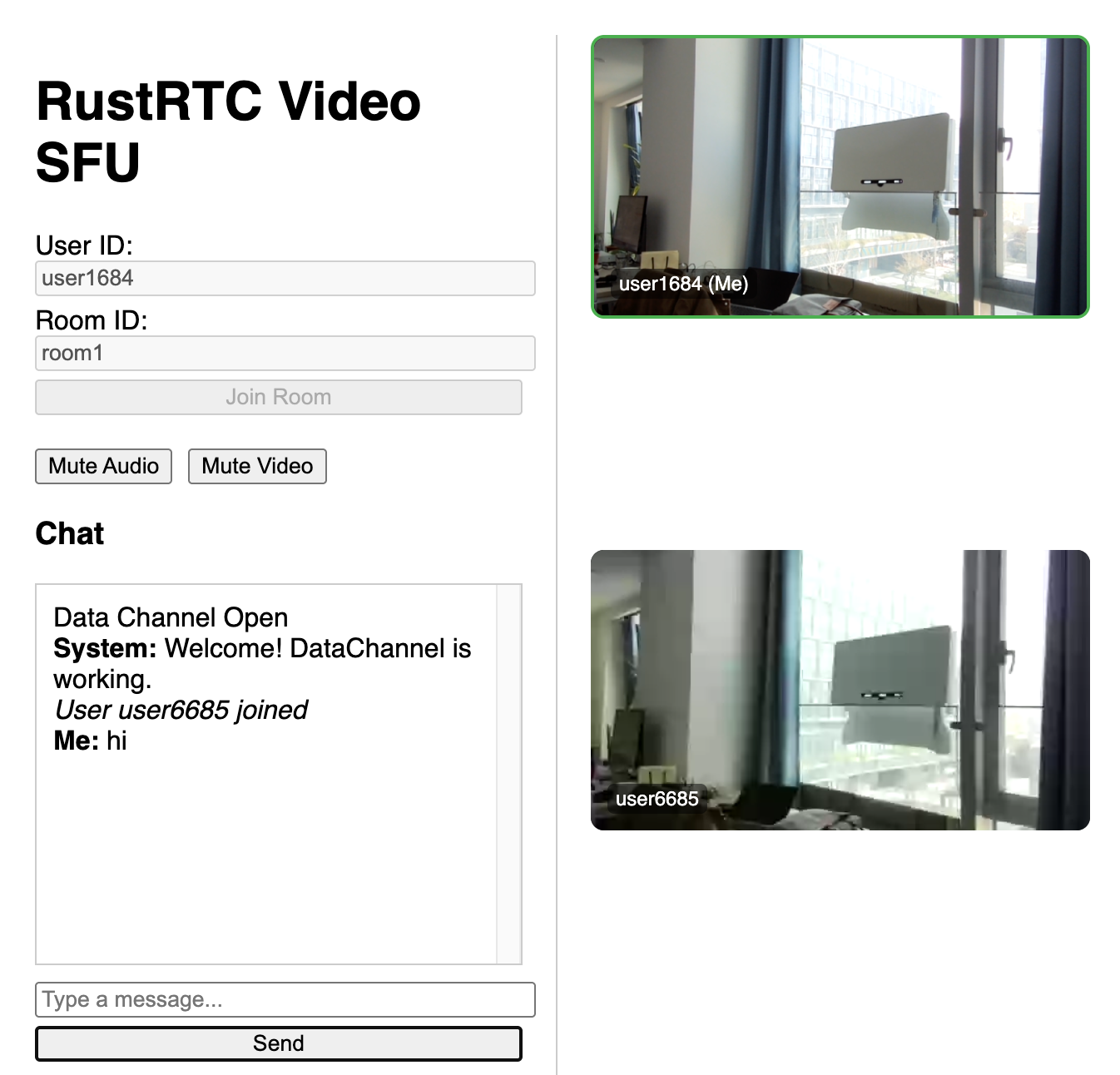
A multi-user video conferencing server. It receives media from each participant and forwards it to others.
1. Run the server:
```bash
cargo run --example rustrtc_sfu
```
2. Open your browser and navigate to `http://127.0.0.1:8081`. Open multiple tabs/windows to simulate multiple users.
### Echo Server
The echo server example demonstrates how to accept a WebRTC connection, receive data on a data channel, and echo it back. It also supports video playback if an IVF file is provided.
1. Run the server:
```bash
cargo run --example echo_server
```
2. Open your browser and navigate to `http://127.0.0.1:3000`.
### DataChannel Chat
A multi-user chat room using WebRTC DataChannels.
1. Run the server:
```bash
cargo run --example datachannel_chat
```
2. Open your browser and navigate to `http://127.0.0.1:3000`. Open multiple tabs to chat between them.
### Audio Saver
Records audio from the browser's microphone and saves it to a file (`output.ulaw`) on the server.
1. Run the server:
```bash
cargo run --example audio_saver
```
2. Open your browser and navigate to `http://127.0.0.1:3000`. Click "Start" to begin recording.
### RTP Play (FFmpeg)
Streams a video file (`examples/static/output.ivf`) via RTP to a UDP port, which can be played back using `ffplay`.
1. Run the server:
```bash
cargo run --example rtp_play
```
2. In a separate terminal, run `ffplay` (requires ffmpeg installed):
```bash
ffplay -protocol_whitelist file,udp,rtp -i examples/rtp_play.sdp
```
## License
This project is licensed under the MIT License.
