# 🧠 Rust Logic Graph
[](https://www.rust-lang.org/)
[](https://opensource.org/licenses/MIT)
[](https://github.com/KSD-CO/rust-logic-graph)
[](https://github.com/KSD-CO/rust-logic-graph/actions)
A high-performance **reasoning graph framework** for Rust with **GRL (Grule Rule Language)** support. Build complex workflows with conditional execution, topological ordering, and async processing.
---
## ✨ Key Features
- 🔥 **GRL Support** - [rust-rule-engine v0.14.0](https://crates.io/crates/rust-rule-engine) with RETE-UL algorithm (2-24x faster)
- 🔄 **Topological Execution** - Automatic DAG-based node ordering
- ⚡ **Async Runtime** - Built on Tokio for high concurrency
- ⚡ **Parallel Execution** - Automatic parallel execution of independent nodes (v0.5.0)
- 💾 **Caching Layer** - High-performance result caching with TTL, eviction policies, and memory limits (v0.5.0)
- 🧠 **Memory Optimization** - Context pooling and allocation tracking (v0.7.0)
- 🛠️ **CLI Developer Tools** - Graph validation, dry-run, profiling, and visualization (v0.5.0)
- 🎨 **Web Graph Editor** - Next.js visual editor with drag-and-drop interface (v0.8.0)
- � **YAML Configuration** - Declarative graph definitions with external config files (v0.8.5)
- �📊 **Multiple Node Types** - RuleNode, DBNode, AINode
- 📝 **JSON/YAML Configuration** - Simple workflow definitions
- 🎯 **98% Drools Compatible** - Easy migration from Java
- 🌊 **Streaming Processing** - Stream-based execution with backpressure (v0.3.0)
- 🗄️ **Database Integrations** - PostgreSQL, MySQL, Redis, MongoDB (v0.2.0)
- 🤖 **AI/LLM Integrations** - OpenAI, Claude, Ollama (v0.2.0)
---
## 🚀 Quick Start
### Installation
```toml
[dependencies]
rust-logic-graph = "0.8.5"
# With specific integrations
rust-logic-graph = { version = "0.8.5", features = ["postgres", "openai"] }
# With all integrations
rust-logic-graph = { version = "0.8.5", features = ["all-integrations"] }
```
### Simple Example
```rust
use rust_logic_graph::{RuleEngine, GrlRule};
let grl = r#"
rule "Discount" {
when
cart_total > 100 && is_member == true
then
discount = 0.15;
}
"#;
let mut engine = RuleEngine::new();
engine.add_grl_rule(grl)?;
```
## 🏢 Real-World Case Study: Purchasing Flow System
See a complete production implementation in **[case_study/](case_study/)** - A full-featured purchasing automation system built with Rust Logic Graph.
### 📊 System Overview
**Problem**: Automate purchasing decisions for inventory replenishment across multiple products, warehouses, and suppliers.
**Solution**: Business rules in GRL decide when/how much to order. Orchestrator executes the workflows.
### 🎯 Two Architecture Implementations
**1. Microservices (v4.0)** - 7 services with gRPC
- Orchestrator (port 8080) - Workflow coordination
- OMS Service (port 50051) - Order management data
- Inventory Service (port 50052) - Stock levels
- Supplier Service (port 50053) - Supplier information
- UOM Service (port 50054) - Unit conversions
- Rule Engine (port 50055) - GRL business rules
- PO Service (port 50056) - Purchase order management
**2. Monolithic (Clean Architecture)** - Single HTTP service with dynamic configuration
- Same business logic as microservices (shared GRL rules)
- Single process on port 8080
- **Multi-database architecture** - 4 separate PostgreSQL databases (oms_db, inventory_db, supplier_db, uom_db)
- **YAML-driven workflow** - Graph structure defined in `purchasing_flow_graph.yaml`
- **Dynamic field mapping** - Config-driven data extraction from context
- **Zero hardcoded fields** - All field names configurable via YAML
- Direct in-process execution (no network calls)
### 🔥 GRL Business Rules (15 Rules)
```grl
rule "CalculateShortage" salience 120 no-loop {
when
required_qty > 0
then
Log("Calculating shortage...");
shortage = required_qty - available_qty;
Log("Shortage calculated");
}
rule "OrderMOQWhenShortageIsLess" salience 110 no-loop {
when
shortage > 0 && shortage < moq && is_active == true
then
Log("Shortage less than MOQ, ordering MOQ");
order_qty = moq;
}
```
**See full rules**: [purchasing_rules.grl](case_study/microservices/services/rule-engine-service/rules/purchasing_rules.grl)
### YAML Configuration (NEW in v0.8.5)
Both Monolithic and Microservices implementations support **YAML-based graph configuration**:
**Monolithic YAML Example** (`purchasing_flow_graph.yaml`):
```yaml
nodes:
oms_history:
type: DBNode
database: "oms_db" # Multi-database routing
query: "SELECT product_id, avg_daily_demand::float8, trend FROM oms_history WHERE product_id = $1"
inventory_levels:
type: DBNode
database: "inventory_db"
query: "SELECT product_id, available_qty::float8, reserved_qty::float8 FROM inventory WHERE product_id = $1"
rule_engine:
type: RuleNode
description: "Evaluate business rules with dynamic field mapping"
dependencies:
- oms_history
- inventory_levels
- supplier_info
- uom_conversion
field_mappings: # Dynamic field extraction (NEW)
avg_daily_demand: "oms_history.avg_daily_demand"
available_qty: "inventory_levels.available_qty"
lead_time: "supplier_info.lead_time"
moq: "supplier_info.moq"
create_po:
type: RuleNode
dependencies:
- rule_engine
field_mappings:
should_order: "rule_engine.should_order"
recommended_qty: "rule_engine.recommended_qty"
product_id: "supplier_info.product_id"
edges:
- from: oms_history
to: rule_engine
- from: inventory_levels
to: rule_engine
- from: rule_engine
to: create_po
```
**Microservices YAML Example** (`purchasing_flow_graph.yaml`):
```yaml
nodes:
oms_grpc:
type: DBNode
description: "Fetch order management data via gRPC"
inventory_grpc:
type: DBNode
description: "Fetch inventory levels via gRPC"
rule_engine_grpc:
type: RuleNode
description: "Evaluate business rules"
dependencies:
- oms_grpc
- inventory_grpc
edges:
- from: oms_grpc
to: rule_engine_grpc
- from: inventory_grpc
to: rule_engine_grpc
```
**Benefits:**
- ✅ **70% less code** - Graph definition moves from Rust to YAML
- ✅ **No recompile** - Change workflows without rebuilding
- ✅ **Dynamic field mapping** - Zero hardcoded field names in Rust code
- ✅ **Multi-database routing** - Each node specifies its database
- ✅ **Multiple workflows** - Easy variants (urgent, standard, approval)
- ✅ **Better readability** - Clear, declarative graph structure
- ✅ **Easy testing** - Test with different configurations
**Usage:**
```rust
// Monolithic - Default config with multi-database
executor.execute("PROD-001").await?;
// Monolithic - Custom workflow
executor.execute_with_config("PROD-001", "urgent_flow.yaml").await?;
// Microservices - Default config with gRPC nodes
orchestrator.execute("PROD-001").await?;
```
**Key Architecture Differences:**
| **Database Access** | Direct SQL queries to 4 DBs | gRPC calls to services |
| **Field Mapping** | YAML `field_mappings` config | Hardcoded in gRPC nodes |
| **Rule Engine** | In-process RuleEngine call | gRPC to rule-engine-service |
| **Communication** | Function calls | gRPC (network) |
| **Graph Executor** | `PurchasingGraphExecutor` | `OrchestratorExecutor` |
| **Node Types** | `DynamicDBNode`, `DynamicRuleNode` | `OmsGrpcNode`, `RuleEngineGrpcNode` |
**Documentation**: See [YAML_CONFIGURATION_SUMMARY.md](case_study/YAML_CONFIGURATION_SUMMARY.md)
### Microservices Communication Flow
After v0.8.0 refactor, the Orchestrator now uses **rust-logic-graph's Graph/Executor pattern** to coordinate microservices:
- The Orchestrator receives a purchasing request (HTTP) and creates a **Graph** with 6 custom **gRPC Nodes**.
- Each Node wraps a gRPC call to a service: `OmsGrpcNode`, `InventoryGrpcNode`, `SupplierGrpcNode`, `UomGrpcNode`, `RuleEngineGrpcNode`, `PoGrpcNode`.
- The **Executor** runs the graph in topological order:
1. **Data Collection Phase** (parallel): OMS, Inventory, Supplier, UOM nodes execute simultaneously via gRPC
2. **Rule Evaluation Phase**: RuleEngineGrpcNode waits for all data, then evaluates GRL rules
3. **Execution Phase**: PoGrpcNode creates/sends PO based on rule decisions
- All business logic (decision flags, calculations) comes from GRL rules. The Orchestrator is a pure executor.
**Graph Topology**:
```
OMS Node ────┐
│
Inventory ───┼──→ RuleEngine Node ──→ PO Node
│
Supplier ────┤
│
UOM Node ────┘
```
**Benefits of Graph/Executor Pattern**:
- ✅ **Declarative**: Define workflow as nodes + edges instead of imperative code
- ✅ **Parallel Execution**: Data nodes run concurrently automatically
- ✅ **Type Safety**: Custom Node implementations with Rust's type system
- ✅ **Testable**: Each node can be tested in isolation
- ✅ **Consistent**: Same pattern used in monolithic and microservices
```
┌─────────────────────────────────────────────────────────────────────┐
│ CLIENT (HTTP REST) │
└────────────────────────────────┬────────────────────────────────────┘
│ POST /purchasing/flow
▼
┌────────────────────────────────────────────────────────────┐
│ Orchestrator Service (Port 8080) │
│ ┌─────────────────────────────────────────────────────┐ │
│ │ rust-logic-graph Graph Executor │ │
│ │ │ │
│ │ Creates Graph with 6 gRPC Nodes: │ │
│ │ • OmsGrpcNode → gRPC to OMS :50051 │ │
│ │ • InventoryGrpcNode → gRPC to Inventory :50052 │ │
│ │ • SupplierGrpcNode → gRPC to Supplier :50053 │ │
│ │ • UomGrpcNode → gRPC to UOM :50054 │ │
│ │ • RuleEngineGrpcNode → gRPC to Rules :50055 │ │
│ │ • PoGrpcNode → gRPC to PO :50056 │ │
│ │ │ │
│ │ Graph Topology: │ │
│ │ OMS ───────┐ │ │
│ │ Inventory ─┼─→ RuleEngine ──→ PO │ │
│ │ Supplier ──┤ │ │
│ │ UOM ───────┘ │ │
│ └─────────────────────────────────────────────────────┘ │
└────────┬───────────────────────────────────────────────────┘
│
┌─────────────┼──────────────────┬────────────────┬──────────────┐
│ (Parallel) │ (Parallel) │ (Parallel) │ (Parallel) │
▼ ▼ ▼ ▼ │
┌──────────┐ ┌────────────┐ ┌─────────────┐ ┌───────────┐ │
│OMS :50051│ │Inventory │ │Supplier │ │UOM :50054 │ │
│ │ │:50052 │ │:50053 │ │ │ │
│• History │ │• Levels │ │• Pricing │ │• Convert │ │
│• Demand │ │• Available │ │• Lead Time │ │• Factors │ │
└────┬─────┘ └─────┬──────┘ └──────┬──────┘ └─────┬─────┘ │
│ │ │ │ │
└──────────────┴────────────────┴───────────────┘ │
│ │
│ Data stored in Graph Context │
▼ │
┌─────────────────┐ │
│ Rule Engine │ (Port 50055 - gRPC) │
│ :50055 │ │
│ │ │
│ • GRL Rules │ • Evaluates 15 rules │
│ • Calculations │ • Returns decision flags │
│ • Decision Flags│ • NO side effects │
└────────┬────────┘ │
│ │
│ Flags stored in Graph Context │
▼ │
┌─────────────────┐ │
│ PO Service │ (Port 50056 - gRPC) │
│ :50056 │◄─────────────────────────────┘
│ │
│ • Create PO │ • Reads flags from context
│ • Send to │ • Executes based on rules
│ Supplier │ • Email/API delivery
└─────────────────┘
```
**Note**: The Rule Engine service returns decision flags and calculations to the Graph Context. The PoGrpcNode then reads these flags from the context to determine whether to create/send the PO.
### Where rust-logic-graph is Used
**Monolithic App** (`case_study/monolithic/`):
- Uses `Graph`, `Executor`, and custom `Node` implementations
- **Multi-database architecture**: 4 separate PostgreSQL databases (oms_db, inventory_db, supplier_db, uom_db)
- **Dynamic field mapping**: YAML-configured field extraction with zero hardcoded field names
- **Config-driven nodes**: `DynamicDBNode` and `DynamicRuleNode` read behavior from YAML
- Database routing via `database` field in YAML (e.g., `database: "oms_db"`)
- Field mappings via `field_mappings` in YAML (e.g., `avg_daily_demand: "oms_history.avg_daily_demand"`)
- `RuleEngineService` accepts `HashMap<String, Value>` for complete flexibility
- Graph structure defined in `purchasing_flow_graph.yaml`
- Single process, no network calls
**Orchestrator Microservice** (`case_study/microservices/services/orchestrator-service/`):
- Uses `Graph`, `Executor`, and custom gRPC `Node` implementations
- 6 gRPC nodes make network calls to remote services
- Same graph topology as monolithic
- Distributed across multiple processes
**Rule Engine Service** (`case_study/microservices/services/rule-engine-service/`):
- Uses `RuleEngine` for GRL evaluation
- Exposed via gRPC endpoint
- Stateless service (no graph execution)
**Other Microservices** (OMS, Inventory, Supplier, UOM, PO):
- Standard gRPC services with database access
- Do NOT use rust-logic-graph directly
- Called by Orchestrator's Graph Executor
**Architecture Highlights:**
**Monolithic Clean Architecture:**
```
┌─────────────────────────────────────────────────────────────────────────┐
│ HTTP REST API (Port 8080) │
│ POST /purchasing/flow {product_id} │
└──────────────────────────────┬──────────────────────────────────────────┘
│
▼
┌──────────────────────────────────────────────────────────────┐
│ PurchasingGraphExecutor (Clean Architecture) │
│ │
│ ┌────────────────────────────────────────────────────────┐ │
│ │ rust-logic-graph Graph/Executor Engine │ │
│ │ │ │
│ │ 1. Load purchasing_flow_graph.yaml │ │
│ │ 2. Parse nodes + edges + field_mappings │ │
│ │ 3. Create DynamicDBNode per database config │ │
│ │ 4. Create DynamicRuleNode with field mappings │ │
│ │ 5. Execute graph in topological order │ │
│ │ │ │
│ │ Graph Topology: │ │
│ │ oms_history ────────┐ │ │
│ │ inventory_levels ───┼──→ rule_engine ──→ create_po │ │
│ │ supplier_info ──────┤ │ │
│ │ uom_conversion ─────┘ │ │
│ └────────────────────────────────────────────────────────┘ │
└──────────────┬───────────────────────────────────────────────┘
│
┌──────────────────┼──────────────────┬──────────────────┬──────────┐
│ (Parallel DBs) │ (Parallel DBs) │ (Parallel DBs) │ (Parallel)
▼ ▼ ▼ ▼ │
┌──────────────┐ ┌──────────────┐ ┌──────────────┐ ┌──────────────┐ │
│ oms_db │ │ inventory_db │ │ supplier_db │ │ uom_db │ │
│ PostgreSQL │ │ PostgreSQL │ │ PostgreSQL │ │ PostgreSQL │ │
│ │ │ │ │ │ │ │ │
│ • history │ │ • levels │ │ • info │ │ • conversion │ │
│ • demand │ │ • available │ │ • pricing │ │ • factors │ │
│ • trends │ │ • reserved │ │ • lead_time │ │ │ │
└──────┬───────┘ └──────┬───────┘ └──────┬───────┘ └──────┬───────┘ │
│ │ │ │ │
│ Query with │ Query with │ Query with │ Query │
│ database:"oms" │ database:"inv" │ database:"sup" │ with DB │
└─────────────────┴─────────────────┴─────────────────┴─────────┘
│
Data stored in Graph Context
with path notation (e.g., "oms_history.avg_daily_demand")
│
▼
┌──────────────────────────────────────────┐
│ DynamicRuleNode (rule_engine) │
│ │
│ YAML field_mappings config: │
│ ┌────────────────────────────────────┐ │
│ │ avg_daily_demand: │ │
│ │ "oms_history.avg_daily_demand" │ │
│ │ available_qty: │ │
│ │ "inventory_levels.available_qty" │ │
│ │ lead_time: │ │
│ │ "supplier_info.lead_time" │ │
│ │ ... (9 total mappings) │ │
│ └────────────────────────────────────┘ │
│ │
│ extract_rule_inputs() loop: │
│ • Reads field_mappings from YAML │
│ • Uses get_value_by_path() for parsing │
│ • Returns HashMap<String, Value> │
│ • ZERO hardcoded field names! │
└──────────────┬───────────────────────────┘
│
▼
┌──────────────────────────────────────────┐
│ RuleEngineService (In-Process) │
│ │
│ evaluate(HashMap<String, Value>) │
│ │
│ • Loads purchasing_rules.grl │
│ • 15 business rules (GRL) │
│ • Accepts dynamic HashMap input │
│ • No struct, no hardcoded fields │
│ • Pure functional evaluation │
│ │
│ Rules calculate: │
│ ✓ shortage = required_qty - available │
│ ✓ order_qty (respects MOQ) │
│ ✓ total_amount with discounts │
│ ✓ requires_approval flag │
│ ✓ should_create_po flag │
└──────────────┬───────────────────────────┘
│
Decision flags returned to Context
│
▼
┌──────────────────────────────────────────┐
│ DynamicRuleNode (create_po) │
│ │
│ YAML field_mappings config: │
│ ┌────────────────────────────────────┐ │
│ │ should_order: │ │
│ │ "rule_engine.should_order" │ │
│ │ recommended_qty: │ │
│ │ "rule_engine.recommended_qty" │ │
│ │ product_id: │ │
│ │ "supplier_info.product_id" │ │
│ │ ... (6 total mappings) │ │
│ └────────────────────────────────────┘ │
│ │
│ • Reads rule_engine output from context │
│ • Dynamic field extraction via YAML │
│ • Creates PO if should_order == true │
│ • Returns PO JSON or null │
└──────────────────────────────────────────┘
```
**Key Design Principles:**
1. **Multi-Database Routing** - Each node specifies its database in YAML:
```yaml
oms_history:
database: "oms_db" # Routes to oms_db pool
```
2. **Dynamic Field Mapping** - Zero hardcoded fields in Rust code:
```yaml
field_mappings:
avg_daily_demand: "oms_history.avg_daily_demand"
```
```rust
for (key, path) in &self.field_mappings {
inputs.insert(key.clone(), get_value_by_path(ctx, path));
}
```
3. **Config-Driven Execution** - Graph structure in YAML, not Rust:
```rust
executor.execute_with_config("PROD-001", "purchasing_flow_graph.yaml")?;
```
4. **HashMap-Based RuleEngine** - Accepts any fields:
```rust
pub fn evaluate(&mut self, inputs: HashMap<String, Value>) -> Result<Output>
```
**Microservices Communication Flow**
1. **Multi-Database Routing** (`graph_executor.rs`):
```rust
oms_history:
database: "oms_db"
query: "SELECT ..."
let pool = self.get_pool(node_config.database.as_deref());
```
2. **Dynamic Field Mapping** (`graph_executor.rs`):
```rust
field_mappings:
avg_daily_demand: "oms_history.avg_daily_demand"
available_qty: "inventory_levels.available_qty"
fn extract_inputs(&self, ctx: &Context) -> HashMap<String, Value> {
for (key, path) in &self.field_mappings {
if let Some(value) = self.get_value_by_path(ctx, path) {
inputs.insert(key.clone(), value);
}
}
}
```
3. **Config-Driven RuleEngine** (`rule_service.rs`):
```rust
pub fn evaluate(&mut self, inputs: HashMap<String, Value>) -> Result<Output> {
}
```
### Web Graph Editor (NEW in v0.8.0)
**🌐 Online Editor**: [https://logic-graph-editor.amalthea.cloud/](https://logic-graph-editor.amalthea.cloud/)
Try the visual graph editor online - no installation required! Create workflows, define rules, and visualize your logic graphs with drag-and-drop.
### CLI Tools (v0.5.0)
```bash
# Build the CLI tool
cargo build --release --bin rlg
# Validate a graph
./target/release/rlg validate --file examples/sample_graph.json
# Visualize graph structure
./target/release/rlg visualize --file examples/sample_graph.json --details
# Profile performance
./target/release/rlg profile --file examples/sample_graph.json --iterations 100
# Dry-run without execution
./target/release/rlg dry-run --file examples/sample_graph.json --verbose
```
**[Full CLI Documentation →](docs/CLI_TOOL.md)**
### Run Examples
```bash
# Basic workflow
cargo run --example simple_flow
# GRL rules
cargo run --example grl_rules
# Advanced integration
cargo run --example grl_graph_flow
```
---
---
## 📚 Documentation
| **[🏢 Case Study: Purchasing Flow](case_study/docs/README.md)** | Real production system with microservices & monolithic implementations |
| **[📋 YAML Configuration Guide](case_study/YAML_CONFIGURATION_SUMMARY.md)** | Declarative graph configuration with YAML (NEW in v0.8.5) |
| **[Graph Editor Guide](graph-editor/README.md)** | Visual web-based graph editor with Next.js (NEW in v0.8.0) |
| **[Memory Optimization Guide](docs/MEMORY_OPTIMIZATION.md)** | Context pooling and allocation tracking (v0.7.0) |
| **[CLI Tool Guide](docs/CLI_TOOL.md)** | Developer tools for validation, profiling, and visualization (v0.5.0) |
| **[Cache Guide](docs/CACHE_IMPLEMENTATION.md)** | Caching layer with TTL and eviction policies (v0.5.0) |
| **[Migration Guide](docs/MIGRATION_GUIDE.md)** | Upgrade guide to v0.14.0 with RETE-UL (v0.5.0) |
| **[Integrations Guide](docs/INTEGRATIONS.md)** | Database & AI integrations (v0.2.0) |
| **[GRL Guide](docs/GRL.md)** | Complete GRL syntax and examples |
| **[Use Cases](docs/USE_CASES.md)** | 33+ real-world applications |
| **[Extending](docs/EXTENDING.md)** | Create custom nodes and integrations |
| **[Implementation](docs/IMPLEMENTATION_SUMMARY.md)** | Technical details |
---
## 🎯 Use Cases
Rust Logic Graph powers applications in:
- 💰 **Finance** - Loan approval, fraud detection, risk assessment
- 🛒 **E-commerce** - Dynamic pricing, recommendations, fulfillment
- 🏥 **Healthcare** - Patient triage, clinical decisions, monitoring
- 🏭 **Manufacturing** - Predictive maintenance, QC automation
- 🛡️ **Insurance** - Claims processing, underwriting
- 📊 **Marketing** - Lead scoring, campaign optimization
- ⚖️ **Compliance** - AML monitoring, GDPR automation
**[View all 33+ use cases →](docs/USE_CASES.md)**
---
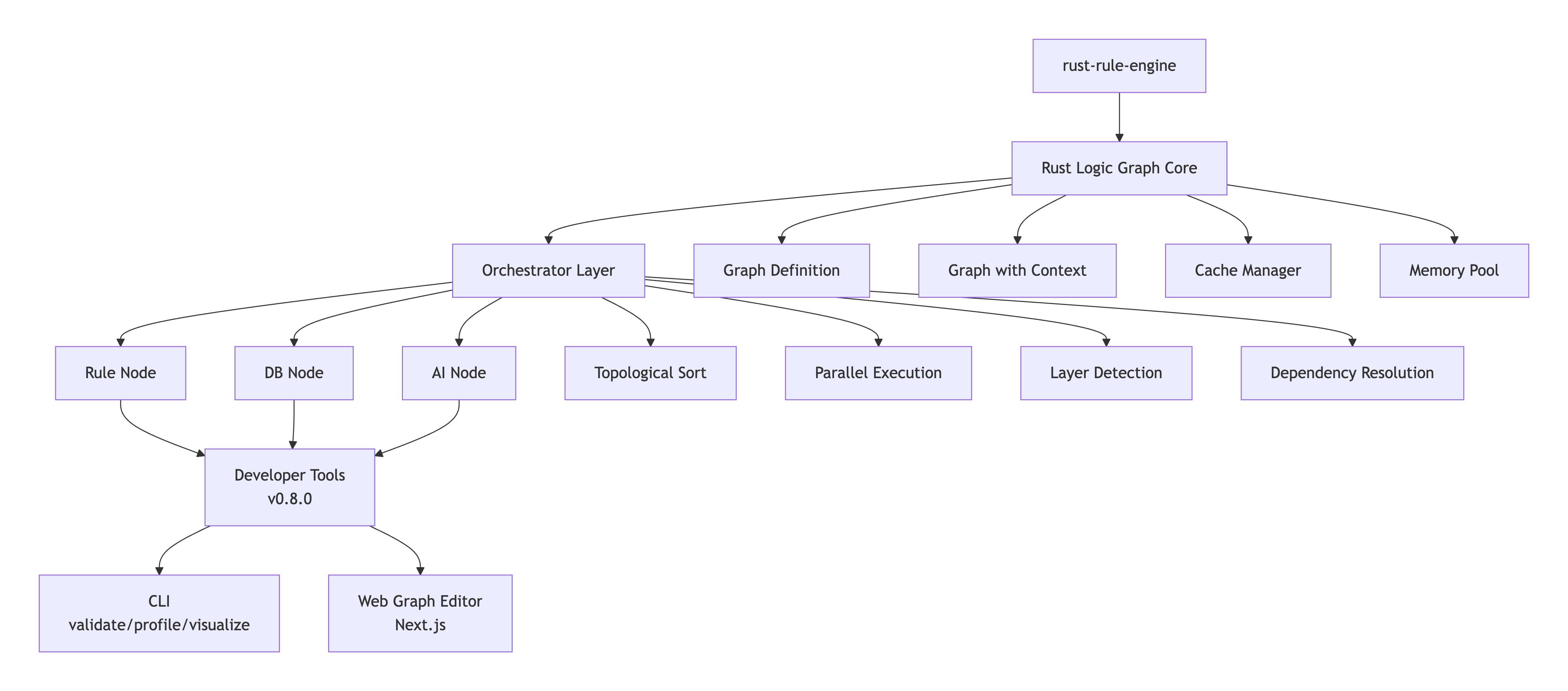
## 🏗️ Architecture
---
## 🔥 GRL Example
```grl
rule "HighValueLoan" salience 100 {
when
loan_amount > 100000 &&
credit_score < 750
then
requires_manual_review = true;
approval_tier = "senior";
}
rule "AutoApproval" salience 50 {
when
credit_score >= 700 &&
income >= loan_amount * 3 &&
debt_ratio < 0.4
then
auto_approve = true;
interest_rate = 3.5;
}
```
**[Learn more about GRL →](docs/GRL.md)**
---
## 📊 Performance
- **RETE-UL Algorithm**: Advanced pattern matching with unlinking (v0.14.0)
- **2-24x Faster**: Than v0.10 at 50+ rules
- **98% Drools Compatible**: Easy migration path
- **Async by Default**: High concurrency support
- **Parallel Execution**: Automatic layer-based parallelism
- **Smart Caching**: Result caching with TTL and eviction policies
---
## 🧪 Testing & CLI Tools
```bash
# Run all tests
cargo test
# Build CLI tool
cargo build --release --bin rlg
# Validate graph
./target/release/rlg validate --file examples/sample_graph.json
# Visualize graph structure
./target/release/rlg visualize --file examples/sample_graph.json
# Profile performance
./target/release/rlg profile --file examples/sample_graph.json --iterations 100
# Dry-run execution
./target/release/rlg dry-run --file examples/sample_graph.json --verbose
```
**Test Results**: ✅ 32/32 tests passing
**[Learn more about CLI tools →](docs/CLI_TOOL.md)**
---
## 📦 Project Status
**Version**: 0.8.5 (Latest)
**Status**: Production-ready with YAML configuration, web graph editor, and real-world case study
### What's Working
- ✅ Core graph execution engine
- ✅ **RETE-UL algorithm** (v0.14.0) - 2-24x faster
- ✅ Three node types (Rule, DB, AI)
- ✅ Topological sorting
- ✅ Async execution
- ✅ JSON I/O
- ✅ **Database integrations** (PostgreSQL, MySQL, Redis, MongoDB)
- ✅ **AI integrations** (OpenAI, Claude, Ollama)
- ✅ **Streaming processing** with backpressure and chunking
- ✅ **Parallel execution** with automatic layer detection
- ✅ **Caching layer** with TTL, eviction policies, memory limits (v0.5.0)
- ✅ **Memory optimization** with context pooling (v0.7.0)
- ✅ **CLI Developer Tools** - validate, profile, visualize, dry-run (v0.5.0)
- ✅ **Web Graph Editor** - Next.js visual editor with drag-and-drop (v0.8.0)
- ✅ **Production Case Study** - Purchasing flow with microservices & monolithic (v0.8.0)
- ✅ **YAML Configuration** - Declarative graph definitions (v0.8.5)
- ✅ Stream operators (map, filter, fold)
- ✅ Comprehensive documentation
### Roadmap
- [x] Streaming processing (v0.3.0) - COMPLETED ✅
- [x] Parallel node execution (v0.4.0) - COMPLETED ✅
- [x] Caching layer (v0.5.0) - COMPLETED ✅
- [x] CLI Developer Tools (v0.5.0) - COMPLETED ✅
- [x] RETE-UL upgrade (v0.5.0) - COMPLETED ✅
- [x] Memory Optimization (v0.7.0) - COMPLETED ✅
- [x] Web Graph Editor (v0.8.0) - COMPLETED ✅
- [x] Production Case Study (v0.8.0) - COMPLETED ✅
- [x] YAML Configuration (v0.8.5) - COMPLETED ✅
- [ ] GraphQL API (v0.9.0)
- [ ] Production release (v1.0.0)
**See [ROADMAP.md](ROADMAP.md) for details**
---
## 🤝 Contributing
Contributions welcome! Please:
1. Fork the repository
2. Create your feature branch
3. Write tests for new features
4. Submit a pull request
---
## 📖 Examples
| `simple_flow.rs` | Basic 3-node pipeline | 36 |
| `advanced_flow.rs` | Complex 6-node workflow | 120 |
| `grl_rules.rs` | GRL rule examples | 110 |
| `grl_graph_flow.rs` | GRL + Graph integration | 140 |
| `postgres_flow.rs` | PostgreSQL integration | 100 |
| `openai_flow.rs` | OpenAI GPT integration | 150 |
| `streaming_flow.rs` | Streaming with backpressure | 200 |
| `parallel_execution.rs` | Parallel node execution | 250 |
### CLI Tool Examples (v0.5.0)
| `examples/sample_graph.json` | Linear workflow with 5 nodes |
| `examples/cyclic_graph.json` | Graph with cycle for testing |
| `examples/sample_context.json` | Sample input data |
**See [CLI_TOOL.md](docs/CLI_TOOL.md) for usage examples**
---
## 🌟 Why Rust Logic Graph?
### vs. Traditional Rule Engines
- ✅ **Async by default** - No blocking I/O
- ✅ **Type safety** - Rust's type system
- ✅ **Modern syntax** - GRL support
- ✅ **Graph-based** - Complex workflows
### vs. Workflow Engines
- ✅ **Embedded** - No external services
- ✅ **Fast** - Compiled Rust code
- ✅ **Flexible** - Custom nodes
- ✅ **Rule-based** - Business logic in rules
---
## 📝 Changelog
### v0.8.5 (2025-11-20) - YAML Configuration Release
**New Features:**
- 📋 **YAML Configuration Support** - Declarative graph definitions
- Load graph structure from YAML files instead of hardcoded
- `GraphConfig` module for parsing YAML configurations
- Support for both JSON and YAML formats
- 70% code reduction in graph executors
- See [YAML Configuration Guide](case_study/YAML_CONFIGURATION_SUMMARY.md)
- 🔧 **Enhanced Graph Executor API**
- `execute()` - Use default configuration
- `execute_with_config(config_path)` - Load custom YAML config
- Dynamic node registration from config
- 📝 **Multiple Workflow Support**
- Standard flow (full process)
- Simplified flow (skip optional steps)
- Urgent flow (fast-track)
- Easy to create custom workflows
- 🏗️ **Monolithic Clean Architecture** (NEW)
- Multi-database architecture with 4 PostgreSQL databases
- Dynamic field mapping via YAML configuration
- Zero hardcoded field names in code
- Database routing per node via config
- `field_mappings` for flexible data extraction
- `RuleEngineService` accepts `HashMap<String, Value>`
- Config-driven `DynamicDBNode` and `DynamicRuleNode`
- 📚 **Comprehensive Documentation**
- YAML configuration guide with examples
- Before/After comparison showing improvements
- Multiple workflow examples
- Integration guides for both architectures
- Clean architecture patterns documentation
**Improvements:**
- Monolithic and Microservices both support YAML configs
- Reduced boilerplate code by 70% in executors
- Better separation of concerns (config vs. code)
- Easier testing with multiple configurations
- No recompilation needed for workflow changes
- Complete flexibility in field naming and mapping
**Examples:**
```yaml
# Monolithic with multi-database
nodes:
oms_history:
database: "oms_db"
query: "SELECT ..."
rule_engine:
field_mappings:
avg_daily_demand: "oms_history.avg_daily_demand"
```
```rust
// Dynamic field extraction (no hardcoding)
let inputs = self.extract_rule_inputs(ctx);
rule_service.evaluate(inputs)?; // HashMap<String, Value>
```
**Compatibility:**
- All tests passing
- API backward compatible
- Existing hardcoded graphs still work
### v0.8.0 (2025-11-20) - Web Editor & Production Case Study Release
**New Features:**
- 🎨 **Web Graph Editor** - Next.js visual editor with drag-and-drop
- Online version: https://logic-graph-editor.amalthea.cloud/
- React Flow-based graph visualization
- Real-time node editing and validation
- Export/import JSON workflows
- See [Graph Editor Guide](graph-editor/README.md)
- 🏢 **Production Case Study** - Complete purchasing flow system
- Microservices architecture (7 services with gRPC)
- Monolithic architecture (single HTTP service)
- 15 GRL business rules for purchasing decisions
- Kubernetes deployment manifests
- Docker Compose for local development
- Shared GRL rules proving portability
- See [Case Study Documentation](case_study/docs/README.md)
**Improvements:**
- Updated README with case study section
- Added online graph editor link
- Comprehensive production examples
**Compatibility:**
- All tests passing
- API backward compatible
### v0.5.0 (2025-11-06) - Performance & Developer Tools Release
**Breaking Changes:**
- ⚡ **Upgraded rust-rule-engine** from v0.10 → v0.14.0
- Now uses RETE-UL algorithm (2-24x faster)
- Better memory efficiency
- Improved conflict resolution
- See [Migration Guide](docs/MIGRATION_GUIDE.md)
**New Features:**
- 🛠️ **CLI Developer Tools** (`rlg` binary)
- Graph validation with comprehensive checks
- Dry-run execution mode
- Performance profiling with statistics
- ASCII graph visualization
- See [CLI Tool Guide](docs/CLI_TOOL.md)
- 💾 **Caching Layer** - High-performance result caching
- TTL-based expiration
- Multiple eviction policies (LRU, LFU, FIFO)
- Memory limits and statistics
- See [Cache Guide](docs/CACHE_IMPLEMENTATION.md)
- ⚡ **Parallel Node Execution** - Automatic detection and parallel execution
- Layer detection algorithm using topological sort
- Concurrent execution within layers
- Parallelism analysis and statistics
- 📊 **ParallelExecutor** - New executor with parallel capabilities
- 📝 **New Examples** - CLI examples and test graphs
- ✅ **32 Tests** - Comprehensive test coverage
**Improvements:**
- Updated documentation with CLI tools, caching, and migration guides
- Performance benchmarking utilities
- Example graph files for testing
**Compatibility:**
- All 32 tests passing
- API is backward compatible (100%)
- Performance: 2-24x faster rule matching
### v0.3.0 (2025-11-03) - Streaming & Performance Release
**New Features:**
- 🌊 **Streaming Processing** - Stream-based node execution
- Backpressure handling with bounded channels
- Large dataset support with chunking
- Stream operators (map, filter, fold, async map)
- 📝 **New Example** - `streaming_flow.rs` with 6 demonstrations
- ✅ **8 New Tests** - Streaming module testing
**Performance:**
- Processed 10,000 items in chunks
- ~432 items/sec throughput with backpressure
### v0.2.0 (2025-11-02) - Integrations Release
**New Features:**
- 🗄️ **Database Integrations** - PostgreSQL, MySQL, Redis, MongoDB
- 🤖 **AI/LLM Integrations** - OpenAI GPT-4, Claude 3.5, Ollama
- 📝 **Integration Examples** - `postgres_flow.rs`, `openai_flow.rs`
- 📚 **INTEGRATIONS.md** - Comprehensive integration guide
- 🎛️ **Feature Flags** - Optional dependencies for integrations
### v0.1.0 (2025-11-01) - Initial Release
**Core Features:**
- 🧠 Core graph execution engine
- 🔥 GRL (Grule Rule Language) integration
- 🔄 Topological sorting
- ⚡ Async execution with Tokio
- 📊 Three node types (Rule, DB, AI)
- 📝 JSON I/O for graphs
- 📚 4 working examples
- ✅ 6/6 tests passing
---
## 📄 License
MIT License - see [LICENSE](LICENSE) for details.
---
## 🔗 Links
- **Repository**: https://github.com/KSD-CO/rust-logic-graph
- **rust-rule-engine**: https://crates.io/crates/rust-rule-engine
- **Documentation**: [docs/](docs/)
- **Issues**: [GitHub Issues](https://github.com/KSD-CO/rust-logic-graph/issues)
---
## 👥 Authors
**James Vu** - Initial work
---
## 🙏 Acknowledgments
Built with:
- [rust-rule-engine v0.14.0](https://crates.io/crates/rust-rule-engine) - GRL support with RETE-UL
- [Tokio](https://tokio.rs/) - Async runtime
- [Petgraph](https://github.com/petgraph/petgraph) - Graph algorithms
- [Serde](https://serde.rs/) - Serialization
- [Clap](https://github.com/clap-rs/clap) - CLI framework
---
<div align="center">
**⭐ Star us on GitHub if you find this useful! ⭐**
[Documentation](docs/) • [Examples](examples/) • [Use Cases](docs/USE_CASES.md) • [YAML Config Guide](case_study/YAML_CONFIGURATION_SUMMARY.md)
</div>