
🧠 Rust Logic Graph




A high-performance reasoning graph framework for Rust with GRL (Grule Rule Language) support. Build complex workflows with conditional execution, topological ordering, and async processing.
✨ Key Features
- 🔥 GRL Support - rust-rule-engine v0.14.0 with RETE-UL algorithm (2-24x faster)
- 🔄 Topological Execution - Automatic DAG-based node ordering
- ⚡ Async Runtime - Built on Tokio for high concurrency
- ⚡ Parallel Execution - Automatic parallel execution of independent nodes (v0.5.0)
- 💾 Caching Layer - High-performance result caching with TTL, eviction policies, and memory limits (v0.5.0)
- 🧠 Memory Optimization - Context pooling and allocation tracking (v0.7.0)
- 🛠️ CLI Developer Tools - Graph validation, dry-run, profiling, and visualization (v0.5.0)
- 🎨 Web Graph Editor - Next.js visual editor with drag-and-drop interface (v0.8.0)
- 📊 Multiple Node Types - RuleNode, DBNode, AINode
- 📝 JSON Configuration - Simple workflow definitions
- 🎯 98% Drools Compatible - Easy migration from Java
- 🌊 Streaming Processing - Stream-based execution with backpressure (v0.3.0)
- 🗄️ Database Integrations - PostgreSQL, MySQL, Redis, MongoDB (v0.2.0)
- 🤖 AI/LLM Integrations - OpenAI, Claude, Ollama (v0.2.0)
🚀 Quick Start
Installation
[]
= "0.8.0"
# With specific integrations
= { = "0.8.0", = ["postgres", "openai"] }
# With all integrations
= { = "0.8.0", = ["all-integrations"] }
Simple Example
use ;
let grl = r#"
rule "Discount" {
when
cart_total > 100 && is_member == true
then
discount = 0.15;
}
"#;
let mut engine = new;
engine.add_grl_rule?;
🏢 Real-World Case Study: Purchasing Flow System
See a complete production implementation in case_study/ - A full-featured purchasing automation system built with Rust Logic Graph.
📊 System Overview
Problem: Automate purchasing decisions for inventory replenishment across multiple products, warehouses, and suppliers.
Solution: Business rules in GRL decide when/how much to order. Orchestrator executes the workflows.
🎯 Two Architecture Implementations
1. Microservices (v4.0) - 7 services with gRPC
- Orchestrator (port 8080) - Workflow coordination
- OMS Service (port 50051) - Order management data
- Inventory Service (port 50052) - Stock levels
- Supplier Service (port 50053) - Supplier information
- UOM Service (port 50054) - Unit conversions
- Rule Engine (port 50055) - GRL business rules
- PO Service (port 50056) - Purchase order management
2. Monolithic - Single HTTP service
- Same business logic as microservices
- Single process on port 8080
- Shared GRL rules file
- Direct function calls instead of gRPC
🔥 GRL Business Rules (15 Rules)
rule "CalculateShortage" salience 120 no-loop {
  when
    required_qty > 0
  then
    Log("Calculating shortage...");
    shortage = required_qty - available_qty;
    Log("Shortage calculated");
}

rule "OrderMOQWhenShortageIsLess" salience 110 no-loop {
  when
    shortage > 0 && shortage < moq && is_active == true
  then
    Log("Shortage less than MOQ, ordering MOQ");
    order_qty = moq;
}
See full rules: purchasing_rules.grl
Microservices Communication Flow
This case study uses a gRPC-based communication pattern between small services. The high-level flow:
- The Orchestrator receives a purchasing request (HTTP/gRPC) and queries services (OMS, Inventory, Supplier, UOM) to build a context for rule evaluation.
- The Orchestrator sends the context to the Rule Engine service (gRPC). The Rule Engine evaluates the shared GRL rules and returns decision flags rather than performing side-effects.
- Decision flags include fields like:
should_create_po,should_send_po,po_status,send_method, and computed values such asorder_qty,shortage,total_amount. - Based on flags, the Orchestrator calls the PO Service to create a purchase order, and if
should_send_pois true, it instructs the Supplier Service to send the PO using the selectedsend_method(email/API).
Typical proto message fields (summary):
- EvaluateRequest: product_id, required_qty, available_qty, moq, unit_price, lead_time
- EvaluateResponse: should_create_po, should_send_po, po_status, send_method, order_qty, total_amount
This separation keeps rules pure (no side-effects) and centralizes execution decisions in the Orchestrator.
┌─────────────────────────────────────────────────────────────────────┐
│                         CLIENT (HTTP REST)                          │
└────────────────────────────────┬────────────────────────────────────┘
         │ POST /purchasing/flow
         ▼
        ┌────────────────────────┐
        │  Orchestrator Service  │ (Port 8080 - HTTP)
        │  ┌──────────────────┐  │
        │  │ Workflow Manager │  │ • Fetches data from services
        │  │ Pure Executor    │  │ • Calls rule engine for decisions
        │  └──────────────────┘  │ • Executes based on flags
        └────────┬───────────────┘
           │ (gRPC calls - parallel)
  ┌────────────────────┼────────────────────┬───────────────┐
  │                    │                    │               │
  ▼                    ▼                    ▼               ▼
┌──────────────┐    ┌──────────────┐    ┌──────────────┐   ┌──────────────┐
│ OMS Service  │    │   Inventory  │    │   Supplier   │   │ UOM Service  │
│   :50051     │    │   Service    │    │   Service    │   │   :50054     │
│              │    │    :50052    │    │    :50053    │   │              │
│ • History    │    │ • Levels     │    │ • Info       │   │ • Conversion │
│ • Demand     │    │ • Available  │    │ • Pricing    │   │ • Factors    │
└──────────────┘    └──────────────┘    └──────────────┘   └──────────────┘
           │
           │ gRPC with context data
           ▼
        ┌────────────────────────┐
        │ Rule Engine Service    │ (Port 50055 - gRPC)
        │  ┌──────────────────┐  │
        │  │ GRL Rule Engine  │  │ • Evaluates business rules
        │  │ Decision Maker   │  │ • Returns calculations + flags
        │  │ (Calculation     │  │ • NO execution/side effects
        │  │  Mode)           │  │
        │  └─────────┬────────┘  │
        │            │           │
        │     ┌──────▼────────┐  │
        │     │ GRL Rules     │  │
        │     │ (15 rules)    │  │
        │     └───────────────┘  │
        └────────────────────────┘
           │
           │ Returns: {
           │   should_create_po: true,
           │   should_send_po: true,
           │   order_qty: 245,
           │   total_amount: 3797.50,
           │   approval_status: "auto_approved"
           │ }
           ▼
        ┌────────────────────────┐
        │  Orchestrator reads    │
        │  flags & executes:     │
        └────────┬───────────────┘
           │
    ┌────────────┴─────────────┐
    │                          │
    ▼                          ▼
  ┌──────────────┐          ┌──────────────┐
  │ PO Service   │          │  (Future)    │
  │   :50056     │          │ Notification │
  │              │          │   Service    │
  │ • CreatePO   │          │              │
  │ • SendPO     │          │ • Alerts     │
  └──────────────┘          │ • Emails     │
          └──────────────┘
Web Graph Editor (NEW in v0.8.0)
🌐 Online Editor: https://logic-graph-editor.amalthea.cloud/
Try the visual graph editor online - no installation required! Create workflows, define rules, and visualize your logic graphs with drag-and-drop.
CLI Tools (v0.5.0)
# Build the CLI tool
# Validate a graph
# Visualize graph structure
# Profile performance
# Dry-run without execution
Run Examples
# Basic workflow
# GRL rules
# Advanced integration
📚 Documentation
| Document | Description |
|---|---|
| 🏢 Case Study: Purchasing Flow | Real production system with microservices & monolithic implementations |
| Graph Editor Guide | Visual web-based graph editor with Next.js (NEW in v0.8.0) |
| Memory Optimization Guide | Context pooling and allocation tracking (v0.7.0) |
| CLI Tool Guide | Developer tools for validation, profiling, and visualization (v0.5.0) |
| Cache Guide | Caching layer with TTL and eviction policies (v0.5.0) |
| Migration Guide | Upgrade guide to v0.14.0 with RETE-UL (v0.5.0) |
| Integrations Guide | Database & AI integrations (v0.2.0) |
| GRL Guide | Complete GRL syntax and examples |
| Use Cases | 33+ real-world applications |
| Extending | Create custom nodes and integrations |
| Implementation | Technical details |
🎯 Use Cases
Rust Logic Graph powers applications in:
- 💰 Finance - Loan approval, fraud detection, risk assessment
- 🛒 E-commerce - Dynamic pricing, recommendations, fulfillment
- 🏥 Healthcare - Patient triage, clinical decisions, monitoring
- 🏭 Manufacturing - Predictive maintenance, QC automation
- 🛡️ Insurance - Claims processing, underwriting
- 📊 Marketing - Lead scoring, campaign optimization
- ⚖️ Compliance - AML monitoring, GDPR automation
🏗️ Architecture
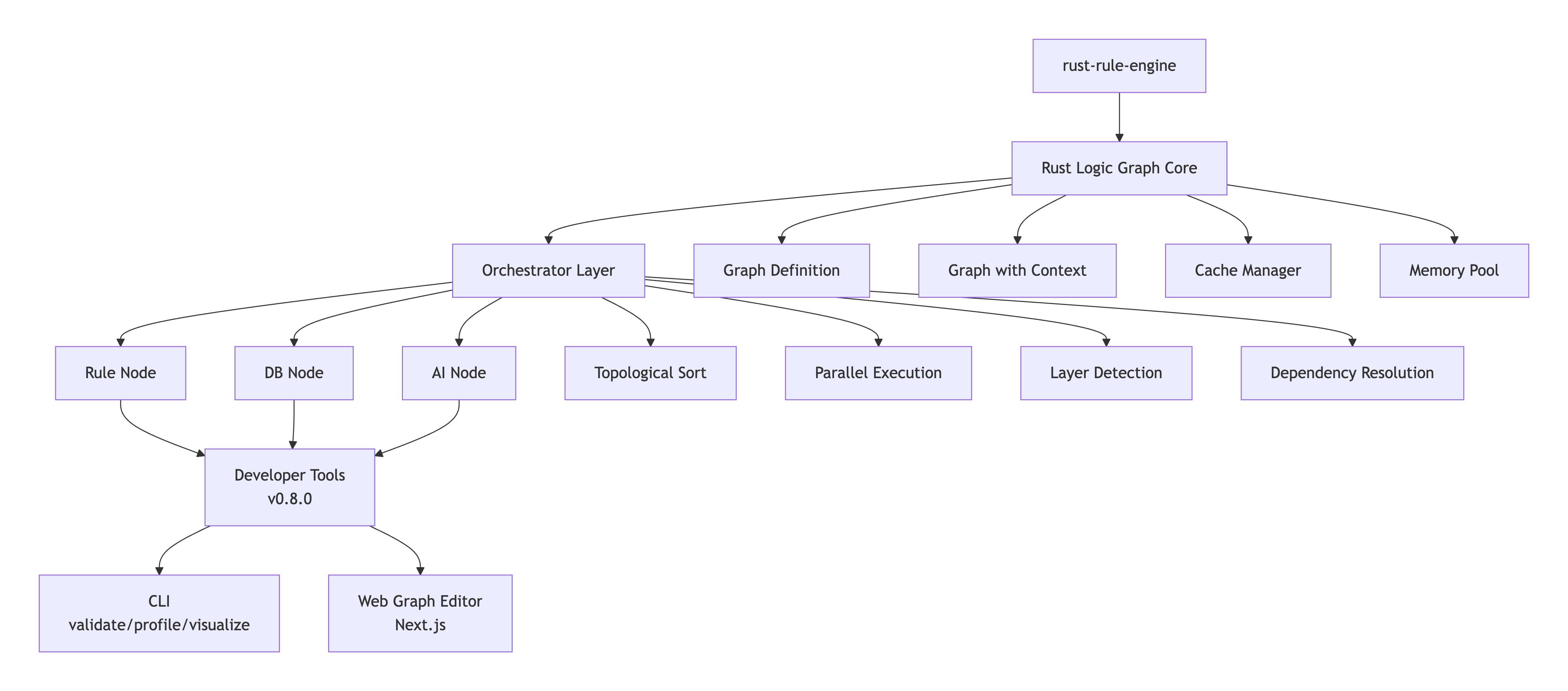
🔥 GRL Example
rule "HighValueLoan" salience 100 {
    when
        loan_amount > 100000 &&
        credit_score < 750
    then
        requires_manual_review = true;
        approval_tier = "senior";
}

rule "AutoApproval" salience 50 {
    when
        credit_score >= 700 &&
        income >= loan_amount * 3 &&
        debt_ratio < 0.4
    then
        auto_approve = true;
        interest_rate = 3.5;
}
📊 Performance
- RETE-UL Algorithm: Advanced pattern matching with unlinking (v0.14.0)
- 2-24x Faster: Than v0.10 at 50+ rules
- 98% Drools Compatible: Easy migration path
- Async by Default: High concurrency support
- Parallel Execution: Automatic layer-based parallelism
- Smart Caching: Result caching with TTL and eviction policies
🧪 Testing & CLI Tools
# Run all tests
# Build CLI tool
# Validate graph
# Visualize graph structure
# Profile performance
# Dry-run execution
Test Results: ✅ 32/32 tests passing
📦 Project Status
Version: 0.8.0 (Latest) Status: Production-ready with web graph editor and real-world case study
What's Working
- ✅ Core graph execution engine
- ✅ RETE-UL algorithm (v0.14.0) - 2-24x faster
- ✅ Three node types (Rule, DB, AI)
- ✅ Topological sorting
- ✅ Async execution
- ✅ JSON I/O
- ✅ Database integrations (PostgreSQL, MySQL, Redis, MongoDB)
- ✅ AI integrations (OpenAI, Claude, Ollama)
- ✅ Streaming processing with backpressure and chunking
- ✅ Parallel execution with automatic layer detection
- ✅ Caching layer with TTL, eviction policies, memory limits (v0.5.0)
- ✅ Memory optimization with context pooling (v0.7.0)
- ✅ CLI Developer Tools - validate, profile, visualize, dry-run (v0.5.0)
- ✅ Web Graph Editor - Next.js visual editor with drag-and-drop (v0.8.0)
- ✅ Production Case Study - Purchasing flow with microservices & monolithic (v0.8.0)
- ✅ Stream operators (map, filter, fold)
- ✅ Comprehensive documentation
Roadmap
- Streaming processing (v0.3.0) - COMPLETED ✅
- Parallel node execution (v0.4.0) - COMPLETED ✅
- Caching layer (v0.5.0) - COMPLETED ✅
- CLI Developer Tools (v0.5.0) - COMPLETED ✅
- RETE-UL upgrade (v0.5.0) - COMPLETED ✅
- Memory Optimization (v0.7.0) - COMPLETED ✅
- Web Graph Editor (v0.8.0) - COMPLETED ✅
- Production Case Study (v0.8.0) - COMPLETED ✅
- GraphQL API (v0.9.0)
- Production release (v1.0.0)
See ROADMAP.md for details
🤝 Contributing
Contributions welcome! Please:
- Fork the repository
- Create your feature branch
- Write tests for new features
- Submit a pull request
📖 Examples
| Example | Description | Lines |
|---|---|---|
simple_flow.rs |
Basic 3-node pipeline | 36 |
advanced_flow.rs |
Complex 6-node workflow | 120 |
grl_rules.rs |
GRL rule examples | 110 |
grl_graph_flow.rs |
GRL + Graph integration | 140 |
postgres_flow.rs |
PostgreSQL integration | 100 |
openai_flow.rs |
OpenAI GPT integration | 150 |
streaming_flow.rs |
Streaming with backpressure | 200 |
parallel_execution.rs |
Parallel node execution | 250 |
CLI Tool Examples (v0.5.0)
| File | Description |
|---|---|
examples/sample_graph.json |
Linear workflow with 5 nodes |
examples/cyclic_graph.json |
Graph with cycle for testing |
examples/sample_context.json |
Sample input data |
See CLI_TOOL.md for usage examples
🌟 Why Rust Logic Graph?
vs. Traditional Rule Engines
- ✅ Async by default - No blocking I/O
- ✅ Type safety - Rust's type system
- ✅ Modern syntax - GRL support
- ✅ Graph-based - Complex workflows
vs. Workflow Engines
- ✅ Embedded - No external services
- ✅ Fast - Compiled Rust code
- ✅ Flexible - Custom nodes
- ✅ Rule-based - Business logic in rules
📝 Changelog
v0.8.0 (2025-11-20) - Web Editor & Production Case Study Release
New Features:
- 🎨 Web Graph Editor - Next.js visual editor with drag-and-drop
- Online version: https://logic-graph-editor.amalthea.cloud/
- React Flow-based graph visualization
- Real-time node editing and validation
- Export/import JSON workflows
- See Graph Editor Guide
- 🏢 Production Case Study - Complete purchasing flow system
- Microservices architecture (7 services with gRPC)
- Monolithic architecture (single HTTP service)
- 15 GRL business rules for purchasing decisions
- Kubernetes deployment manifests
- Docker Compose for local development
- Shared GRL rules proving portability
- See Case Study Documentation
Improvements:
- Updated README with case study section
- Added online graph editor link
- Comprehensive production examples
Compatibility:
- All tests passing
- API backward compatible
v0.5.0 (2025-11-06) - Performance & Developer Tools Release
Breaking Changes:
- ⚡ Upgraded rust-rule-engine from v0.10 → v0.14.0
- Now uses RETE-UL algorithm (2-24x faster)
- Better memory efficiency
- Improved conflict resolution
- See Migration Guide
New Features:
- 🛠️ CLI Developer Tools (
rlgbinary)- Graph validation with comprehensive checks
- Dry-run execution mode
- Performance profiling with statistics
- ASCII graph visualization
- See CLI Tool Guide
- 💾 Caching Layer - High-performance result caching
- TTL-based expiration
- Multiple eviction policies (LRU, LFU, FIFO)
- Memory limits and statistics
- See Cache Guide
- ⚡ Parallel Node Execution - Automatic detection and parallel execution
- Layer detection algorithm using topological sort
- Concurrent execution within layers
- Parallelism analysis and statistics
- 📊 ParallelExecutor - New executor with parallel capabilities
- 📝 New Examples - CLI examples and test graphs
- ✅ 32 Tests - Comprehensive test coverage
Improvements:
- Updated documentation with CLI tools, caching, and migration guides
- Performance benchmarking utilities
- Example graph files for testing
Compatibility:
- All 32 tests passing
- API is backward compatible (100%)
- Performance: 2-24x faster rule matching
v0.3.0 (2025-11-03) - Streaming & Performance Release
New Features:
- 🌊 Streaming Processing - Stream-based node execution
- Backpressure handling with bounded channels
- Large dataset support with chunking
- Stream operators (map, filter, fold, async map)
- 📝 New Example -
streaming_flow.rswith 6 demonstrations - ✅ 8 New Tests - Streaming module testing
Performance:
- Processed 10,000 items in chunks
- ~432 items/sec throughput with backpressure
v0.2.0 (2025-11-02) - Integrations Release
New Features:
- 🗄️ Database Integrations - PostgreSQL, MySQL, Redis, MongoDB
- 🤖 AI/LLM Integrations - OpenAI GPT-4, Claude 3.5, Ollama
- 📝 Integration Examples -
postgres_flow.rs,openai_flow.rs - 📚 INTEGRATIONS.md - Comprehensive integration guide
- 🎛️ Feature Flags - Optional dependencies for integrations
v0.1.0 (2025-11-01) - Initial Release
Core Features:
- 🧠 Core graph execution engine
- 🔥 GRL (Grule Rule Language) integration
- 🔄 Topological sorting
- ⚡ Async execution with Tokio
- 📊 Three node types (Rule, DB, AI)
- 📝 JSON I/O for graphs
- 📚 4 working examples
- ✅ 6/6 tests passing
📄 License
MIT License - see LICENSE for details.
🔗 Links
- Repository: https://github.com/KSD-CO/rust-logic-graph
- rust-rule-engine: https://crates.io/crates/rust-rule-engine
- Documentation: docs/
- Issues: GitHub Issues
👥 Authors
James Vu - Initial work
🙏 Acknowledgments
Built with:
- rust-rule-engine v0.14.0 - GRL support with RETE-UL
- Tokio - Async runtime
- Petgraph - Graph algorithms
- Serde - Serialization
- Clap - CLI framework
⭐ Star us on GitHub if you find this useful! ⭐