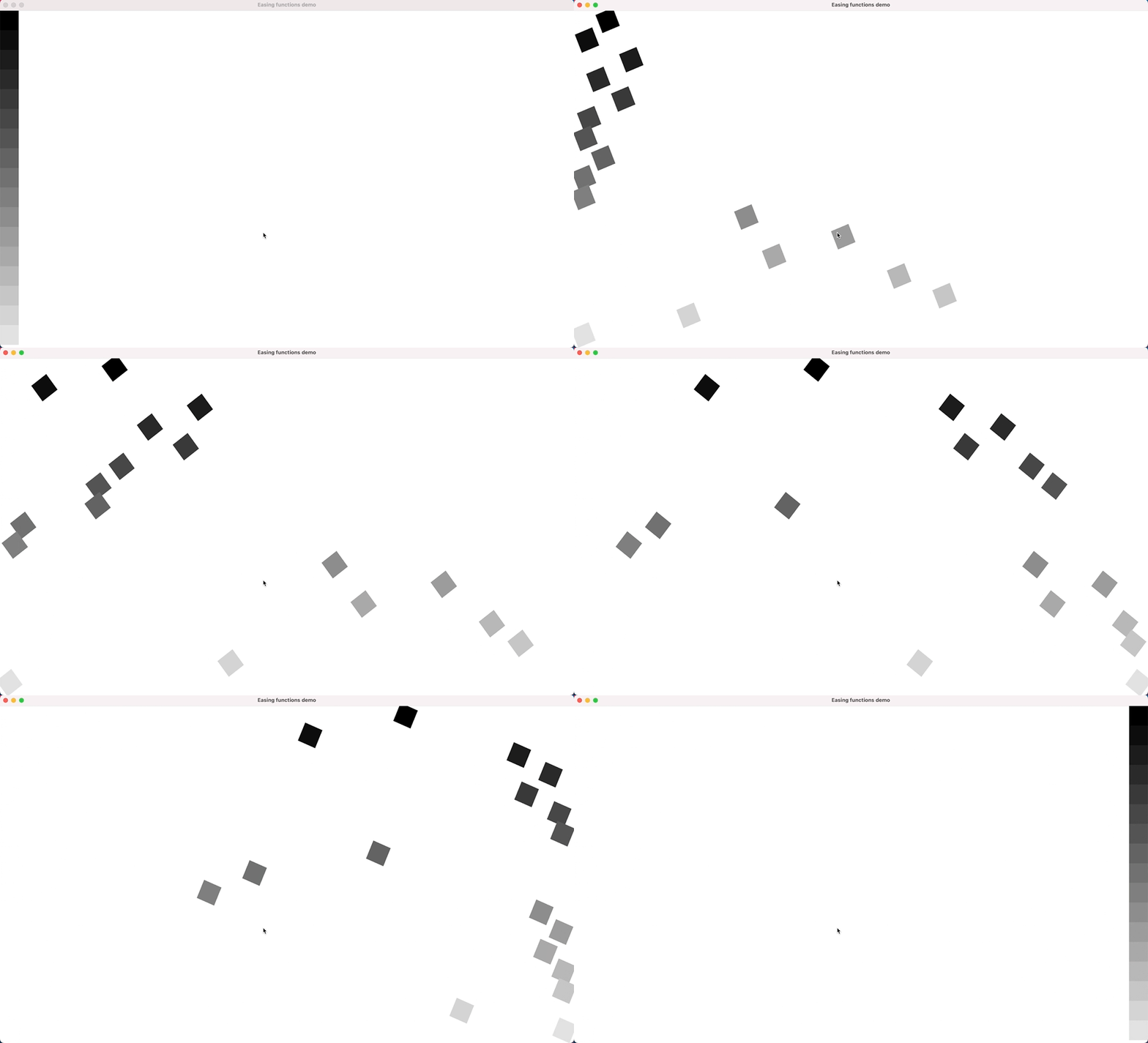
use std::sync::Arc;
use winit::{
event::{Event, KeyEvent, WindowEvent},
event_loop::{ControlFlow, EventLoop},
keyboard::{KeyCode, PhysicalKey},
window::WindowBuilder,
};
use rust_animation::animation::Animation;
use rust_animation::animation::EasingFunction;
use rust_animation::layer::LayoutMode;
use rust_animation::layer::Layer;
use rust_animation::play::Play;
fn main() {
let event_loop = EventLoop::new().unwrap();
let window = Arc::new(
WindowBuilder::new()
.with_title("Easing functions demo")
.with_inner_size(winit::dpi::LogicalSize::new(1280, 720))
.build(&event_loop)
.unwrap(),
);
let window_size = window.inner_size();
let (width, height) = (window_size.width, window_size.height);
let mut play = Play::new(
"Easing functions demo".to_string(),
width as i32,
height as i32,
LayoutMode::UserDefine,
);
play.init_wgpu_with_surface(window.clone(), width, height);
let mut stage = Layer::new("stage".to_string(), width, height, None);
stage.set_visible(true);
let easing_functions = vec![
EasingFunction::EaseIn,
EasingFunction::EaseInCubic,
EasingFunction::EaseInOut,
EasingFunction::EaseInOutCubic,
EasingFunction::EaseInOutQuad,
EasingFunction::EaseInOutQuart,
EasingFunction::EaseInOutQuint,
EasingFunction::EaseInQuad,
EasingFunction::EaseInQuart,
EasingFunction::EaseInQuint,
EasingFunction::EaseOut,
EasingFunction::EaseOutCubic,
EasingFunction::EaseOutQuad,
EasingFunction::EaseOutQuart,
EasingFunction::EaseOutQuint,
EasingFunction::Linear,
EasingFunction::Step,
];
let mut y = 0;
let time = 5.0;
let width_layer = 63;
let height_layer = width_layer;
for i in 0..17 {
let layer_name = format!("layer_{}", i + 1);
let mut layer = Layer::new(layer_name.to_string(), width_layer, height_layer, None);
layer.x = 0;
layer.y = y;
y += height_layer as i32;
layer.set_color(i as f32 / 18.0, i as f32 / 18.0, i as f32 / 18.0);
let mut animation = Animation::new();
animation.apply_translation_x(0, (width - width_layer) as i32, time, easing_functions[i]);
animation.apply_rotation(0, 360, time, EasingFunction::Linear);
layer.set_animation(Some(animation));
stage.add_sub_layer(layer);
}
play.add_stage(stage);
event_loop
.run(move |event, elwt| {
elwt.set_control_flow(ControlFlow::Poll);
match event {
Event::WindowEvent { event, .. } => match event {
WindowEvent::CloseRequested => elwt.exit(),
WindowEvent::KeyboardInput {
event:
KeyEvent {
physical_key: PhysicalKey::Code(KeyCode::Escape),
..
},
..
} => elwt.exit(),
WindowEvent::Resized(new_size) => {
play.resize(new_size.width, new_size.height);
}
WindowEvent::RedrawRequested => {
play.render();
window.request_redraw();
}
_ => {}
},
Event::AboutToWait => {
window.request_redraw();
}
_ => {}
}
})
.unwrap();
}