1
2
3
4
5
6
7
8
9
10
11
12
13
14
15
16
17
18
19
20
21
22
23
24
25
26
27
28
29
30
31
32
33
34
35
36
37
38
39
40
41
42
43
44
45
46
47
48
49
50
51
52
53
54
55
56
57
58
59
60
61
62
63
64
65
66
67
68
69
70
71
72
73
74
75
76
77
78
79
80
81
82
83
84
85
86
87
88
89
90
91
92
93
94
95
96
97
98
99
100
101
102
103
104
105
106
107
108
109
110
111
112
113
114
115
116
117
118
119
120
121
122
123
124
125
126
127
128
129
130
131
132
133
134
135
136
137
138
139
140
141
142
143
144
145
146
147
148
149
150
151
152
153
154
155
156
157
158
159
160
161
162
163
164
165
166
167
168
169
170
171
172
173
174
175
176
177
178
179
180
181
182
183
184
185
186
187
188
189
190
191
192
193
194
195
196
197
198
199
200
201
202
203
204
205
206
207
208
209
210
211
212
213
214
215
216
217
218
219
220
221
222
223
224
225
226
227
228
229
230
231
232
233
234
235
236
237
238
239
240
241
242
243
244
245
246
247
248
249
250
251
252
253
254
255
256
257
258
259
260
261
262
263
264
265
266
267
268
269
270
271
272
273
274
275
276
277
278
279
280
281
282
283
284
285
286
287
288
289
290
291
292
293
294
295
296
297
298
299
300
301
302
303
304
305
306
307
308
309
310
311
312
313
314
315
316
317
318
319
320
321
322
323
324
325
326
327
328
329
330
331
332
333
334
335
336
337
338
339
340
341
342
343
344
345
346
347
348
349
350
351
352
353
354
355
356
357
358
359
360
361
362
363
364
365
366
367
368
369
370
371
372
373
374
375
376
377
378
379
380
381
382
383
384
385
386
387
388
389
390
391
392
393
394
395
396
397
398
399
400
401
402
403
404
use super::Stats;
use crate::math::SQRT_EPSILON;
use crate::StrError;
/// Golden section ratio: (3 - sqrt(5)) / 2
const GSR: f64 = 0.38196601125010515179541316563436188227969082019424;
/// Implements algorithms for finding a local minimum of f(x)
#[derive(Clone, Copy, Debug)]
pub struct MinSolver {
/// Max number of iterations
///
/// ```text
/// n_iteration_max ≥ 2
/// ```
pub n_iteration_max: usize,
/// Tolerance
///
/// e.g., 1e-10
pub tolerance: f64,
}
impl MinSolver {
/// Allocates a new instance
pub fn new() -> Self {
MinSolver {
n_iteration_max: 100,
tolerance: 1e-10,
}
}
/// Validates the parameters
fn validate_params(&self) -> Result<(), StrError> {
if self.n_iteration_max < 2 {
return Err("n_iteration_max must be ≥ 2");
}
if self.tolerance < 10.0 * f64::EPSILON {
return Err("the tolerance must be ≥ 10.0 * f64::EPSILON");
}
Ok(())
}
/// Employs Brent's method to find the minimum of f(x)
///
/// See: <https://mathworld.wolfram.com/BrentsMethod.html>
///
/// See also: <https://en.wikipedia.org/wiki/Brent%27s_method>
///
/// # Input
///
/// * `xa` -- first coordinate of the "bracket" containing the local minimum
/// * `xb` -- second coordinate of the "bracket" containing the local minimum
/// * `params` -- optional control parameters
/// * `args` -- extra arguments for the callback function
/// * `f` -- is the callback function implementing `f(x)` as `f(x, args)`; it returns `f @ x` or it may return an error.
///
/// **Note:** `xa < xb` or `xa > xb` are accepted. However, `xa` must be different from `xb`.
///
/// # Output
///
/// Returns `(xo, stats)` where:
///
/// * `xo` -- is the coordinate of the minimum
/// * `stats` -- some statistics regarding the computations
///
/// # Examples
///
/// ## Simple quadratic equation
///
/// ```
/// use russell_lab::*;
///
/// fn main() -> Result<(), StrError> {
/// let args = &mut 0;
/// let solver = MinSolver::new();
/// let (xa, xb) = (-4.0, 4.0);
/// let (xo, stats) = solver.brent(xa, xb, args, |x, _| Ok(4.0 + f64::powi(1.0 - x, 2)))?;
/// println!("\noptimal = {:?}", xo);
/// println!("\n{}", stats);
/// approx_eq(xo, 1.0, 1e-7);
/// Ok(())
/// }
/// ```
///
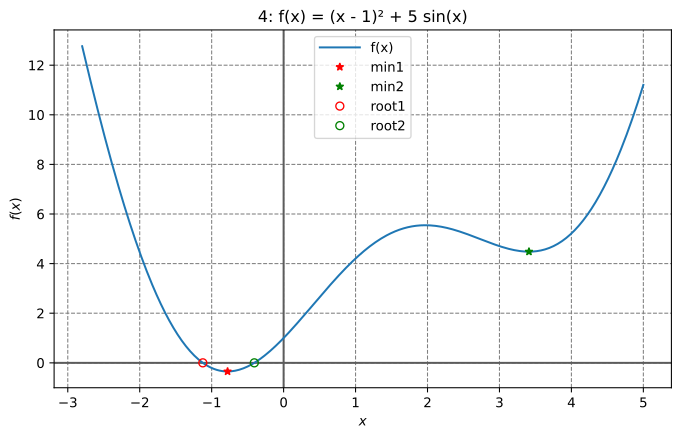
/// ## Test function number four
///
/// 
///
/// ```
/// use russell_lab::*;
///
/// fn main() -> Result<(), StrError> {
/// // "4: f(x) = (x - 1)² + 5 sin(x)"
/// let f = |x: f64, _: &mut NoArgs| Ok(f64::powi(x - 1.0, 2) + 5.0 * f64::sin(x));
/// let args = &mut 0;
///
/// // minimize
/// let solver = MinSolver::new();
/// let (xo, stats) = solver.brent(-2.0, 2.0, args, f)?;
/// println!("\noptimal = {}", xo);
/// println!("\n{}", stats);
/// approx_eq(xo, -0.7790149303951403, 1e-8);
/// Ok(())
/// }
/// ```
pub fn brent<F, A>(&self, xa: f64, xb: f64, args: &mut A, mut f: F) -> Result<(f64, Stats), StrError>
where
F: FnMut(f64, &mut A) -> Result<f64, StrError>,
{
// Based on ZEROIN C math library: <http://www.netlib.org/c/>
// By: Oleg Keselyov <oleg@ponder.csci.unt.edu, oleg@unt.edu> May 23, 1991
//
// G.Forsythe, M.Malcolm, C.Moler, Computer methods for mathematical
// computations. M., Mir, 1980, p.180 of the Russian edition
//
// The function makes use of the "gold section" procedure combined with
// the parabolic interpolation.
// At every step program operates three abscissae - x,v, and w.
// * x - the last and the best approximation to the minimum location,
// i.e. f(x) <= f(a) or/and f(x) <= f(b)
// (if the function f has a local minimum in (a,b), then the both
// conditions are fulfilled after one or two steps).
//
// v,w are previous approximations to the minimum location. They may
// coincide with a, b, or x (although the algorithm tries to make all
// u, v, and w distinct). Points x, v, and w are used to construct
// interpolating parabola whose minimum will be treated as a new
// approximation to the minimum location if the former falls within
// `[a,b]` and reduces the range enveloping minimum more efficient than
// the gold section procedure.
//
// When f(x) has a second derivative positive at the minimum location
// (not coinciding with a or b) the procedure converges super-linearly
// at a rate order about 1.324
//
// The function always obtains a local minimum which coincides with
// the global one only if a function under investigation being
// uni-modular. If a function being examined possesses no local minimum
// within the given range, The code returns 'a' (if f(a) < f(b)), otherwise
// it returns the right range boundary value b.
// check
if f64::abs(xa - xb) < 10.0 * f64::EPSILON {
return Err("xa must be different from xb");
}
// validate the parameters
self.validate_params()?;
// allocate stats struct
let mut stats = Stats::new();
// initialization
let (mut a, mut b) = if xa < xb { (xa, xb) } else { (xb, xa) };
let mut v = a + GSR * (b - a);
let mut fv = f(v, args)?;
stats.n_function += 1;
// auxiliary
let mut x = v;
let mut w = v;
let mut fx = fv;
let mut fw = fv;
// solve
let mut converged = false;
for _ in 0..self.n_iteration_max {
stats.n_iterations += 1;
// auxiliary variables
let del = b - a;
let mid = (a + b) / 2.0;
let tol = SQRT_EPSILON * f64::abs(x) + self.tolerance / 3.0;
// converged?
if f64::abs(x - mid) + del / 2.0 <= 2.0 * tol {
converged = true;
break;
}
// gold section step
let mut tmp = a - x;
if x < mid {
tmp = b - x;
}
let mut step_new = GSR * tmp;
// try interpolation
if f64::abs(x - w) >= tol {
let t = (x - w) * (fx - fv);
let q = (x - v) * (fx - fw);
let mut p = (x - v) * q - (x - w) * t;
let mut q = 2.0 * (q - t);
if q > 0.0 {
p = -p;
} else {
q = -q;
}
if f64::abs(p) < f64::abs(step_new * q) && p > q * (a - x + 2.0 * tol) && p < q * (b - x - 2.0 * tol) {
step_new = p / q;
}
}
// adjust the step
if f64::abs(step_new) < tol {
if step_new > 0.0 {
step_new = tol;
} else {
step_new = -tol;
}
}
// next approximation
let t = x + step_new;
let ft = f(t, args)?;
stats.n_function += 1;
// t is a better approximation
if ft <= fx {
if t < x {
b = x;
} else {
a = x;
}
v = w;
w = x;
x = t;
fv = fw;
fw = fx;
fx = ft;
// x remains the better approx
} else {
if t < x {
a = t;
} else {
b = t;
}
if ft <= fw || w == x {
v = w;
w = t;
fv = fw;
fw = ft;
} else if ft <= fv || v == x || v == w {
v = t;
fv = ft;
}
}
}
// check
if !converged {
return Err("brent solver failed to converge");
}
// done
stats.stop_sw_total();
Ok((x, stats))
}
}
////////////////////////////////////////////////////////////////////////////////////////////////////////////////////////
#[cfg(test)]
mod tests {
use super::MinSolver;
use crate::algo::testing::get_test_functions;
use crate::algo::NoArgs;
use crate::approx_eq;
#[test]
fn validate_params_works() {
let mut solver = MinSolver::new();
solver.n_iteration_max = 0;
assert_eq!(solver.validate_params().err(), Some("n_iteration_max must be ≥ 2"));
solver.n_iteration_max = 2;
solver.tolerance = 0.0;
assert_eq!(
solver.validate_params().err(),
Some("the tolerance must be ≥ 10.0 * f64::EPSILON")
);
}
#[test]
fn brent_captures_errors_1() {
let f = |x, _: &mut NoArgs| Ok(x * x - 1.0);
let args = &mut 0;
assert_eq!(f(1.0, args).unwrap(), 0.0);
let mut solver = MinSolver::new();
assert_eq!(
solver.brent(-0.5, -0.5, args, f).err(),
Some("xa must be different from xb")
);
solver.n_iteration_max = 0;
assert_eq!(
solver.brent(-0.5, 2.0, args, f).err(),
Some("n_iteration_max must be ≥ 2")
);
}
#[test]
fn brent_captures_errors_2() {
struct Args {
count: usize,
target: usize,
}
let f = |x, args: &mut Args| {
let res = if args.count == args.target {
Err("stop")
} else {
Ok(x * x - 1.0)
};
args.count += 1;
res
};
let args = &mut Args { count: 0, target: 0 };
let solver = MinSolver::new();
// first function call
assert_eq!(solver.brent(-0.5, 2.0, args, f).err(), Some("stop"));
// second function call
args.count = 0;
args.target = 1;
assert_eq!(solver.brent(-0.5, 2.0, args, f).err(), Some("stop"));
}
#[test]
fn brent_works_1() {
// Solving the first problem with Python/SciPy
// (too many iterations for such simple problem!)
//
// ```python
// import scipy.optimize as opt
// def f(x): return (x**2.0-1.0)
// opt.minimize_scalar(f,bracket=(-5.0,5.0),method='brent')
// ```
//
// Output
//
// ```text
// message:
// Optimization terminated successfully;
// The returned value satisfies the termination criteria
// (using xtol = 1.48e-08 )
// success: True
// fun: -1.0
// x: 3.5919470973405176e-11
// nit: 38
// nfev: 41
// ```
let args = &mut 0;
let solver = MinSolver::new();
for (i, test) in get_test_functions().iter().enumerate() {
println!("\n===================================================================");
println!("\n{}", test.name);
if let Some(bracket) = test.min1 {
let (a, b) = if i % 2 == 0 {
(bracket.a, bracket.b)
} else {
(bracket.b, bracket.a)
};
let (xo, stats) = solver.brent(a, b, args, test.f).unwrap();
println!("\nxo = {:?}", xo);
println!("\n{}", stats);
approx_eq(xo, bracket.xo, test.tol_min);
approx_eq((test.f)(xo, args).unwrap(), bracket.fxo, 1e-15);
}
if let Some(bracket) = test.min2 {
let (a, b) = if i % 2 == 0 {
(bracket.a, bracket.b)
} else {
(bracket.b, bracket.a)
};
let (xo, stats) = solver.brent(a, b, args, test.f).unwrap();
println!("\nxo = {:?}", xo);
println!("\n{}", stats);
approx_eq(xo, bracket.xo, test.tol_min);
approx_eq((test.f)(xo, args).unwrap(), bracket.fxo, 1e-15);
}
if let Some(bracket) = test.min3 {
let (a, b) = (bracket.a, bracket.b);
let (xo, stats) = solver.brent(a, b, args, test.f).unwrap();
println!("\nxo = {:?}", xo);
println!("\n{}", stats);
approx_eq(xo, bracket.xo, test.tol_min);
approx_eq((test.f)(xo, args).unwrap(), bracket.fxo, 1e-15);
}
}
println!("\n===================================================================\n");
}
#[test]
fn brent_fails_on_non_converged() {
let f = |x, _: &mut NoArgs| Ok(x * x - 1.0);
let args = &mut 0;
assert_eq!(f(0.0, args).unwrap(), -1.0);
let mut solver = MinSolver::new();
solver.n_iteration_max = 2;
assert_eq!(
solver.brent(-5.0, 5.0, args, f).err(),
Some("brent solver failed to converge")
);
}
}