//! Russell - Rust Scientific Library
//!
//! `russell_lab`: Scientific laboratory for linear algebra and numerical mathematics
//!
//! **Important:** This crate depends on external libraries (non-Rust). Thus, please check the [Installation Instructions on the GitHub Repository](https://github.com/cpmech/russell).
//!
//! # Introduction
//!
//! This crate extends Rust with scientific computing capabilities, such as special mathematical functions (e.g., Bessel, beta, elliptic integral, erf, erfc, gamma), auxiliary mathematical functions (e.g., ramp, Heaviside, boxcar, logistic), numeric constants (e.g., SQRT_PI, EULER, NAPIER), numerical differentiation (e.g., to check analytical derivatives), functions to validate calculations, code performance measurement, least-square fitting, reading/writing table-formatted data, generation of grid coordinates for plotting, interpolation, and others. This crate also implements several functions to perform linear algebra computations (e.g., Matrix, Vector, Matrix-Vector, Eigen-decomposition, SVD, Inverse, and more).
//!
//! The code shall be implemented in *native Rust* code as much as possible. However, thin interfaces ("wrappers") are implemented for some of the best tools available in numerical mathematics, including [OpenBLAS](https://github.com/OpenMathLib/OpenBLAS) and [Intel MKL](https://www.intel.com/content/www/us/en/docs/onemkl/developer-reference-c/2023-2/overview.html).
//!
//! The code is organized in modules:
//!
//! * [algo] -- Structs and algorithms that roughly depend on the other modules
//! * [base] -- "Base" functionality to help other modules
//! * [check] -- Functions to assist in unit and integration testing
//! * [math] (*not re-exported*) -- Mathematical "special" functions and constants
//! * [matrix] -- Matrix struct and associated functions
//! * [matvec] -- Functions operating on matrices and vectors
//! * [vector] -- Vector struct and associated functions
//!
//! Other functionality may be found in external crates, for instance:
//!
//! * [lambert_w](https://github.com/JSorngard/lambert_w) -- Computes the [Lambert W function](https://mathworld.wolfram.com/LambertW-Function.html)
//!
//! ## Linear algebra
//!
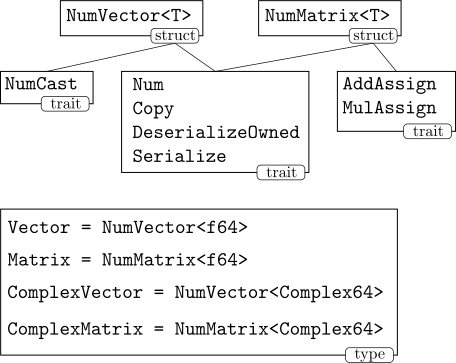
//! For linear algebra, the main structures are [NumVector] and [NumMatrix], that are generic Vector and Matrix structures. The Matrix data is stored as **column-major**. The [Vector] and [Matrix] are `f64` and `Complex64` aliases of `NumVector` and `NumMatrix`, respectively.
//!
//! The figure below illustrates the base structures (struct) for linear algebra computations. The vector and matrix structures are generic but require the type parameter to implement a set of traits. The essential trait is the `Num` trait provided by the `num-traits` crate. This trait allows vectors and matrices in Russell to hold any numerical type. The `Copy` trait enables the possibility of cloning vectors and matrices directly; however, for efficiency, the BLAS functions can be called instead. `DeserializedOwned` and `Serialize` allow vectors and matrices to be serialized/deserialized, a feature that propagates for all other structures depending on `NumVector` and `NumMatrix`. This feature allows, for instance, writing and reading JSON files with simulation results. `NumCast` is required by `NumVector` because the `linspace` member function needs to cast the number of grid points to the final type (e.g., `f64`). `NumMatrix` requires the `AddAssign` and `MulAssign` traits to implement the convenience member functions named `add` and `mul`.
//!
//! 
//!
//! `NumVector` has a single data member named `data` (a `Vec<T>`) holding all elements. Thus, `NumVector` wraps the native Rust vector struct. `NumVector` implements various methods, including functions for constructing and transforming vectors. One helpful method is `linspace` to generate a sequence of equally spaced numbers. `NumVector` implements the `Index` trait, allowing the access of elements using the `[i]` notation where `i` is the index.
//!
//! `NumMatrix` stores all entries in the *column-major* representation. The main reason for using the column-major representation is to make the code work directly with Fortran routines, such as the BLAS/LAPACK functions. It is worth noting that BLAS/LAPACK have functions that accept row-major matrices. Nonetheless, these functions add an overhead due to temporary memory allocation and copies, including transposing matrices.
//!
//! Thus, column-major data storage is essential. However, this requirement yields an undesirable side effect. Unfortunately, it is no longer possible to use the Index trait to access matrix elements using a notation such as `a[i][j]` as in other languages. Alternatively, `russell_lab` implements member functions `get(i, j)` and `set(i, j, value)` to access and update matrix elements.
//!
//! `NumMatrix` also implements the `AsArray2D` trait, allowing matrices to be constructed from fixed-size nested lists of elements (stack-allocated), growable nested arrays of type `Vec<Vec<T>>` (heap-allocated) and slices that are views into an array. For example, matrices can be created as follows:
//!
//! ```
//! use russell_lab::{NumMatrix, StrError};
//!
//! fn main() -> Result<(), StrError> {
//! let a = NumMatrix::<i32>::from(&[
//! [1, 2, 3], //
//! [4, 5, 6], //
//! [7, 8, 9], //
//! ]);
//! println!("{}", a);
//! assert_eq!(
//! format!("{}", a),
//! "┌ ┐\n\
//! │ 1 2 3 │\n\
//! │ 4 5 6 │\n\
//! │ 7 8 9 │\n\
//! └ ┘"
//! );
//! assert_eq!(a.as_data(), &[1, 4, 7, 2, 5, 8, 3, 6, 9]);
//! Ok(())
//! }
//! ```
//!
//! Finally, `NumVector` and `NumMatrix` implement the `Display` trait, allowing them to be pretty printed.
//!
//! ### Functionality
//!
//! The linear algebra functions currently handle only `(f64, i32)` pairs, i.e., accessing the `(double, int)` C functions. We also consider `(Complex64, i32)` pairs.
//!
//! There are many functions for linear algebra, such as (for Real and Complex types):
//!
//! * Vector addition ([vec_add()]), copy ([vec_copy()]), inner ([vec_inner()]) and outer ([vec_outer()]) products, norms ([vec_norm()]), and more
//! * Matrix addition ([mat_add()]), multiplication ([mat_mat_mul()], [mat_t_mat_mul()]), copy ([mat_copy()]), singular-value decomposition ([mat_svd()]), eigenvalues ([mat_eigen()], [mat_eigen_sym()]), pseudo-inverse ([mat_pseudo_inverse()]), inverse ([mat_inverse()]), norms ([mat_norm()]), and more
//! * Matrix-vector multiplication ([mat_vec_mul()])
//! * Solution of dense linear systems with symmetric ([mat_cholesky()]) or non-symmetric ([solve_lin_sys()]) coefficient matrices
//!
//! The `russell_lab` functions are higher-level than the BLAS/LAPACK counterparts, thus losing some of the generality of BLAS/LAPACK. Each BLAS/LAPACK function wrapped by `russell_lab` is carefully documented and thoroughly tested.
//!
//! `russell_lab` implements functions organized in the `vector`, `matvec`, and `matrix` directories. These directories correspond to the BLAS terminology as Level 1, Level 2, and Level 3.
//!
//! All vector functions are prefixed with `vec_` and `complex_vec_`, whereas all matrix functions are prefixed with `mat_` and `complex_mat_`. The `matvec` functions have varied names, albeit descriptive.
//!
//! `russell_lab` implements several other interfaces to BLAS/LAPACK. However, some functions are complemented with native Rust code to provide a higher-level interface or improve the functionality. For instance, after calling the DGEEV function, `mat_eigen` post-processes the results via the `dgeev_data` function to extract the results from LAPACK's compact representation, generating a more convenient interface to the user.
//!
//! An example of added functionality is the `mat_pseudo_inverse` function, which computes the pseudo-inverse of a rectangular matrix using the singular-value decomposition. This function is based on the singular-value decomposition routine provided by LAPACK.
//!
//! ## Complex numbers
//!
//! For convenience, this library re-exports:
//!
//! * `num_complex::Complex64` -- Needed for ComplexMatrix, ComplexVector and complex functions
//! * `num_complex::ComplexFloat` -- Needed for the intrinsic Complex64 operators such as `abs()` an others
//!
//! When using the [crate::cpx!] macro, the `Complex64` type must be imported as well. For example:
//!
//! ```
//! use russell_lab::{cpx, Complex64};
//!
//! println!("{}", cpx!(1.0, 2.0));
//! ```
//!
//! # Examples
//!
//! ## (matrix) Eigen-decomposition of a small matrix
//!
//! ```
//! use russell_lab::{mat_eigen, Matrix, Vector};
//! use russell_lab::StrError;
//!
//! fn main() -> Result<(), StrError> {
//! let data = [
//! [2.0, 0.0, 0.0],
//! [0.0, 3.0, 4.0],
//! [0.0, 4.0, 9.0],
//! ];
//! let mut a = Matrix::from(&data);
//! let m = a.nrow();
//! let mut l_real = Vector::new(m);
//! let mut l_imag = Vector::new(m);
//! let mut v_real = Matrix::new(m, m);
//! let mut v_imag = Matrix::new(m, m);
//! mat_eigen(&mut l_real, &mut l_imag, &mut v_real, &mut v_imag, &mut a)?;
//! println!("eigenvalues =\n{}", l_real);
//! println!("eigenvectors =\n{}", v_real);
//! Ok(())
//! }
//! ```
//!
//! ## (math) Bessel functions
//!
//! ```
//! use russell_lab::math;
//! use russell_lab::{Vector, StrError};
//!
//! fn main() -> Result<(), StrError> {
//! let xx = Vector::linspace(0.0, 15.0, 101)?;
//! let j0 = xx.get_mapped(|x| math::bessel_j0(x));
//! let j1 = xx.get_mapped(|x| math::bessel_j1(x));
//! let j2 = xx.get_mapped(|x| math::bessel_jn(2, x));
//! Ok(())
//! }
//! ```
/// Defines the error output as a static string
pub type StrError = &'static str;
/// Defines complex numbers with f64-real and f64-imaginary parts
pub use num_complex::Complex64;
pub use num_complex::ComplexFloat;
pub mod algo;
pub mod base;
pub mod check;
mod internal;
pub mod math;
pub mod matrix;
pub mod matvec;
pub mod vector;
pub use algo::*;
pub use base::*;
pub use check::*;
use internal::*;
pub use matrix::*;
pub use matvec::*;
pub use vector::*;
// run code from README file
#[doc = include_str!("../README.md")]
#[cfg(doctest)]
pub struct ReadmeDoctest;