
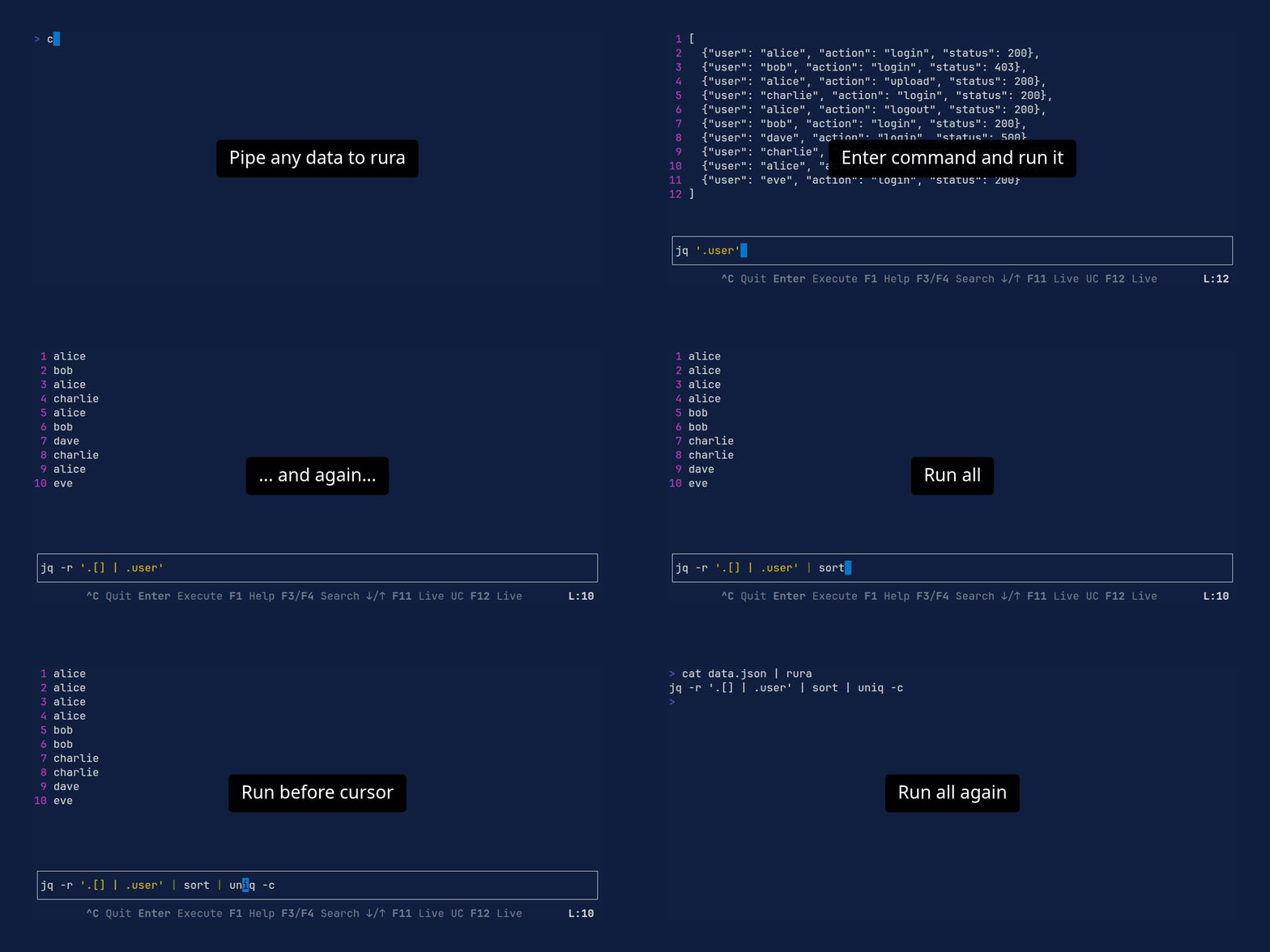
Rura transforms the tedious "edit, up-arrow, rerun" shell cycle into a fluid, interactive TUI scratchpad. It features live previews, syntax highlighting, and partial execution, allowing you to debug and iterate on commands in real time.
Features
- Partial Pipeline Execution: Execute only up to the current subcommand to debug complex pipes.
- Context-aware Completion: Tab-complete commands and file paths using your system's bash tools.
- Live Execution Modes: Real-time feedback as you type, with optional "Live Until Cursor" or "Live Full" modes.
- Search: Search and highlight text within the output pane with regex support.
- Syntax Highlighting: Visual feedback for subcommand boundaries, quotes, and pipes.
- Persistent History: Quickly access and reuse previous commands.
- Line Wrapping: Toggle whether long output lines wrap to fit the view.
- Flexible Error Display: Choose between "inline" errors (replacing the main view) or a dedicated "pane" (showing both output and errors).
- Customizable: Fully configurable key bindings, themes, and UI placement via TOML.
Installation
Check the Releases page for pre-compiled binaries for your platform.
Homebrew (macOS/Linux):
Arch Linux (AUR): Install via your AUR helper:
# Pre-compiled binary
# Build from latest git source
Cargo:
# From crates.io
# From source
Usage
You can start Rura by passing a file as an argument, piping data into it, or providing an initial command.
# Open a file
# Pipe data into rura
|
# Start with an initial command
# Print the last executed command from history without opening the UI
CLI Arguments
-f, --file <FILE>: Path to the input file.-c, --command <COMMAND>: Initial command to populate the input field.-C, --config <FILE>: Path to a custom TOML configuration file.-l, --last: Print the last command from history and exit.-V, --version: Print version information.
Key Bindings
Command Execution
- Enter: Execute the full command pipeline.
- Alt + \: Execute the pipeline up to the current subcommand (where your cursor is).
- Alt + |: Execute the pipeline up to the previous subcommand.
- Alt + i: Reset view to show the original input data.
Navigation & View
- Arrows or Alt + h/j/k/l: Scroll the output (Left, Down, Up, Right).
- PageUp / PageDown or Alt + Up / Down: Scroll the output by page.
- Ctrl + u / Ctrl + d: Scroll up or down quickly.
- Alt + w: Toggle line wrapping.
Search
- F3 / F4: Search forward or backward in the output.
- Alt + x: Toggle regex mode.
- Alt + c: Toggle case sensitivity.
Live Execution Modes
- F11: Toggle "Live Until Cursor" mode. Executes the pipeline up to the cursor as you type (requires confirmation).
- F12: Toggle "Live Full" mode. Executes the entire pipeline as you type (requires confirmation).
Command Input & Subcommands
- Tab: Trigger forward command or file completion (requires
bashwithcompgenavailable). - Shift + Tab: Trigger backward command or file completion.
- Alt + Right: Move cursor to the next subcommand.
- Alt + Left: Move cursor to the previous subcommand.
- Home / End: Move cursor to the beginning or end of the command line.
- Ctrl + p: Previous command in history.
- Ctrl + n: Next command in history.
General
- F1: Toggle help screen.
- Ctrl + c: Exit Rura. The last executed command is printed to your terminal.
Configuration
Rura can be configured via a TOML file. The configuration path is determined as follows:
- Path specified by the
--config(or-C) CLI argument. - Path specified by the
RURA_CONFIGenvironment variable. - Default path:
- Linux:
~/.config/rura/config.toml - macOS:
~/Library/Application Support/rura/config.toml
- Linux:
General Options
command_line_placement: Set to"top"or"bottom"(default) to change where the input field is rendered.error_display_mode: Set to"inline"or"pane"(default) to choose how errors are shown:inline: Errors replace the main output view. A status indicator (e.g.,ERR(1)) appears in the status bar.pane: A dedicated error pane appears, allowing you to see the error message while still viewing the last successful output in the main area.
highlight_duration_ms: Duration in milliseconds for the temporary highlighting when executing commands (default:250).debounce_duration_ms: Duration in milliseconds to wait before executing commands in live mode (default:500).
Customizing Key Bindings
You can override any default key binding in the [keybindings] section. Multiple keys can be assigned to the same action.
[]
= ["ctrl+q", "ctrl+c"]
= ["enter"]
= ["tab"]
= ["shift+tab"]
= ["alt+right"]
Customizing Theme
Colors and styles can be adjusted in the [theme] section. Supported colors include red, green, yellow, blue, magenta, cyan, gray, black, white, and hex codes (e.g., "#ffffff").
Available theme keys:
cmd_regular: Default subcommand style.cmd_regular_pipe: Style for the pipe character in regular mode.cmd_regular_current: Background style for the currently selected subcommand.cmd_highlight: Style for the subcommand being executed.cmd_highlight_pipe: Style for the pipe character during execution.cmd_highlight_current: Style for the current subcommand during execution.cmd_quoted: Style for quoted strings.cmd_invalid: Style for invalid subcommands (if parsing fails).output_highlight: Style for search results in the output.output_highlight_current: Style for the currently selected search result.line_nums: Style for line numbers in the output.
[]
= "black"
= "yellow"
= true
[]
= "magenta"
Storage & Logs
History
Rura maintains a persistent command history. The history file is located at:
- Linux:
~/.local/share/rura/history.txt - macOS:
~/Library/Application Support/rura/history.txt
Logs
Application logs are useful for troubleshooting. They are stored at:
- Linux:
~/.cache/rura/logs.txt - macOS:
~/Library/Caches/rura/logs.txt