
rung



A Git workflow tool for managing stacked PRs (pull request chains).
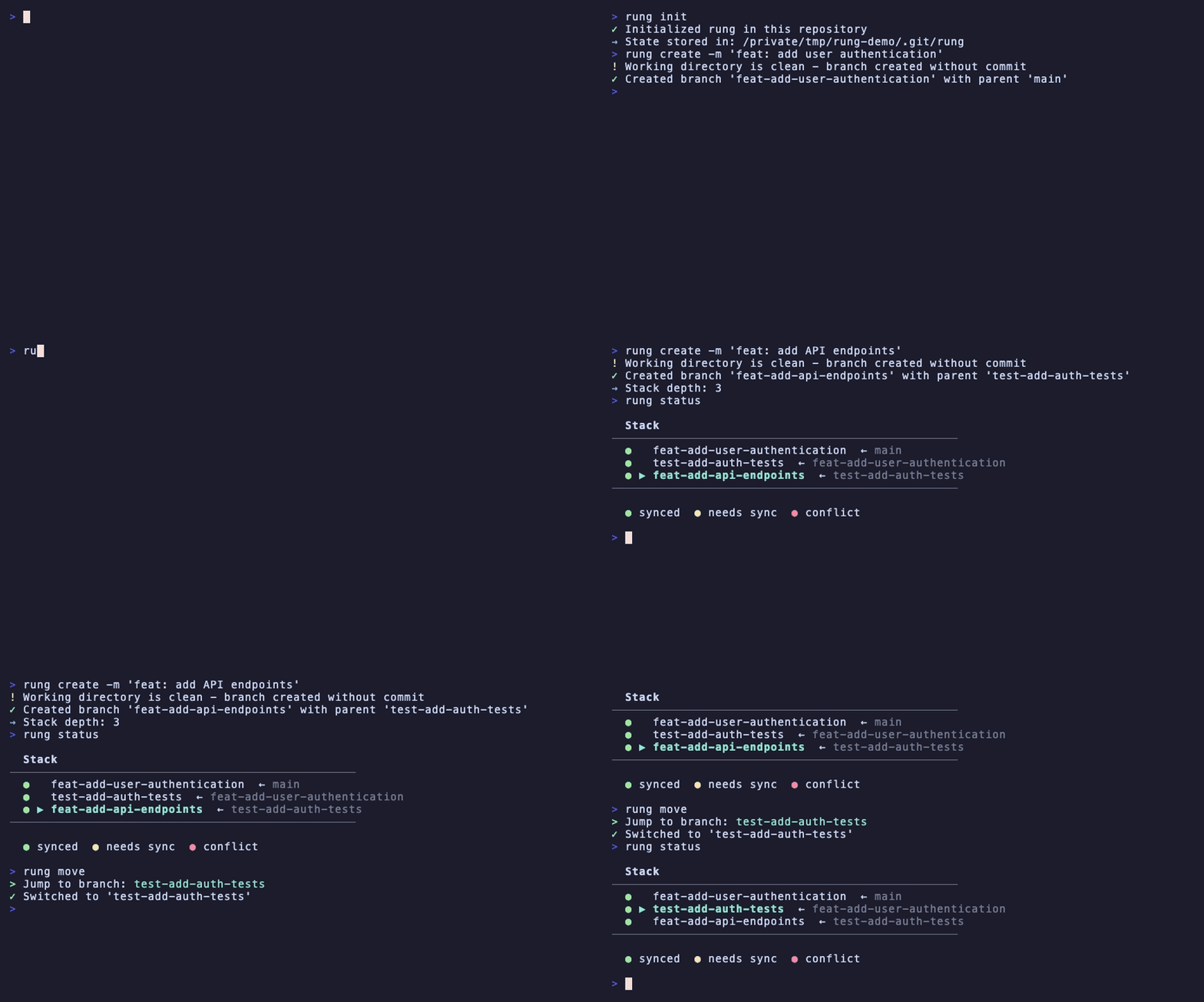
Overview
Rung helps you work with dependent branches by:
- Tracking branch relationships in a stack
- Syncing child branches when parents are updated
- Managing PR chains on GitHub with automatic stack comments
- Handling merges with automatic descendant rebasing
Installation
Pre-built binaries (recommended)
Download the latest release for your platform from GitHub Releases.
macOS (Apple Silicon):
|
macOS (Intel):
|
Linux (x86_64):
|
Windows: Download the .zip from releases and add to your PATH.
Homebrew (macOS/Linux)
From crates.io
With cargo-binstall (faster, no compilation)
From source
Quick Start
# Initialize rung in a repository
# Create a branch and commit in one step
# → Creates branch 'feat-add-user-authentication' and commits
# Create another branch on top
# → Creates branch 'feat-add-auth-tests' and commits
# Submit all branches as PRs
# (branches created with -m use their commit message as PR title)
# View stack status
Commands
Global Options
--json- Output as JSON (for tooling integration). Supported by:status,doctor,sync,submit,merge,log-q, --quiet- Suppress informational output. Only errors and essential results (like PR URLs) are printed. Exit code 0 indicates success. Cannot be used with--json.
rung init
Initialize rung in the current repository. Creates a .git/rung/ directory to store stack state.
rung create [name]
Create a new branch with the current branch as its parent. This establishes the branch relationship in the stack.
When using -m, rung will:
- Derive the branch name from the message (if not provided explicitly)
- Create and checkout the new branch
- Stage all changes
- Commit with the provided message
The branch name is derived from the message by slugifying it (e.g., "feat: add auth" becomes feat-add-auth). The commit message is then used as the PR title when you run rung submit.
Options:
-m, --message <message>- Commit message. Stages all changes and creates a commit. If no branch name is provided, derives it from the message.--dry-run- Preview what would happen without making changes
rung status
Display the current stack as a tree view with sync state and PR status.
Options:
--fetch- Fetch latest PR status from GitHub
Remote Divergence Indicators:
The status display shows how local branches compare to their remote counterparts:
(2↑)- Branch is 2 commits ahead of remote (safe to push)(1↓)- Branch is 1 commit behind remote (remote has changes)(2↑ 1↓)- Branch has diverged (2 ahead, 1 behind) - force push needed
When branches have diverged, a warning is shown with guidance to use rung submit --force (which uses --force-with-lease for safety).
rung sync
Sync the stack by rebasing all branches when the base moves forward.
If conflicts occur:
# Resolve conflicts, then:
# Or abort and restore:
Options:
--dry-run- Show what would be done without making changes--continue- Continue after resolving conflicts--abort- Abort and restore from backup-b, --base <branch>- Base branch to sync against (default: repository's default branch)
rung submit
Push all stack branches and create/update PRs on GitHub. Each PR includes a stack comment showing the branch hierarchy.
Options:
--draft- Create PRs as drafts--force- Force push using--force-with-leasefor safety, even if remote has changes-t, --title <title>- Custom PR title for current branch (overrides commit message)
rung merge
Merge the current branch's PR via GitHub API. Automatically:
- Rebases all descendant branches onto the new base
- Updates PR bases on GitHub
- Removes the branch from the stack
- Deletes local and remote branches
- Pulls latest changes to keep local up to date
Options:
-m, --method <method>- Merge method:squash(default),merge, orrebase--no-delete- Don't delete the remote branch after merge
rung undo
Undo the last sync operation, restoring all branches to their previous state.
rung nxt
Navigate to the next (child) branch in the stack.
rung prv
Navigate to the previous (parent) branch in the stack.
rung move
Interactive branch picker for quick navigation. Opens a TUI list to select and jump to any branch in the stack.
Displays all branches and highlights the current branch. PR numbers are shown when available:
? Jump to branch:
  feat/auth #41
> feat/api #42 ◀
  feat/ui
rung restack
Move a branch to a different parent in the stack by rebasing it onto a new base.
If conflicts occur:
# Resolve conflicts, then:
# Or abort and restore:
Options:
--onto <branch>- New parent branch to rebase onto (interactive selection if not specified)--include-children- Also rebase all descendant branches--dry-run- Show what would be done without making changes--force- Proceed even if branches have diverged from remote--continue- Continue after resolving conflicts--abort- Abort and restore from backup
Note: If any affected branches have diverged from their remote tracking branches (both local and remote have unique commits), restack will warn and abort. You can use --force to proceed anyway.
rung log
Show commits on the current branch (commits between parent branch and HEAD). Helps visualize what's in the current stack branch.
Example output:
a1b2c3d    Add user authentication     alice
e4f5g6h    Fix login redirect          alice
Options:
--json- Output as JSON (includes branch name, parent, and commit details)
rung absorb
Absorb staged changes into the appropriate commits in your stack. This analyzes staged hunks and automatically creates fixup commits targeting the commits that last modified those lines.
# Stage some changes first
# Preview what would be absorbed
# Absorb the changes (creates fixup commits)
# Use --base to specify the base branch if auto-detection fails
# Then apply the fixups with an interactive rebase
# IMPORTANT: Use the same base branch as the absorb command above
This is useful when you have small fixes or tweaks that should go into earlier commits in your stack rather than being new commits.
Options:
--dry-run- Show what would be absorbed without making changes-b, --base <branch>- Base branch to determine rebaseable range (default: auto-detect). The same base should be used when runninggit rebase --autosquash.
How it works:
- Parses your staged diff into hunks
- Uses
git blameto find which commit last modified each hunk's lines - Validates the target commit is in your stack (not already on the base branch)
- Creates
fixup!commits targeting the appropriate commits
Limitations:
- New files cannot be absorbed (no blame history)
- Hunks touching lines from multiple commits cannot be absorbed
- Only works with commits in the rebaseable range (between base and HEAD)
rung doctor
Diagnose issues with the stack and repository. Checks:
- Stack integrity: Branches exist, parents are valid, no circular dependencies
- Git state: Clean working directory, not detached HEAD, no rebase in progress
- Sync state: Branches that need rebasing, sync operations in progress
- GitHub connectivity: Authentication, PR status (open/closed/merged)
Issues are reported with severity (error/warning) and actionable suggestions.
Typical Workflow
# Start on main
# Initialize rung (first time only)
# Create first feature branch
# Make changes and commit
&&
# Create dependent branch
# Make more changes
&&
# Submit both as PRs
# After review, merge from bottom of stack
# Continue with remaining PRs
Stack Comments
When you submit PRs, rung adds a comment to each PR showing the stack hierarchy:
* **#124** 👈
* **#123**
* `main`

---
*Managed by [rung](https://github.com/auswm85/rung)*
Configuration
Rung stores its state in .git/rung/:
stack.json- Branch relationships and PR numbersconfig.json- Repository-specific settingsbackups/- Sync backup data for undo
Requirements
- Rust 1.85+
- Git 2.x
- GitHub CLI (
gh) authenticated, orGITHUB_TOKENenvironment variable
Project Structure
crates/
  rung-cli/      # Command-line interface
  rung-core/     # Core logic (stack, sync, state)
  rung-git/      # Git operations wrapper
  rung-github/   # GitHub API client
Development
# Clone and set up git hooks
# Run tests
# Run with clippy
# Build release
Authors
License
MIT