# rsecure
`rsecure` is a simple and secure command-line tool for AES-GCM file encryption and decryption, built in pure Rust. Ideal for protecting sensitive files, backups, and personal data.
> _Keep It Simple Stupid_
<p align="center" >
<img alt="GitHub code size in bytes" src="https://img.shields.io/github/languages/code-size/containerscrew/rsecure">
<img alt="GitHub last commit" src="https://img.shields.io/github/last-commit/containerscrew/rsecure">
<img alt="GitHub issues" src="https://img.shields.io/github/issues/containerscrew/rsecure">
<img alt="GitHub pull requests" src="https://img.shields.io/github/issues-pr/containerscrew/rsecure">
<img alt="GitHub Repo stars" src="https://img.shields.io/github/stars/containerscrew/rsecure?style=social">
<img alt="GitHub watchers" src="https://img.shields.io/github/watchers/containerscrew/rsecure?style=social">
<img alt="License" src="https://img.shields.io/badge/License-GPLv3-blue.svg">
<img alt="Crates.io" src="https://img.shields.io/crates/v/rsecure">
<img alt="AUR Version" src="https://img.shields.io/aur/version/rsecure">
<img alt="Crates.io Total Downloads"
src="https://img.shields.io/crates/d/rsecure?label=crates.io%20downloads">
<img alt="GitHub Releases Downloads"
src="https://img.shields.io/github/downloads/containerscrew/rsecure/total?label=github%20downloads">
</p>
---
---
# Installation
```shell
Specific version:
```shell
> [!NOTE]
> The installation script automatic detects your `OS` and `ARCH` and install the correct binary for you (rpm, deb, apk or just a binary in `/usr/local/bin`). In alpine, install the package `apk add gcompat
` sine the binary is built with `glibc` and alpine uses `musl`.
## AUR (Arch Linux)
```bash
paru -S rsecure # or yay -S rsecure
```
## Homebrew
```bash
brew tap containerscrew/tap
brew install --cask rsecure
```
> [!WARNING]
> Since this binary is not signed by the Apple ecosystem, you will need to run the following command to allow it to run on your system.
```bash
xattr -d com.apple.quarantine /opt/homebrew/bin/rsecure
```
> If you still have issues running the binary, I recommend using the `cargo` installation method or downloading the binary from the [releases page](https://github.com/containerscrew/rsecure/releases). Use the first method (installing via `curl` and the `install.sh` script).
## Using [`cargo`](https://rustup.rs/)
```bash
cargo install rsecure
cargo install rsecure@0.3.3 # specific version
```
## Local build
```bash
git clone https://github.com/containerscrew/rsecure.git
cd rsecure
cargo build --release
sudo cp ./target/release/rsecure /usr/local/bin/
```
# Usage
## Commands
| `rsecure create-key -o /mnt/myusb/rsecure.key` | Generate a new AES-256 key and save it to a file |
| `openssl rand -out /mnt/myusb/rsecure.key 32` | Alternative: generate a random 256-bit key using OpenSSL |
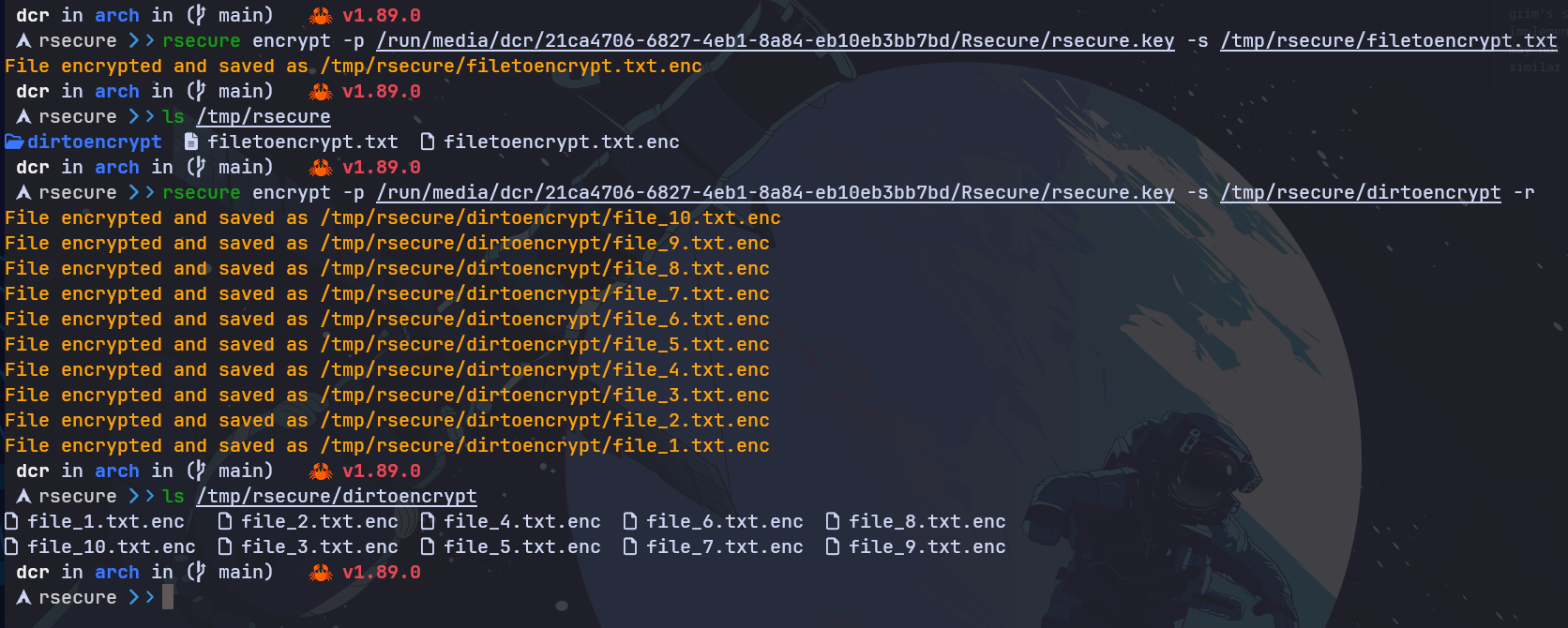
| `rsecure encrypt -p /mnt/myusb/rsecure.key -s /tmp/mydirectory/text_to_encrypt.txt` | Encrypt a single file (`.enc` file is created in the same directory) |
| `rsecure encrypt -p /mnt/myusb/rsecure.key -s /tmp/mydirectory/files/` | Encrypt all files in a directory |
| `rsecure decrypt -p /mnt/myusb/rsecure.key -s /tmp/mydirectory/text_to_encrypt.txt.enc` | Decrypt a single encrypted file |
| `rsecure decrypt -p /mnt/myusb/rsecure.key -s /tmp/mydirectory/files/` | Decrypt all files in a directory |
| `rsecure encrypt -r -p /mnt/myusb/rsecure.key -s /tmp/rsecure/dirtoencrypt/` | Encrypt and **remove** original files (plain text) |
| `rsecure encrypt -p /mnt/myusb/rsecure.key -s /tmp/rsecure/dirtoencrypt -e '.git'` | Encrypt all files in a directory excluding `.git/` files |
> [!WARNING]
> Saving the key in the same local filesystem where you save the encrypted files is not a good idea.
> Save the key in a secure location, like a `USB drive` or a password manager.
> Or just save it in a `root owned directory` with strict permissions (will require sudo to use it).
Something like:
```bash
sudo rsecure encrypt -p /root/rsecure.key -s /home/dcr/Documents/PrivateDocuments -r
```
> `rsecure` must be in a PATH directory where `root` user can execute it. Which means, if you installed it using `cargo`, you need to add `~/.cargo/bin` to the `PATH` variable in the `root` user environment. Or just copy the binary to `/usr/local/bin/` or any other directory in the `PATH`.
> [!IMPORTANT]
> By default, `rsecure` will not delete the source plain files after encryption to avoid data loss.
> If you want to delete the source files after encryption, use `-r` flag.
# Local dev
Testing encryption and decryption:
```bash
mkdir -p /tmp/rsecure/dirtoencrypt
touch /tmp/rsecure/filetoencrypt.txt
echo 'please, hack me!' > /tmp/rsecure/filetoencrypt.txt
for i in {1..10}; do
head -c 100 /dev/urandom | base64 > /tmp/rsecure/dirtoencrypt/file_$i.txt
done
mkdir /tmp/rsecure/dirtoencrypt/.git/
touch /tmp/rsecure/dirtoencrypt/.git/ignoreme.txt
touch /tmp/rsecure/dirtoencrypt/.git/notthisfile.txt
```
```bash
rsecure create-key -o ~/.keys/rsecure.key
rsecure encrypt -p ~/.keys/rsecure.key -s /tmp/rsecure/filetoencrypt.txt
rsecure decrypt -p ~/.keys/rsecure.key -s /tmp/rsecure/filetoencrypt.txt.enc
#
rsecure encrypt -p ~/.keys/rsecure.key -s /tmp/rsecure/dirtoencrypt/
rsecure decrypt -p ~/.keys/rsecure.key -s /tmp/rsecure/dirtoencrypt/
rsecyre encrypt -p ~/.keys/rsecure.key -s /tmp/rsecure/dirtoencrypt/ -e '.git'
```
# TODO
- Current logic reads every file into memory before encrypting it, which is not good for large files. I need to implement a streaming encryption and decryption logic to handle large files without consuming too much memory. Also take a look to implement parallel encryption and decryption to speed up the process.
- Share my public GPG key to verify the integrity of the binary releases
# License
**`rsecure`** is distributed under the terms of the [GPL3](./LICENSE) license.
