# Tell Error Logging
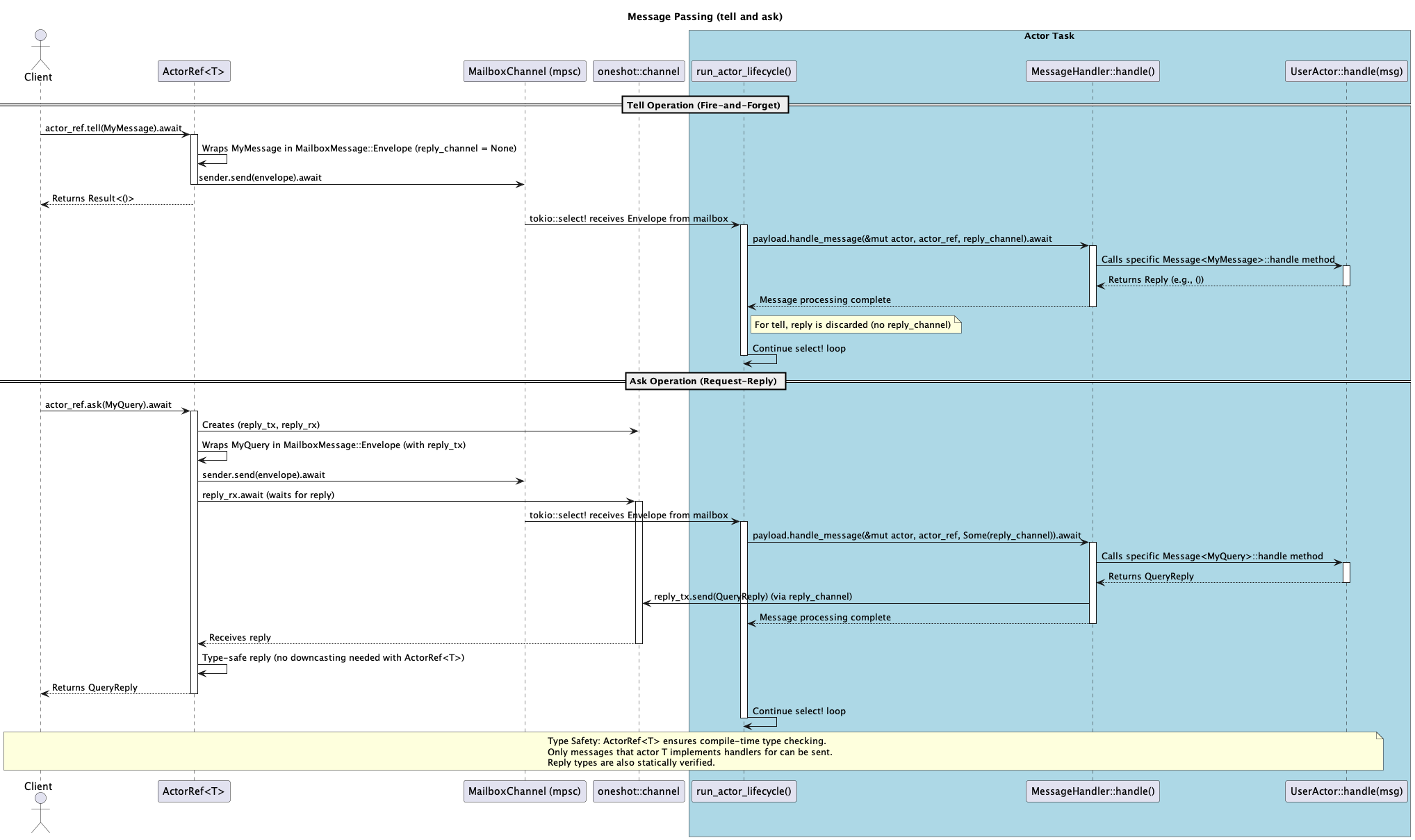
When using `tell()` (fire-and-forget), the handler's return value is normally discarded silently.
If the handler returns `Result<T, E>` and the result is `Err`, no indication of the failure is provided to the caller or the logs.
rsActor solves this with the `on_tell_result` hook on the `Message` trait, combined with automatic code generation via the `#[handler]` macro.
## How It Works
The `Message<T>` trait includes an `on_tell_result` method:
```rust
pub trait Message<T: Send + 'static>: Actor {
type Reply: Send + 'static;
fn handle(&mut self, msg: T, actor_ref: &ActorRef<Self>)
-> impl Future<Output = Self::Reply> + Send;
// Called only for tell() — not for ask()
fn on_tell_result(_result: &Self::Reply, _actor_ref: &ActorRef<Self>) {
// default: do nothing
}
}
```
- **`tell()` path**: After the handler completes, `on_tell_result` is called with the result.
- **`ask()` path**: `on_tell_result` is **not** called — the caller receives the result directly.
## Automatic Generation with `#[handler]`
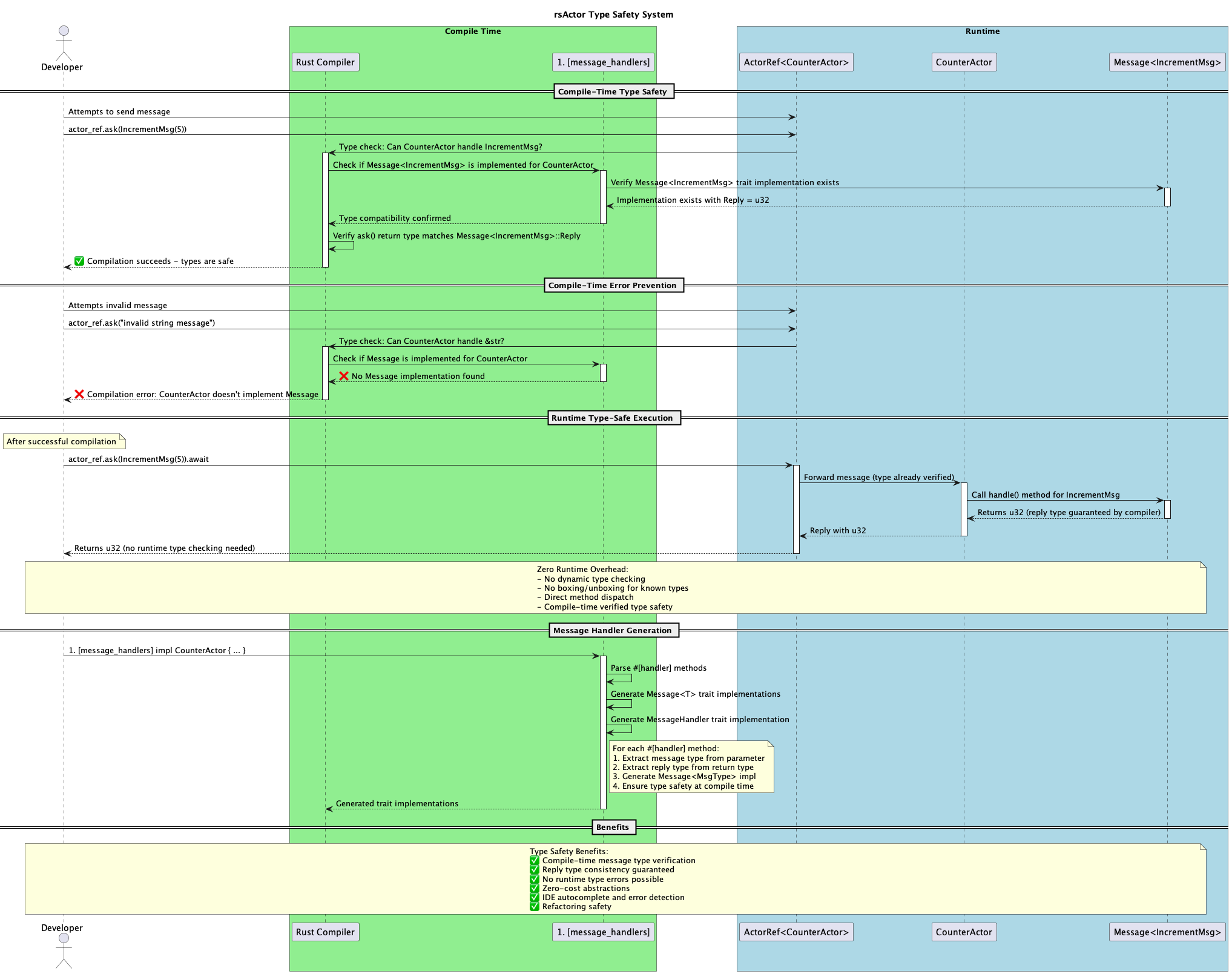
When using the `#[handler]` macro, `on_tell_result` is **automatically generated** if the return type is syntactically `Result<T, E>`. The generated code logs errors via `tracing::error!`.
```rust
#[message_handlers]
impl MyActor {
// Return type is Result<_, _> → on_tell_result generated automatically
#[handler]
async fn handle_work(
&mut self, msg: DoWork, _: &ActorRef<Self>,
) -> Result<(), WorkError> {
self.do_work(msg).await
}
}
```
This generates:
```rust
impl Message<DoWork> for MyActor {
type Reply = Result<(), WorkError>;
async fn handle(&mut self, msg: DoWork, actor_ref: &ActorRef<Self>) -> Self::Reply {
self.handle_work(msg, actor_ref).await
}
fn on_tell_result(result: &Self::Reply, actor_ref: &ActorRef<Self>) {
if let Err(ref e) = result {
tracing::error!(
actor = %actor_ref.identity(),
message_type = %std::any::type_name::<DoWork>(),
"tell handler returned error: {}", e
);
}
}
}
```
Non-Result return types use the default no-op:
```rust
#[handler]
async fn handle_count(&mut self, msg: GetCount, _: &ActorRef<Self>) -> u32 {
self.count
}
// → on_tell_result not generated, default no-op applies
```
## Type Alias: `#[handler(result)]`
Rust proc macros cannot resolve type aliases. If the return type is a type alias for `Result`, auto-detection will not work:
```rust
type MyResult = Result<String, MyError>;
#[message_handlers]
impl MyActor {
// ✗ MyResult is not syntactically Result<T, E> → no auto-detection
#[handler]
async fn handle_process(
&mut self, msg: Process, _: &ActorRef<Self>,
) -> MyResult {
self.process(msg).await
}
}
```
Use `#[handler(result)]` to force generation:
```rust
#[message_handlers]
impl MyActor {
// ✓ Explicitly marked → on_tell_result generated
#[handler(result)]
async fn handle_process(
&mut self, msg: Process, _: &ActorRef<Self>,
) -> MyResult {
self.process(msg).await
}
}
```
Note: `#[handler(result)]` on a method with no return type (unit `()`) is a compile error.
## Suppressing Logging: `#[handler(no_log)]`
If a handler returns `Result` but you intentionally don't want tell errors logged, use `#[handler(no_log)]`:
```rust
#[message_handlers]
impl MyActor {
// Result return, but errors are expected and not worth logging
#[handler(no_log)]
async fn handle_optional(
&mut self, msg: TryOptional, _: &ActorRef<Self>,
) -> Result<(), IgnorableError> {
self.try_optional(msg).await
}
}
```
`#[handler(result)]` and `#[handler(no_log)]` are mutually exclusive — combining them is a compile error.
## Decision Table
| `#[handler]` | `Result<T, E>` | Auto-generated (logs errors) |
| `#[handler]` | Non-Result (e.g., `u32`) | Default no-op |
| `#[handler(result)]` | Any (including type alias) | Generated (logs errors) |
| `#[handler(result)]` | `()` (no return) | **Compile error** |
| `#[handler(no_log)]` | `Result<T, E>` | Default no-op (suppressed) |
| `#[handler(result, no_log)]` | — | **Compile error** (mutually exclusive) |
## Display Bound on Error Type
The generated `on_tell_result` uses `tracing::error!("...: {}", e)`, which requires `E: Display`.
This is enforced implicitly — if `E` doesn't implement `Display`, the compiler emits:
```
error[E0277]: `MyError` doesn't implement `std::fmt::Display`
```
This is a deliberate design choice. Adding an explicit `where E: Display` bound is not possible because `E` is embedded inside `Self::Reply = Result<T, E>`, and the proc macro cannot know the concrete `E` type for type aliases.
## Manual Override
For manual `Message` trait implementations, override `on_tell_result` directly:
```rust
impl Message<MyMsg> for MyActor {
type Reply = Result<(), MyError>;
async fn handle(&mut self, msg: MyMsg, actor_ref: &ActorRef<Self>) -> Self::Reply {
// ...
}
fn on_tell_result(result: &Self::Reply, actor_ref: &ActorRef<Self>) {
if let Err(ref e) = result {
tracing::error!(actor = %actor_ref.identity(), "handler error: {}", e);
}
}
}
```
The hook is synchronous and stateless by design:
- **No `&self`**: Actor state is not accessible, keeping the hook purely observational.
- **Not `async`**: No hidden async control flow in fire-and-forget paths.