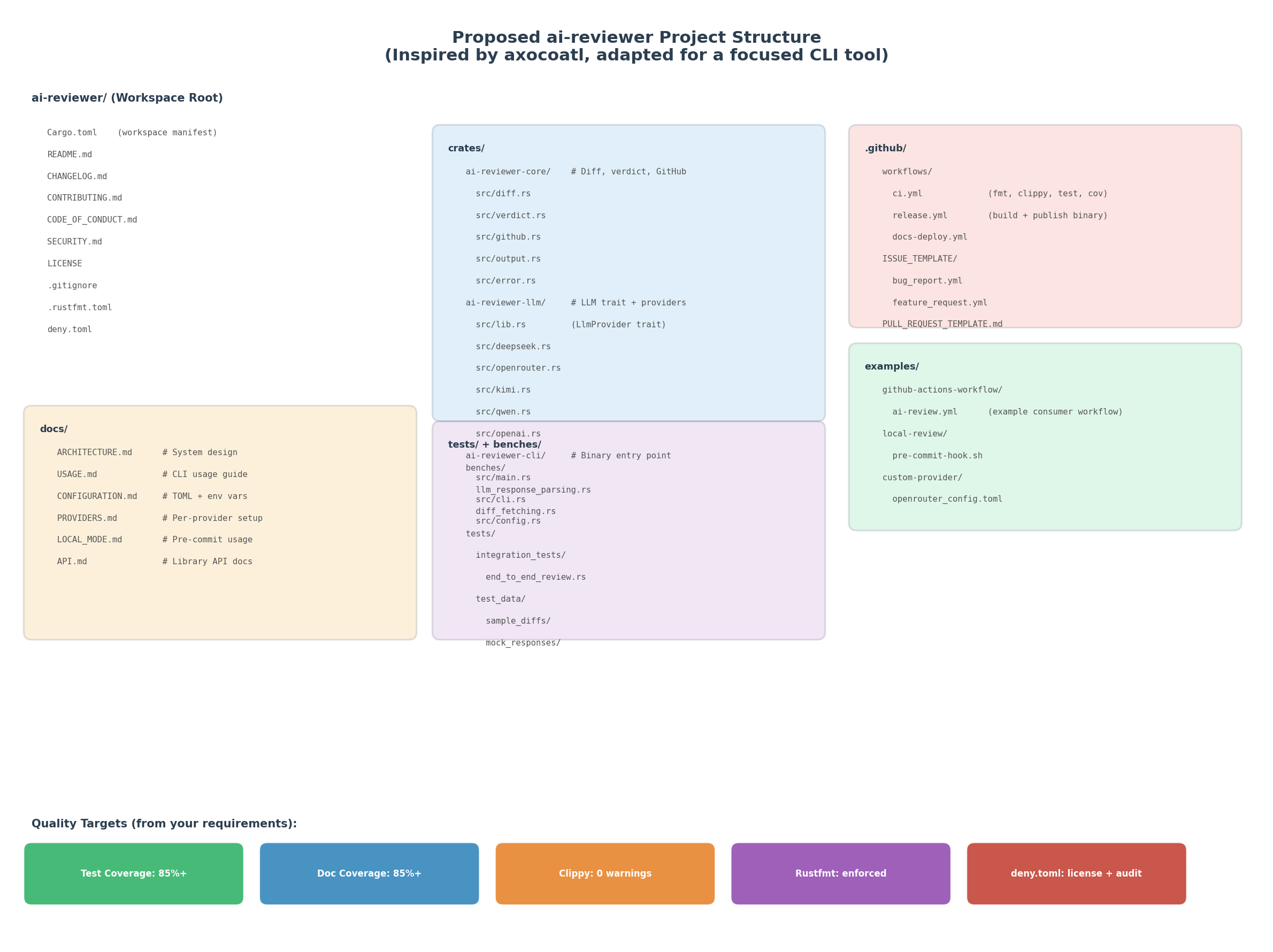
# rs-guard — Architecture
This document describes the system design, key decisions, and extension points of rs-guard.
---
## Overview
rs-guard is a **single-binary, single-pass review pipeline**. It fetches a diff, calls an LLM once, parses the structured response, and either submits a GitHub review (CI mode) or prints a colored terminal summary (local mode). No intermediate state is persisted, no comments are posted during analysis, and no database or server is required.
---
## Pipeline Flow
```mermaid
flowchart TD
A(["rs-guard invoked"]) --> B["Parse CLI Args\n(clap)"]
B --> C["Resolve Config\nCLI → env → TOML → defaults"]
C --> D{"Diff Source?"}
D -->|"--diff-file"| E["Read Diff File\nfetch_file_diff()"]
D -->|"GITHUB_ACTIONS=true"| F["Fetch PR Diff\nfetch_pr_diff() via GitHub REST API"]
D -->|"local"| G["Fetch Staged Diff\nfetch_local_diff()\ngit diff --cached"]
E & F & G --> H["Validate Diff\nsize + content markers"]
H --> I["Chunk Diff\nchunk_diff()\n400 head + 400 tail lines"]
I --> J["Check Cache\nDiffCache::get()"]
J -->|"Hit"| M
J -->|"Miss"| K["Call LLM\nprovider.chat_completion()\nwith_retry + circuit breaker"]
K --> L["Store in Cache\nDiffCache::set()"]
L --> M["Parse Verdict\nparse_verdict()\n[RS_GUARD_VERDICT_METADATA] block"]
M --> N["Write Artifacts\nreview-result.txt\nrs-guard-metrics.json"]
N --> O{"Mode?"}
O -->|"CI"| P["Submit GitHub Review\nsubmit_review()\nAPPROVE / REQUEST_CHANGES / COMMENT"]
O -->|"Local"| Q["Print Colored Summary\nprint_colored_summary()\nExit 2 if REQUEST_CHANGES"]
P --> R(["Exit 0"])
Q --> S(["Exit 0 or 2"])
```
---
## Module Structure
```mermaid
graph LR
main["main.rs"] --> pipeline
main --> cli
pipeline["pipeline.rs\nOrchestration"] --> cache
pipeline --> config
pipeline --> diff
pipeline --> github
pipeline --> llm
pipeline --> output
pipeline --> redact
pipeline --> verdict
diff["diff.rs"] --> http
diff --> retry
github["github.rs"] --> http
github --> retry
llm["llm/"] --> factory
llm --> providers
factory --> deepseek
factory --> kimi
factory --> qwen
factory --> openrouter
factory --> openai
config["config.rs"] --> llm
config --> http
cache["cache.rs"] --> error
retry["retry.rs"] --> error
output["output.rs"] --> verdict
verdict["verdict.rs"] --> error
error["error.rs"]
redact["redact.rs"]
http["http.rs"] --> error
```
---
## Key Modules
### `pipeline.rs` — Orchestration
The single entry point for all review logic. `run_pipeline()` accepts a `Config` and optional diff file path, drives the full workflow, and returns a `PipelineResult` enum instead of calling `process::exit()`. This keeps the library testable without subprocess spawning.
```rust
pub enum PipelineResult {
Success, // exit 0
ReviewBlocked, // exit 2 — local mode REQUEST_CHANGES
}
```
### `llm/` — Provider Abstraction
All providers implement the `LlmProvider` async trait:
```rust
#[async_trait]
pub trait LlmProvider: Send + Sync + std::fmt::Debug {
fn name(&self) -> &'static str;
async fn chat_completion(
&self,
system_prompt: &str,
user_content: &str,
temperature: f32,
) -> Result<String, RsGuardError>;
}
```
The `factory.rs` module maps a provider name string to a `Box<dyn LlmProvider>`. Adding a new provider requires:
1. A new module in `src/llm/` implementing the trait
2. An entry in `providers.rs` (metadata: name, env var, default model, base URL)
3. A match arm in `factory.rs`
See [docs/API.md](API.md) for a complete step-by-step guide.
### `cache.rs` — Response Caching
Cache entries are keyed by a SHA-256 hash of all LLM call parameters:
```
key = SHA-256(diff_content | prompt | provider | model | temperature)
```
Each `.cache` file stores:
- **Line 1:** Unix timestamp (seconds since epoch) — stored in content, not mtime, for reliability
- **Line 2+:** The raw LLM response
Writes are atomic: content is written to a `.tmp` file in the same directory, then renamed into place. This prevents partial reads from concurrent rs-guard processes.
The cache enforces a configurable maximum size (default: 100 MB) using LRU cleanup: entries are sorted by stored timestamp and the oldest are removed until the total falls below the limit.
### `retry.rs` — Retry + Circuit Breaker
**Retry policy:** Up to 3 retries with exponential backoff (1s, 2s, 4s base) and ±25% jitter. Only retries on retryable errors (429, 5xx, timeouts). Non-retryable errors (404, 401, 403) are returned immediately.
**Circuit breaker:** Simple two-state (Closed/Open). Opens after N consecutive failures; auto-resets to Closed after a configurable cooldown. No half-open state (keeps complexity low for v1). Thread-safe via `Arc<Mutex<>>`. Opt-in, disabled by default.
```mermaid
stateDiagram-v2
[*] --> Closed
Closed --> Open : N consecutive failures
Open --> Closed : Cooldown elapsed + request allowed
Closed --> Closed : Success (reset failure count)
```
### `diff.rs` — Diff Fetching + Chunking
Three diff sources with different behavior:
| GitHub API (`--ci`) | `fetch_pr_diff()` | Posts an explanatory `COMMENT` review |
| File (`--diff-file`) | `fetch_file_diff()` | Prints to stderr, exits 0 |
| Local (`git diff --cached`) | `fetch_local_diff()` | Prints to stderr, exits 0 |
After fetching, `chunk_diff()` trims large diffs to the first 400 + last 400 lines (configurable via `chunk_head_lines` / `chunk_tail_lines` in `.reviewer.toml`). Returns `Cow<str>` — borrowed when no truncation is needed (zero allocation in the common case).
### `verdict.rs` — Verdict Parsing
The LLM is instructed to append a structured block at the end of its response:
```
[RS_GUARD_VERDICT_METADATA]
Verdict: POSITIVE
CriticalBugs: 0
SecurityIssues: 0
```
The parser extracts this block using regex, strips it from the display text, and applies the review state logic:
```
NEGATIVE or security_issues > 0 or critical_bugs > 2 → REQUEST_CHANGES
critical_bugs == 0 and security_issues == 0 → APPROVE
otherwise → COMMENT
```
### `github.rs` — Review Submission
Submits reviews via the GitHub REST API (`POST /repos/{owner}/{repo}/pulls/{pr}/reviews`). Includes `<!-- rs-guard-bot -->` as an HTML comment signature in the review body for identification.
When the new state is non-blocking (`APPROVE` or `COMMENT`), any previous rs-guard `CHANGES_REQUESTED` reviews are dismissed to clean up the PR review list.
Fallback: if `APPROVE` or `REQUEST_CHANGES` fails with HTTP 403 (insufficient token permissions), the state is downgraded to `COMMENT` and resubmitted.
---
## CI vs Local Mode Detection
```mermaid
flowchart LR
A["Start"] --> B{"GITHUB_ACTIONS\nenv var set?"}
B -->|"Yes"| C["CI Mode\nFetch PR diff via API\nSubmit GitHub review"]
B -->|"No"| D{"--diff-file\nflag set?"}
D -->|"Yes"| E["File Mode\nRead diff from path\nPrint colored summary"]
D -->|"No"| F["Local Mode\ngit diff --cached\nPrint colored summary\nExit 2 if blocked"]
```
---
## Security Model
### SSRF Protection
All provider base URLs are validated against a per-provider allowlist before any HTTP request is made. This ensures that `Authorization` headers containing API keys are never sent to an attacker-controlled host.
- **CI mode (GitHub API):** URL must match `api.github.com` or the configured GitHub Enterprise base URL.
- **Provider APIs:** URL must match the known canonical base URL for the provider.
- **Local/test mode:** Loopback addresses (`127.0.0.1`, `localhost`, `[::1]`) are allowed — enables wiremock-based testing.
### Secret Handling
- API keys are read from environment variables, never from the diff content or command-line arguments.
- The `redact.rs` module strips known secret patterns from LLM responses before writing artifacts or submitting reviews.
- `log_redacted()` truncates sensitive content in debug log output.
- Secrets are never written to the response cache.
### Token Permissions
rs-guard requests the minimum GitHub token scope needed: `pull-requests: write`. If the token only has `read` permission, the submission is downgraded to `COMMENT` (which requires only `read` for public repos, or a token that can post comments).
---
## Performance Characteristics
| Binary size (release, stripped) | ~5 MB |
| Cold startup to first API call | < 100ms |
| End-to-end latency (cache miss) | 3–15s (LLM-dominated) |
| End-to-end latency (cache hit) | < 200ms |
| Memory footprint | < 50 MB |
| Diff size limit | 100 KB / 1500 lines |
The Criterion benchmarks in `benches/verdict.rs` cover verdict parsing (the only CPU-intensive step). Run with:
```bash
cargo bench --bench verdict
```
---
## Extending the Codebase
### Adding a New LLM Provider
See [docs/API.md](API.md#adding-a-new-provider).
### Adding a New Diff Source
1. Add a new function in `diff.rs` returning `Result<DiffResult, RsGuardError>`
2. Add the corresponding CLI flag or env var detection in `cli.rs` / `config.rs`
3. Add a new branch in the diff-source `if/else` block in `pipeline.rs`
4. Handle the `DiffTooLarge` case consistently with the existing sources
### Modifying the Verdict Format
The metadata block format is defined in the default prompt (`config.rs::DEFAULT_PROMPT`) and parsed in `verdict.rs::parse_verdict()`. Both must be kept in sync. Add tests to `verdict_tests.rs` for any new fields.