# rpi — a Rust-native coding-agent runtime
[](https://crates.io/crates/rpi-cli)
[](https://crates.io/crates/rpi-cli)
[](https://docs.rs/rpi-cli)
[](#license)
[](#install)
[](https://github.com/bigfish1913/pi-rust/actions/workflows/ci.yml)
[](https://github.com/bigfish1913/pi-rust/stargazers)
[](https://github.com/bigfish1913/pi-rust/releases/latest)
`rpi` is a library-first coding-agent runtime written in Rust, plus a terminal
agent built on top of it. Nine composable crates span provider adapters, a
durable crash-resumable agent loop, a terminal UI, and a stable plugin ABI — so
the same code works as an embedded SDK or as a ready-to-run `rpi` command.
Website: <https://rpi.laofu.online/> · Docs: <https://rpi.laofu.online/docs.html>

<sub>Interactive TUI. See [`docs/guides/user-guide.md`](docs/guides/user-guide.md) for the full command surface.</sub>

<sub>The agent loop and a real `write` tool round-trip, recorded with no API key and no network — the same path the tests take. Source of truth is [`demo/sdk.tape`](demo/sdk.tape); regenerate with `task demo`.</sub>
## Three ways to use it
| A working terminal coding agent | nothing | `cargo install rpi-cli` |
| Your own agent inside your process | `rpi-agent` (+ `rpi-ai`, `rpi-tools`) | [`examples/minimal`](examples/minimal) |
| A tool/provider that extends every session | `rpi-plugin-sdk` | [`examples/plugin-stub`](examples/plugin-stub) |
The three share one implementation. Build your tools once, debug them inside an
embedded agent, and ship the same code as a `cdylib` plugin that the global `rpi`
loads. See [`docs/agent/project-structure.md`](docs/agent/project-structure.md) for the recommended
project layout.
## Install
**Prebuilt binary** (no Rust toolchain needed):
```bash
Verifies the published SHA-256 checksum and installs to `/usr/local/bin` or
`~/.local/bin`. Preview first with `--dry-run`.
**From crates.io** (requires Rust 1.78+):
```bash
cargo install rpi-cli
rpi --version
```
**Package managers:**
```bash
brew tap bigfish1913/tap && brew install rpi # macOS (Apple silicon), Linux
scoop bucket add bigfish1913 https://github.com/bigfish1913/scoop-bucket
scoop install rpi # Windows
```
The Homebrew formula omits Intel macOS because no `x86_64-apple-darwin` build is
published — use `cargo install rpi-cli` there. A winget manifest is [open for
review](https://github.com/microsoft/winget-pkgs/pull/444745).
**From source:**
```bash
git clone https://github.com/bigfish1913/pi-rust.git
cd pi-rust && cargo run -p minimal # offline agent, no API key required
```
Real output of the two offline examples — no credentials, no network, identical
bytes every run. Regenerate with `task demo-transcript`:
```text
$ cargo run -q -p minimal
minimal example: 2 messages after run
- user
- assistant
assistant reply: Hello from the faux provider!
AgentEnd observed.
$ cargo run -q -p tools-example
tools example: 4 messages after run
wrote out.txt (28 bytes): "hello from the tools example"
AgentEnd observed; tool ran against OsExecutionEnv.
```
## Quick start
### The CLI
```bash
export ANTHROPIC_API_KEY=... # or OPENAI_API_KEY, or ~/.rpi/agent/models.json
rpi # interactive TUI
rpi -p "summarize the README" # one-shot
rpi --mode json -p "list the crates" # machine-readable event stream
```
Sessions persist as JSONL and survive a crash mid-run; `rpi` resumes from the
last committed frame rather than replaying the turn. Custom Anthropic or
OpenAI-compatible gateways are declared in `~/.rpi/agent/models.json` and
selected with `--model <provider>/<model>`.
### The SDK
Build an agent against a deterministic in-process provider — no API key, no
network, no flakiness:
```rust
use rpi_agent::AgentBuilder;
use rpi_ai::providers::faux::{FauxProvider, FauxScript};
use rpi_ai::Provider;
#[tokio::main]
async fn main() {
// `FauxProvider::new` already returns an `Arc<Self>`.
let provider = FauxProvider::new(FauxScript::new().with_text("Hello from the faux provider!"));
let model = provider.default_model().clone();
let agent = AgentBuilder::new()
.model(model)
.system_prompt("You are a helpful assistant.")
.stream_fn(make_stream_fn(provider))
.build()
.expect("agent builds");
let mut events = agent.subscribe();
agent.prompt("hi").await.expect("prompt completes");
while let Ok(ev) = events.try_recv() {
let _ = ev; // AgentEvent::{MessageUpdate, ToolEnd, AgentEnd, …}
}
println!("{} messages after the run", agent.state().messages.len());
}
```
`make_stream_fn` bridges the synchronous `StreamFn` contract to the async
provider — the full version is in [`examples/minimal/src/main.rs`](examples/minimal/src/main.rs)
(`cargo run -p minimal`).
## Crates
Nine crates, one version, published together. Dependency direction is one-way
and enforced in review:
```
rpi-telemetry → rpi-ai → rpi-agent → rpi-tools → rpi-harness
```
Three crates sit outside that chain:
- `rpi-tui` depends on no other `rpi-*` crate.
- `rpi-plugin-sdk` is a leaf too (it has no `rpi-*` deps), but it is not only
the host's plugin contract: `rpi-tools` also reads its env-var names, so the
host and its plugins cannot disagree about the strings they exchange across
the ABI. That edge is names-only — nothing is linked or called.
- `rpi-extensions` is `rpi-plugin-sdk` plus `rpi-ai`/`rpi-agent`, since it hosts
plugins that run tools.
- `rpi-cli` depends on all eight of the others, which is how the `rpi` binary
gets the TUI, the harness and the plugin loader at once.
| [`rpi-telemetry`](https://crates.io/crates/rpi-telemetry) | Span/event contracts with a no-op default — instrumentation is opt-in, and pulls in no tracing or OpenTelemetry backend |
| [`rpi-ai`](https://crates.io/crates/rpi-ai) | Provider-agnostic message, streaming and tool-schema types; Anthropic + OpenAI-compatible + `faux` providers |
| [`rpi-agent`](https://crates.io/crates/rpi-agent) | The agent loop: `AgentTool`, events, hooks, queues, cancellation |
| [`rpi-tools`](https://crates.io/crates/rpi-tools) | `read`/`write`/`edit`/`bash` (+ `grep`, `find`, `ls`, `powershell`) and the `ExecutionEnv` seam |
| [`rpi-harness`](https://crates.io/crates/rpi-harness) | Session tree, JSONL persistence, compaction, crash recovery, the run loop |
| [`rpi-tui`](https://crates.io/crates/rpi-tui) | Terminal UI primitives: components, layout, editor, transcript rendering |
| [`rpi-cli`](https://crates.io/crates/rpi-cli) | The `rpi` binary: TUI, one-shot and JSON modes, config, plugin loading |
| [`rpi-plugin-sdk`](https://crates.io/crates/rpi-plugin-sdk) | The stable `#[repr(C)]` ABI contract for plugins. No `rpi-*` deps; only `serde_json`, behind a default `json` feature that can be turned off |
| [`rpi-extensions`](https://crates.io/crates/rpi-extensions) | Host-side plugin loader and the async-across-ABI tool bridge |
Every crate has its own README and docs.rs page. The `crates/rpi-*`
directories and the published crate names use the same `rpi-` prefix.
## Why rpi
Most coding agents are CLIs. `rpi` is a **runtime with a CLI attached**, which
changes what you can build with it:
- **Embeddable.** The agent loop is a library. `rpi-agent` + `rpi-ai` is enough
to run an agent inside your own process, with your own event handling and
output — no shelling out to a tool and scraping stdout.
- **Testable offline.** A deterministic `faux` provider and an in-memory
execution environment are first-class, not mocks bolted on. `rpi-ai` puts its
real HTTP providers behind a `providers` feature flag, so your test suite
cannot silently depend on the network for the paths you exercise.
- **Durable.** Sessions are a tree with JSONL persistence and per-frame
progress. A crash mid-tool-call resumes instead of losing the turn or
double-executing the tool.
- **Extensible across a stable boundary.** Plugins are Rust `cdylib`s behind a
hand-written, panic-contained C ABI with version negotiation — the ABI
survives compiler and crate version skew, so extensions do not break on every
release.
- **One implementation, two surfaces.** The global CLI and an embedded agent load
the same tools. You do not maintain a plugin and a library variant separately.
### How it compares
Structural differences against other terminal coding agents. Facts about other
tools are as of 2026-09 and change often — check their documentation; only the
`rpi` column is maintained here.
| Language | Rust | TypeScript | Rust | TypeScript/Go | Python |
| Source available | ✅ MIT | ❌ | ✅ | ✅ | ✅ |
| Usable as an embedded library | ✅ | ❌ | ❌ | ⚠️ | ⚠️ |
| First-class plugin ABI | ✅ | hooks/MCP | ❌ | plugin API | ❌ |
| Headless server + remote client | ✅ | ⚠️ | ✅ | ✅ | ⚠️ |
| Provider-agnostic gateways | ✅ | ❌ | ❌ | ✅ | ✅ |
If you want the most polished single-vendor experience, use the vendor's tool.
`rpi` is for people who want to own the loop.
## Performance
Measured on Windows 11 (x86_64), rustc 1.97.1, `--release`. Both scripts
rebuild and re-measure on your own machine.
`sh scripts/bench.sh` — standalone numbers:
| Release binary size | **21.8 MiB** |
| `rpi --version` wall time | **~17 ms** median |
| RSS once the agent is ready | **12.0 MiB** |
`node scripts/bench-vs-pi.mjs --pi <path-to-pi>` — against native Pi on the same
machine, both offline, each with a fresh isolated config directory:
| `--version` | **17.5 ms** | 169.5 ms | **9.7× faster** |
| Cold start | **17.7 ms** | 189.5 ms | **10.7× faster** |
| RSS at ready | **12.0 MiB** | 91.5 MiB | **7.6× smaller** |
| Install footprint | **21.8 MiB** (one binary) | ~385 MiB (+ ~91 MiB Node) | **~18–22× smaller** |
**Cold start** is spawn → the agent answering its first command: process creation
plus full initialisation, excluding teardown and any LLM work. rpi's `--version`
(17.5 ms) and cold start (17.7 ms) are effectively equal, so startup is process
creation, not initialisation; Pi is dominated by Node boot.
Isolation caveat: rpi reads `RPI_CODING_AGENT_DIR` / `RPI_OFFLINE`, native Pi reads
`PI_CODING_AGENT_DIR` / `PI_OFFLINE`. Set the matching pair for each, or rpi
silently loads the machine's global plugins.
Method, raw per-run numbers, and what is *not* measured (LLM latency, tool-loop
throughput, long sessions, TUI frame cost) are in
[`docs/performance/benchmark-vs-pi.md`](docs/performance/benchmark-vs-pi.md).
## Plugins
Plugins are Rust `cdylib` libraries behind a stable `#[repr(C)]` ABI. A plugin
can register tools, providers, slash commands, event handlers, markdown
renderers and discovered resources.
```bash
rpi install rpi-todo # build from crates.io and install
rpi install my-ext --path ../my-ext # local, for development
rpi dev # build + watch + live reload
```
The host loads project `.rpi/extensions`, then global
`~/.rpi/agent/extensions`, then any `--extensions-dir`.
Ready-to-install extensions live in the companion
[`pi-rust/rpi-package`](https://github.com/pi-rust/rpi-package) repository, with
an [online catalog](https://rpi.laofu.online/packages.html).
```rust
use rpi_plugin_sdk::{export_plugin, StbStringRef};
export_plugin!(|api| {
if let Some(declare) = api.declare {
declare(StbStringRef::from_str(r#"{"priority":60,"platforms":["linux"]}"#));
}
// register tools / handlers through `api`
0
});
```
Start from [`examples/plugin-stub`](examples/plugin-stub) — a complete plugin
with the full `execute`→`poll`→`cancel`→`destroy` lifecycle — and read
[`docs/extensions/authoring.md`](docs/extensions/authoring.md) for the safety
rules, which are load-bearing rather than stylistic.
## Remote mode
```bash
rpi --server # headless agent over TCP, prints an auth token
rpi --connect host:port --token T # TUI client with zero local agent resources
```
The client holds no provider, tools, extensions or session files — all agent
work happens on the server, so a thin terminal anywhere can drive a beefy
machine. See [`docs/remote/user-guide.md`](docs/remote/user-guide.md).
## Project status
| Current release | **[0.3.9](https://github.com/bigfish1913/pi-rust/releases)** (nine crates, published together) |
| Stability | `rpi-ai`, `rpi-agent`, `rpi-tools`, `rpi-harness`, `rpi-plugin-sdk` are the intended stable surface |
| MSRV | 1.78 |
| Platforms | Linux, macOS, Windows (CI runs the suite on Linux) |
| Not yet | Intel macOS prebuilt binaries |
`rpi` is a self-contained Rust coding-agent stack. No Node component is
required and none is loaded.
## Documentation
- [User guide](docs/guides/user-guide.md) — commands, config, sessions, skills
- [Architecture](docs/architecture/overview.md) — how the crates fit together and why
- [Building an agent project](docs/agent/project-structure.md) — recommended structure
- [Extension authoring](docs/extensions/authoring.md) — plugin templates and ABI rules
- [Remote mode](docs/remote/user-guide.md) — protocol, tokens, limitations
- [Roadmap](ROADMAP.md) · [Changelog](CHANGELOG.md)
- [docs.rs](https://docs.rs/rpi-cli) for per-crate API docs
## Contributing
Issues and PRs are welcome. Start with [CONTRIBUTING.md](CONTRIBUTING.md) for the
build/test commands and the repository layout, and the
[roadmap](ROADMAP.md) for what is already planned. Security problems should go
through [SECURITY.md](SECURITY.md), not a public issue.
The whole test suite runs offline: `cargo test --workspace --locked`.
## Community
Questions, ideas and early builds are welcome in either group:
<table>
<tr>
<td align="center" width="50%">
<img src="docs/images/weixin.png" width="230" alt="WeChat group QR code"><br>
<sub><b>WeChat</b> — <a href="https://weixin.qq.com/g/AQYAAD8z3FmKPk143hi_HUVOtGvNqlHWMtVZu1VGGB_46JKoNpyhJvS7kDwQwUTr">微信交流群</a></sub>
</td>
<td align="center" width="50%">
<img src="docs/images/tg.png" width="230" alt="Telegram group QR code"><br>
<sub><b>Telegram</b> — <a href="https://t.me/+7YfN4TZPP7Y0M2Q1">t.me/+7YfN4TZPP7Y0M2Q1</a></sub>
</td>
</tr>
</table>
<sub>Group invite codes expire — WeChat's rotates every few days. If a QR code stops working, open an issue and it will be refreshed.</sub>
## License
MIT. See [LICENSE](LICENSE) and [NOTICE](NOTICE).
The `rpi-*` crates are a Rust-native coding-agent stack.
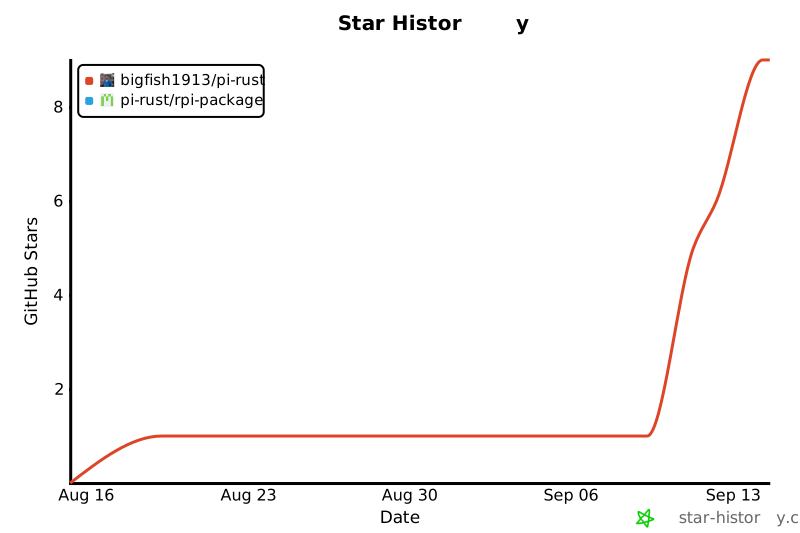
## Star history
[](https://www.star-history.com/#bigfish1913/pi-rust&pi-rust/rpi-package&Date)