# rpi — Rust port of the Pi agent SDK
[](https://crates.io/crates/rpi-cli)
[](https://docs.rs/rpi-plugin-sdk)
[](https://github.com/bigfish1913/pi-rust/actions)
A Rust port of [earendil-works/pi](https://github.com/earendil-works/pi)'s SDK
layer — a library-first, multi-crate workspace for building personal LLM coding
agents in Rust, plus an `rpi` CLI built on top.
> **Naming.** The published crates use the `rpi-` prefix (the upstream `pi-*`
> names are owned on crates.io by a parallel port). The on-disk directories stay
> `crates/pi-*` for history; the `package.name` in each `Cargo.toml` is
> `rpi-*`, so `extern crate` / `use` paths are `rpi_ai`, `rpi_agent`, etc.
## Crates (published as `rpi-*`)
| `rpi-telemetry` | `pi-telemetry/` | Telemetry span/event contracts (noop default). |
| `rpi-ai` | `pi-ai/` | Unified multi-provider LLM types + streaming (Anthropic + faux). |
| `rpi-agent` | `pi-agent/` | Agent runtime + loop, `AgentTool` trait, events, hooks, queues. |
| `rpi-tools` | `pi-tools/` | Pi-compatible coding tools (`read`/`write`/`edit`/`bash`) + `ExecutionEnv`. |
| `rpi-harness` | `pi-harness/` | `AgentHarness`: session tree, JSONL persistence, compaction, run loop. |
| `rpi-cli` | `pi-cli/` | Terminal coding-agent CLI (`rpi` binary) on top of the library crates. |
| `rpi-plugin-sdk` | `rpi-plugin-sdk/` | Stable C ABI for Rust-native plugins and extension discovery. |
| `rpi-extensions` | `rpi-extensions/` | Dynamic plugin loader and `AgentTool` adapter. |
| `rpi-tui` | `pi-tui/` | Terminal UI primitives used by the interactive CLI. |
Dependency direction: `rpi-telemetry → rpi-ai → rpi-agent → rpi-tools → rpi-harness → rpi-cli`.
### Rust registry links
| `rpi-cli` | [crates.io](https://crates.io/crates/rpi-cli) | [docs.rs](https://docs.rs/rpi-cli) |
| `rpi-agent` | [crates.io](https://crates.io/crates/rpi-agent) | [docs.rs](https://docs.rs/rpi-agent) |
| `rpi-plugin-sdk` | [crates.io](https://crates.io/crates/rpi-plugin-sdk) | [docs.rs](https://docs.rs/rpi-plugin-sdk) |
| `rpi-extensions` | [crates.io](https://crates.io/crates/rpi-extensions) | [docs.rs](https://docs.rs/rpi-extensions) |
The registry pages are the canonical entry points for installing the CLI or
embedding the SDK. The repository may contain unreleased changes; check the
published version shown on crates.io before depending on a new API.
### Extension package repository
Ready-to-install Rust-native extensions are maintained in the companion
[`pi-rust/rpi-package`](https://github.com/pi-rust/rpi-package) repository.
Browse its [`packages/`](https://github.com/pi-rust/rpi-package/tree/master/packages)
directory for package source, usage documentation, and release metadata, or use
the [online package catalog](https://rpi.laofu.online/packages.html).
## Relationship to the TypeScript source
The TypeScript reference is checked out under `.reference/pi/` (read-only). Every
Rust module names the TS file it mirrors in its module-level doc comment. The
crate family is a Rust-native reimplementation, not a thin wrapper — it ports the
SDK surface (`pi-ai`, `pi-agent-core`, the harness tools, the session layer) and
the CLI, keeping the layering and behavior faithful while using idiomatic Rust
(`async`/`await`, `Arc`, `serde`, `tokio`).
## How you build an agent
```rust
use rpi_agent::{Agent, AgentTool, AgentEvent};
use rpi_ai::{providers::faux::faux_provider, Model};
let model = faux_provider().model("echo");
let mut agent = Agent::builder(model)
.system_prompt("You are a helpful assistant.")
.tool(MyTool)
.build();
let mut events = agent.subscribe();
tokio::spawn(async move {
while let Some(ev) = events.recv().await {
match ev { /* AgentEvent::MessageUpdate { .. }, etc. */ }
}
});
agent.prompt("Hello!").await.unwrap();
```
See [docs/architecture.md](docs/architecture.md) for the full design.
## Build a plugin
Plugins are Rust `cdylib` libraries loaded through the stable ABI exposed by
`rpi-plugin-sdk`. The repository includes a complete `echo` tool example that
also exercises event and resource discovery:
```bash
cargo build -p plugin-stub
```
Then point the CLI at the directory containing the generated library (the
extension is named `plugin_stub.dll`, `libplugin_stub.so`, or
`libplugin_stub.dylib` depending on the platform):
```bash
rpi --extensions-dir target/debug -p 'echo "hi"'
```
The plugin depends on `rpi-plugin-sdk` only; the host-side loader lives in
`rpi-extensions`. See [`examples/plugin-stub`](examples/plugin-stub) and the
[`rpi-plugin-sdk` API docs](https://docs.rs/rpi-plugin-sdk) for the ABI
contract.
### Install a crates.io extension
`rpi install` installs Rust-native extensions directly from Cargo. The package
must expose an `rpi-plugin-sdk` compatible `cdylib` target:
```bash
rpi install rpi-extension-example
rpi install rpi-extension-example --version 0.1.0
rpi install rpi-extension-example --force
```
The command resolves and builds the crate with Cargo in release mode, then
copies its `.dll`, `.so`, or `.dylib` into `~/.rpi/agent/extensions` (or the
directory selected by `RPI_CODING_AGENT_DIR`). The extension is loaded on the
next `rpi` start. For local development, use
`rpi install my-extension --path ../my-rpi-extension --force`.
This is intentionally different from plain `cargo install`: `cargo install`
only copies executable targets, while rpi loads dynamic-library extensions.
### Develop an extension with watch mode
From a Rust extension crate (`[lib] crate-type` contains `"cdylib"`), start the
development host with:
```bash
rpi dev
```
The command detects the Cargo package, performs an initial build, stages a
versioned library under `.rpi/extensions/.dev`, and watches the crate sources.
Successful source changes trigger a rebuild and the same live reload used by
the TUI's `/reload` command. A failed build keeps the currently loaded plugin.
For a workspace containing multiple extensions, select one explicitly:
```bash
rpi dev --package rpi-todo
rpi dev --release
rpi dev --no-watch
```
See [`docs/extension-authoring.md`](docs/extension-authoring.md) for complete
Rust extension and Pi JS/TS package templates, safety rules, testing, and
release checklists.
### Load static Pi packages
> **Beta notice:** JavaScript/TypeScript package loading through the Node host
> and skill-invocation rendering in the TUI are experimental compatibility
> features. They are suitable for local evaluation and feedback, but are not
> recommended for production workloads and may change before stabilization.
rpi can load Pi packages, including their static resources and executable
JavaScript/TypeScript extensions. Install a package with:
```bash
rpi install-pi npm:@scope/my-package@1.0.0
rpi install-pi npm:my-alias@npm:@scope/my-package@^1
rpi install-pi git:github.com/user/my-package@v1
rpi install-pi ./my-pi-package
```
卸载已安装的扩展或 Pi package:
```bash
rpi uninstall rpi-extension-example
rpi uninstall-pi npm:@scope/my-package
# 等价写法:rpi uninstall pi npm:@scope/my-package
```
npm and Git installs use Pi-compatible managed stores: project packages live
under `.pi/npm` and `.pi/git`, while `--global` uses the configured rpi agent
directory's `npm` and `git` stores. Local directories are enabled in place and
are never copied or deleted. Existing legacy `.rpi/packages`, `.pi/packages`,
and native `~/.pi/agent` installs remain discoverable. Package-manager argv is
selected from project `.rpi/settings.json`, project `.pi/settings.json`, then
global `settings.json`; the default is npm. rpi treats the setting as structured
argv rather than a shell command string, applies hardened encoding to Windows
`.cmd` shims, and uses the native Pi flags for npm, pnpm, or bun.
Package discovery and loading are disabled by default; start rpi with
`--enable-pi-packages` to opt in. That startup performs a short one-shot Node.js
discovery pass. In the interactive TUI, a long-lived Node.js host starts
immediately before the first submitted prompt (or earlier when a package
command or tool is used), so an idle TUI does not keep Node resident.
`registerTool`, `registerCommand`, and `resources_discover` are supported.
TypeScript uses Node's native type stripping when available, or a package-local
`jiti` dependency. Pi peer/runtime packages are installed and aliased from
nested `node_modules` when npm does not hoist them. Node.js is required, and
extension code has the same filesystem/network permissions as the current user.
Command handlers receive the core Pi context (`mode`, `hasUI`, `capabilities`,
`model`, `modelRegistry`, `ui.notify`, editor text access, and session metadata).
When the active Rust provider is available, `modelRegistry.getProvider(id)`
supports Pi-compatible `streamSimple()`/`complete()` calls; stream events are
delivered as an async-iterable snapshot and `result()` resolves to the final
assistant message. `ctx.ui.custom` fullscreen components are bridged through a
Node Component proxy with terminal input, resize, overlay, and lifecycle
events; extensions still need to stay within the Pi component contract.
The host also exposes the internal `pi.runtimeRequest(action, args)` bridge for
capabilities that are enabled by rpi; extensions should check
`ctx.capabilities` before using it.
For a package that is already present locally, enable it without downloading:
```bash
rpi package add ../my-pi-package
rpi package list
rpi package remove ../my-pi-package
```
The package may provide `skills/`, `prompts/`, `themes/`, `SYSTEM.md`, and
`APPEND_SYSTEM.md`. An optional `rpi` (or legacy `pi`) object in `package.json`
can override those resource paths; `rpi` wins when both are present. Package resources are loaded after project and
global resources, so `.rpi`/`.pi` and `~/.rpi/agent` always win collisions.
`--theme <name-or-path>` selects a package theme in the interactive TUI when
startup also includes `--enable-pi-packages`; an explicit JSON path does not
require package discovery.
## Status (v1)
- **Providers:** Anthropic Messages and OpenAI-compatible Chat Completions,
plus a faux provider for tests. Third-party endpoints are configured through
`~/.rpi/agent/models.json`; Anthropic endpoint overrides also support
`ANTHROPIC_BASE_URL`/`ANTHROPIC_AUTH_TOKEN`.
- **Auth (in priority order):** `--api-key` → `~/.rpi/auth.json` (set via
`rpi auth login`) → `~/.rpi/agent/models.json` `apiKey` → provider environment
variables (`OPENAI_API_KEY`, `ANTHROPIC_AUTH_TOKEN`, `ANTHROPIC_API_KEY`). `rpi auth
login`/`check`/`logout` manage the stored credential.
- **Tools:** the CLI defaults to Pi's `read`, `write`, `edit`, and `bash`
tools. The former rpi-only `grep`, `find`, `ls`, `docs`, and `powershell`
implementations remain library code but are not loaded by default.
- **Extensions:** Rust `cdylib` plugins can be installed with `rpi install` and
are discovered from project `.rpi/extensions`, legacy `.pi/extensions`,
global `~/.rpi/agent/extensions`, and `--extensions-dir`.
- **Project resources:** rpi-owned skills, prompts, system instructions, and
extensions use `.rpi/` first; the original Pi `.pi/` layout remains a
compatibility fallback. When both contain the same skill or prompt name,
`.rpi/` wins. Project `.rpi/settings.json` can add `skillDirs`, `promptDirs`,
`extensionDirs`, and `packages` (with `.pi/settings.json` as fallback).
- **Pi packages:** package specs in `~/.rpi/agent/settings.json` (`packages`
array) are loaded only when startup includes `--enable-pi-packages`. Skills,
prompt templates, themes, system prompt fragments, and JavaScript/TypeScript
extensions are supported through the Node host; without the flag, configured
Pi packages are not discovered or executed. Rust `cdylib` extensions remain
available for native integrations unless `--no-extensions` is supplied.
- **Sessions:** JSONL v4 durable backend + in-memory ephemeral; compaction + a
split-turn two-LLM-call invariant.
## Configuration
`rpi` persists credentials under `~/.rpi/` (override the dir with the
`RPI_CODING_AGENT_DIR` env var):
```
~/.rpi/
└── agent/
├── auth.json # set with `rpi auth login` (0o600 on Unix)
└── models.json # optional: custom providers/models
```
`auth.json` holds the stored API key for `anthropic` (written by
`rpi auth login`, removed by `rpi auth logout`); `auth check` reports whether
any auth source is ready without touching the network.
`models.json` is a hand-edited file for custom Anthropic or OpenAI-compatible gateways:
```jsonc
{
"providers": {
"gateway": {
"api": "anthropic-messages",
"baseUrl": "https://gateway.example.com",
"apiKey": "sk-gateway-secret",
"authHeader": true, // wrap apiKey as Authorization: Bearer
"headers": { "x-portkey-key": "…" }, // optional extra headers
"models": [
{ "id": "custom-claude", "name": "Custom Claude" }
]
}
}
}
```
Then `rpi --model gateway/custom-claude -p "hi"` routes to the gateway (the
`gateway/` prefix is CLI namespacing). For an OpenAI-compatible endpoint, set
`"api": "openai-completions"`; its `apiKey` is sent as a Bearer token and the
provider streams `/v1/chat/completions`.
**Default model (no `--model`).** A bare `rpi -p "hi"` picks the default the way
native pi does — the first *authenticated* model in the catalog when the
built-in default isn't authenticated. So a `models.json`-only Anthropic or
OpenAI gateway setup "just works": the gateway model is the only authenticated
one, so `rpi -p "hi"` routes through it — no `--model` needed. With a standard
`ANTHROPIC_API_KEY`/`auth.json`/`--api-key` setup, the native Pi default
`claude-opus-4-8` is selected when available.
See
[docs/m6-cli-open-questions.md §4–5](docs/m6-cli-open-questions.md) for the
full auth precedence, the default-selection rule, the `~/.rpi`-flat-vs-nested
divergence, and what's deferred (OAuth, `$ENV` credential expansion,
multi-provider registry).
## Releasing
The workspace `Taskfile.yml` is the canonical release entry point. Run
`cargo login` once first so `~/.cargo/credentials.toml` contains a
publish-scoped token; crates.io records are permanent.
```bash
task dry-run RELEASE_VERSION=0.1.18
task publish RELEASE_VERSION=0.1.18
```
Both commands require a clean worktree and one consistent version across all
nine release crates. `task publish` runs the locked workspace test and check
suites, publishes in dependency order, waits for each crate to reach the
crates.io index, and safely resumes by skipping exact versions already present.
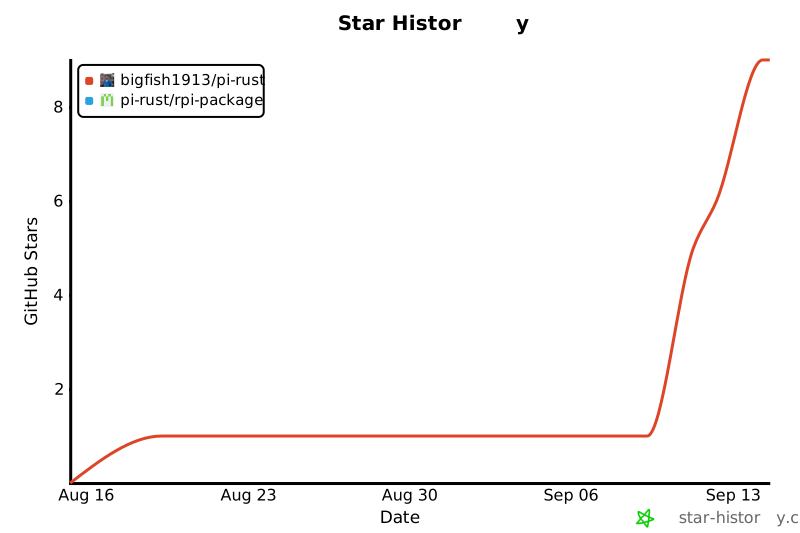
## Star history
[](https://www.star-history.com/#bigfish1913/pi-rust&pi-rust/rpi-package&Date)
## License
MIT. See [LICENSE](LICENSE).
This is a Rust port of [earendil-works/pi](https://github.com/earendil-works/pi)
(© Mario Zechner, MIT). The `rpi-*` crates are a Rust-native reimplementation of
the original MIT-licensed TypeScript SDK; the upstream source is checked out
under `.reference/pi/` (read-only, gitignored).