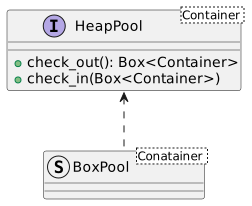
use super::HeapPool;
use crate::prelude::*;
use std::{
borrow::Borrow,
cell::RefCell,
};
pub struct RefCellBox<T, F, W>
where
F: Emitter<T>,
W: Handler<RefCell<T>>,
{
unused_pool: Vec<Box<RefCell<T>>>,
new_gen: F,
grow_size: u8,
washer: W,
}
impl<T, F, W> RefCellBox<T, F, W>
where
F: Emitter<T>,
W: Handler<RefCell<T>>,
{
pub fn new(
unused_pool: Vec<Box<RefCell<T>>>,
new_gen: F,
grow_size: u8,
washer: W,
) -> RefCellBox<T, F, W>
{
RefCellBox {
unused_pool,
new_gen,
grow_size,
washer,
}
}
pub fn unused_pool_size(&self) -> usize
{
self.unused_pool.len()
}
pub fn expand(&mut self)
{
(0..self.grow_size).for_each(|_| {
let pool_obj = Box::new(RefCell::new(self.new_gen.emit()));
self.unused_pool.push(pool_obj);
});
}
}
impl<T, F, W> HeapPool<Box<RefCell<T>>> for RefCellBox<T, F, W>
where
F: Emitter<T>,
W: Handler<RefCell<T>>,
{
fn check_out(&mut self) -> Box<RefCell<T>>
{
if self.unused_pool.is_empty() {
self.expand();
}
self.unused_pool.pop().expect("Unused pool is empty.")
}
fn check_in(
&mut self,
container: Box<RefCell<T>>,
)
{
self.washer.handle(container.borrow());
self.unused_pool.push(container);
}
}