# rlsf
<p>
<a href="https://docs.rs/rlsf/"><img src="https://docs.rs/rlsf/badge.svg" alt="docs.rs"></a> <a href="https://crates.io/crates/rlsf"><img src="https://img.shields.io/crates/v/rlsf"></a> <img src="https://img.shields.io/badge/license-MIT%2FApache--2.0-blue">
</p>
This crate implements the TLSF (Two-Level Segregated Fit) dynamic memory allocation algorithm¹. Requires Rust 1.61.0 or later.
- **Allocation and deallocation operations are guaranteed to complete in constant time.**
TLSF is suitable for real-time applications.
- **Fast and small.**
You can have both.
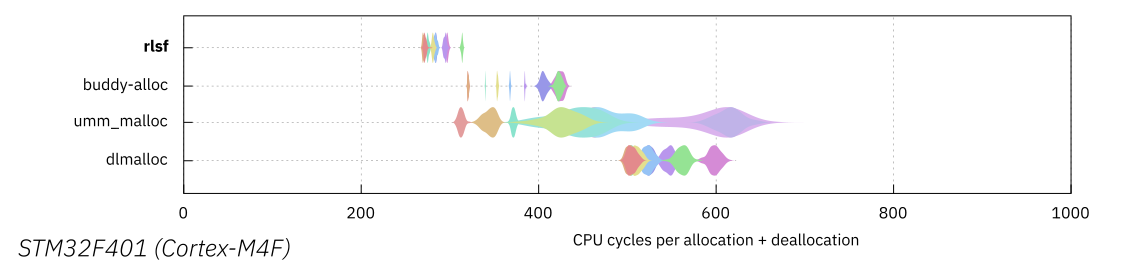
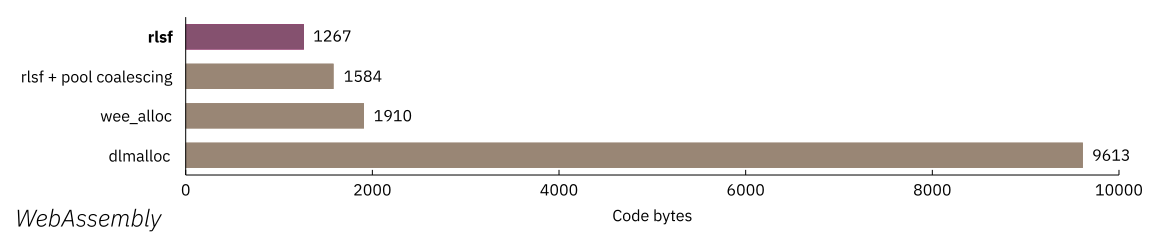
It was found to be smaller and faster² than most `no_std`-compatible allocator crates.
- **Accepts any kinds of memory pools.**
The low-level type [`Tlsf`](#tlsf-core-api) just divides any memory pools you provide (e.g., a `static` array) to serve allocation requests.
The high-level type [`GlobalTlsf`](#globaltlsf-global-allocator) automatically acquires memory pages using standard methods on supported systems.
- **This crate supports `#![no_std]`.**
It can be used in bare-metal and RTOS-based applications.
<sub>¹ M. Masmano, I. Ripoll, A. Crespo and J. Real, "TLSF: a new dynamic memory allocator for real-time systems," *Proceedings. 16th Euromicro Conference on Real-Time Systems*, 2004. ECRTS 2004., Catania, Italy, 2004, pp. 79-88, doi: 10.1109/EMRTS.2004.1311009.</sub>
<sub>² Compiled for and measured on a STM32F401 microcontroller using
<a href="https://github.com/yvt/farcri-rs">FarCri.rs</a>.</sub>
## Measured Performance
## Drawbacks
- **It does not support concurrent access.**
A whole pool must be locked for allocation and deallocation.
If you use a FIFO lock to protect the pool, the worst-case execution time will be `O(num_contending_threads)`.
You should consider using a thread-caching memory allocator (e.g., TCMalloc, jemalloc) if achieving a maximal throughput in a highly concurrent environment is desired.
- **Complete reliance on segregated freelists means internal fragmentation proportional to free block sizes.**
The `SLLEN` parameter allows for adjusting the trade-off between fewer freelists and lower fragmentation.
- **No special handling for small allocations (one algorithm for all sizes).**
This may lead to inefficiencies in allocation-heavy applications compared to modern scalable memory allocators, such as glibc and jemalloc.
## Examples
### `Tlsf`: Core API
```rust
use rlsf::Tlsf;
use std::{mem::MaybeUninit, alloc::Layout};
let mut pool = [MaybeUninit::uninit(); 65536];
// On 32-bit systems, the maximum block size is 16 << FLLEN = 65536 bytes.
// The worst-case internal fragmentation is (16 << FLLEN) / SLLEN - 2 = 4094 bytes.
// `'pool` represents the memory pool's lifetime (`pool` in this case).
let mut tlsf: Tlsf<'_, u16, u16, 12, 16> = Tlsf::new();
// ^^ ^^ ^^
// FLLEN
tlsf.insert_free_block(&mut pool);
unsafe {
let mut ptr1 = tlsf.allocate(Layout::new::<u64>()).unwrap().cast::<u64>();
let mut ptr2 = tlsf.allocate(Layout::new::<u64>()).unwrap().cast::<u64>();
*ptr1.as_mut() = 42;
*ptr2.as_mut() = 56;
assert_eq!(*ptr1.as_ref(), 42);
assert_eq!(*ptr2.as_ref(), 56);
tlsf.deallocate(ptr1.cast(), Layout::new::<u64>().align());
tlsf.deallocate(ptr2.cast(), Layout::new::<u64>().align());
}
```
### `GlobalTlsf`: Global Allocator
`GlobalTlsf` automatically acquires memory pages through platform-specific mechanisms.
It doesn't support returning memory pages to the system even if the system supports it.
```rust
#[cfg(all(target_arch = "wasm32", not(target_feature = "atomics")))]
#[global_allocator]
static A: rlsf::SmallGlobalTlsf = rlsf::SmallGlobalTlsf::new();
let mut m = std::collections::HashMap::new();
m.insert(1, 2);
m.insert(5, 3);
drop(m);
```
## Details
### Changes from the Original Algorithm
- The end of each memory pool is capped by a sentinel block (a permanently occupied block) instead of a normal block with a last-block-in-pool flag.
This simplifies the code a bit and improves its worst-case performance and code size.
## Cargo Features
- `unstable`: Enables experimental features that are exempt from the API stability guarantees.
## License
MIT/Apache-2.0