[](https://pypi.org/project/ridal/)
[](https://crates.io/crates/ridal)
[](
https://github.com/erikmannerfelt/ridal/actions/workflows/rust.yml
)
#  Ridal — Speeding up Ground Penetrating Radar (GPR) processing
The aim of `ridal` is to quickly and accurately process GPR data.
In one command, most data can be processed in pre-set profiles or with custom filter settings, and batch modes allow for sequences of datasets to be processed with the same settings.
Built in [rust](https://rust-lang.org/) with a high focus on testing and performance, `ridal` may be for you if large data volumes and strange fileformats are common issues.
The name is a take on the loosely defined "Data Abstraction Library" (DAL) projects like [GDAL](https://gdal.org) and [PDAL](https://pdal.org), but for radar.
A near-term goal of Ridal is to enable easy translation between formats, such as `ridal translate input.rad output.dzt` (this is not yet implemented).
Much of the functionality has been inspired from the projects [RGPR](https://github.com/emanuelhuber/RGPR) and [ImpDAR](https://github.com/dlilien/ImpDAR); both of which are more mature projects.
For example, Ridal currently only works on Malå (.rd3) and pulseEKKO (.dt1) radar formats.
For many uses, these will more likely be the tools for you!
Prior to Feb. 2026, this program was called `rsgpr`.
## Note on imminent interface change
**The CLI/Python interface will soon change completely (0.5 or 0.6) and all code will need to be modified accordingly. See [Issue #82](https://github.com/erikmannerfelt/ridal/issues/82) for more info.**
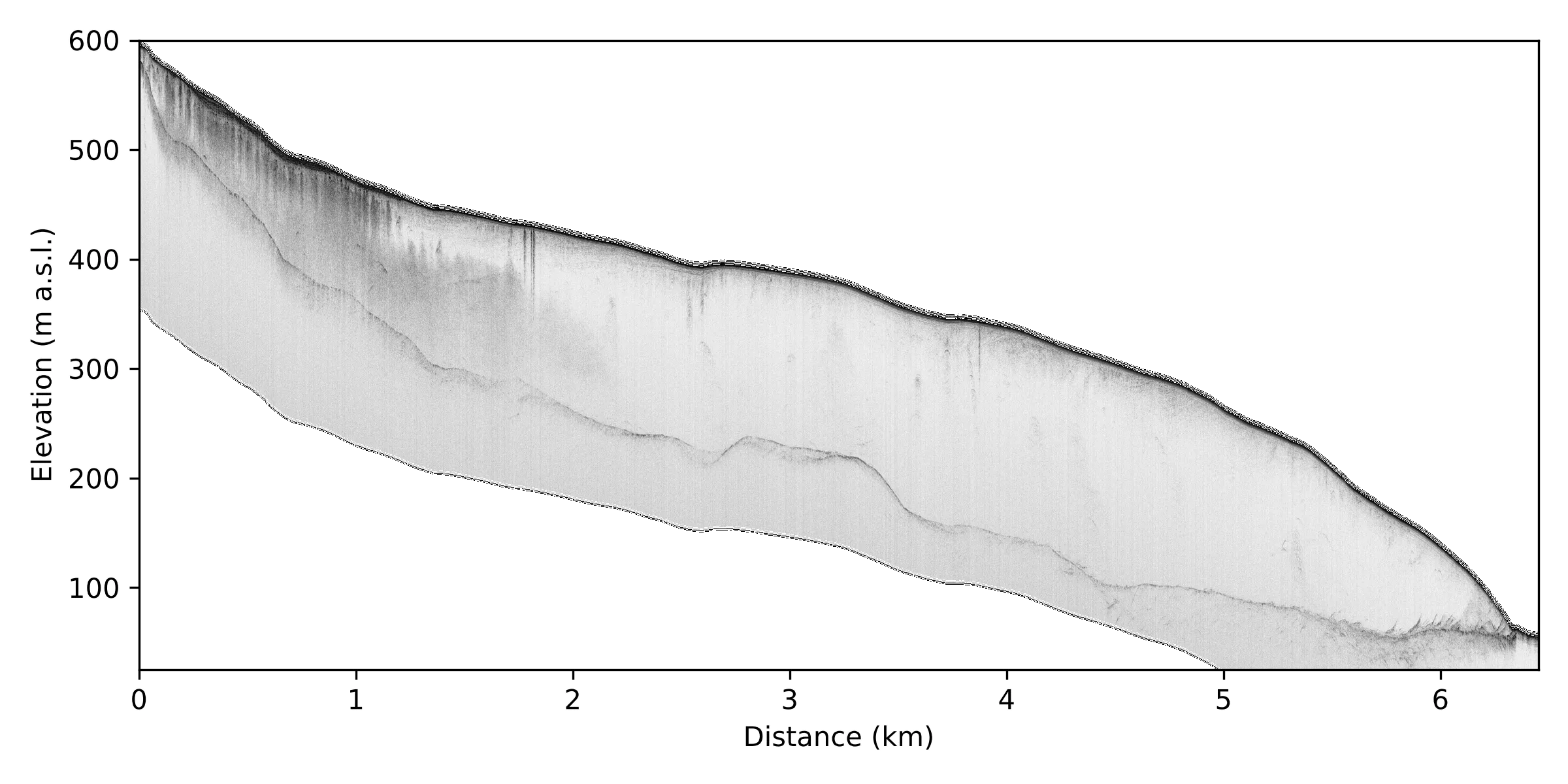
*Radargram (100 MHz Malå) of Kroppbreen in Svalbard. Collected 28 Feb. 2023.*
### Installation
#### Requirements
- `cargo`(only for the CLI; not the python package). Easiest installed using [rustup](https://rustup.rs).
- `gdal` (optional, for sampling heights from DEMs). For Debian or derivatives, this means `gdal-bin`.
- `proj` (optional, for CRS support other than WGS84 UTM Zones). For Debian or derivatives, this means `proj-bin`.
Using cargo, the `ridal` CLI can be installed (after installing the requirements):
```bash
cargo install ridal
```
with nix, the flake can be used without worrying about the requirements above:
```nix
{
inputs = {
ridal.url = "github:erikmannerfelt/ridal";
};
}
```
or in an ephemeral shell:
```bash
nix shell github:erikmannerfelt/ridal
```
#### Python
There's a very early implementation of a Python package, which will be expanded in the future:
```bash
pip install ridal
```
See [scripts/render_kroppbreen.py](https://github.com/erikmannerfelt/ridal/blob/main/scripts/render_kroppbreen.py) for an example of how it can be used.
### Simple CLI usage
See the help page of `ridal` for info on how to interact with the CLI:
```bash
ridal -h
```
To toggle useful information on a file, the `-i` or `--info` argument shows the metadata and a summary of the location data:
```bash
ridal -f DAT_001_A1.rd3 -i
```
Processing a file using the default processing profile:
```bash
ridal -f DAT_001_A1.rd3 --default
```
**All processing steps** are shown in the [steps.md](https://github.com/erikmannerfelt/ridal/blob/main/steps.md) file.
The output will be a NetCDF file with the same name but an `.nc` suffix.
By default, the output is saved in the same directory as the input.
For more control, the output directory and/or filename can be controlled with `-o` or `--output`.
To process multiple files in "batch mode", provide a ["glob"](https://en.wikipedia.org/wiki/Glob_(programming)) pattern as the filename.
Optionally, for many sequential files, the `--merge` argument allows merging multiple files into one.
```bash
ridal -f "data/*.rd3" --merge "10 min" --default -o output/
```
A rudimentary profile renderer is available with the `-r` argument.
This will be saved in the same location as the output file as a JPG if another filename is not given.
## Papers using Ridal
- [Kleber et al. (2023): Groundwater springs formed during glacial retreat are a large source of methane in the high Arctic](https://doi.org/10.1038/s41561-023-01210-6)
- [Harcourt et al. (2026): Surging glaciers in Svalbard: Observing their distribution, characteristics and evolution](https://doi.org/10.1016/j.earscirev.2026.105410)
... and many others in preparation/review