
rfast



Run Rust files like scripts — instant caching, zero boilerplate, full dependency support.
rfast turns Rust into a scripting language. Write a .rs file, run it – no cargo new, no Cargo.toml, no waiting. Dependencies? Just declare them in a comment. One‑liners? rfast -e 'println!("Hello")' – with external crates and automatic caching. Perfect for quick scripts, build tools, data pipelines, and trying out libraries.
🎬 Demo
✨ Features
- Zero‑boilerplate scripts – a single
.rsfile withfn main()is enough. - Inline dependencies – declare crates inside
/* [dependencies] */or//!lines. - Instant evaluation –
rfast -e '...'compiles and caches by source + deps + imports. Re‑runs are instant. - Dependency injection – add a crate to any script with
rfast -d serde script.rs. - Features in dependencies – specify features directly:
-d tokio=1.0,full,rt. - Test your scripts –
rfast --test script.rsrunscargo testinside the script. - Force recompilation –
rfast --force run script.rsignores cache and rebuilds. - Quiet by default – only your program’s output goes to stdout. Perfect for pipes. Use
-vto see compilation logs. - Smart caching – binaries are stored in
~/.cache/rfast/keyed by content hash. Cache never gets stale. - Cross‑platform – Linux, macOS, Windows (with
.batlaunchers). - Shell completions – generate for
bash,zsh,fish,powershell.
📦 Installation
Or build from source:
🚀 Quick Start
1. Run a simple script
Create hello.rs:
# Hello, world!
2. Add a dependency
Inside your script, use a metadata block:
/*
[dependencies]
colored = "3.1"
*/
use Colorize;
Run it – rfast automatically compiles, caches, and runs.
3. One‑liners with -e
No file needed:
With external dependencies and imports:
The first run compiles (2‑3 seconds), subsequent runs are instant.
4. Add a dependency to an existing script
This injects serde = "*" into the script’s metadata block.
5. Create a new script from a template
Generates a ready‑to‑use script with a dependency placeholder.
6. Run tests inside a script
Create test_script.rs:
//! [dependencies]
7. Force recompilation
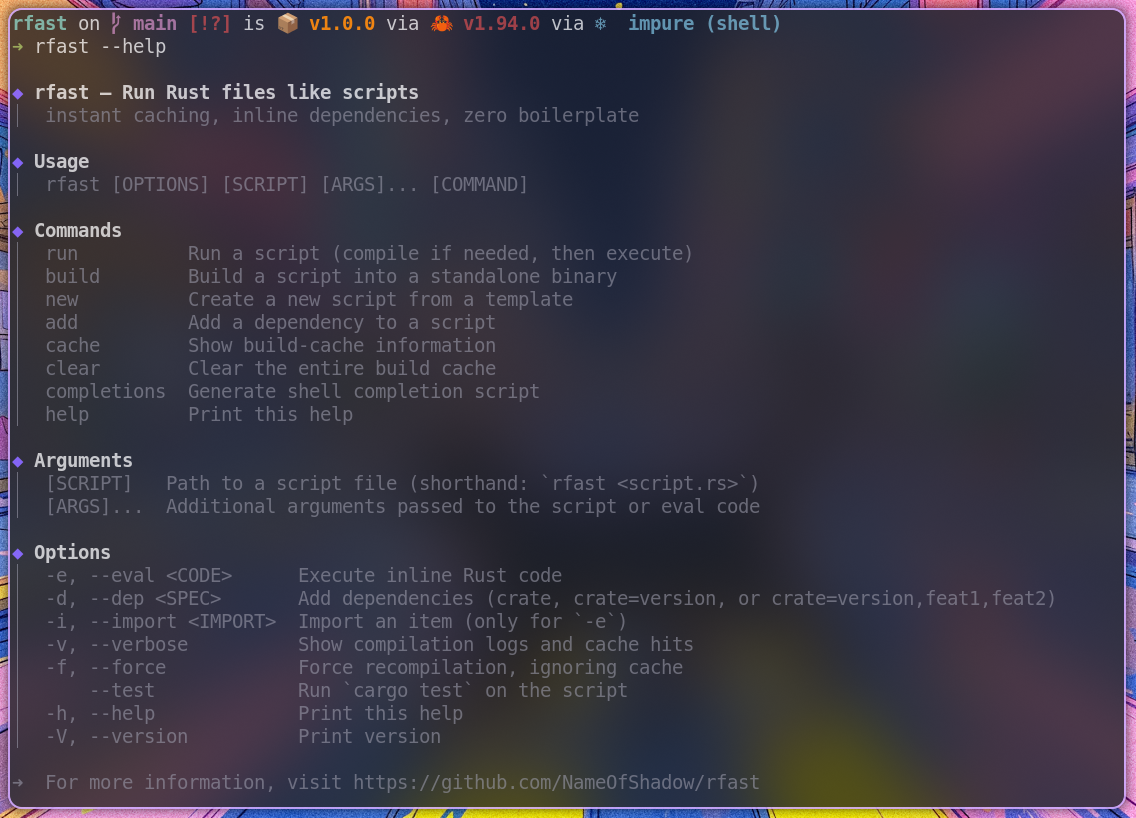
📋 Command Reference
rfast [OPTIONS] [SCRIPT] [ARGS]... [COMMAND]
Global Options
| Flag | Description |
|---|---|
-e, --eval <CODE> |
Execute inline Rust code. |
-d, --dep <SPEC> |
Add a dependency. Format: crate, crate=version, or crate=version,feat1,feat2. |
-i, --import <IMPORT> |
Import an item (e.g., -i colored::Colorize). Only for -e. |
-v, --verbose |
Show compilation logs and cache hits. |
--force |
Force recompilation, ignoring cache. |
--test |
Run cargo test on the script instead of executing it. |
-h, --help |
Print help. |
-V, --version |
Print version. |
Commands
| Command | Description |
|---|---|
run <script.rs> [args...] |
Run a script (default if no command given). Supports --force flag. |
build <script.rs> [--output <path>] [--release] |
Build a standalone binary. |
new <file.rs> |
Create a new script from template. |
add <crate> <script.rs> [--version <ver>] |
Add a dependency to a script. |
cache |
Show cache info (location, size, entries). |
clear |
Clear the entire build cache. |
completions <shell> |
Generate shell completion script. |
💡 Examples
Use in a pipeline (quiet mode)
|
Pretty‑print JSON
|
Use a specific version of a crate with features
Build a release binary
Force rebuild and see verbose output
Run tests with custom arguments
⚙️ Shell Completions
Generate and install completions:
# Bash
# Zsh
# add to ~/.zshrc: fpath+=~/.zfunc; autoload -U compinit && compinit
# Fish
🧠 How It Works
Script execution
rfast hashes the script content (SHA‑256). It creates a temporary Cargo project under ~/.cache/rfast/<hash>/, writes a Cargo.toml with the declared dependencies, and compiles the script. The binary is cached. Subsequent runs check the stamp file and execute the binary instantly.
Eval mode
The source code, dependencies (-d), and imports (-i) are combined into a hash. The resulting binary is stored under ~/.cache/rfast/eval/<hash>/. Same code → instant re‑run.
Dependency injection
rfast -d crate script.rs finds the /* [dependencies] */ block (or creates one) and appends crate = "*". Works with both block and line‑comment metadata.
Features in dependencies
When you write -d tokio=1.0,full,rt, rfast translates it into tokio = { version = "1.0", features = ["full", "rt"] } in the generated Cargo.toml.
Testing mode
rfast --test script.rs compiles the script (if needed) and runs cargo test inside its project directory, forwarding any extra arguments after -- to cargo test.
🗑️ Cache Management
View cache:
Clear cache:
🔄 Compatibility with other script runners
rfast understands the dependency syntax of popular Rust script runners, so you can run existing scripts without changes:
| Tool | Syntax example | Supported |
|---|---|---|
| cargo-script | //! ```cargo block or // cargo-deps: time="0.1.25" |
✅ |
| cargo-eval | Same as cargo-script (identical format) | ✅ |
| cargo-play | //# serde_json = "*" |
✅ |
| rust-script | /* [dependencies] */ block |
✅ |
| rfast native | //! [dependencies] line comments |
✅ |
All these formats are detected automatically. You can also mix them – rfast will find the first valid metadata block.
Examples:
// cargo-script style
// cargo-deps: time="0.1.25"

// cargo-play style
//# serde_json = "*"

// rfast style (block comment)
/*
[dependencies]
colored = "3.1"
*/
Run any of them with rfast script.rs – no migration needed.
🧩 Comparison with similar tools
| Tool | Description | rfast advantage |
|---|---|---|
cargo-script |
Runs Rust scripts with dependencies. | rfast caches binaries, has instant -e with deps, and quieter default. |
rust-script |
Similar to cargo-script. | rfast offers built‑in -e with dependency caching and automatic import injection. |
cargo-eval |
One‑liner evaluator. | rfast -e caches the result, supports multiple dependencies via -d, and works in pipelines without noise. |
🤝 Contributing
Contributions are welcome! Please open an issue or pull request on GitHub.
📄 License
MIT © NameOfShadow
rfast – Rust scripting, finally friction‑free.