Crate ray_tracing_core
GitHub page rabbid76.github.io/ray-tracing-with-rust
GitHub repository Rabbid76/ray-tracing-with-rust
Based on Peter Shirley's books:
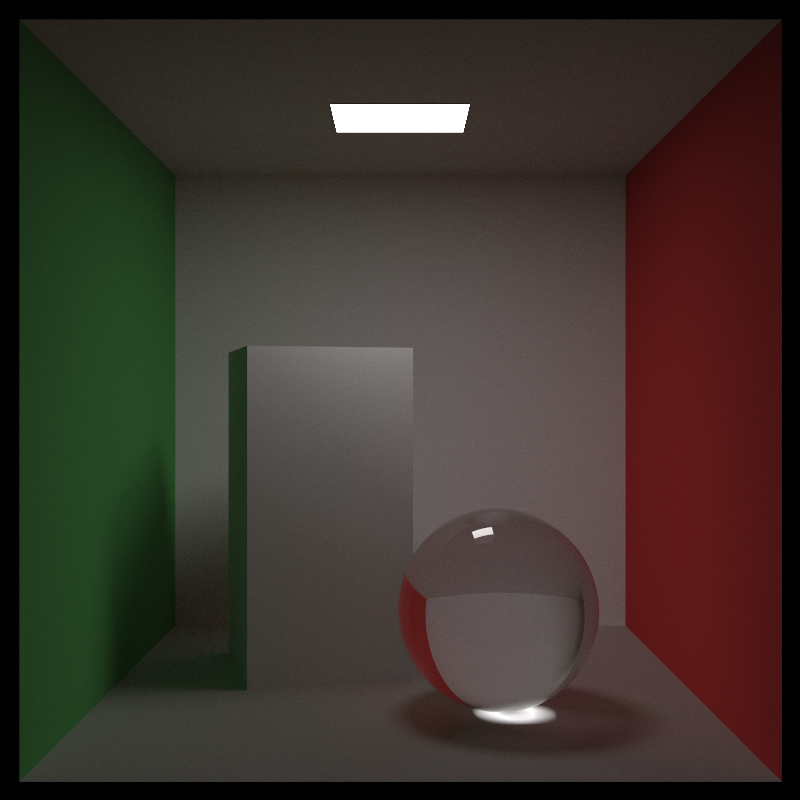
“Note that I avoid most “modern features” of C++, but inheritance and operator overloading are too useful for ray tracers to pass on.”
― Peter Shirley, Ray Tracing in One Weekend
Example
use ray_tracing_core::random;
use ray_tracing_core::test::TestSceneSimple;
use ray_tracing_core::types::ColorRGB;
use ray_tracing_core::types::FSize;
fn main() {
let cx = 40;
let cy = 20;
let samples = 10;
let scene = TestSceneSimple::new().scene;
let mut pixel_data: Vec<u8> = Vec::with_capacity(cx * cy * 4);
pixel_data.resize(cx * cy * 4, 0);
for x in 0..cx {
for y in 0..cy {
let mut c = ColorRGB::new(0.0, 0.0, 0.0);
for _ in 0..samples {
let u = (x as FSize + random::generate_size()) / cx as FSize;
let v = 1.0 - (y as FSize + random::generate_size()) / cy as FSize;
c = c + scene.ray_trace_color(u, v);
}
c = c / samples as FSize;
let i = (y * cx) + x;
pixel_data[i * 4] = (c[0].sqrt() * 255.0).round() as u8;
pixel_data[i * 4 + 1] = (c[1].sqrt() * 255.0).round() as u8;
pixel_data[i * 4 + 2] = (c[2].sqrt() * 255.0).round() as u8;
pixel_data[i * 4 + 3] = 255;
}
}
}
