
radicle-tui
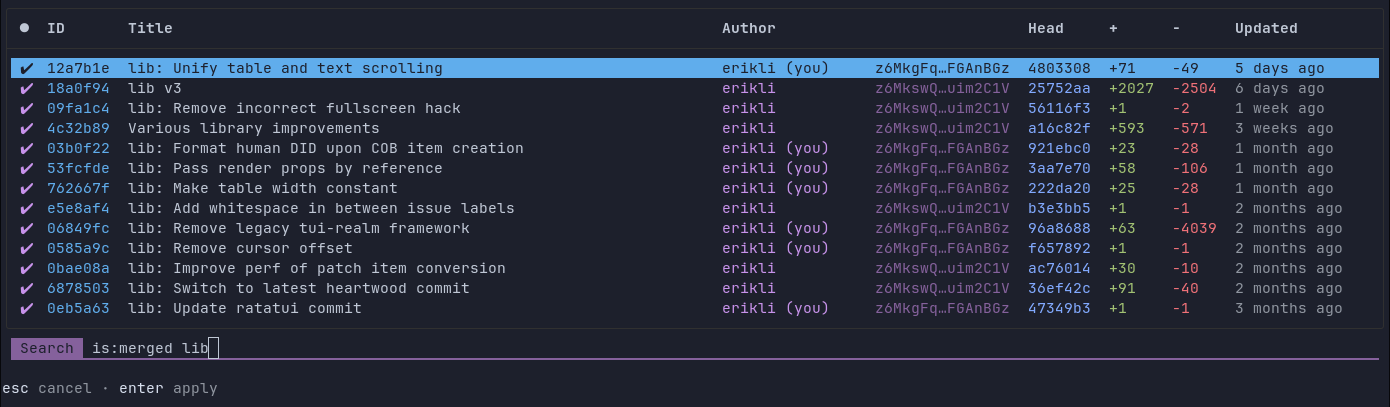
radicle-tui provides various terminal user interfaces for interacting with the Radicle code forge. It also exposes the application framework they were built with.
Table of Contents
Getting started
This crate provides a binary called rad-tui which contains all user interfaces. Specific interfaces can be run by the appropriate command, e.g. rad-tui patch select shows a patch selector.
The interfaces are designed to be modular and to integrate well with the existing Radicle CLI. Right now, the binary is meant to be called from rad, which will collect and process its output, e.g.
rad patch show
will show a patch selector and pass on the id of the selected patch.
Note: The integration into the Radicle CLI is not fully done, yet. Please refer to the Usage section for information on how to use
rad-tuialready.
Installation
Requirements
- Linux or Unix based operating system.
- Git 2.34 or later
- OpenSSH 9.1 or later with
ssh-agent
From source
Note: Requires the Rust toolchain.
You can install the binary from source, by running the following commands from inside this repository:
cargo install --path . --force --locked
Or directly from our seed node:
cargo install --force --locked --git https://seed.radicle.xyz/z39mP9rQAaGmERfUMPULfPUi473tY.git
This will install rad-tui. All available commands can be shown by running rad-tui --help.
Usage
Soon, rad-tui will be integrated into heartwood. Until then, you can use the rad proxy script that is provided. It's considered to be a drop-in replacement for rad and can be used for testing and prototyping purposes. It should reflect the current behavior, as if rad-tui would have been integrated, e.g.
# show an interface that let's you select a patch
# show an interface that let's you select a patch and an operation
Both commands will call into rad-tui, process its output and call rad accordingly.
Interfaces
Select a patch, an issue or a notification and an operation:
rad-tui <patch | issue | inbox> select
Same as above:
rad-tui <patch | issue | inbox> select --mode operation
Select a patch, an issue or a notification only and return its id:
rad-tui <patch | issue | inbox> select --mode id
Output
All interfaces return a common JSON object on stderr that reflects the choices made by the user, e.g.:
{ "operation": "show", "ids": ["546443226b300484a97a2b2d7c7000af6e8169ba"], args:[] }
Application framework
The library portion of this crate is a framework that is the foundation for all radicle-tui binaries. The framework is built on top of ratatui and mostly follows the Flux application pattern. It took some ideas from tui-realm and cursive. The concurrency model was mostly inspired by rust-chat-server.
Note: Existing core functionalities are considered to be stable, but the API may still change at any point. New features like configurations, used-defined keybindings, themes etc. will be added soon though.
The framework comes with a widget library that provides low-level widgets such as lists, text fields etc. as well as higher-level application widgets such as windows, pages and various other containers.
Note: The widget library is under heavy development and still missing most low-level widgets. These will be added where needed by the
radicle-tuibinaries.
Design
The framework was built with a few design goals in mind:
- async: state updates and IO should be asynchronous and not block the UI
- declarative: developers should rather think about the What then the How
- widget library: custom widgets should be easy to build; ready-made widgets should come with defaults for user interactions and rendering
The central pieces of the framework are the Store, the Frontend and a message passing system that let both communicate with each other. The Store handles the centralized application state and sends updates to the Frontend, whereas the Frontend handles user-interactions and sends messages to the Store, which updates the state accordingly.
On top of this, an extensible widget library was built. A widget is defined by an implementation of the View trait and a Widget it is wrapped in. A View handles user-interactions, updates itself whenever the application state changed and renders itself frequently. A Widget adds additional support for properties and event, update and render callbacks. Properties define the data, configuration etc. of a widget. They are updated by the framework taking the properties built by the on_update callback. The on_event callback is used to emit application messages whenever a widget receives an event.
The main idea is to build widgets that handle their specific events already, and that are updated with the properties built by the on_update callback. Custom logic is added by setting the on_event callback. E.g. the Table widget handles item selection already; items are set via the on_update callback and application messages are emitted via the on_event callback.
Example
use Result;
use Key;
use Text;
use radicle_tui as tui;
use store;
use ;
use ToWidget;
use ;
/// Centralized application state.
/// All messages known by the application.
/// Implementation of the app-state trait. It's updated whenever a message was received.
/// Applications quit whenever an `Exit` is returned by the `update` function. The `Exit`
/// type also provides and optional return value.
/// 1. Initializes the communication channel between frontend and state store
/// 2. Initializes the application state
/// 3. Builds a textarea widget which renders a welcome message and quits the
/// application when (q) is pressed
/// 4. Runs the TUI application
pub async
ROADMAP
The project roadmap is largely defined by the requirements of the Radicle team. If you're missing something or have any suggestions that would make this better, please feel free to get in touch.
Now
- Patch and issue preview in selection interfaces
- Basic
radicle-cliintegration
Next
- Support for multiple selected list and tree items
- Read configuration from file
- Support user-defined keybindings
- Patch review
Later
- Streamline CLI integration w/ config and flags for
radcommands (e.g.rad patch edit --tui)` - Read COBs from JSON input
- Add support for custom themes
Contributing
Contributions are what make the open source community such an amazing place to learn, inspire, and create. Any contributions you make are greatly appreciated.
If you have any suggestions that would make this better, please clone the repo and open a patch. You can also simply open an issue with the label "enhancement".
Contact
Please get in touch on Zulip.
License
radicle-tui is distributed under the terms of both the MIT license and the Apache License (Version 2.0).
See LICENSE-APACHE and LICENSE-MIT for details.