[](https://crates.io/crates/quickheap)
[](https://docs.rs/quickheap)
[](https://doi.org/10.48550/ARXIV.2604.25681)
# SimdQuickHeap: A fast SIMD-based priority queue
The SimdQuickHeap is, as the name suggests, a **fast priority queue**.
It has some similarities to QuickSelect, and uses SIMD for fast partitioning and
insertion of elements.
Unlike the classic binary heap (and $d$-ary heap variants), it is I/O-efficient
and **does not suffer from bad cache-locality** when the size of the queue exceeds
the cache.
Currently, it only supports `i32`, `u32`, `i64`, and `u64` keys and requires
either AVX2 or AVX-512.
See the preprint for details and benchmarks:
> SimdQuickHeap: The QuickHeap Reconsidered
> Johannes Breitling, Ragnar Groot Koerkamp, Marvin Williams, Arxiv 2026
> https://doi.org/10.48550/ARXIV.2604.25681
An older blogpost can be found here:
https://curiouscoding.nl/posts/quickheap.
## Example
``` sh
cargo add quickheap
```
```rust
let mut q = quickheap::SimdQuickHeap::<u64>::default();
q.push(4);
q.push(1);
q.push(7);
assert_eq!(q.pop(), Some(1));
q.push(7);
q.push(3);
assert_eq!(q.pop(), Some(3));
assert_eq!(q.pop(), Some(4));
assert_eq!(q.pop(), Some(7));
assert_eq!(q.pop(), Some(7));
assert_eq!(q.pop(), None);
```
## Results
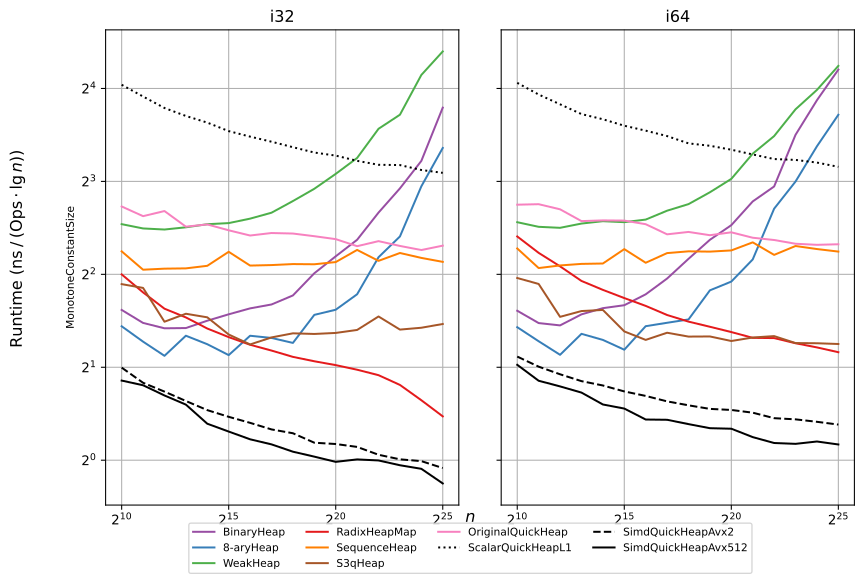
Below you can see the results for 32-bit and 64-bit data when we first push `n`
elements and then how long it takes on average to do a pair of push and pop
operations. Note that the y-axis is normalized by `log_2(n)` as well.
The SimdQuickHeap is around 2x faster than the Radix heap, and up to 10x faster
than the binary heap and d-ary heap.
## Running the benchmarks
Benchmarks can be found in the [bench/](bench/) directory, and Rust FFI wrappers around
external C++ implementations can be found in [ext/](ext/), with submodules
containing the original C++ sources in nested `third_party` directories.
(Run `git submodule update --init --recursive` to initialize them.)
Run `just bench-small plot-all` (see the [`justfile`](justfile)) for a small subset of
the experiments. Note that these need nightly Rust for some unstable convenience features.
If you get linker errors, comment out the `.flag("-flto")` in `ext/{s3q-sys,sequence-heap-sys,boost-heap-sys}/build.rs`.
