
Please check the build logs for more information.
See Builds for ideas on how to fix a failed build, or Metadata for how to configure docs.rs builds.
If you believe this is docs.rs' fault, open an issue.
[Round] ⬜
[!NOTE]
A transparent, click-through overlay that draws rounded corners on every connected monitor. Native on macOS and Windows; Linux builds but is untested.
One tray icon. One overlay per screen. No window manager plugins.






What it does
Round is a Tauri 2 tray application. It spawns one borderless, transparent
webview per monitor, sized to that monitor's bounds, draws four rounded corners
inside it with Solid, and is controlled from the system tray. Size, ink, and
visibility are persisted through tauri-plugin-store, so the desktop looks the
same after a reboot.
Each window is lifted above the OS chrome, because a corner that the menu bar or the taskbar draws over is not a corner:
- macOS sets
NSStatusWindowLevel, the collection behaviourcanJoinAllSpaces | stationary | ignoresCycle | fullScreenAuxiliary, andsetIgnoresMouseEvents:YES. Transparency requiresmacOSPrivateApi. - Windows calls
SetWindowPos(HWND_TOPMOST, ..., SWP_NOACTIVATE)and addsWS_EX_TOOLWINDOW | WS_EX_NOACTIVATE | WS_EX_TRANSPARENTon top of Tauri'sWS_EX_LAYERED, then switches off Windows 11's own corner rounding (DWMWCP_DONOTROUND) so the drawn corners are the only ones. - Linux falls back to
always_on_top+skip_taskbar; struts and panels from the desktop environment may still draw over the corners.
Install
Release bundle
Download the macOS .dmg or the Windows installer from
releases and launch it. Round
lives in the tray - there is no dock window and no main window.
[!IMPORTANT]
The macOS bundle is ad-hoc signed (
signingIdentity: "-") and not notarised, because hardened-runtime signing without a Developer ID is rejected on Apple Silicon. Gatekeeper asks you to confirm the first launch.
From source
To produce the installers instead of the bare binary:
As a Rust library
The same engine is published as a crate, so an overlay can be added to another Tauri application without copying this one:
use ;
// One overlay per monitor, then lift it above the OS chrome.
let screen = of;
let window = new
.inner_size
.position
.transparent
.build?;
raise; // platform-correct lift, no cfg at the call site
The crate ships the library target and the round binary. The binary embeds the
webview build (Package/Web/Target) at compile time, so it is built from a
checkout where pnpm run Build has run - a cargo install pround without that
directory has no corners to draw and the build says so.
[!NOTE]
The published
pround0.0.1 is a one-version name reservation. The library described here ships with 0.0.9, which supersedes it; until that version is published,cargo add proundresolves the empty reservation.
The tray menu
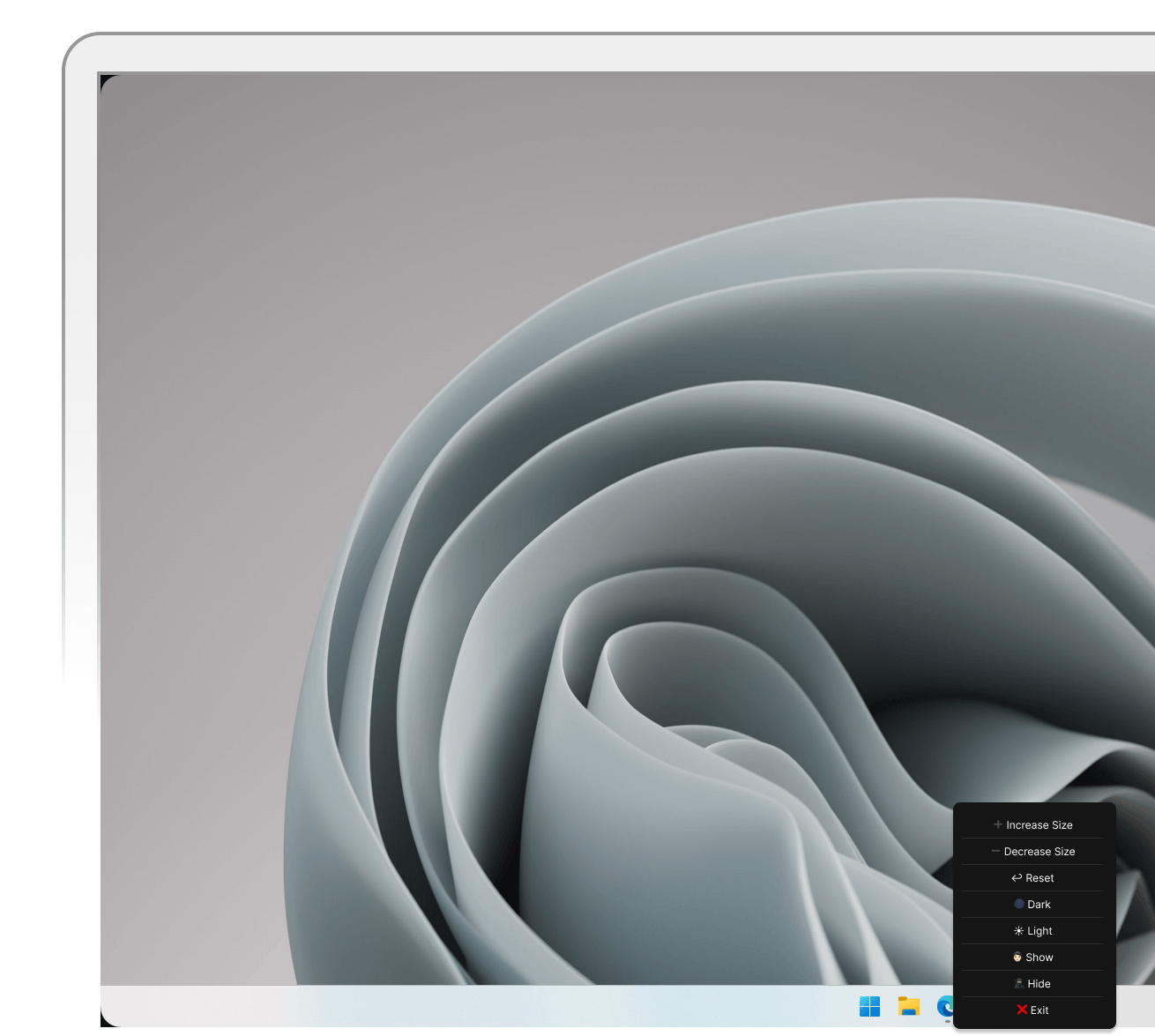
- Increase Size ➕ - grow the corner radius by 6px.
- Decrease Size ➖ - shrink it by 6px, never below 0.
- Reset ↩️ - back to the default radius of 23px.
- Dark 🌑 / Light ☀️ - draw the corners in black or white.
- Show 👨🏻 / Hide 🥷🏽 - show or hide every overlay at once.
- No Dock ⚓ - macOS only; toggles the dock icon through
NSApplicationActivationPolicy.Accessoryand is checked while the icon is hidden. - Exit ❌ - quit.
Every entry is one variant of pround::Action::Action, which owns both the menu
identifier and the menu text; the handler is a match over Action and returns
an Effect (Persist, Dock(hidden), Exit) rather than re-deriving what the
click meant.
Repository layout
Crate/Round- the Rust crate, published to crates.io aspround.Source/Library.rsis the crate root (the overlay engine),Source/Main.rsis theroundbinary, and each domain (Action,Effect,Message,Mode,Overlay,Screen,Settings,Tray) is its own PascalCase directory with amod.rsfacade.Package/Web- the webview package: Solid 1.9 + Vite 8 + Tailwind 3, built by@playform/build's tsconfig base intoPackage/Web/Target. The crate embeds that directory at compile time; it is never copied into the crate.Documentation- the guides (Architecture.md,Releasing.md, anIndex.mdmap) and the architecture graphs (Knowledge.dot,Knowledge.svg)..github/workflows-Check,Build,Publish,Auto,Dependabot,GitHub.
Documentation
- Architecture - the module map, the startup sequence, the tray → settings → webview event flow, the webview contract, and where to change what.
- Releasing - the version in four files, the
Round/v*tag, the opt-in crates.io publish, and how to test a publish without burning a version. - Documentation index - the map of the set.
Development
Prerequisites: the Rust nightly toolchain from rust-toolchain.toml
(rustfmt + clippy included), Node ≥ 22.22.3, and pnpm 12 (pinned in
package.json).
Cargo.lock is deliberately untracked: the crate publishes to crates.io and
every consumer resolves its own graph. Target/ and Package/Web/Target/ are
build output and are ignored.
Continuous integration
Check.yml- on every push and pull request toCurrent: builds the webview package once, shares it as an artifact, then runscargo fmt --check,cargo clippy -D warnings,cargo check, and a packaging guard that asserts the crate's own files (Source/,icons/,tauri.conf.json) are in the published tarball.Build.yml- on aRound/v*tag: creates the release once, then bundles on macOS (arm64 and x86_64), Linux, and Windows, checksums every artifact, attaches them to the release, and fails if a platform is missing.Publish.yml- on aRound/v*tag: the packaging guard and a library consumer probe run against the crate. Publishing to crates.io is an explicit opt-in (workflow_dispatchwithpublish_crates=true), so a tag push can never burn an immutable version; it authenticates through crates.io trusted publishing (OIDC, no stored registry token) and skips a version that is already live.Auto.yml- a daily heartbeat that touches.github/Update.md, nothing else.Dependabot.yml- daily updates for npm, cargo, and GitHub Actions, with Tailwind pinned to 3.x.
Changelog
See
CHANGELOG.md
for a history of changes to this app.
License
CC0-1.0 - public domain dedication.