# processkit
Async child-process management for Rust + [tokio](https://tokio.rs/) with a
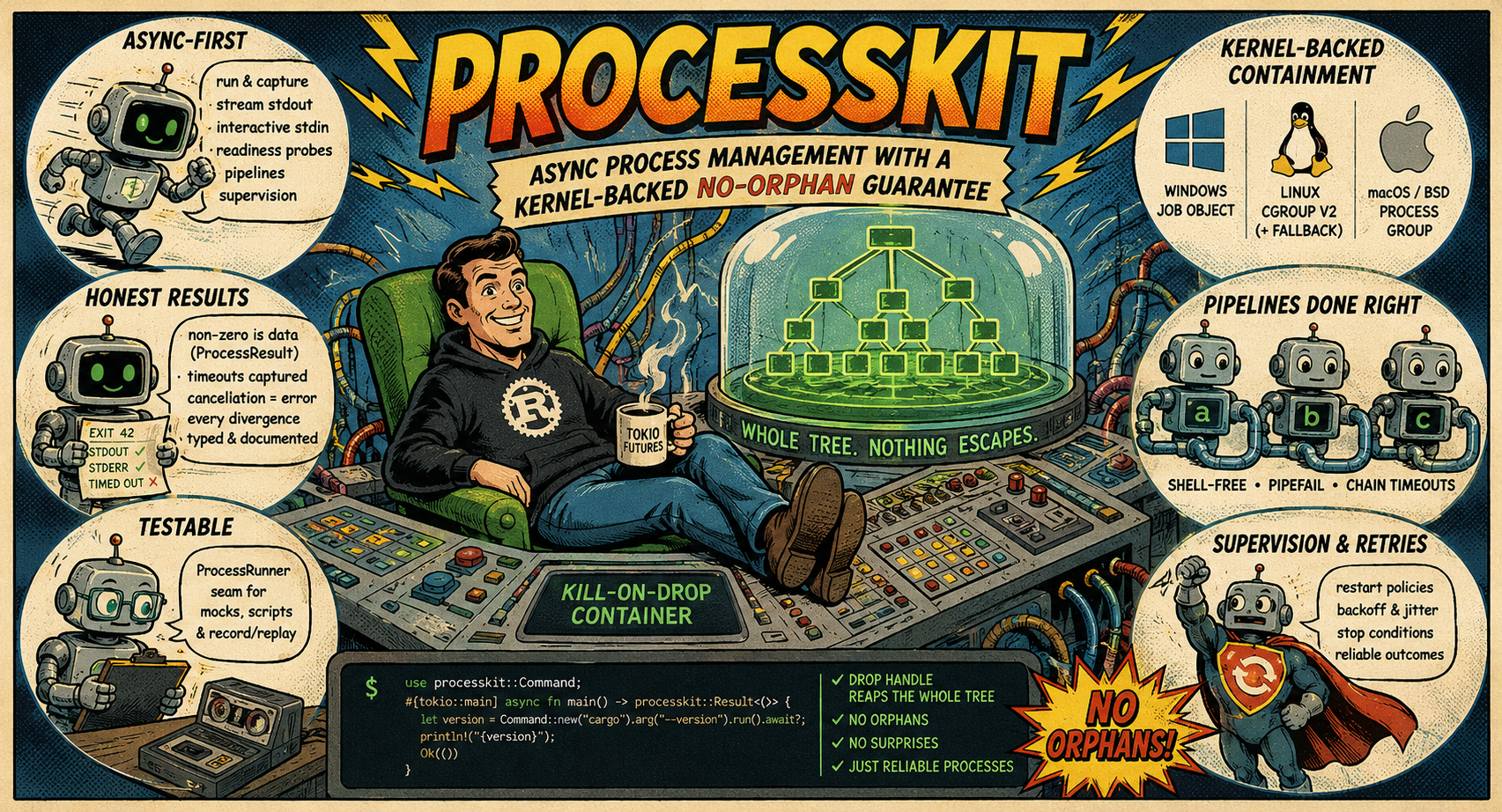
kernel-backed no-orphan guarantee: every process you start — and everything
*it* spawns — lives in a kill-on-drop container (a **Linux cgroup v2**, a **Windows
Job Object**, or a POSIX process group), so no descendant ever outlives
your program.
Beyond spawning a subprocess: run-and-capture, line streaming, interactive
stdin, opt-in pseudo-terminal (PTY) sessions, shell-free pipelines, readiness
probes, timeouts & cancellation, supervision with restart/backoff, and a
mockable runner seam for subprocess-free tests.
[](https://crates.io/crates/processkit)
[](https://docs.rs/processkit)
[](https://github.com/ZelAnton/ProcessKit-rs/actions/workflows/ci.yml)
[](https://coveralls.io/github/ZelAnton/ProcessKit-rs?branch=main)
[](LICENSE)
[](Cargo.toml)
```rust,no_run
use processkit::Command;
#[tokio::main]
async fn main() -> processkit::Result<()> {
let version = Command::new("cargo").arg("--version").run().await?;
println!("{version}");
Ok(())
}
```
## Why processkit?
`std::process` and `tokio::process` reach (at most) the direct child. The
processes *it* spawned — a build tool's compiler children, the real payload
behind a wrapper (`cmd /c …`, `sh -c …`), a test's helper servers — survive a
timeout, a panic, or a dropped future, and keep running as orphans.
`processkit` spawns every child into the operating system's own containment
primitive — a **Job Object** on Windows, a **cgroup v2** on Linux (with a
process-group fallback), a POSIX **process group** on macOS/BSD — so teardown
is a kernel operation over the whole tree, not a best-effort signal to one pid:
- **Nothing escapes silently.** Dropping the handle or group reaps every
descendant, grandchildren included. Where a mechanism has a genuine weakness
(a `setsid` child escapes a POSIX process group), the active
[`Mechanism`](https://docs.rs/processkit/latest/processkit/enum.Mechanism.html)
is reported instead of pretending — never a silent downgrade.
- **Async-first.** Run-and-capture, line streaming, interactive stdin,
readiness probes, shell-free pipelines, supervision — all tokio futures.
- **Honest results.** A non-zero exit is data ([`ProcessResult`]) until you ask
for success; a timeout is *captured* in the result; a cancellation is always
an error; every platform divergence is typed or documented.
- **Testable.** One trait seam ([`ProcessRunner`]) swaps the real spawner for
scripted doubles or record/replay cassettes — no subprocess in your tests.
**One deliberate exception.** For the legitimate handoff cases — daemonizing, a
`nohup`-style helper meant to *outlive* its launcher — `Command::spawn_detached`
is a single, loudly-named opt-in that spawns a child **outside** this containment
(a new session on Unix, unassigned to the Job Object on Windows) and hands back a
`DetachedChild` the crate never kills, reaps, times out, or captures. It inverts
the headline guarantee *on purpose*, so it is a separate, non-interchangeable
type, it refuses any owner-dependent knob (a timeout, capture wiring, interactive
stdin) with a loud typed error rather than ignoring it, and it deliberately does
**not** break a child out of a *host* Job Object / cgroup it inherits (a CI
runner, a `systemd` scope) — it escapes only *this crate's* per-run containment.
### How it compares
| `std::process` | — | — | — | — |
| `tokio::process` | — | ✓ | — | — |
| [`command-group`](https://crates.io/crates/command-group) | ✓ | ✓ | — | — |
| [`async-process`](https://crates.io/crates/async-process) | — | ✓ (smol) | — | — |
| [`duct`](https://crates.io/crates/duct) | — | — | — | pipelines |
| **`processkit`** | **✓** | **✓** (tokio) | **✓** | **✓** |
The first column is the differentiator: a child's *descendants* are contained
and reaped as a unit (Job Object / cgroup v2 / process group), not just the
direct child.
> **Status:** stable — **3.x** is the current published line; the latest release
> is available on the [GitHub Releases page](https://github.com/ZelAnton/ProcessKit-rs/releases/latest).
> The public API follows [Semantic Versioning](https://semver.org/): a
> `processkit = "3"` requirement accepts compatible `3.x` upgrades but not a
> future `4.0`. See [`CHANGELOG.md`](CHANGELOG.md).
## What's new in 3.0
- **Real PTY sessions.** Enable the opt-in `pty` feature and call
`Command::use_pty()` for a child that requires a controlling terminal:
`openpty` on Unix, `CreatePseudoConsole` (ConPTY) on Windows. Initial and live
window sizing use `pty_size` / `resize_pty`; output is the terminal's merged
stdout/stderr stream, while the existing job/cgroup/process-group containment
and kill-on-drop guarantee remain unchanged. Start with the
[PTY dialog guide](docs/streaming.md#pty-dialog-wait-for-a-prompt-then-answer)
and check the [platform matrix](docs/platform-support.md#pty-mode-use_pty-the-pty-feature).
- **Smaller, decomposed errors.** `Error` is now a pointer-sized wrapper around
`Box<ErrorReason>`. Existing classifiers and accessors stay on `Error`; code
that matched enum variants now uses `err.reason()` (or `into_reason()`), and
`ErrorKind` provides a coarser total routing classification. See
[Errors](docs/errors.md) and the [2.x → 3.0 migration](docs/upgrading.md#300-from-2x).
- **One stream for the full process lifecycle.** The renamed `events()` stream
now yields `ProcessEvent::Started`, ordered stdout/stderr lines, and
`ProcessEvent::Exited`. Pipelines and supervisors also gained live
`PipelineSession` / `SupervisionSession` handles, so multi-stage and restarted
workloads can be observed and stopped while they run. See [lifecycle events](docs/streaming.md#the-full-lifecycle-as-one-stream-events),
[live pipelines](docs/pipelines.md#streaming-a-live-chain), and
[live supervision](docs/supervision.md#live-sessions-start).
- **Explicit control over a process tree's lifetime.** `ProcessGroup::stop`
reports the graceful-soft-stop → wait → hard-kill path as a `ShutdownReport`,
`update_limits` changes caps on a live group, and `spawn_detached` is the
deliberately separate escape hatch for a child that must outlive its launcher.
See [observable teardown](docs/process-groups.md#observing-the-teardown-stop-and-shutdownreport),
[live limits](docs/process-groups.md#updating-a-live-group), and
[detached children](docs/process-groups.md#deliberately-detaching-a-child-spawn_detached).
- **Streaming results and safer capture.** `output_stream` /
`output_stream_bytes` yield bounded batch work in completion order;
byte-accurate raw tees expose the undecoded stream; and `CapturePolicy`
transforms retained lines before they enter a result, making redaction a
first-class capture boundary. See [results as they finish](docs/batch.md#results-as-they-finish),
[raw output](docs/streaming.md#byte-accurate-raw-output-stdout_raw_tee), and
[redaction at capture](docs/streaming.md#redaction-at-capture-capture_policy).
- **Runtime capability and process introspection.** `host_containment()` reports
the effective host mechanism without spawning, `process_info` plus
`process_is_alive` provide reuse-safe PID checks outside a group, and the new
`metrics` feature exports run/retry/restart counters and duration histograms
without recording argv or environment values. See [platform support](docs/platform-support.md#containment-mechanisms),
[process identity](docs/process-groups.md#identifying-a-process-by-pid-outside-a-group),
and [observability](docs/observability.md#metrics).
## Install
```bash
cargo add processkit
```
This crate requires a [tokio](https://tokio.rs/) runtime. Minimum Supported Rust
Version: **1.88**.
## Verifying provenance
Every release is published to crates.io with **Trusted Publishing** (a
short-lived token minted over GitHub OIDC — no long-lived API token) and ships a
**build-provenance attestation** for the packaged crate. That lets you confirm a
release was built by this repository's `release.yml` workflow and not tampered
with.
The `.crate` and a `SHA256SUMS` file are attached to each
[GitHub Release](https://github.com/ZelAnton/ProcessKit-rs/releases). With the
`gh` CLI (2.49+):
```bash
# Fetch the artifacts for the version you depend on (e.g. v2.3.2):
gh release download v<version> --repo ZelAnton/ProcessKit-rs
# Check the digests, then verify provenance against this repo + workflow:
sha256sum -c SHA256SUMS
gh attestation verify processkit-<version>.crate --repo ZelAnton/ProcessKit-rs
```
A successful `gh attestation verify` proves the `.crate` was produced by the
`release.yml` workflow in `ZelAnton/ProcessKit-rs`. See
[SECURITY.md](SECURITY.md) for the release-integrity model.
## Picking a verb
Every run starts with the same builder; the verb you finish with decides what
you get back:
| stdout, success required | [`.run()`] | trimmed `String`; non-zero exit / timeout / kill → typed `Error` |
| the full outcome, exit code as data | `.output_string()` / `.output_bytes()` | [`ProcessResult`] — code, stdout, stderr, `timed_out`; never errors on non-zero |
| just the exit code | `.exit_code()` | `i32` (a timed-out / killed run errors instead of inventing `-1`) |
| a yes/no answer | `.probe()` | `bool` — exit 0 → `true`, 1 → `false`, anything else errors |
| a typed value from stdout | `.parse(\|s\| …)` / `.try_parse(\|s\| …)` | `T` — success required; fails loud on a truncated capture |
| the first matching output line | `.first_line(\|l\| …)` | `Option<String>` — `None` when stdout closes without a match |
| a live handle — streaming, stdin, probes | `.start()` | [`RunningProcess`] |
The same vocabulary repeats on every layer (`ProcessRunner`, `CliClient`), and
`processkit::run("git", ["status"])` / `processkit::output_string(…)` skip the builder
for one-liners.
## Quick start
```rust,no_run
use processkit::{Command, ProcessGroup, Stdin};
#[tokio::main]
async fn main() -> processkit::Result<()> {
// Capture output; a non-zero exit does not error on its own.
let result = Command::new("git").args(["rev-parse", "HEAD"]).output_string().await?;
println!("HEAD is {}", result.stdout().trim());
// Require success and get trimmed stdout directly.
let version = Command::new("cargo").arg("--version").run().await?;
println!("{version}");
// Feed stdin.
let sorted = Command::new("sort")
.stdin(Stdin::from_string("banana\napple\n"))
.output_string()
.await?;
println!("{}", sorted.stdout());
// Share one kill-on-drop group across several children; dropping the group
// reaps the whole tree.
let group = ProcessGroup::new()?;
let _server = group.start(&Command::new("some-server")).await?;
// ... work ...
group.shutdown().await?; // graceful SIGTERM → wait → SIGKILL (Unix); atomic on Windows
Ok(())
}
```
## Documentation
This README is the quick tour. The **[`docs/` guide set](docs/README.md)**
goes deeper on every capability, with more examples and the platform fine
print collected in one place — browse it as a published site at
**<https://zelanton.github.io/ProcessKit-rs/>**, built from this repository's
`docs/` sources by the `docs` GitHub Actions workflow
(`.github/workflows/docs.yml`). This repository is the sole source of the
documentation site; it does not consume or publish to any other repository.
New here? Skim the [Cookbook](docs/cookbook.md) first — it maps "I want to …"
tasks to working snippets — then read [Running commands](docs/commands.md)
end to end:
| [Cookbook](docs/cookbook.md) | Task → snippet recipes for everything below; the fastest way in |
| [Running commands](docs/commands.md) | The full `Command` builder and every consuming verb, with error semantics |
| [Running many at once](docs/batch.md) | Bounded `output_all` / `output_all_bytes` fan-out, containment choices, and `wait_any` / `wait_all` races and joins |
| [Comparative benchmarks](docs/comparison.md) | End-to-end processkit vs. plain Tokio and standard-library baselines for capture, streaming, and concurrent fan-out |
| [Process groups](docs/process-groups.md) | Containment, teardown, signals, suspend/resume, members, limits, stats |
| [Streaming & interactive I/O](docs/streaming.md) | Line streaming, conversational stdin, PTY dialogs/window resize/output hygiene, readiness probes, `wait_any`, profiling |
| [Pipelines](docs/pipelines.md) | Shell-free `a \| b \| c`, pipefail attribution, chain timeouts |
| [Timeouts, retries & cancellation](docs/timeouts-and-cancellation.md) | Captured vs raised deadlines, retry classifiers, `CancellationToken` |
| [Errors](docs/errors.md) | The `Error` wrapper and every `ErrorReason` variant → source → recommended reaction, `ErrorKind`, subtle look-alikes, classifiers, and ties to retries & supervision |
| [Supervision](docs/supervision.md) | Restart policies, backoff & jitter, stop conditions, outcomes |
| [Observability](docs/observability.md) | The `tracing` events and `metrics` counters/histograms over already-computed run data — secret-hygiene (never argv/env), cardinality, wiring an exporter |
| [Testing your code](docs/testing.md) | The `ProcessRunner` seam, scripted/recording/mock doubles, cassettes, `CliClient` |
| [Platform support](docs/platform-support.md) | Mechanisms, all capability matrices, every caveat |
| [Running untrusted children](docs/untrusted-children.md) | Hardening checklist for launching an untrusted program: containment, resource limits, privilege drop, env hygiene, output/wall-time bounds |
| [Upgrading](docs/upgrading.md) | Per-version consumer upgrade notes, including the 2.x → 3.0 `ErrorReason` and lifecycle-event migrations |
API reference: [docs.rs/processkit](https://docs.rs/processkit).
Where the project is headed: the **[roadmap](ROADMAP.md)** (committed near-term
work). Open proposals and settled decisions live in [`ideas/`](ideas/) and
[`decisions/`](decisions/).
## Feature flags
Each flag is **additive** and only gates *visibility* — the kill-on-drop tree
guarantee is unconditional in every configuration.
| `process-control` | ✅ | `Signal`, `ProcessGroup::{signal, suspend, resume, members, adopt}` |
| `stats` | — | group/per-run resource measurement, `sample_stats`, `profile` (opt-in — specialized to metrics; adds no extra crate, only a Windows OS-library link for the peak-memory readout) |
| `limits` | — | whole-tree resource caps (implies `stats`) |
| `record` | — | record/replay cassettes (pulls `serde`) |
| `mock` | — | `mockall`-generated `MockRunner` (test-only; its surface is semver-exempt — prefer `ScriptedRunner`/`RecordingRunner`) |
| `tracing` | — | lifecycle events: spawn/exit, timeout/cancel, teardown, retries, storms (never argv/env) |
| `metrics` | — | counters/histograms over already-computed run data: run/spawn counters, duration histograms, exit-code/timeout/cancel tally, retry/restart/storm events, into any `metrics` recorder (never argv/env) |
| `pty` | — | real pseudo-terminal launch mode (`openpty` on Unix, ConPTY on Windows), interactive master input, merged output, initial/live window sizing |
## Capping a group's resources
Requires the **`limits`** feature (off by default) — add it to the dependency:
```toml
processkit = { version = "…", features = ["limits"] }
```
`ProcessGroupOptions` can then bound the whole tree's memory, process count, and CPU
at creation, so a runaway or untrusted child tree can't exhaust the host:
```rust,no_run
use processkit::{Command, ProcessGroup, ProcessGroupOptions};
#[tokio::main]
async fn main() -> processkit::Result<()> {
let group = ProcessGroup::with_options(
ProcessGroupOptions::default()
.max_memory(512 * 1024 * 1024) // 512 MiB across the tree
.max_processes(64)
.cpu_quota(0.5), // half of one core
)?;
let _job = group.start(&Command::new("untrusted-tool")).await?;
// ... work ...
Ok(())
}
```
`cpu_quota` is a fraction of a **single** core (`0.5` = half a core, `2.0` = two
cores); on Windows it is converted against the host's CPU count and is approximate.
Limits need a real container — a **Windows Job Object** or a **Linux cgroup v2**.
There is no whole-tree limit on macOS/the BSDs or the Linux process-group fallback.
A Linux cgroup limit additionally needs this process to run
at the **real cgroup-v2 root**: the crate creates the limit cgroup under this process's
own cgroup and enables the controllers there, which cgroup v2's "no internal processes"
rule allows only for the real hierarchy root — *not* a cgroup-namespace root (so an
ordinary container EBUSYs too), and *not* under a systemd session/scope/service. The crate
does not migrate your process to work around it, so in practice limits apply only at a
minimal non-systemd init. When a requested limit can't be enforced, `with_options`
returns `ErrorReason::ResourceLimit` instead of a silently-unbounded group — an unapplied cap
is no protection.
*Deeper: [Process groups → resource limits](docs/process-groups.md).*
## Signalling and pausing the whole tree
Beyond the kill/shutdown teardown verbs, a group can broadcast a signal to every
member or freeze and thaw the whole tree:
```rust,no_run
use processkit::{Command, ProcessGroup, Signal};
#[tokio::main]
async fn main() -> processkit::Result<()> {
let group = ProcessGroup::new()?;
let _server = group.start(&Command::new("my-server")).await?;
group.signal(Signal::Hup)?; // e.g. "reload configuration"
group.suspend()?; // freeze the whole tree…
group.resume()?; // …and let it run again
Ok(())
}
```
Signals map directly to POSIX signals on Unix. On Windows, `Signal::Kill` takes
the Job Object whole-tree terminate path; `Int`/`Term` make a best-effort soft
stop through `CTRL_BREAK` for opted-in console process groups plus `WM_CLOSE`
for windowed members, and return `ErrorReason::Unsupported` only when neither is
reachable. Other Windows signals are unsupported. `soft_stop_scope()` lets a
caller inspect that reach before acting. Suspend/resume work everywhere a
container exists — one `cgroup.freeze` write covering the subtree on Linux,
`SIGSTOP`/`SIGCONT` on macOS/BSD and the Linux process-group fallback (both
idempotent), and
per-thread suspension on Windows (best-effort; only there nested suspends
stack and need matching resumes).
*Deeper: [Process groups → signals, suspend/resume](docs/process-groups.md).*
## Inspecting the tree
`members()` snapshots the live member pids, and `wait_any` races several running
processes, reporting whichever exits first — the natural primitive for
supervising a few long-lived children:
```rust,no_run
use processkit::{Command, ProcessGroup, wait_any};
#[tokio::main]
async fn main() -> processkit::Result<()> {
let group = ProcessGroup::new()?;
let mut a = group.start(&Command::new("server-a")).await?;
let mut b = group.start(&Command::new("server-b")).await?;
println!("live pids: {:?}", group.members()?);
// Borrows only: the loser stays usable after the race.
let (idx, outcome) = wait_any(&mut [&mut a, &mut b]).await?;
println!("contender #{idx} exited first with {outcome:?}");
Ok(())
}
```
`members()` lists the whole tree on Windows (Job Object) and Linux (cgroup); the
POSIX process-group backends list the tracked group *leaders* only. (`members`
is part of the default-on `process-control` feature; `wait_any` is always
available.) `wait_any` applies no per-process timeout (bound the race with
`tokio::time::timeout`) and does no output pumping — drain chatty children
first.
*Deeper: [Process groups → members](docs/process-groups.md) ·
[Streaming → racing children](docs/streaming.md).*
## Running many at once
`wait_any`'s siblings cover the *join* and *fan-out* cases. `wait_all` joins a
fixed set of handles you already hold, returning every outcome in order;
`output_all` runs a whole batch of commands with a **concurrency cap**, so
fanning out hundreds of commands can't exhaust file descriptors or the process
table:
```rust,no_run
use processkit::{Command, JobRunner, wait_all, output_all};
#[tokio::main]
async fn main() -> processkit::Result<()> {
let group = processkit::ProcessGroup::new()?;
let mut a = group.start(&Command::new("worker-a")).await?;
let mut b = group.start(&Command::new("worker-b")).await?;
let outcomes = wait_all(&mut [&mut a, &mut b]).await?; // both, in input order
// 200 conversions, but never more than 8 processes alive at once.
let cmds = (0..200).map(|i| Command::new("convert").arg(format!("{i}.png")));
let results = output_all(cmds, 8, &JobRunner).await;
let failed = results.iter().filter(|r| !matches!(r, Ok(o) if o.is_success())).count();
println!("{:?}; {failed} conversions failed", outcomes);
Ok(())
}
```
`output_all` is **collect-all**: each element is one command's independent
`Result`, so a non-zero exit (an `Ok` with a non-zero code) never short-circuits
the batch — the caller folds the outcomes. Pass `&group` instead of `&JobRunner`
to keep every child in one shared kill-on-drop group. It is deliberately not a
pool, scheduler, or retrier. For batches whose stdout is binary, `output_all_bytes`
is the identical fan-out with each result captured as `Vec<u8>`. `wait_all` shares
`wait_any`'s two non-features (no per-process timeout, no output pumping).
## Sampling stats over time
A point-in-time `stats()` becomes a series with `sample_stats`, and a single run
can be profiled end-to-end (requires the opt-in `stats` feature):
```rust,no_run
use processkit::prelude::StreamExt;
use processkit::{Command, ProcessGroup};
use std::time::Duration;
#[tokio::main]
async fn main() -> processkit::Result<()> {
// A CPU/RSS/process-count series for a whole group:
let group = ProcessGroup::new()?;
let _worker = group.start(&Command::new("worker")).await?;
let mut samples = group.sample_stats(Duration::from_millis(250));
if let Some(s) = samples.next().await {
println!("procs={} rss={:?}", s.active_process_count, s.peak_memory_bytes);
}
drop(samples);
// …or a one-shot summary of a single run:
let profile = Command::new("crunch")
.start().await?
.profile(Duration::from_millis(100)).await?;
println!(
"outcome={:?} took={:?} peak_rss={:?} avg_cpu_cores={:?}",
profile.outcome, profile.duration, profile.peak_memory_bytes, profile.avg_cpu_cores(),
);
Ok(())
}
```
The series inherits `stats()`'s platform matrix (full CPU/memory on Windows and
Linux cgroup; counts only on the POSIX process-group backends); `profile`
samples the started child process itself and applies the run's normal
timeout/output handling.
*Deeper: [Process groups → stats](docs/process-groups.md) ·
[Streaming → profiling a run](docs/streaming.md).*
## Supervising a long-lived child
Where `Command::retry` replays one run until it succeeds, a `Supervisor` keeps a
child **alive**: it restarts the command per policy whenever it exits, with
bounded restarts and exponential backoff (jittered by default so a restarted
fleet doesn't stampede):
```rust,no_run
use processkit::{Command, RestartPolicy, Supervisor};
use std::time::Duration;
#[tokio::main]
async fn main() -> processkit::Result<()> {
let outcome = Supervisor::new(Command::new("my-server").args(["--port", "8080"]))
.restart(RestartPolicy::OnCrash) // Always | OnCrash | Never
.max_restarts(5)
.backoff(Duration::from_millis(200), 2.0) // base, multiplier (cap: .max_backoff)
.storm_pause(Duration::from_secs(15)) // crash-loop guard (off by default)
.stop_when(|res| res.code() == Some(0)) // a clean exit ends supervision
.run()
.await?;
println!("ended after {} restarts: {:?}", outcome.restarts, outcome.stopped);
Ok(())
}
```
`run()` reports a `SupervisionOutcome` — the final run's result, the restart
count, and why supervision stopped. The opt-in **failure-storm guard**
distinguishes "fails rarely" from "crash-looping": each failure feeds a score
that halves every `failure_decay`; past `failure_threshold` the supervisor
takes one collective `storm_pause` instead of hammering restarts at backoff
speed. Supervision is platform-agnostic and runs through the `ProcessRunner`
seam: pass `.with_runner(&group)` to keep every incarnation in one shared
kill-on-drop group, or a `ScriptedRunner` to test supervision logic
hermetically.
*Deeper: [Supervision](docs/supervision.md).*
## Waiting for a child to be ready
"Start a server, then use it" needs the server to be *ready*, not merely
started. Three probes replace the arbitrary sleep:
```rust,no_run
use processkit::Command;
use std::time::Duration;
#[tokio::main]
async fn main() -> processkit::Result<()> {
let mut run = Command::new("my-server").start().await?;
// Wait for the startup banner (returns the matching line)…
let banner = run
.wait_for_line(|l| l.contains("listening on"), Duration::from_secs(10))
.await?;
println!("server says: {banner}");
// …or for the port to accept connections…
let addr = "127.0.0.1:8080".parse().expect("valid socket address");
run.wait_for_port(addr, Duration::from_secs(10)).await?;
// …or for any async health check to pass.
run.wait_for(|| async { health_check().await }, Duration::from_secs(10)).await?;
// ready — use the server …
Ok(())
}
async fn health_check() -> bool {
// e.g. probe an HTTP /health endpoint
true
}
```
A probe that doesn't pass within its deadline — or that can no longer pass
(the child exits; for `wait_for_line`, its stdout closes) — fails with
`ErrorReason::NotReady` (distinct from `ErrorReason::Timeout`, which is the run's own
`Command::timeout`) and **does not kill the child**: the caller decides what
happens next. `wait_for_line` consumes stdout up to the match
(continue with `finish`); `wait_for_port` / `wait_for` background-drain and
discard stdout/stderr (so the child never blocks on a full pipe) but hand
none of it back.
*Deeper: [Streaming → readiness probes](docs/streaming.md).*
## Pipelines without a shell
`a | b | c` without a shell string — stages connected in-process (a relay, not a
shell), so no quoting or injection surface, and each stage lives in its own
kill-on-drop sub-group (a chain-wide teardown still reaches every stage):
```rust,no_run
use processkit::Command;
#[tokio::main]
async fn main() -> processkit::Result<()> {
let out = Command::new("git").args(["log", "--format=%an"])
.pipe(Command::new("sort"))
.pipe(Command::new("uniq").arg("-c"))
.output_string()
.await?;
println!("{}", out.stdout());
Ok(())
}
```
The `|` operator is equivalent sugar: `(a | b | c).run()`.
The outcome is **pipefail**: `stdout` is the last stage's output, while the
exit code, stderr, and reported program come from the first stage that didn't
exit cleanly (or the last stage when all succeed). For a consumer that
legitimately stops reading early — the `producer | head -1` shape, where the
producer's broken-pipe death (its next write fails once the downstream closes)
is expected — mark that stage `.unchecked_in_pipe()` and pipefail skips it (a
*checked* failure still always wins).
The first stage's `stdin` source is honored; inner stages read from the pipe.
`.timeout(d)` bounds the whole chain (killing every stage at the deadline),
and `run()` requires every stage to succeed, returning the trimmed final
stdout.
*Deeper: [Pipelines](docs/pipelines.md).*
## Environment and privileges
Spawn-time controls for sandboxing and service launch:
```rust,no_run
use processkit::Command;
#[tokio::main]
async fn main() -> processkit::Result<()> {
Command::new("worker")
.inherit_env(["PATH", "HOME", "LANG"]) // allow-list on a cleared env
.uid(1000).gid(1000) // Unix: drop privileges
.setsid() // Unix: new session
.run()
.await?;
Command::new("helper")
.create_no_window() // Windows: no console window
.run()
.await?;
Command::new("daemonish")
.kill_on_parent_death() // die with a SIGKILLed parent
.start()
.await?;
Ok(())
}
```
`inherit_env` clears the environment and copies only the named parent vars
(explicit `env`/`env_remove` still apply on top); it works everywhere. `uid` /
`gid` (group id is set before user id) and `setsid` are POSIX-only — on other
targets the run fails with `ErrorReason::Unsupported` rather than silently skipping
a privilege drop. One Linux caveat: under the **cgroup** mechanism the child
joins its cgroup after the uid has already dropped, and the auto-created
cgroup isn't writable by the target user — the spawn fails with a permission
error (never an uncontained child); privilege drop currently composes cleanly
with the process-group mechanism. `setsid` keeps containment: the group
tracks the new session's process group. `create_no_window` is a harmless
no-op outside Windows and, unlike the raw `ProcessGroup::spawn` escape hatch,
survives the group's `CREATE_SUSPENDED` containment flag (they are OR'd
together). `kill_on_parent_death` hardens the one case `Drop` can't cover —
the parent dying abruptly (`SIGKILL`): Windows already guarantees it (the job
handle closes with the process), Linux arms `PDEATHSIG` on the direct child,
macOS/BSD have no equivalent (documented no-op).
*Deeper: [Running commands → privileges and spawn flags](docs/commands.md).*
## Cancelling a run
Hand a command a
[`CancellationToken`] (re-exported from `tokio-util`); cancelling the token
kills the process tree, and every consuming path reports `ErrorReason::Cancelled`:
```rust,no_run
use processkit::{CancellationToken, Command};
#[tokio::main]
async fn main() -> processkit::Result<()> {
let token = CancellationToken::new();
let job = tokio::spawn({
let token = token.child_token();
async move {
Command::new("long-job").cancel_on(token).run().await
}
});
// elsewhere — a shutdown signal, a sibling failure, a UI button:
token.cancel();
assert!(matches!(job.await.unwrap().map_err(|e| e.into_reason()), Err(processkit::ErrorReason::Cancelled { .. })));
Ok(())
}
```
Unlike a timeout — whose expiry is *captured* in the result as `timed_out` —
cancellation is **always an error**: the run was abandoned, so there is no
result to inspect. When a cancel and a timeout land together, cancellation
wins. A token cancelled *before* the run starts short-circuits without
spawning anything. On a shared [`ProcessGroup`] handle, cancelling kills the
child itself but leaves the group's siblings alone (same scope as a timeout),
and a supervised command that gets cancelled stops its `Supervisor` for good —
restarting into a still-cancelled token would loop futilely.
For a typed wrapper whose commands never cross your code, set the token once
on the client: `CliClient::new("gh").default_cancel_on(token.child_token())`
— cancelling it kills every in-flight command of that client.
*Deeper: [Timeouts, retries & cancellation](docs/timeouts-and-cancellation.md).*
## Async streaming and interactive I/O
The one-shot helpers above buffer the whole output. For long-running or
conversational children, `start()` returns a live [`RunningProcess`] you can
drive asynchronously.
### Stream stdout line by line
Process each line as it arrives — no waiting for the child to exit, no buffering
the full output. `StreamExt` (in `processkit::prelude`, re-exported from
`tokio-stream`) provides `.next()`:
```rust,no_run
use processkit::prelude::StreamExt;
use processkit::{Command, Finished, Outcome};
#[tokio::main]
async fn main() -> processkit::Result<()> {
let mut run = Command::new("git")
.args(["log", "--oneline", "-n", "50"])
.start()
.await?;
let mut lines = run.stdout_lines()?;
while let Some(line) = lines.next().await {
println!("commit: {line}");
}
// After the stream ends, collect the outcome and whatever went to stderr
// (drained in the background while you streamed stdout). The `Outcome`
// distinguishes a clean exit, a signal kill, and a timeout.
let Finished { outcome, stderr, .. } = run.finish().await?;
if outcome != Outcome::Exited(0) {
eprintln!("git ended {outcome:?}: {stderr}");
}
Ok(())
}
```
> The command's [`timeout`] **bounds the stream**: at the deadline the tree
> (own-group handle) or the direct child (shared-group handle) is killed, the
> pipes close, and the stream ends. A `cancel_on` token ends
> the stream the same way, and the following `finish` reports
> `ErrorReason::Cancelled`. For an ad-hoc bound, wrapping the loop in
> [`tokio::time::timeout`] and dropping the handle (which kills the tree) still
> works.
### Interactive stdin — write requests, read responses
Keep stdin open with `keep_stdin_open()`, take the writer with
`take_stdin()`, then interleave async writes and reads:
```rust,no_run
use processkit::prelude::StreamExt;
use processkit::Command;
// `ProcessStdin`'s writer methods return `std::io::Result` (idiomatic for a
// writer), so this example uses `Box<dyn std::error::Error>` to mix them with the
// crate's `Result`; in a `processkit::Result` function, `.map_err(processkit::ErrorReason::Io)?`.
#[tokio::main]
async fn main() -> Result<(), Box<dyn std::error::Error>> {
// `bc` evaluates each stdin line and prints the result on stdout.
let mut run = Command::new("bc").keep_stdin_open().start().await?;
let mut stdin = run.take_stdin().expect("stdin was kept open");
stdin.write_line("2 + 2").await?;
stdin.write_line("6 * 7").await?;
stdin.finish().await?; // send EOF so bc finishes
let mut answers = run.stdout_lines()?;
while let Some(answer) = answers.next().await {
println!("bc says: {answer}");
}
Ok(())
}
```
> Writing the whole input *before* reading is fine for a small payload like this.
> For a **large** interactive stdin, drain stdout concurrently (write from one
> task, read `stdout_lines` from another) — otherwise the child can block writing
> stdout while you block writing stdin, a full-duplex deadlock. See the note in
> [`docs/streaming.md`](docs/streaming.md#interactive-stdin). (The non-interactive
> `Stdin::from_*` sources are written on a background task and never deadlock.)
### Feed stdin from an async stream, react to stdout as it's read
`Stdin::from_lines` writes each item of any `Stream<Item = String>` as a line —
back it with a channel, a file tail, or a network source. Pair it with
`on_stdout_line` / `on_stderr_line` to handle output inline (the handler runs on
the read pump, in addition to capture):
```rust,no_run
use processkit::{Command, Stdin};
use tokio_stream::iter; // any `Stream<Item = String>` works
#[tokio::main]
async fn main() -> processkit::Result<()> {
let input = iter(vec!["banana".to_owned(), "apple".to_owned(), "cherry".to_owned()]);
let result = Command::new("sort")
.stdin(Stdin::from_lines(input))
.on_stdout_line(|line| println!("sorted: {line}"))
.output_string()
.await?;
let _ = result; // already printed line by line above
Ok(())
}
```
*Deeper: [Streaming & interactive I/O](docs/streaming.md).*
## Wrapping a CLI tool
`CliClient` + the `cli_client!` macro turn a typed wrapper around an external
tool (`git`, `jj`, `gh`, …) into just its parsers — the runner is injectable, so
the wrapper is hermetically testable with a `ScriptedRunner` (no subprocess).
The seam covers **streaming too**: a scripted `start()` feeds canned lines
through the same pump machinery, so `stdout_lines`/`wait_for_line`-based
orchestration tests hermetically as well:
```rust,no_run
use processkit::{cli_client, ProcessRunner, Result};
use std::path::Path;
cli_client!(pub struct Git => "git");
impl<R: ProcessRunner> Git<R> {
pub async fn head(&self, dir: &Path) -> Result<String> {
self.core.run(self.core.command_in(dir, ["rev-parse", "HEAD"])).await
}
}
```
*Deeper: [Testing your code → CliClient](docs/testing.md).*
## Recording and replaying runs
Requires the **`record`** feature (off by default). `RecordReplayRunner` turns
real runs into a JSON cassette once, then replays them deterministically —
fast, hermetic, no subprocess in CI:
```rust,no_run
use processkit::{Command, JobRunner, ProcessRunnerExt};
use processkit::testing::RecordReplayRunner;
#[tokio::main]
async fn main() -> processkit::Result<()> {
// Record once against the real tool (e.g. an opt-in `--record` test run):
let runner = RecordReplayRunner::record("fixtures/git.json", JobRunner::new());
let version = runner.run(&Command::new("git").arg("--version")).await?;
runner.save()?; // or best-effort on drop
// Replay everywhere else — no subprocess, identical results:
let runner = RecordReplayRunner::replay("fixtures/git.json")?;
assert_eq!(runner.run(&Command::new("git").arg("--version")).await?, version);
Ok(())
}
```
Entries are matched by program + args + a stdin **source digest** (hashed,
never persisted: in-memory bytes hash their content, a `from_file` source hashes
its path) — **not** `cwd`, so a cassette recorded from one absolute working
directory (a dev box, a tempdir) still replays when the same invocation runs
from a different one (a CI workspace, a teammate's checkout). Environment
override **values never reach the file** — only the
sorted variable names, so env values can't leak through a committed fixture (and
env differences can't cause spurious misses). **Note:** argv, cwd, stdout, and
stderr *are* stored **verbatim** and can carry secrets (a `--password=…` flag, a
token echoed to output) — review a fixture before committing it; on Unix the
file is written `0600`. When one invocation was recorded
several times, replay serves the entries in capture order and then repeats the
last one — a recorded sequence of changing outputs replays faithfully, while
retry/probe loops keep getting a stable final answer. An invocation absent from
the cassette is a strict `ErrorReason::CassetteMiss` (distinct from a missing program,
so `is_not_found()` is `false`; replay never spawns a surprise subprocess), and
the file carries a format `version` so future readers fail loudly instead of
misreading old fixtures.
*Deeper: [Testing your code → record/replay](docs/testing.md).*
## Other languages
Not on Rust?
- [**`processkit-py`**](https://pypi.org/project/processkit-py/) is a Python
wrapper (PyO3 bindings) over this crate's core — the same kill-on-drop
containment and underlying engine, with an asyncio-facing API on top.
- [**ProcessKit for .NET**](https://github.com/ZelAnton/ProcessKit-fSharp) is a
native F# sibling implementation with first-class F# and C# APIs and the same
kernel-backed no-orphan model.
This crate remains the source of truth for the Rust core and its Python
bindings; file their core bugs and feature requests here.
## Contributing
Running the tests and the (maintainer-only) release process are documented in
[CONTRIBUTING.md](CONTRIBUTING.md). New contributors: [ARCHITECTURE.md](ARCHITECTURE.md)
maps the crate's internal layers, seams, data flow, and invariants.
## License
Licensed under the [MIT License](LICENSE).
[`ProcessGroup`]: https://docs.rs/processkit/latest/processkit/struct.ProcessGroup.html
[`Command`]: https://docs.rs/processkit/latest/processkit/struct.Command.html
[`ProcessResult`]: https://docs.rs/processkit/latest/processkit/struct.ProcessResult.html
[`.run()`]: https://docs.rs/processkit/latest/processkit/struct.Command.html#method.run
[`ProcessRunner`]: https://docs.rs/processkit/latest/processkit/trait.ProcessRunner.html
[`RunningProcess`]: https://docs.rs/processkit/latest/processkit/struct.RunningProcess.html
[`timeout`]: https://docs.rs/processkit/latest/processkit/struct.Command.html#method.timeout
[`tokio::time::timeout`]: https://docs.rs/tokio/latest/tokio/time/fn.timeout.html
[`CancellationToken`]: https://docs.rs/tokio-util/latest/tokio_util/sync/struct.CancellationToken.html